Saturday, December 26, 2009

Obama delcares torturers immune from prosecution

Stock Photo of the Consitution of the United S...Image by Rosie O'Beirne via Flickr

Shocked and Unnerved

Everywhere and anywhere, those seen as rejecting even a small measure of an America-centric perspective will be labeled undesirables, subversives, and even “enemy combatants,” whether or not evidence supports the assertion.
--Chapter 11, "Social," Financial Armageddon

Although I predicted as much in my 2007 book, even I am shocked and unnerved at how quickly the U.S. is abandoning principles that once defined our nation as "the land of the free and the home of the brave." In "Supreme Court Guts Due Process Protection," Naked Capitalism highlights a recent development that should frighten the wits out of any American who is still capable of thinking:

Reader Walter passed along this distressing sighting from Chris Floyd’s blog. American civil liberties were gutted last week, and the media failed to take note of it.

The development? If the president or one of his subordinates declares someone to be an “enemy combatant” (the 21st century version of “enemy of the state”) he is denied any protection of the law. So any trouble-maker (which means anyone) can be whisked away, incarcerated, tortured, “disappeared,” you name it. Floyd’s commentary:

After hearing passionate arguments from the Obama Administration, the Supreme Court acquiesced to the president’s fervent request and, in a one-line ruling, let stand a lower court decision that declared torture an ordinary, expected consequence of military detention, while introducing a shocking new precedent for all future courts to follow: anyone who is arbitrarily declared a “suspected enemy combatant” by the president or his designated minions is no longer a “person.” They will simply cease to exist as a legal entity. They will have no inherent rights, no human rights, no legal standing whatsoever — save whatever modicum of process the government arbitrarily deigns to grant them from time to time, with its ever-shifting tribunals and show trials.

It is hard to overstate the significance of this horrid decision. The fact that the Supreme Court authorized this land grab says we no longer have an independent judiciary, that the Supreme Court itself is gutting the protections supposedly provided by the legal system. Per Floyd:

In fact, our most august defenders of the Constitution did not have to exert themselves in the slightest to eviscerate not merely 220 years of Constitutional jurisprudence but also centuries of agonizing effort to lift civilization a few inches out of the blood-soaked mire that is our common human legacy. They just had to write a single sentence.

Now Floyd saw this mainly as an issue of the treatment of enemy combatants and Obama hypocrisy about torture, which is bad enough:

The Constitution is clear: no person can be held without due process; no person can be subjected to cruel and unusual punishment. And the U.S. law on torture of any kind is crystal clear: it is forbidden, categorically, even in time of “national emergency.” And the instigation of torture is, under U.S. law, a capital crime. No person can be tortured, at any time, for any reason, and there are no immunities whatsoever for torture offered anywhere in the law.

And yet this is what Barack Obama — who, we are told incessantly, is a super-brilliant Constitutional lawyer — has been arguing in case after case since becoming president: Torturers are immune from prosecution; those who ordered torture are immune from prosecution….let’s be absolutely clear: Barack Obama has taken the freely chosen, public, formal stand — in court — that there is nothing wrong with any of these activities.

Yves here. The implications are FAR worse. Anyone can be stripped, with NO RECOURSE, of all their legal rights on a Presidential say so. Readers in the US no longer have any security under the law.

Roman citizens enjoyed a right to a trial, a right of appeal, and could not be tortured, whipped, or executed except if found guilty of treason, and anyone charged with treason could demand a trial in Rome. We have regressed more than 2000 years with this appalling ruling.

Doctor Admits Vaccine Is More Deadly Than Swine Flu Itself


Doctor Admits Vaccine Is More Deadly Than Swine Flu Itself & Will Not Give It To His Kids.

Friday, December 25, 2009

Understanding The FED for Dummies 101

Interview with J.S. Kim

Introduction

J.S. Kim is the founder of SmartKnowledgeU™, an independent investment research and wealth consulting firm. J.S. accurately called the recent global financial crisis, sharing his thoughts on his investment blog, to his subscribers, and in a series of YouTube videos. His articles have been reprinted online by Reuters, the New York Times, USA Today, the Wall Street Journal, the Financial Times and the International Business Times. He recently authored the timely book, “Confessions of a Wall Street Insider, a Zen approach to making a fortune from the coming global economic crisis.”

Recently, J.S. Kim and I have been speaking via Skype and email about the banking industry, the Federal Reserve, fixes for the economy, and current investment trends.

Interview

Ilene: Hi J.S., thanks for speaking with me and showing me how to use Skype; this is pretty easy. Can you tell me a little about your background and what led you into the financial field?

J.S.: I studied neurobiology at University of Pennsylvania and then earned two masters at the University of Texas, in Public Policy and Business Administration. After graduating, I began working in the Private Wealth Management division of Wells Fargo. Subsequently, I worked for several years at Smith Barney. In 2005, I launched my company, SmartKnowledgeU™.

Ilene: What did you learn while working in the banking industry?

J.S.: I was seeing an unsettling picture of industry excesses. I saw problems developing, for example, with mortgages – no document loans or liar loans. If the loan application didn’t support a mortgage, the loan might be denied at first, but then it was sent through a special process to convert it to a no document loan. Every bank did it. This was not specific to Wells Fargo. All the major U.S. banks had this “don’t ask, don’t tell” policy, so they could say they didn’t know. They either should have known from the start that the mortgages couldn’t be paid back, or they didn’t care because they were making huge commissions up front. So they would make the loans and then slice and dice them up and quickly sell them off.

Ilene: The banks knew what they were doing and knew they’d be bailed out as well?

J.S.: Yes, this happened before in the 1920s and I believe they knew it would happen again. The process of taking the clients’ money and making loans that are gambles (heads I win, tails the taxpayer pays) has a history that goes back to the Great Depression. They have the best of both worlds. The reward for risks stays with the banks top executives, but losses are shifted to the taxpayers.

This is a pattern that happens over and over again – the robbing of a nation’s wealth for the benefit of the elite banking oligarchs. This is nothing new, and nobody should have been surprised by ex-Goldman Sachs CEO and then US Treasury Secretary’s bait and switch with the $700+ billion bailout plan in which he promised to use the money to help American homeowners stay in their homes. Paulson promptly reneged on the deal as soon as Congress passed the bill and gave the money to his banking buddies.

Ilene: So do you believe it was a conspiracy to rid the population of wealth and transfer it to the bankers?

J.S.: I really don’t subscribe to conspiracy theories. Rather the system enables the bankers to do what they do. The banking industry and the media take the tactic of calling people who believe that cycles of boom and bust are intentional, “conspiracy theorists.” It’s the simplest way for the bankers to keep their power by calling everyone that exposes their immorality and greed as crazy conspiracy loonies. As Simon Johnson said in his article, “The Quiet Coup” (The Atlantic, May 2009), the bankers have taken over all major world governments so the public never receives the truth. Instead, we have to look for it.

Education has been taken over by the moneyed elites as well. Keynesian economics, not the Austrian theory, is the predominantly accepted theory and the one taught in every major economics school today. I graduated from the University of Texas at Austin with my MBA, but in that time, I hadn’t learned anything truthful about economics. What I learned since is in almost direct opposition to what my school taught.

The central bankers’ reach extends to academia and permeates the field. There was a good article on this recently in Huffington Post. This is not conspiracy. This is stifling of an opposing viewpoint, the one that would enlighten the world to the fraud of our global monetary system and our global banking system.

J.S.: Yes, that’s the one. A journalism professor of mine, Professor Mercedes Lynn de Uriarte from the University of Texas, once told me that if I only read the mainstream newspapers or watched the mainstream TV news channels, I would never understand the truth about any major political event. When I asked her what she meant by this, she told me that all major media outlets frame stories by excluding relevant facts. Therefore, one must dig for these relevant facts that would be reported through independent media channels.

Our education about the economy, the monetary system and the banking system is the same. Government and academic officials continually exclude and withhold relevant facts from us. If one truly wants to consider oneself “educated” in matters of our monetary system, one must dig for the truth. I guarantee what one discovers would be shocking to most people.

Ilene: When you say “they,” who do you mean?

J.S.: The government officials that have allegiances to bankers and the private individuals that control the world’s most important central banks.

Ilene: What do you see as the source of the problems caused by the banking system?

J.S.: Central banks are the original creators of the collapse. For instance, the bankers have caused problems inherent in a fractional reserve lending system by allowing much less than 10% to be kept in reserve. A ten percent reserve was way too much for the bankers, and over time, the member banks of the Federal Reserve system lobbied the U.S. Federal Reserve (through Chairman Alan Greenspan back then) to ensure that today, the real requirement is less than 2%, and in many cases, incredibly, zero percent. The central bankers run the economy, not the government.

Ilene: They lobby the Federal Reserve?

J.S.: Yes, that’s correct, Ilene. The banks lobbied the Fed chairman directly.

Ilene: So you’re saying that those who control the banks have enormous political power, due to controlling so much of the world’s wealth?

J.S.: Yes, look at how U.S. Congressmen Mel Watt (NC-Dem) has recently tried to gut Ron Paul’s bill to audit the Fed and its monetary policy. The bankers have people in their back pocket throughout government that work for their own interests and against the rights of the people.

The owners of the central banks direct policy decisions. Men like Ben Bernanke and Alan Greenspan are just the face of the U.S. Fed but ultimately not the real decision makers. The owners of the central banks influence global economic policy at meetings such as the G-8, G-20 and Bilderberg group meetings. They get together and make decisions that affect the entire global monetary system. Collectively, the original founders of the U.S. Federal Reserve held 20% to 25% of the world’s wealth in the early 1900’s. I believe their wealth is greater now.

In fact, I loathe using the term the U.S. Federal Reserve, because the founders of the US Federal Reserve purposefully placed the word “Federal” in the name of the U.S. Central Bank to fool the people into believing that the U.S. government is running this institution. It’s actually a public-private hybrid. They felt that the people would trust a government monetary institution but not a privately held one. And they were right. So they misrepresented themselves in the assignment of this name. A more accurate name for the U.S. Federal Reserve would be something like “The Most Powerful Private Bank in the World.”

Ilene: I’ve read that no one owns the Fed, on its website, but entities have stock in the Fed and get 6% in dividends. So what does “ownership” mean? It’s not clear. It would be interesting to have an audit of the Fed to get a better idea of what it is doing and why. It also says on the website that the Fed is regularly audited. If this were true, why do we need Ron Paul’s audit the Fed bill?

J.S.: It’s audited, but not by an outside independent auditor. Not worth much in my opinion. It hasn’t been audited by an outside independent auditor since it was founded in 1913.

They say the twelve regional Federal Reserve Banks control the Fed because they issue stock to member banks, but the stock is stock in word only because it carries no weight normally assigned to stock – no voting rights, no ownership rights. The only regional bank with true power is the NY reserve bank.

Ilene: Do you believe these bankers, or groups, control the elections and ultimately the politicians?

J.S.: Yes. President Obama owes the central bankers because they contributed to his campaign and they were responsible for his present position. Obama pulled his cabinet members from Wall Street. His cabinet consists of more power players from Wall Street than any administration in the past several decades. That’s how the political system is built. If you’re backed by a certain element, you have to do favors for them. It’s also hard to get factual information out because the moneyed elites also control the media.

Ilene: Why do you believe there’s no free market?

J.S. It’s impossible to have free markets and central banks at the same time. The free market will dictate what the interest rate should be, but central banks keep altering it and causing boom bust cycles. They created the housing bubble because interest rates were so low for too long. Whenever central banks artificially suppress interest rates to serve their purposes, a real estate or stock market bubble is inevitable. And a bubble always bursts. Without a central bank, the fed-induced cycles would be very much muted. Artificially set interest rates cause bubbles and are clearly not consistent with a free market. When we put an end to the central banks, people will have a chance to have free markets. In my mind, the greatest gift in the world would be to have a free market and to shut down all of the world’s central banks.

Ilene: How can some of the problems with our economy get fixed?

J.S.: Implement sound money again. All people, no matter where in the world we live, are debt slaves to the central banks. If you have strong moral opposition to the concept of slavery, then you should be strongly opposed to the very idea of central banks. We have little power in retaining our wealth, since the banks devalue our wealth at will. Alan Greenspan himself stated in 1967 that “gold and economic freedom are inseparable,” and that “under the gold standard, a free banking system stands as the protector of an economy’s stability and balanced growth. When gold is accepted as the medium of exchange by most or all nations, an unhampered free international gold standard serves to foster a world-wide division of labor and the broadest international trade.” Of course today, a dual bi-metal gold/silver standard is probably more realistic to implement as a sustainable solution than a gold standard. But Alan Greenspan’s former comments grant a narrow window into the mentality of central banker’s today. This is why the U.S. and the U.K. are always denigrating gold. Gold is the anti-US dollar, the kryptonite to central bankers per se. In order to keep people slaves to a fraudulent monetary system, people must not own gold or silver, for it is the only means people have to protect themselves against the theft of their wealth by central banks through inflation and devaluation of paper currencies.

Ilene: Can you tell me about the Worldwide Initiative to Prevent Financial Fraud?

J.S.: This is a collective project run by various people of different ages and professions, running the gamut of students to professional career men and women. I’ve agreed to participate in it and contribute articles but those that run the project wish to remain anonymous and I respect their wish.

Often the greatest most truthful dissent in history has originated under conditions of anonymity. For example, the Federalist papers, a series of 85 articles advocating the ratification of the US Constitution were written under anonymity by Alexander Hamilton, James Madison and John Jay. Writing under conditions of anonymity spared Hamilton, Madison and Jay from acts of retaliation from the intolerant elites currently in power at the time. The same can be said of Subcomandante Marcos, or Zero Delegado, in his struggle to reinstate the property rights of the poor in Mexico, of his decision to never show his face in public.

Thus, I have no problem with the fact that the Worldwide Initiative to Prevent Financial Fraud is run by people wishing to remain anonymous. Some of history’s most important changes critical to freedom were only possible due to the cloak of security and assurances against retribution by those in power that can only be afforded through anonymous dissent.

Ilene: From the site:

As truth is always censored from the top down, this unique initiative to educate the world’s population about the true roots of this global financial crisis must originate momentum from the bottom up in an organic fashion. The inspiration for this project is the deafening silence that exists in the mainstream media regarding the true originators and the real story behind this global economic crisis. The fact that global stock markets can rise at the same time when the world’s leading economies are deathly ill is a symptom of this fraud, and this situation will not end well for the world’s citizens unless we take action now…

In our estimation, less than 1% of the world understands the central role central bankers have played in our current global economic crisis.

In your estimation, less than 1% of the population understands the role the central bankers have played. Can you tell me what you wish people understood about the central bankers that they don’t understand? What do we need to understand?

J.S. Sure. But I want to be clear that I am answering this question not on behalf of the Worldwide Initiative to Permanently End Financial Fraud but as JS Kim, Chief Investment Strategist for SmartKnowledgeU, LLC.

In a free market, market forces would dictate interest rates, as the forces of supply and demand would dictate the flow of money into various investment opportunities. When a central bank continuously interferes in this process by artificially cutting or increasing interest rates, it disrupts free market forces and creates artificial bubbles and collapses.

In a sound money system (i.e. money backed by silver or gold, or best yet, one backed by a dual gold and silver standard) there would be no need for central banks. Though this is a complex process that could take 10 pages to explain, I’ll try to explain it in as simple terms as possible. If money supply becomes too great, the people turn in their paper money for gold and silver, and interest rates naturally increase as bankers do not wish to give up commodities of value (silver and gold) for commodities with zero intrinsic value (paper). If money supply is too small and is stifling economic growth, interest rates would naturally fall to stimulate growth. Thus gold (or gold and silver) naturally regulates the monetary supply to provide sustainable economic growth and to regulate interest rates. In the absence of central banks, there would also be an absence of capital bubbles and bursting bubbles. However, the purpose of a central bank is to allow its owners to manipulate currency supplies, valuations, and to control the wealth of a nation at the worst possible outcome to its citizens.

The U.S. Central Bank, the U.S. Federal Reserve, states on its website that one of its primary missions is price stability. Since the U.S. Federal Reserve was formed in 1913, the US dollar has lost 98% if its value. Price stability would mean that the U.S. dollar would have lost 5% or less of its value since 1913. People do not understand that central banks are formed solely to enrich its owners and that they cause great harm to all citizens of the nations in which they operate. Central banks are a scam a million times greater than Bernard Madoff’s ponzi scheme.

Reblog this post [with Zemanta]

Thursday, December 24, 2009

U.S. CRASHING INTO A BRICK WALL AT HIGH SPEED

Louis James
International Speculator
L: So, Ben Bernanke just got named “Person of the Year” by Time magazine. I know you must have some thoughts in response to this auspicious event?

Doug: I just don’t know where they find these people... On the other hand, Slime magazine has always said that those named Person of the Year are not necessarily the most laudable people, but those who’ve had the greatest impact on the events in a given year. That would explain Hitler’s achievement of the same honor, and Stalin getting the nod twice.

L: Not to mention Bin Laden.

Doug: Yes, let’s not mention him. This is different: Bernanke isn’t being held up as a villain, but as a hero.

L: The tagline Time puts on it is: “The story of the year was a weak economy that could have been much, much weaker. How the mild-mannered man who runs the Federal Reserve prevented an economic catastrophe.”

Doug: Right. And Bernanke is always presented as a Ph.D., a scholar of the Great Depression, its causes, and how to cure such an economic downturn. But he hasn’t prevented an economic catastrophe – he’s done just the opposite of what needs to be done, and there’s going to be hell to pay.

It’s quite perverse. Look at Alan Greenspan. In the 1960s, he was an acolyte of Ayn Rand and wrote a famous essay defending the gold standard, which I read in her book, Capitalism: The Unknown Ideal. And then he goes on to become the most inflationary Fed chairman in history – until Bernanke superseded him.

The really shameful thing about Greenspan is, not only were his policies the igniters of the giant bubbles we saw in the stock market and then in real estate, but since he was associated with pure capitalism through Rand, his failures through government intervention in the market have falsely discredited capitalism as a system in many people’s view.

L: The same could be said of Ronald Reagan. He got elected on a libertarian platform, speaking of free enterprise and getting the government off the back of the little guy. So now many people think that the chronic deficits and other problems of the Reagan years proved that limited government doesn’t work. It’s the same swindle you see in intro economics courses that teach young people that the Great Depression proved that laissez-faire capitalism doesn’t work – when it was, again, government intervention in the market that created the Great Depression.

Doug: That’s right. Reagan allowed Congress to run gigantic, greater-than-ever-seen-before deficits that still have to be paid for, either through higher taxes or debasing the currency, or both – or selling off the assets of the United States to foreign creditors. The Reagan deficits are nothing, of course, compared to the current ones.

L: I wonder how much we could get for the Statue of Liberty? She’s got to be feeling uncomfortable in a country that no longer wants anyone’s tired, poor, huddled masses, yearning to breathe free.

Doug: That’s a good question. The copper alone is worth a lot of money at this point.

L: A quick web search shows two frequently cited figures for Miss Liberty’s copper skin: one of about 60,000 pounds, the other 179,000 pounds. At three bucks a pound of copper, that’s either $180,000 or something over half a million bucks – a drop in the ocean of America’s national debt.

Doug: I would have thought it was more, but of course the dollar isn’t worth a damn anymore. The real value would be as a work of art, of course. Although it must be said that considerations like that didn’t stop peasants in the Middle Ages from melting down Roman bronzes and disassembling classical buildings because they needed the raw materials. I wonder what it would fetch at a Sotheby’s auction? I’d guess the Chinese might be willing to pay half a billion or even a billion dollars to take the lady home. It’d be a good deal, since the ideals behind the statue are as dead as the Constitution itself.

L: Yes… we’re not using the Constitution either, maybe we should sell that to them as well. But even a billion dollars would still be a drop in America’s ocean of debt.

Doug: A billion is only a thousandth of a trillion, and they’re now thinking in trillions. Obama may soon have to ask his science czar what comes after a trillion.

Getting back to Bernanke, the situation just shows one more time how corrupt the U.S. educational system is. That someone can get a Ph.D. and become known as a scholar of the depression era, and draw exactly the wrong conclusions about absolutely everything concerning it – what caused it, how to cure it – and then be held up as a model of relevant and useful academics… It just goes to show how utterly beyond hope the situation is.

L: Well, given what you’ve said about the education system teaching mostly worthless BS, especially when it comes to business and economics, why should we expect anything other than BS from someone who’s got it Piled High & Deep?

Doug: [Chuckles] Yes, that is what Ph.D. stands for, after all. In areas other than hard science, it has value mostly as a trade credential with the chattering classes. Its value in the real world is usually negative.

L: Is it possible that he actually does know what really caused the Great Depression and our current economic difficulties, but is caught by politics and can’t do or say anything other than what he is doing? Back in Greenspan’s day, there were people who thought Greenspan still believed everything he wrote in his essay on the gold standard and was trying to balance what was politically feasible with what he knew to be right – that he was doing things he knew were harmful because if he didn’t do them, someone worse would do much more harm.

Doug: I asked Barbara Branden that one time, and that was her opinion. She thought he still believed in the free market and gold money. But a person who believes one thing and does another is usually called a hypocrite.

L: I think it was Ron Paul who once told me that he’d asked Greenspan about his essay defending the gold standard, and that Greenspan had told him that he still believed everything he wrote in the essay.

Doug: I think I’ve heard that story too. It’s an interesting conundrum. I’ve thought about what I’d do if I were president of the United States, or chairman of the Fed, if my choices were limited to what’s politically possible. The right thing now, which is to bring on a deflationary collapse that would liquidate much of the malinvestment of recent decades, is not politically possible. With more than 50% of the people in the United States being net recipients of government largesse, no one can get elected, nor stay elected, who applies the breaks to the gravy train. The system is totally corrupt at this point.

I think I read the other day that something like 15% of the population is now on some level of food stamp subsidy, and another 15% are eligible but don’t know it, or are not yet willing to accept the stigma. In the face of these kinds of facts, if anyone in power did what was necessary to liquidate past mistakes and get the economy back on a sound and sustainable path upwards, it would probably bring on a social revolution.

We’re going to have a social revolution anyway, and it’s probably better to have it sooner rather than later. This whole house of cards should have been collapsed back in the ‘60s, as opposed to having been built 40 stories higher since then. That just means it’ll be an even bigger mess when it does collapse. But it would take immense courage to set that collapse off deliberately. Whoever did it might well end up dead. And the same people who are cheerleading the current leadership’s disastrous moves would blame that courageous person for bringing on the United States’ second and Greater Depression. So, from at least a personal point of view, there’s nothing to be gained by doing the right thing. Although history would vindicate you, you’d be ostracized now.

L: That just raises an already impossibly high bar. The U.S. won’t be able to pay, when the bill comes due.

Doug: Yes. One of the most distressing things about this whole debacle is the total lack of intellectual honesty among any of the participants and decision-makers responsible for what’s going on – with Bernanke being perhaps the worst of all.

On July 1, 2005, Bernanke stated with great confidence that the U.S. was not experiencing a housing bubble, saying: “I think what is more likely is that house prices will slow, maybe stabilize, might slow consumption spending a bit.”

L: Wow – could he possibly have been more wrong about anything more important?

Doug: In November of the same year, he talked about derivatives, saying, “With respect to their safety, derivatives, for the most part, are traded among very sophisticated financial institutions and individuals who have considerable incentive to understand them and to use them properly.” He also said, “The Federal Reserve’s responsibility is to make sure that the institutions it regulates have good systems and good procedures for ensuring that their derivatives portfolios are well managed and do not create excessive risk in their institutions.”

And a couple months after that, back on housing again, he said, “Our expectation is that the decline in activity or the slowing in activity will be moderate, that house prices will probably continue to rise.”

L: So much for the wisdom of the expert…

Doug: Well, he’s not stupid, not in the sense of being unintelligent – he’s obviously very intelligent – but I would say he’s stupid in a better, more sophisticated sense of the word. One that I think is more useful, that being: an unwitting tendency towards self-destruction. And I’m afraid his stupidity is not just going to drag down the U.S. financial system, but the U.S. itself with it.

What he said about the housing and derivatives bubbles shows that he either has no idea what’s going on, or he’s a pathological liar. Reality was totally absent from those two statements.

And in February of 2008, he said, “I expect there will be some failures of smaller banks.” Bear Stearns collapsed just a couple weeks later…

L: You’re kidding!

Doug: I wish I were. I’d like to believe the second most powerful man in the world weren’t either a knave, or a fool, or both. Remember, this is the same guy who told the world that Fannie and Freddie were “adequately capitalized” and “in no danger of failing.”

Earlier this year he said, “Currently, we don’t think [the unemployment rate] will get to 10 percent." Wrong again – and if you actually count people who are out of work, rather than the government’s phony subset of that number, we already have over 17% unemployment.

This guy is truly pathetic – but nobody points any of this stuff out. That he can be so dead wrong about so many vital things and not get called on it is simply amazing to me – it makes me feel like I’m living in some sort of demented parallel universe.

L: This has to be the worst case of “the emperor’s new clothes” on record.

Doug: Quite possibly. After all, who can gainsay the word of the second most powerful man on the planet? And a Ph.D. expert on the Great Depression to boot. Which makes perverse sense, as only an expert can screw things up as royally as he has.

I’m afraid the U.S. dollar is going to be totally destroyed. The consequences of that are going to make everything that’s going on now pale by comparison. I mean, as bad as the consequences of propping up all these dinosaurs like General Motors and AIG – and General Electric and Goldman Sachs, among many others, might be next – through direct theft from the U.S. taxpayer are, that’s nothing compared to what will happen when things get really bad, which they haven’t yet.

It’s really going to be bad when they destroy the dollar – that’s when it’s really going to hit the fan. Runaway inflation is bad enough in a place like Zimbabwe, where most of the people are still living on a subsistence level. And it was bad enough in Germany in the 1920s, when most Germans were still living on farms or making things with their own hands. But in an advanced industrial society, as heavily urbanized as the U.S. is, runaway inflation is going to be unbelievably disastrous. As dim as the average American is, he’s bound to get perturbed when his quality of life nosedives, and who knows what the social consequences of that will be.

L: Social revolution… Massive social change.

Doug: Yes. Runaway inflation in the U.S. would be the ultimate disaster. Think about all those people who have dollars set aside, which is to say the prudent middle class; they’ll be totally wiped out. Even huge corporations that have massive cash reserves, like Microsoft and McDonald’s, if they don’t hedge that cash with the utmost skill, could find those hoards wiped out and themselves bankrupted as well. Remember that people all over the world are holding U.S. dollars. There’s far more U.S. currency outside the U.S. than there is inside the U.S., and all those foreigners are going to resent it personally and hold it against Americans when their U.S. dollars are wiped out. On top of that, most central banks around the world hold U.S. dollars as their main asset, and that will be wiped out as well. It’s going to be a complete, worldwide disaster.

It’s going to be much worse than what happened in Germany or Zimbabwe. This is a couple orders of magnitude greater seriousness – and it seems to me that this is almost certain to happen with a monumentally stupid person like Bernanke steering the ship of state into a reef.

L: Is there really any possible way he could not see the reef he’s got the U.S. pointed straight at?

Doug: Another interesting question, because, as I say, he’s not an unintelligent man but a stupid man, as I use the word.

L: But some people don’t see the world the way we do. Is it possible that he actually believes his own spin? Some people see price destruction and asset devaluation in some areas offsetting the inflation of the money supply, and believe there is some super-economic formula that really smart people like Bernanke can figure out, for the U.S. to spend its way back into prosperity.

Doug: I just don’t see how someone who’s studied the history of economics can so completely set aside its most pertinent lessons. It’s possible that he knows he’s caught between a rock and a hard place – in technical economic terms, that he knows he and the economy are totally screwed – and sees no choice but to carry on as long as he can and hope for a miracle. He probably knows that giving the economy the medicine it really needs would bring on a deflationary collapse, and losing his job would be the least of his worries.

As I’ve explained before, deflation is not only not a bad thing, it can be a very good thing. In a deflationary environment, the purchasing unit – the dollar – becomes worth more. That rewards people who have saved dollars, the prudent middle class upon which so much in modern society depends, and makes them prone to save more. Inflation makes people very loathe to save because what they’re saving is going down in value. And the solution to this depression we’re entering is not more spending, it’s not more consumption, it’s just the opposite of what these morons in Washington are saying: it’s less consumption and more savings. Savings are capital accumulation, and that’s what’s needed to start new businesses, create more jobs, and so forth in a sustainable way. Creating phony make-work jobs with more debt only serves to make things worse, come reckoning day.

So, switching from an inflationary policy to a deflationary one would be the right thing to do, but it would be such a sharp adjustment, this whiplash would hurt a huge number of people in the short term. And though most people don’t see it, the U.S. is on such a shaky political foundation at this point… It’s really become a question of “Do you want to die by fire or by ice?” Either way, the U.S. is going to crash into a brick wall at high speed.

L: So, caught between the rock and the hard place, maybe he doesn’t believe anything he’s saying – he’s just trying to hold off the noose as long as he can.

Doug: That’s a possibility. You and I will never get an interview with him, of course, and whoever does get an interview with him will get the kind of meaningless convoluted answers that Fed chairmen are notorious for giving. Answers so opaque as to be worthless. The only solution to this problem is, ultimately, to abolish the Federal Reserve. As we’ve argued many times in The Casey Report, it serves no useful purpose whatsoever – it’s nothing more than a convenient instrument for inflation, which is to say, indirect taxation. But is that going to happen? I don’t think so. And that’s why I think the whole socio-political system in the U.S. is on the ragged edge of being overturned at this point.

L: The hollow oak that looks so mighty to all but is so rotten through its core that it collapses in the next storm. Do you suppose Bernanke could be doing it on purpose? Could he and Greenspan before him (who apparently claims to still believe in the gold standard) be orchestrating this crash on purpose, deliberately doing everything opposite of what’s necessary, carefully postponing the catastrophe each time to make it bigger and bigger, so that when it finally does all come crashing down, it does so in such a spectacular way, it teaches the world an unforgettable lesson on why you should never ever use paper for money?

Doug: That might explain their actions, but the odds on that scenario are slim to none. And Slim is out of town. Besides, I’m not a fan of conspiracy theories. I don’t think anyone could pull such a scheme off… But the bankruptcy of the U.S. government is baked in the cake. And that’s a good thing, in that they’ll have less ability to intervene in everyone’s lives domestically and in foreign countries. The bad news is that the government may bankrupt the country in a vain effort to keep itself alive.

L: So… Investment implications?

Doug: Everything we’ve been saying for years now – and as Casey Report readers know, we did see and write about a credit crisis leading to a currency crisis before it happened – about rigging for stormy weather is all the more vital now that the storm is upon us.

What, specifically, does that mean?

First and foremost, all of your savings, money that you don’t want to lose but need in a liquid form, should be in gold or gold proxies. To a lesser degree, silver as well – silver being a sort of poor man’s gold. That’s number one. You should have a very large position in these two things.

Second, regarding the speculative funds that you have, remember how much money Washington is creating. That’s definitely going to inflate other speculative bubbles to be on the watch for. I think it’s possible to make serious money spotting these early and cashing in before they pop. That’s number two: position yourself for taking advantage of speculative opportunities.

Third – and I can’t emphasize this enough – is that since what we’re really looking at is a political disaster causing the economic disaster, you must diversify your assets politically. And since the epicenter of this meltdown is the U.S., it’s absolutely vital that you diversify your assets, including the gold and the speculative investments, outside the U.S. That’s number three, but not third in importance – there will be foreign exchange controls, and once we have those, your alternatives will be severely circumscribed.

These are the three most critical pieces of advice I can think of to give to anyone.

L: Heavy stuff, Doug – thanks for laying it out so clearly.

Doug: You’re welcome. I just hope our readers will actually act on this, because it can not only make the difference between going under and surviving, but this basic approach and the details we spell out in The Casey Report can help them to turn crisis into opportunity. Some people will prosper during these difficult times – I hope it’s our readers who do.

Bogus Healthcare Bill Abolishes The Right to Sovereignty Over Our Own Bodies

Ellen Brown
Compulsory Private Health Insurance: Just Another Bailout for the Financial Sector?

Dr. Benjamin Rush, a signer of the Declaration of Independence, is quoted as warning two centuries ago:

"Unless we put medical freedom into the Constitution, the time will come when medicine will organize into an underground dictatorship. . . . The Constitution of this republic should make special privilege for medical freedom as well as religious freedom."

That time seems to have come, but the dictatorship we are facing is not the sort that Dr. Rush was apparently envisioning. It is not a dictatorship by medical doctors, many of whom are as distressed by the proposed legislation as the squeezed middle class is. The new dictatorship is not by doctors but by Wall Street -- the FIRE (finance, insurance, and real estate) sector that now claims 40% of corporate profits.

Economist L. Randall Wray observes that ever since Congress threw out the Glass-Steagall Act separating commercial banking from investment banking, insurance and Wall Street finance have been "two peas in a pod." He writes:

"[T] here is a huge untapped market of some 50 million people who are not paying insurance premiums--and the number grows every year because employers drop coverage and people can't afford premiums. Solution? Health insurance "reform' that requires everyone to turn over their pay to Wall Street. . . . This is just another bailout of the financial system, because the tens of trillions of dollars already committed are not nearly enough."

The health reform bills now coming through Congress are not focused on how to make health care cheaper or more effective, how to eliminate waste and fraud, or how to cut out expensive middlemen. As originally envisioned, the public option would have pursued those goals. But the public option has been dropped from the Senate bill and radically watered down in the House bill. Rather than focusing on making health care affordable, the bills focus on how to force people either to buy health insurance if they don't have it, or to pay more for it if they do. If you don't have insurance and don't purchase it, you will be subject to a hefty fine. And if you do purchase it, premiums, co-pays, co-insurance payments and deductibles are liable to keep health care cripplingly expensive. Most of the people who don't have health care can't afford to pay the deductibles, so they will never use the plans they are forced to buy.

To subsidize those who can't pay, the Senate bill would make families earning two to four times the poverty level who don't have employer-sponsored insurance surrender 8% to 12% of their income to insurance payments, or pay a fine. In another effort to make the insurance payments "affordable," the Senate bill calls for the lowest cost plan to cover only sixty percent of health care costs. "In other words," wrote Dr. Andrew Coates in a November 23 article, "a guarantee of insurance industry dominance and the continued privatization of health care in every arena."

An excellent analysis was posted on December 22 by a national organization of 17,000 physicians called Physicians for a National Health Program. The authors observed:

"Some paint the Senate bill as a flawed first step to reform that will be improved over time, citing historical examples such as Social Security. But where Social Security established the nidus of a public institution that grew over time, the Senate bill proscribes any such new public institution. Instead, it channels vast new resources including funds diverted from Medicare into the very private insurers who caused today's health care crisis. Social Security's first step was not a mandate that payroll taxes which fund pensions be turned over to Goldman Sachs! . . .

"The bill would drain $43 billion from Medicare payments to safety-net hospitals, threatening the care of the 23 million who will remain uninsured even if the bill works as planned. . . . The bill would leave hundreds of millions of Americans with inadequate insurance an "actuarial value' as low as 60 percent of actual health costs. . . . The bill would inflate the already crushing burden of insurance-related paperwork that currently siphons $400 billion from care annually. . . . [T]he bill will cause U.S. health costs to increase even more rapidly than presently, and budget neutrality is to be achieved by draining funds from Medicare and an accounting trick front-loading the new revenues while delaying most new coverage until 2014."

The Right to Sovereignty Over Our Own Bodies

Compulsory health insurance is like compulsory selective military service (the draft), except that all of our numbers have come up. The argument has been made that auto insurance is compulsory, so why not health insurance? But the obvious response is that you can choose to drive a car. The only way to escape the vehicle we call a body is to give up the ghost.

And that brings up another issue alluded to by Dr. Rush: the matter of freedom of choice in health care, which some people would equate with freedom of religion. Not everyone believes in Modern Medicine. If we the people have a right to choose what we believe about life after death, we should have the right to choose what we believe about life before death, by choosing how to maintain our own bodies.

The conventional treatment promoted by the medical/pharmaceutical complex is an aggressive approach that can wind up killing the patient as collateral damage in its war on the disease. Among other researchers questioning the wisdom of this approach is Gary Null, who reported the results of an exhaustive independent review by the Nutrition Institute of America in 2004. The reviewers concluded that the number one killer is not heart disease or cancer but conventional medicine itself. Conventional medicine was found to be responsible for an estimated 783,936 deaths annually, including 106,000 deaths from adverse drug reactions, 98,000 from medical errors, and 88,000 from infection; and those figures were conservative, since no more than 20 percent of iatrogenic (doctor- or drug-caused) mishaps are ever reported.

There are more natural, less invasive alternatives, but most are not covered by insurance; and even such simple remedies as healthy organic food may be too expensive for people forced to use a major portion of their incomes for medical insurance. A true public option of the Medicare-for-all variety could have solved the problem by keeping health care affordable. If other industrialized countries can find the money for a national health service, we could too. For a model, we could follow the lead of Canada, which originally obtained the funds for its national health service from its own publicly-owned central bank. But that will be the subject of another article. Stay tuned.

We're Screwed!

ShadowStats.com founder John Williams explains the risk of hyperinflation. Worst-case scenario? Rioting in the streets and devolution to a bartering system.

Phil Maymin
Do you believe everything the government tells you? Economist and statistician John Williams sure doesn't. Williams, who has consulted for individuals and Fortune 500 companies, now uncovers the truth behind the U.S. government's economic numbers on his Web site at ShadowStats.com. Williams says, over the last several decades, the feds have been infusing their data with optimistic biases to make the economy seem far rosier than it really is. His site reruns the numbers using the original methodology. What he found was not good.

Maymin: So we are technically bankrupt?

Williams: Yes, and when countries are in that state, what they usually do is rev up the printing presses and print the money they need to meet their obligations. And that creates inflation, hyperinflation, and makes the currency worthless.

Obama says America will go bankrupt if Congress doesn't pass the health care bill.

Well, it's going to go bankrupt if they do pass the health care bill, too, but at least he's thinking about it. He talks about it publicly, which is one thing prior administrations refused to do. Give him credit for that. But what he's setting up with this health care system will just accelerate the process.

Where are we right now?

In terms of the GDP, we are about halfway to depression level. If you look at retail sales, industrial production, we are already well into depressionary. If you look at things such as the housing industry, the new orders for durable goods we are in Great Depression territory. If we have hyperinflation, which I see coming not too far down the road, that would be so disruptive to our system that it would result in the cessation of many levels of normal economic commerce, and that would throw us into a great depression, and one worse than was seen in the 1930s.

What kind of hyperinflation are we talking about?

I am talking something like you saw with the Weimar Republic of the 1930s. There the currency became worthless enough that people used it actually as toilet paper or wallpaper. You could go to a fine restaurant and have an expensive dinner and order an expensive bottle of wine. The next morning that empty bottle of wine is worth more as scrap glass than it had been the night before filled with expensive wine.

We just saw an extreme example in Zimbabwe. ... Probably the most extreme hyperinflation that anyone has ever seen. At the same time, you still had a functioning, albeit troubled, Zimbabwe economy. How could that be? They had a workable backup system of a black market in U.S. dollars. We don't have a backup system of anything. Our system, with its heavy dependence on electronic currency, in a hyperinflation would not do well. It would probably cease to function very quickly. You could have disruptions in supply chains to food stores. The economy would devolve into something like a barter system until they came up with a replacement global currency.

What can we do to avoid hyperinflation? What if we just shut down the Fed or something like that?

We can't. The actions have already been taken to put us in it. It's beyond control. The government does put out financial statements usually in December using generally accepted accounting principles, where unfunded liabilities like Medicare and Social Security are included in the same way as corporations account for their employee pension liabilities. And in 2008, for example, the one-year deficit was $5.1 trillion dollars. And that's instead of the $450 billion, plus or minus, that was officially reported.

Wow.

These numbers are beyond containment. Even the 2008 numbers, you can take 100 percent of people's income and corporate profit and you'd still be in deficit. There's no way you can raise enough money in taxes.

What about spending?

If you eliminated all federal expenditures except for Medicare and Social Security, you'd still be in deficit. You have to slash Social Security and Medicare. But I don't see any political will to rein in the costs the way they have to be reined in. There's just no way it can be contained. The total federal debt and net present value of the unfunded liabilities right now totals about $75 trillion. That's five times the level of GDP.

What can we, the people, do to stop the government from, you know, taking all our money?

We should have acted 20 years ago. There's not much you can do at this point to prevent the eventual debasement of the dollar. This involves both sides of the political spectrum. It's not limited to the Republicans or the Democrats. They've both been very active in setting this up.

What can individuals do?

The only thing individuals can do now is look to protect themselves. I wish I could see a way, but shy of severe slashing of the social programs that is so politically reprehensible and would create such problems and social unrest, I don't see that as a practical solution.

If you're a young 20- or 25-year-old guy or gal, would you move to another country? What would you do?

We still have a great country. We're going through a period of economic pain. It's happened before. This is the kind of thing that's taken us decades to get into and it will take us decades to get out. Although the hyperinflation is going to be limited largely to the U.S., the economic downturn will affect things globally. I can't tell you how things will go with a hyperinflationary Great Depression, which is where I see things going.

It's the type of thing that will tend to lead to significant political change. People tend to vote their pocketbooks. You could have the rise of a third party. You could even have rioting in the streets. I'm not formally predicting that — anyone can run these different scenarios. For the individual, what you need to do, from an investment standpoint, look to preserve your wealth and assets. Don't worry about the day-to-day fluctuations in the markets. What I'm talking about here is over the long haul...

[Gold is] going to be highly volatile, as will the dollar, over the near term, but longer term, physical gold I would look at as a primary hedge for preserving the purchasing power of your wealth and assets. Maybe some physical silver. Get some assets outside the U.S. dollar. I might even look to move some assets physically outside the United States. The key here is to look at a longer range survival package, battening down the hatches, and preserving your wealth and assets during a very difficult time. Once you're through that, you'll have some extraordinary investment opportunities, and I can't tell you what it's going to be like on the other side of this crisis.

Wednesday, December 23, 2009

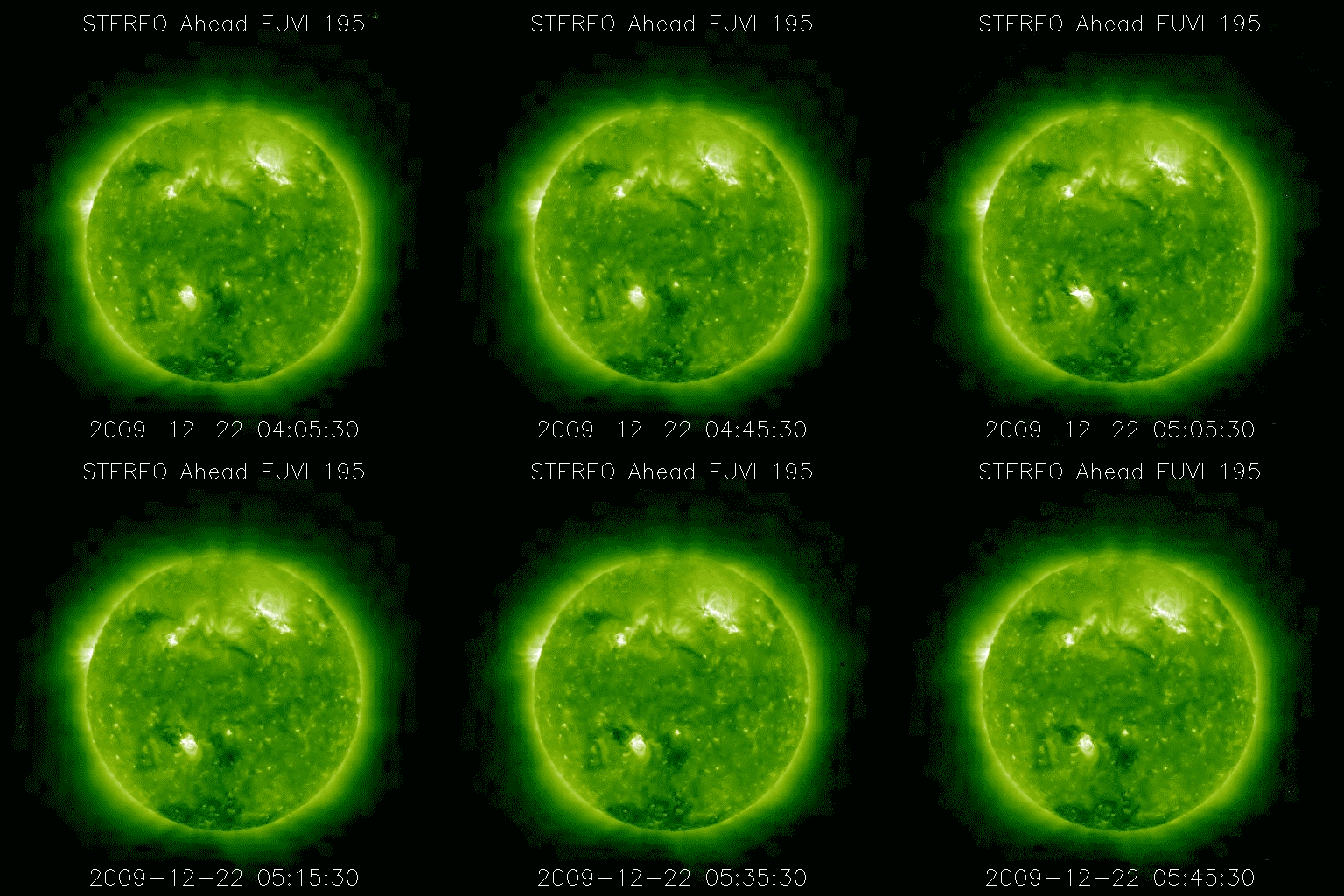
Solar Tsunami

spaceweather.com
The solar system is passing through an interstellar cloud that physics says should not exist. In the Dec. 24th issue of Nature, a team of scientists reveal how NASA's Voyager spacecraft have solved the mystery. Get the full story from Science@NASA.

SOLAR ACTIVITY: Yesterday, Dec. 22nd at approximately 0455 UT, magnetic fields around sunspot 1036 erupted, producing a C7-class solar flare. NASA's STEREO-A spacecraft was almost directly above the sunspot at the time of the blast and recorded this extreme ultraviolet movie:

The shadowy wave racing away from the blast site is a "solar tsunami"--a swell of hot, magnetized plasma about 100,000 km high packing as much energy as a million megatons of TNT. The tsunami petered out before it went more than halfway around the sun, but another manifestation of the blast is still going. The eruption hurled a faint coronal mass ejection (CME) into space and the billion-ton cloud should cross Earth's orbit on or about Dec. 25th. A glancing blow to Earth's magnetic field could spark polar auroras for Christmas.

more images: from Pete Lawrence of Selsey, West Sussex, UK; from C. Swiger and J. Stetson of South Portland, Maine; from Robert Arnold of Isle of Skye, Scotland

Reblog this post [with Zemanta]

Tuesday, December 22, 2009

While You Were Sleeping The Economy Collapsed

Giordano Bruno
One of the most powerful forces in human psychology is the force of habit. Consistency, apathetic comfort, ties men to the ocean bottom to squeeze every ounce of oxygen from their last breath until it is gone, and we wake up at 50 or 60, only realizing then that we have done the same things and thought the same thoughts for decades without err. Repetition makes us easy to startle and easy to control. Any sudden break in daily routine can cause most people to freeze; animals gripped with terror at the very possibility of necessary individual action or adaptation.

This same repetition induces a type of “sleepwalk” in the average person, a zombie-like reanimation of brain functions that shriveled up and died years before, giving the impression of “life,” but in reality, it is merely a life on autopilot.

This is what makes catastrophes so catastrophic. It is not always the events themselves that reap such destruction, but people’s delayed reactions and dulled senses. The more ignorant the populace, the more magnified and painful such events become. Our lack of knowledge and reasonable action sets our own house ablaze, brings economies to ruin, and murders civilizations. Others may tip the problems into motion, but in the end, all of us, each and every individual, is responsible for the final result.

It is nearly Christmas, 2009, and the dangers of routine are never more blindingly obvious than they are at this time of year. A dangerous economic storm looms, its effects culminating most likely sometime in 2010. Many people know its there, they can feel it, but the chains of routine drag them back. “Our world will remain the same tomorrow as it was today…” they tell themselves, “…how could things possibly change?”

Mixed Signals Indicate Economic Disinformation

There are a number of half truths and financial fantasies floating around the U.S. today, which may explain why some have decided to throw caution to the wind, adopting a cult-like blind faith in the “unsinkable” American economy. I suspect that the consequences for this error in judgment will become quite clear to most by the end of next year, but until then, let’s examine our current situation, what the government has to say about it, and the reality they wish to gloss over.

Unemployment Thwarted By Bailouts?

Unfortunately, it depends on who you ask. If you ask the Labor Department, the U.S. lost only 11,000 jobs in November, far less than forecast, and unemployment evened out to 10% from 10.2%. Great news, right? It would be, if it were true…

Other data shows that the major revision in job losses may be an overenthusiastic calculation by the Labor Department.

First, the holiday season is notorious for generating thousands of temporary, low-paying part time jobs with an average of only 15-20 hours a week. The Labor Department counts people working these jobs as fully employed even though they do not make nearly enough money to support themselves and most will likely lose their positions once the Christmas season is over. Even with this influx of minimum wage holiday jobs to dilute unemployment numbers, it appears most retailers are only hiring about half of the number of temporary workers they did last year:

http://www.kidk.com/news/local/78476852.html

What this means is, unemployment will probably hit very hard in February and March when retailers begin cutting back once more, especially if Christmas profits fall short of target.

Second, there is a lot of evidence to suggest that the Labor Department is grossly and deliberately misreporting unemployment figures. Other groups which measure unemployment, including the ADP, have released national job loss reports that greatly differ from that of the Labor Department for November. In most cases, the Labor Department “adjusts” its numbers a month later to match ADP’s more accurate assessments. Very rarely do the ADP’s numbers completely overshoot actual job loss calculations. For November however, the Labor Department predicted only 11,000 jobs lost, while the ADP measured 169,000 jobs lost!

http://www.adpemploymentreport.com/

This is a major discrepancy! Either the ADP has somehow calculated way off the mark (which rarely if ever happens), or the Labor Department has rigged the numbers. Such a discrepancy by the Labor Department could not be made accidentally. It is hard to say which one is the case, but since the ADP is consistently accurate, and the Labor Department has more reason to flub the statistics, I will have to lean towards the ADP’s numbers as a realistic representation of November job losses.

What is more frightening is that eventually, the Labor Department will have to account for all the lost jobs they hid last month. When they make this adjustment, it will seem as though job loss has exploded after a short lull. This will send an abrasive shock through markets next year. In fact, markets recently took a hit as the government reported that the number of Americans filing for initial unemployment insurance at the beginning of December jumped much higher than analyst expectations:

http://money.cnn.com/2009/12/10/news/economy/initial_jobless_claims/index.htm

One would think claims should begin to dissipate after the miracle jobless drop in November.

Adding a sharper edge to this realization is the fact that a record 37.2 million Americans now require food stamps in order to survive, while the media blathers on about imminent recovery. That is 1 out of every 8 people in this country:

http://www.bloomberg.com/apps/news?pid=20601012&sid=aFbqGE.lEdi0

It is these kinds of mixed signals that reveal misinformation and half-truths by MSM and government sources.

Waiting For The Return Of The Dollar? Don’t Hold Your Breath…

As we have predicted in the past, erratic market movements have begun to occur this holiday season, and the artificial Dow rally will probably not make it through the winter. With uncertainty in stocks comes a flight to “safe haven” investments. Historically, the U.S. Dollar has been considered a safe haven, and out of habit, some investors continue to dump their assets into dollars when expecting fickle market conditions.

Recent weakness in the Euro has also lifted the dollar. Not drastically by any means, but enough to give the impression that the Greenback may soon make its return. Great news, right? Again, not quite…

Many investors make the mistake of looking only at the relative weakness of other world currencies when assessing the Dollar’s strength, but there are many other factors to consider. The Greenback is unique in that it derives its strength not so much from the overall health of the U.S. economy, or any solid circulation fundamentals, but from the fact that it is the “world reserve currency”. When we examine the foundation of the Dollar, we find an extremely weak overprinted currency belonging to a country with a $9.2 Trillion projected deficit and totally reliant on foreign investment. However, as long as the Dollar retains its label as the world reserve currency, it will continue to have a psychological significance to investors.

It would not take massive inflation to collapse the Greenback (although this is occurring). Wholesale prices jumped 1.8 percent last month, more than double the gain analysts expected, and sparking fears that the Fed will soon be forced to raise interest rates:

http://finance.yahoo.com/news/Spike-in-wholesale-inflation-apf-2682030532.html?x=0

Mainstream economists are attempting to downplay these numbers by claiming that the inflation will be temporary, but in reality, we are only seeing the beginning. This also throws a monkey wrench into the arguments made by some financial advisors that the dollar is safe, and we are more likely to see deflation than inflation. If this was truly a deflationary collapse like the Great Depression, then why have prices on goods increased instead of decreased? We should have seen substantial price cuts on commodities and base manufacturing materials if deflation was the threat, but this has not occurred.

A deflationary collapse would be far preferable to an inflationary collapse. With the dollar still intact, the economy could be rebuilt without help from outside agencies like the IMF. We know that the Elites are attempting to force the U.S. to answer to a centralized economic authority and accept a global currency in the form of Special Drawing Rights. They cannot accomplish this goal without collapsing the dollar. Period.

Setting the inflation threat aside, though, the only trigger necessary for a Dollar implosion would be for it to lose its reserve status in the eyes of the international financial community. Once this superfluous status is removed, the Dollar would no longer be considered a safe haven investment, and its value would plummet.

The signs that this event is about to occur are becoming more evident, most especially in Treasury Bond auctions and investment:

http://www.treas.gov/press/releases/tg443.htm

http://market-ticker.denninger.net/archives/1730-TIC-Data-Confirms-Foreign-Appetite-Gone.html

The “Treasury Yield Curve” is now the steepest it has been since at least 1980:

http://www.bloomberg.com/apps/news?pid=20601103&sid=atmWh_C.Afkk

Foreign investment in U.S. debt has plummeted. Barack Obama is attempting to auction off $150 Billion in U.S. T-bills, but net foreign acquisition of long-term securities, taking into account adjustments, is estimated to have been only $8.3 billion. Even more disturbing, foreign holdings of dollar-denominated short-term U.S. securities, including Treasury bills, and other custody liabilities decreased $43.9 billion. Foreign holdings of Treasury bills decreased $38.3 billion. Meaning, not only are foreign investors NOT buying American debt, they are also beginning to get rid of the treasuries they already own! The biggest purchaser of U.S. Treasury debt is now the private Federal Reserve, printing money out of thin air and buying T-bills in order to prop up the value of its own currency! This cannot go on for much longer.

In order to permanently strengthen the basic value of the dollar, one of two things must happen; either the Fed must decrease the supply of dollars in the system (they are doing the opposite, printing up to $24 Trillion out of thin air in the span of a year), or, the Fed must somehow increase demand for all the dollars being created. As the dismal results of recent treasury auctions show, NO ONE wants dollars, especially not for the long term.

The consequences of this are obvious. Eventually, our incredible debt will become unserviceable, and the dollar will become completely undesirable. The Federal Reserve will be forced to raise interest rates and stop its endless printing, which will then pull the rug out from under the Dow and the T-bill market, making things even worse. Dollar proponents always seem to forget this very important detail; America is taking on more debt than it or any other country has in history. Without continued exponential investment from other countries, this debt will end the dollar, regardless of the weakness or strength of other national currencies, or the true rate of inflation.

For now, the Dollar will enjoy an increase in value due to weakness in Europe and uncertainty in stocks, sending more crisscrossed signals to the public as to the actual health of the economy. As far as the basics are concerned however, this increase will be short lived.

Credit Market Recovery? Not A Chance…

The stated purpose, the entire reason for the Banker Bailouts and the flood of printed money into our financial systems, was to “restore credit markets” so that banks could begin lending again.

First off, such a concept is astoundingly moronic. What caused the collapse of the housing market in the first place? Unhindered accumulation of debt by people who could not afford to pay it back! This debt was, of course, facilitated by the private Federal Reserve’s artificially low interest rates, which gave banks free reign to throw cheap money wherever they pleased. When people began to default on their loans en masse, the bubble burst, and triggered the landslide we are seeing today.

How exactly would the creation of more lending, and therefore more debt, fix a problem caused by too much debt? If the average American can’t afford to pay back their old debts, then why in the world would they want to take on new debt? The philosophy of forcing liquidity into the same debt mechanisms which caused the problem in the first place to save the economy could only be dreamed up by someone with the mind of a naive child, unless, that someone wanted to deliberately make the problem worse….

If that is the case, then they have succeeded admirably.

Banks received trillions of dollars in bailout money, but still have not returned to standard lending practices. In fact many have tightened their restrictions on lending even further:

http://moneyfeatures.blogs.money.cnn.com/2009/12/07/mortgage-lenders-still-arent-lending/

http://www.nypost.com/p/news/business/banks_need_to_lend_now_wIZJF5AD5gzJPV8ICjaByK

The Treasury has reported that bank lending balances continued to drop nine consecutive months through October:

http://finance.yahoo.com/news/Treasury-report-shows-bank-apf-2357245330.html?x=0&sec=topStories&pos=6&asset=&ccode=

So the goal of the bailouts, the goal given as an excuse to assuage the anger of the American people, was never accomplished, and probably never will be.

If banks aren’t using the bailout money they were given to create new loans then what are they doing with it? Some are hoarding the cash, while others have been gambling with it in the stock market! If the bailout money is still sitting in the pockets of bankers, and it never went into credit markets, then how can the Fed claim that it stopped the collapse? The fact is, the bailouts have done absolutely nothing except prop up the Dow and give the illusion that things are improving. No amount of spin, though, can change the fundamentals.

Banks across the country continue to shut down at an alarming rate. The FDIC has closed 140 so far this year, and recently announced the closure of two banks in California with assets totaling in excess of $10 Billion!

http://news.yahoo.com/s/ap/20091219/ap_on_bi_ge/us_bank_closures

Not only this, but the FDIC is in many cases unable to sell off these bankrupt assets to other banks, meaning, they are forced to absorb the entire debt instead of a small piece of it. Any depositors at the RockBridge Commercial Bank with savings of more than $250,000 in their accounts have essentially lost the remainder. Recovery of their savings could take months, and even then they may get only a portion of what they had in their accounts.

What does this mean? It means that the FDIC is having trouble guaranteeing your deposits. Why? Because the FDIC is broke. Before the announcement of the two California banks totaling $10 Billion, the FDIC was officially in the red for $8.2 Billion. The real amount of debt the FDIC has incurred is probably far more than reported.

I have heard it argued that 140 closed banks is not such a terrible number. During the Great Depression, over 3000 banks were shut down. This is another straw man debate point. Yes, thousands of banks were closed during the depression, but there were numerous small private banks and city banks in those days, and their total deposits were miniscule compared to modern corporate banks. It is not the number of banks closed that is important, it is the size of their assets and deposits which makes or breaks the FDIC.

How long can the Treasury go printing money to bailout the FDIC? I suspect not very long.

Housing Is Still In Trouble

The bottom line is, nothing has changed except how we are told to perceive the situation. Changing how one looks at a problem does not make the problem go away, as much as we would like it to. This fact goes for the housing issue as well.

We are told constantly by the MSM that the markets are improving, but if this is so, then why are large banks continuing to go bankrupt due to defaults on home loans? Why is it that mortgage delinquencies continue to rise to record levels every month?

http://realestateinvestordaily.com/market-information-news/mortgage-delinquencies-set-new-record-in-third-quarter/

Even families that received direct help from the U.S. government “foreclosure prevention plan” are behind on their payments!

http://www.reuters.com/article/idUSTRE5B41ME20091205

A glut of foreclosed homes are now on the market, but banks are having trouble finding anyone to buy, even at discount price ranges:

http://news.yahoo.com/s/nm/20091215/ts_nm/us_usa_housing_foreclosures

In response, the Federal Reserve is executing a plan to pump $1.25 Trillion into mortgage backed securities in order to bring interest rates down to record lows. This is very similar to the policy which they used to cause the housing crash in the first place:

http://finance.yahoo.com/news/Rates-on-30year-mortgages-set-apf-646421176.html?x=0&sec=topStories&pos=4&asset=&ccode=

Again, what we are told by the MSM and the government, and what seems to be occurring at the foundations of the economy, are in total opposition. Someone somewhere is lying.

On The Other Side Of The World…

Terrible events can occur while the masses are psychologically unaware or “asleep”, but they can also occur while we are literally asleep too. In a world designed around the concept of Globalization, that which damages the economy of one country, can have drastic effects on another. This was made evident by the recent trouble in Dubai, however, there is much more happening on the other side of the world that we rarely hear about.

Both Greece and Spain are currently in dire straights with mounting and unserviceable debt:

http://moneynews.com/Economy/greece-downgrade-credit-rating/2009/12/16/id/343500

http://www.economist.com/world/europe/displaystory.cfm?story_id=14973182

But these are not the only European countries in danger of default. If one examines debt as a percentage of a country’s GDP, one can see which nations are on the edge of collapse.

european-debt.jpg

Nations with a high debt to GDP ratio have a tendency to default, that is, to go bankrupt. Greece and Italy already have a national debt larger then their entire GDP, which means the revenue of each country for a whole year is not enough to pay off what they owe! This indicates the very real possibility of economic collapse in these countries. Spain, UK, and Germany are all on the edge of the abyss as well.

It is important to note here that America’s debt is now around 75% of our GDP, and is projected to increase to 100% of our GDP by the end of Obama’s first term:

http://en.wikipedia.org/wiki/United_States_public_debt

Debt is the major driving force that will trigger collapse, and the U.S. is well on its way to accumulating epic amounts of it.

If any of these countries default on their debt (including the U.S.) the shockwave will send the rest of the globe into financial retreat.

Smoke And Mirrors

It’s nice to maintain a rosy outlook on the economic situation we face. It makes us feel safe. The fact is, though, that we are far from safe, and denying the problem will not make it go away. The MSM’s main drive, at least for now, is to promote a sense of well being. Some of them do it because they believe the markets are driven by psychology and that by creating a positive atmosphere, we can somehow make our troubles disappear through shear force of will. Of course, this is an absurd notion.

Others ignore the facts and spin ideas of recovery deliberately and with malicious intent, because they know comfortable people are not alert, and those that are not alert are easy to surprise, and surprised people are easy to control. The globalist George Soros for instance has lately been denying all signs of collapse, and making claims countries like Greece, Dubai, and the UK, have nothing to worry about:

http://moneynews.com/StreetTalk/Soros-Greece-Dubai-Default/2009/12/14/id/342566

Gee, I know that makes me feel a whole lot better.

What we are witnessing today is perhaps the greatest faux recovery in the history of the world. There is a reason why there is so much conflicting evidence. There is a reason why many economists are confused as to where the economy is going; because some of the evidence is based in fact, while the rest is designed to deceive. Learning and standing by economic fundamentals can help one in discerning what rings true and what does not. The fundamentals cannot be changed, they can only be hidden. Stick with the foundations of the system, ignore the fluff, the fog and shadows media game, and you will never be caught unaware when disaster strikes.

States' jobless funds in crisis

Peter Whoriskey
Washington Post
The recession's jobless toll is draining unemployment-compensation funds so fast that according to federal projections, 40 state programs will go broke within two years and need $90 billion in loans to keep issuing the benefit checks.

The shortfalls are putting pressure on governments to either raise taxes or shrink the aid payments.

Debates over the state benefit programs have erupted in South Carolina, Nevada, Kansas, Vermont and Indiana. And the budget gaps are expected to spread and become more acute in the coming year, compelling legislators in many states to reconsider their operations.

Currently, 25 states have run out of unemployment money and have borrowed $24 billion from the federal government to cover the gaps. By 2011, according to Department of Labor estimates, 40 state funds will have been emptied by the jobless tsunami.

"There's immense pressure, and it's got to be faced," said Indiana state Rep. David Niezgodski (D), a sponsor of a bill that addressed the gaps in Indiana's unemployment program. "Our system was absolutely broke."

The Indiana legislation protected the aid checks, Niezgodski said, but it came after a give-and-take this spring in which Gov. Mitchell E. Daniels Jr. (R) said the state had been providing "Rolls-Royce benefits" and several thousand union workers countered by protesting proposed cuts at the state capitol. In January, the legislature is slated to consider a bill to delay the proposed tax increases intended to refill the fund.

In Nevada, Gov. Jim Gibbons (R) and legislators have feuded over the unemployment program, which is $85 million in debt to the federal government, with Gibbons accusing the legislature of "callous disregard" for not setting a tax rate.

And last week, a state task force in Kentucky recommended cutting benefits about 9 percent and imposing a week's delay in their payment. The average benefit check there is about $309 a week. The task force also proposed raising taxes.

"There were some moments of high anxiety" during the negotiations between industry and labor groups, said Joseph U. Meyer, the state's acting secretary of education and workforce development. "But in the end, the realistic options became fairly apparent."

State unemployment-compensation funds are separated from general budgets, so when there is a shortfall, only two primary solutions are typically considered -- either cut the benefit or raise the payroll tax.

Industry and business groups often lobby against raising the payroll tax on employers, while unions and other worker groups protest benefit cuts.

"We want to make sure Kentucky remains competitive and also maintain an environment of fairness," Meyer said of the negotiations.

Nationally, the average tax is about 0.6 percent of payroll; the average weekly check is about $300.

The troubles the state programs face can be traced to a failure during the economic boom to properly prepare for a downturn, experts said.

Unemployment benefits are funded by the payroll tax on employers that is collected at a rate that is supposed to keep the funds solvent. Firms that fire lots of people are supposed to pay higher rates. The federal government pays for administrative costs, and in a recession, it pays for the extension of unemployment benefits beyond 26 weeks. But over the years, the drive to minimize state taxes on employers has reduced the funds to unsustainable levels.

"The benefits haven't grown -- that's not the problem," said Richard Hobbie, director of the National Association of State Workforce Agencies.

Even so, he said, he expects to see unemployment checks reduced.

A shortfall in a state unemployment fund, he said, "usually means cuts in eligibility or benefits."

In Virginia, the unemployment program has borrowed $89 million from the federal government, while Maryland has not borrowed, according to the federal data.

Wayne Vroman, an expert in unemployment insurance at the Urban Institute, said that entering the recession, state programs were on average funded at only one-third the level they should have been, according to generally accepted funding guidelines.

"If you fund a program adequately, you don't need to come to these kinds of difficult decisions," he said.

Before the recession, he said, the funding guidelines "were rarely honored."

While the amount of the states' loans from the federal government is expected to grow rapidly, it is not expected to add to the federal debt. "In the past, the federal government has always gotten its money back," Vroman said.

In the meantime, however, more states are struggling to fill the gap. West Virginia imposed a freeze on benefit levels this year, and legislators in South Carolina are considering one.

"We've obviously got problems with the fund," said South Carolina House Majority Leader Kenny Bingham (R), blaming the trouble in part on the state's unemployment rate of more than 12 percent.

The state owes about $654 million to the federal government for unemployment payments.

"We're not trying to cut benefits," he said. But "if you jack rates up, those business that are struggling to hang on, you make things more difficult."

Marc Faber, ECONOMIC ARMAGEDDON In The U.S.


Marc Faber, ECONOMIC ARMAGEDDON In The U.S.

US armed forces personnel and weapons stationed at 820 installations worldwide

Rick Rozoff
World's Sole Military Superpower's 2 Million-Troop, $1 Trillion Wars

With a census of slightly over 300 million in a world of almost seven billion people, the U.S. accounts for over 40 percent of officially acknowledged worldwide government military spending with a population that is only 4 percent of that of the earth's. A 10-1 disparity.

In addition to its 1,445,000 active duty service members, the Pentagon can and does call upon 1.2 million National Guard and other reserve components. As many as 30% of troops that have served in Afghanistan and Iraq are mobilized reservists. The Army National Guard has activated over 400,000 soldiers since the war in Afghanistan began and in March of 2009 approximately 125,000 National Guard and other reserve personnel were on active duty.

The Defense Department also has over 800,000 civilian employees at home and deployed worldwide. The Pentagon, then, has more than 3.5 million people at its immediate disposal excluding private military contractors.

After allotting over a trillion dollars for the wars in Afghanistan and Iraq alone and packing off more than two million of its citizens to the two nations, the U.S. military establishment and peace prize president have already laid the groundwork for yet more wars. Boeing, Raytheon and General Electric won't be kept waiting.


In his Nobel Peace Prize acceptance speech on December 10 the president of the United States appropriated for his country the title of "the world's sole military superpower" and for himself "the Commander-in-Chief of the military of a nation in the midst of two wars."

This may well have been the first time that an American - and of course any - head of state in history boasted of his nation being the only uncontested military power on the planet and unquestionably the only time a Nobel Peace Prize recipient identified himself as presiding over not only a war but two wars simultaneously.

As to the appropriateness of laying such claims in the venue and on the occasion he did - accepting the world's preeminent peace award before the Norwegian Nobel Committee - Barack Obama at least had the excuse of being perfectly accurate in his contentions.

He is in fact the commander-in-chief in charge of two major and several smaller wars and his nation is without doubt the first global military power which for decades has operated without constraints on five of six inhabited continents and has troops stationed in all six. United States armed forces personnel and weapons, including nuclear arms, are stationed at as many as 820 installations in scores of nations.

The U.S. has recently assigned thousands of troops to seven new bases in Bulgaria and Romania [1], deployed the first foreign troops to Israel in that nation's history to run an interceptor missile radar facility in the Negev Desert [2], and last week signed a status of forces agreement with Poland for Patriot missiles (to be followed by previously ship-based Aegis Standard Missile-3s interceptors) and U.S. soldiers to be stationed there. The troops will be the first foreign forces based in Poland since the dissolution of the Warsaw Pact in 1991.

The U.S., whose current military budget is at Cold War, which is to say at the highest of post-World War II, levels, also officially accounts for over 41% of international military spending according to the Stockholm International Peace Research Institute's report on 2008 figures: $607 billion of $1.464 trillion worldwide. On October 28 President Obama signed the 2010 National Defense Authorization Act with a price tag of $680 billion, including $130 billion for the wars in Afghanistan and Iraq.

That figure excludes military spending outside of the Department of Defense. The American government has for several decades been the standard-bearer in outsourcing to private sector contractors in every realm and the Pentagon is certainly no exception to the practice. According to some estimates, American military and military-related allotments in addition to the formal Pentagon budget can bring annual U.S. defense spending as high as $1.16 trillion, almost half of official expenditures for all of the world's 192 nations, including the U.S., last year.

With a census of slightly over 300 million in a world of almost seven billion people, the U.S. accounts for over 40 percent of officially acknowledged worldwide government military spending with a population that is only 4 percent of that of the earth's. A 10-1 disparity.

The U.S. also has the world's second largest standing army, over 1,445,000 men and women under arms according to estimates of earlier this year, second only to China with 2,255,000. China has a population of over 1.325 billion, more than four times that of America, and does not have a vast army of private contractors supplementing its armed forces. And of course unlike the U.S. it has no troops stationed abroad. India, with a population of 1.140 billion, has active duty troop strength smaller than that of the U.S. at 1,415,000.

The U.S. and Britain are possibly alone in the world in deploying reservists to war zones; this last February the chairman of the U.S. Joint Chiefs of Staff Admiral Michael Mullen acknowledged that 600,000 reserves have been called up to serve in the area of responsibility of the U.S. Central Command, in charge of the Afghan and Iraqi wars, since 2001. In addition to its 1,445,000 active duty service members, the Pentagon can and does call upon 1.2 million National Guard and other reserve components. As many as 30% of troops that have served in Afghanistan and Iraq are mobilized reservists. The Army National Guard has activated over 400,000 soldiers since the war in Afghanistan began and in March of 2009 approximately 125,000 National Guard and other reserve personnel were on active duty.

The Defense Department also has over 800,000 civilian employees at home and deployed worldwide. The Pentagon, then, has more than 3.5 million people at its immediate disposal excluding private military contractors.

In the last 48 hours two unprecedented thresholds have been crossed. On the morning of December 19 the U.S. Senate met in a rare Saturday morning session to approve a $636.3 billion military budget for next year. The vote was 88-10, as the earlier vote by the House of Representatives on December 16 was 395-34. In both cases the negative votes were not necessarily an indication of opposition to war spending but part of the labyrinthine American legislative practices of trade-offs, add-ons and deal-making on other, unrelated issues, what in the local vernacular are colorfully described as horse-trading and log-rolling among other choice terms. A no vote in the House or Senate, then, was not automatically a reflection of anti-war or even fiscally conservative sentiments.

The Pentagon appropriation included another $101 billion for the wars in Afghanistan and Iraq (Obama signed the last formal Iraq and Afghanistan War Supplemental Appropriations, worth $106 billion, in July), but did not include the first of several additional requests, what are termed emergency spending measures, for the Afghan war. The first such request is expected early next year, more than $30 billion for the additional 33,000 U.S. troops to be deployed to the war zone, which will increase the number of American forces there to over 100,000.

On the day of the Senate vote Bloomberg News cited the Congressional Research Service, which had tallied the numbers, in revealing that the funds apportioned for the wars in Afghanistan and Iraq have now pushed the total expenditure for both to over $1 trillion. "That includes $748 billion for spending related to the war in Iraq and $300 billion for Afghanistan, the research service said in a Sept. 28 report."

The new Pentagon spending plan "includes $2.5 billion to buy 10 additional Boeing Co. C-17 transports that weren't requested by the Pentagon. Chicago-based Boeing also would benefit from $1.5 billion for 18 F/A-E/F Super Hornet fighters, nine more than the administration requested."

Funding for military aircraft not even requested by the Defense Department and the White House or for larger numbers of them than were is another curious component of the American body politic. That arms merchants (and not only domestic ones) place their own orders with the American people's alleged representatives - the current Deputy Secretary of Defense, William Lynn, was senior vice president of Government Operations and Strategy for Raytheon Company prior to assuming his new post - is illustrated by the following excerpts from the same report:

"Defense Secretary Robert Gates recommended April 6 that the C-17 program be terminated once Boeing delivers the last of 205 C-17s in late 2010. Boeing, the second-largest defense contractor, has said its plant in Long Beach, California, will shut down in 2011 without more orders.

"The budget also includes $465 million for the backup engine of the F-35 Joint Strike Fighter. The engine is built by Fairfield, Connecticut-based General Electric Co. and London-based Rolls Royce Plc. The administration earlier threatened to veto the entire defense bill if it contained any money for the engine." [3]

The Pentagon and its chief Gates may win battles with the Congress and even the White House when they relate to the use of military force abroad, but against the weapons manufacturers and the congressmen whose election campaigns they contribute to the military brass will come off the losers.

In addition to the nearly two-thirds of a trillion dollar annual Pentagon war chest, the ongoing trillion dollar Broader Middle East war is a lucrative boon to the merchants of death and their political hangers-on.

On December 18 a story was posted on several American armed forces websites that U.S. soldiers have been sent to Afghanistan and Iraq 3.3 million times since the invasion of the first country in October of 2001. The report specifies that "more than 2 million men and women have shouldered those deployments, with 793,000 of them deploying more than once."

The break-down according to services is as follows:

More than 1 million troops from the Army.

Over 389,900 from the Air Force.

Over 367,900 from the Navy.

More than 251,800 Marines.

This past October alone 172,800 soldiers, 31,500 airmen, 30,000 sailors and 20,900 Marines were dispatched to the two war zones. [4]

The bulk of the U.S.'s permanent global warfighting force may be deployed to Afghanistan and Iraq, but enough troops are left over to man newly acquired bases in Eastern Europe, remain in Middle East nations other than Iraq, be based on and transit through the Manas Air Base in Kyrgyzstan, take over seven new military bases in Colombia, run regional operations out of America's first permanent base in Africa - Camp Lemonier in Djibouti, where 2,400 personnel are stationed - and engage in counterinsurgency campaigns in the Philippines, Mali, Uganda, Yemen and Pakistan.

Recently a U.S. armed forces newspaper reported in an article titled "AFRICOM could add Marine Air Ground Task Force" that "A 1,000-strong Marine combat task force capable of rapidly deploying to hot spots could soon be at the disposal of the new U.S. Africa Command."

The feature added that a Marine unit previously attached to the newly launched AFRICOM has "already deployed in support of training missions in Uganda and Mali," whose armies are fighting the Lord's Resistance Army and Tuareg rebels, respectively. [5]

In Yemen, Houthi rebel sources "accused the U.S. air force [on December 15] of joining attacks against them, and killing at least 120 people in a raid in the north of the poor Arab state."

Their information office said "The savage crime committed by the U.S. air force shows the real face of the United States." [6]

According to ABC News "On orders from President Barack Obama, the U.S. military launched cruise missiles early Thursday [December 17] against two suspected al-Qaeda sites in Yemen," [7] to complement mounting missile attacks in Pakistan.

The Houthi rebels are religiously Shi'ia, so any attempt at exploiting an al-Qaeda rationale for bombing their villages is a subterfuge.

At the same time the Commander of U.S. Air Forces in Europe and NATO Allied Air Component, General Roger Brady, fresh from a tour of inspection of the Caucasus nations of Azerbaijan and Georgia, was at the Adazi Training Base in Latvia to meet with the defense ministers of that nation, Estonia and Lithuania and plan "closer military cooperation in the security sector between the Baltic States and the USA which also included joint exercises in the Baltic region." [9] All five nations mentioned above - Azerbaijan, Estonia, Georgia, Latvia and Lithuania - border Russia.

During the same week's summit of the Bolivarian Alliance for the Peoples of Our America (ALBA) in Havana, Cuba, the host country's president Raul Castro said of the latest Pentagon buildup in Colombia that "The deployment of [U.S.] military bases in the region is...an act of aggression against Latin America and the Caribbean." [9]

Less than a week later the government of Colombia, the third largest recipient of American military aid in the world, announced it would construct a new military base near its border with Venezuela. "Defense Minister Gabriel Silva said [on December 18] that the base, located on the Guajira peninsula near the city of Nazaret, would have up to 1,000 troops. Two air battalions would also be activated at other border areas....Army Commander General Oscar Gonzalez meanwhile announced [the following day] that six air battalions were being activated, including two on the border with Venezuela." [10]

After allotting over a trillion dollars for the wars in Afghanistan and Iraq alone and packing off more than two million of its citizens to the two nations, the U.S. military establishment and peace prize president have already laid the groundwork for yet more wars. Boeing, Raytheon and General Electric won't be kept waiting.