English: The SPICE project will investigate the feasibility of one so-called geoengineering technique: the idea of simulating natural processes that release small particles into the stratosphere, which then reflect a few percent of incoming solar radiation, with the effect of cooling the Earth with relative speed. (Photo credit: Wikipedia)
According to US website 'Mother Jones' the CIA is helping fund a study by the National Academy of Sciences (NAS) that will investigate whether humans could use geoengineering - which is defined as deliberate and large-scale intervention in the Earth's climatic system - to stop climate change.
The NAS website describes the study as an investigation into "a limited number of proposed geoengineering techniques, including examples of both solar radiation management (SRM) and carbon dioxide removal (CDR) techniques."
The purpose of this is to comment "generally on the potential impacts of deploying these technologies, including possible environmental, economic, and national security concerns", the website claims.
Solar radiation management (SRM) is a theoretical branch of geoengineering which moots the idea of reflecting sunlight in an attempt to block infrared radiation and halt rising temperatures.
The cost of the project is reported to be $630,000, which NAS is splitting with the CIA, the National Oceanic and Atmospheric Administration, and NASA reports say. Read more >>
A colossal sunspot on the surface of the sun is large enough to swallow six Earths whole, and could trigger solar flares this week, NASA scientists say.
The giant sunspot was captured on camera by NASA's Solar Dynamics Observatory as it swelled to enormous proportions over the 48 hours spanning Tuesday and Wednesday (Feb. 19 and 20). SDO is one of several spacecraft that constantly monitor the sun's space weather environment.
"It has grown to over six Earth diameters across, but its full extent is hard to judge since the spot lies on a sphere, not a flat disk," wrote NASA spokeswoman Karen Fox, of the agency's Goddard Space Flight Center in Greenbelt, Md., in an image description.
The sunspot region is actually a collection of dark blemishes on the surface of the sun that evolved rapidly over the last two days. Sunspots form from shifting magnetic fields at the sun's surface, and are actually cooler than their surrounding solar material.
According to Fox, some of the intense magnetic fields in the sunspot region are pointing in opposite directions, making it ripe for solar activity. Read more >>
If Earth is struck by a large solar flare, some in the scientific community believe:
* The planet will be hit with a widespread loss of power.
* Air travel would be grounded.
* Nuclear plants would be crippled and without sufficient back-up power, dozens could meltdown.
* Satellites would be disabled, causing a serious loss of communication in all areas (military and civilian).
* Food and medicine would be in short supply, setting up the potential for food riots within days of an outage.
The same scientists who believe that a large solar strike could lead to a very rapid societal breakdown say that steps to avoid the problem are available and at a relatively low cost to all of us. What is a “relatively low cost?” They estimate the amount of money needed to insulate the power grid (and ourselves) from trouble to be less than one dollar per American. But Congress said “no” to their proposal.
Is there really cause for concern?
Over the next fourteen months Earth will be on high alert for a huge burst of electromagnetic energy from the sun. This powerful pulse is known as a “Solar Maximum” – an event that could cause catastrophic damage to power grids and communications systems. The peak time for the next big flare is sometime between now and the end of 2013. This possibility has scientists at the National Oceanic and Atmospheric Administration (NOAA) on alert. Tom Bogdan, the director of NOAA’s Space Weather Prediction Center, is monitoring the situation as closely as possible. Read more >>
Late last month, the sun let off another solar flare—and the particles associated with the storm were some of the fastest NASA has ever recorded, reaching speeds of up to 2,200 miles per second, or 7.92 million miles per hour. NASA scientist Phillip Chamberlin, with the solar physics laboratory, called the July 23 "coronal mass ejection," or CME, a "huge" event and said the storm also caused one of the largest magnetic fields ever measured. Luckily, the storm was "directed away from the Earth," so nothing terrestrial was likely affected.
Because it wasn't facing Earth, NASA scientists weren't able to determine the size of the flare that caused the particle ejection. CMEs are associated with large solar storms and are the charged particles that can knock satellites and power grids offline. According to NASA's "SCORE" system, which rates CMEs according to their speed, last month's event was "extremely rare." More common CMEs clock in at about 620 miles per second.
The sun has been extremely volatile this year, Chamberlin says, because the sun is likely entering the peak of its "solar cycle." Strong solar storms are expected to happen with increasing frequency until the beginning of 2014. Read more >>
Every few decades, the sun experiences a particularly large storm that can release as much energy as 1 billion hydrogen bombs. Officials from Europe and the U.S. say an event like that could leave millions on Earth without electricity, running water and phone service.
A massive solar storm could leave millions of people around the world without electricity, running water, or phone service, government officials say.
NASA via Getty Images
In this handout photo provided by NASA, a Solar and Heliospheric Observatory image shows Region 486 that unleashed a record flare last week (lower left) November 18, 2003 on the sun. The spot itself cannot yet be seen but large, hot, gas-filled loops above this region are visible. These post-flare loops are still active.
That was their conclusion after participating in a tabletop exercise that looked at what might happen today if the Earth were struck by a solar storm as intense as the huge storms that occurred in 1921 and 1859.
Solar storms happen when an eruption or explosion on the surface of the sun sends radiation or electrically charged particles toward Earth. Minor storms are common and can light up the Earth's Northern skies and interfere with radio signals.
Every few decades, though, the sun experiences a particularly large storm. These can release as much energy as 1 billion hydrogen bombs.
How Well Can We Weather The Solar Storm?
The exercise, held in Boulder, Colorado, was intended to investigate "what we think could be close to a worst-case scenario," says Tom Bogdan, who directs the Space Weather Prediction Center in Boulder. The Center is a part of the National Oceanic and Atmospheric Administration.
"It's important to understand that, along with other types of natural hazards, (solar) storms can cause impacts," says Craig Fugate, Administrator of the Federal Emergency Management Agency (FEMA), who also took part in the tabletop exercise.
Bogdan and Fugate say that eventually there will be another storm as big as the ones in 1921 and 1859 — a sort of solar Katrina.
But the impact is likely to be far worse than in previous solar storms because of our growing dependence on satellites and other electronic devices that are vulnerable to electromagnetic radiation.
In the tabletop exercise, the first sign of trouble came when radiation began disrupting radio signals and GPS devices, Bogdan says.
Ten or 20 minutes later electrically charged particles "basically took out" most of the commercial satellites that transmit telephone conversations, TV shows and huge amounts of data we depend on in our daily lives, Bogdan says.
"When you go into a gas station and put your credit card in and get some gas," he says, "that's a satellite transaction."
Disabled Satellites Are Just The Beginning
The worst damage came nearly a day later, when the solar storm began to induce electrical currents in high voltage power lines. The currents were strong enough to destroy transformers around the globe," Bogdan says, leaving millions of people in northern latitudes without power.
Without electricity, many people also lost running water, heat, air conditioning and phone service. And places like hospitals had to rely on emergency generators with fuel for only two or three days, Bogdan says.
In many ways, the impact of a major solar storm resembles that of a hurricane or an earthquake, says Fugate.
But a solar Katrina would cause damage in a much larger area than any natural disaster, Fugate says. For example, power could be knocked out almost simultaneously in countries from Sweden to Canada and the U.S., he says. So a lot more people in a lot more places would need help.
Individuals don't need to make any special preparation for a solar storm, Fugate says. The standard emergency kit of water and food and first aid supplies will work just fine.
"If you've got your family disaster plan together, you've taken the steps, whether it be a space storm, whether it be a system failure, whether it be another natural hazard that knocks the power out," Fugate says.
IT IS midnight on 22 September 2012 and the skies above Manhattan are filled with a flickering curtain of colourful light. Few New Yorkers have seen the aurora this far south but their fascination is short-lived. Within a few seconds, electric bulbs dim and flicker, then become unusually bright for a fleeting moment. Then all the lights in the state go out. Within 90 seconds, the entire eastern half of the US is without power.
A year later and millions of Americans are dead and the nation's infrastructure lies in tatters. The World Bank declares America a developing nation. Europe, Scandinavia, China and Japan are also struggling to recover from the same fateful event - a violent storm, 150 million kilometres away on the surface of the sun.
It sounds ridiculous. Surely the sun couldn't create so profound a disaster on Earth. Yet an extraordinary report funded by NASA and issued by the US National Academy of Sciences (NAS) in January this year claims it could do just that.
Over the last few decades, western civilisations have busily sown the seeds of their own destruction. Our modern way of life, with its reliance on technology, has unwittingly exposed us to an extraordinary danger: plasma balls spewed from the surface of the sun could wipe out our power grids, with catastrophic consequences.
The projections of just how catastrophic make chilling reading. "We're moving closer and closer to the edge of a possible disaster," says Daniel Baker, a space weather expert based at the University of Colorado in Boulder, and chair of the NAS committee responsible for the report.
It is hard to conceive of the sun wiping out a large amount of our hard-earned progress. Nevertheless, it is possible. The surface of the sun is a roiling mass of plasma - charged high-energy particles - some of which escape the surface and travel through space as the solar wind. From time to time, that wind carries a billion-tonne glob of plasma, a fireball known as a coronal mass ejection (see "When hell comes to Earth"). If one should hit the Earth's magnetic shield, the result could be truly devastating.
The incursion of the plasma into our atmosphere causes rapid changes in the configuration of Earth's magnetic field which, in turn, induce currents in the long wires of the power grids. The grids were not built to handle this sort of direct current electricity. The greatest danger is at the step-up and step-down transformers used to convert power from its transport voltage to domestically useful voltage. The increased DC current creates strong magnetic fields that saturate a transformer's magnetic core. The result is runaway current in the transformer's copper wiring, which rapidly heats up and melts. This is exactly what happened in the Canadian province of Quebec in March 1989, and six million people spent 9 hours without electricity. But things could get much, much worse than that.
Worse than Katrina
The most serious space weather event in history happened in 1859. It is known as the Carrington event, after the British amateur astronomer Richard Carrington, who was the first to note its cause: "two patches of intensely bright and white light" emanating from a large group of sunspots. The Carrington event comprised eight days of severe space weather.
There were eyewitness accounts of stunning auroras, even at equatorial latitudes. The world's telegraph networks experienced severe disruptions, and Victorian magnetometers were driven off the scale.
Though a solar outburst could conceivably be more powerful, "we haven't found an example of anything worse than a Carrington event", says James Green, head of NASA's planetary division and an expert on the events of 1859. "From a scientific perspective, that would be the one that we'd want to survive." However, the prognosis from the NAS analysis is that, thanks to our technological prowess, many of us may not.
There are two problems to face. The first is the modern electricity grid, which is designed to operate at ever higher voltages over ever larger areas. Though this provides a more efficient way to run the electricity networks, minimising power losses and wastage through overproduction, it has made them much more vulnerable to space weather. The high-power grids act as particularly efficient antennas, channelling enormous direct currents into the power transformers.
The second problem is the grid's interdependence with the systems that support our lives: water and sewage treatment, supermarket delivery infrastructures, power station controls, financial markets and many others all rely on electricity. Put the two together, and it is clear that a repeat of the Carrington event could produce a catastrophe the likes of which the world has never seen. "It's just the opposite of how we usually think of natural disasters," says John Kappenman, a power industry analyst with the Metatech Corporation of Goleta, California, and an advisor to the NAS committee that produced the report. "Usually the less developed regions of the world are most vulnerable, not the highly sophisticated technological regions."
According to the NAS report, a severe space weather event in the US could induce ground currents that would knock out 300 key transformers within about 90 seconds, cutting off the power for more than 130 million people (see map). From that moment, the clock is ticking for America.
First to go - immediately for some people - is drinkable water. Anyone living in a high-rise apartment, where water has to be pumped to reach them, would be cut off straight away. For the rest, drinking water will still come through the taps for maybe half a day. With no electricity to pump water from reservoirs, there is no more after that.
There is simply no electrically powered transport: no trains, underground or overground. Our just-in-time culture for delivery networks may represent the pinnacle of efficiency, but it means that supermarket shelves would empty very quickly - delivery trucks could only keep running until their tanks ran out of fuel, and there is no electricity to pump any more from the underground tanks at filling stations.
Back-up generators would run at pivotal sites - but only until their fuel ran out. For hospitals, that would mean about 72 hours of running a bare-bones, essential care only, service. After that, no more modern healthcare. More...
spaceweather.com The solar system is passing through an interstellar cloud that physics says should not exist. In the Dec. 24th issue of Nature, a team of scientists reveal how NASA's Voyager spacecraft have solved the mystery. Get the full story from Science@NASA.
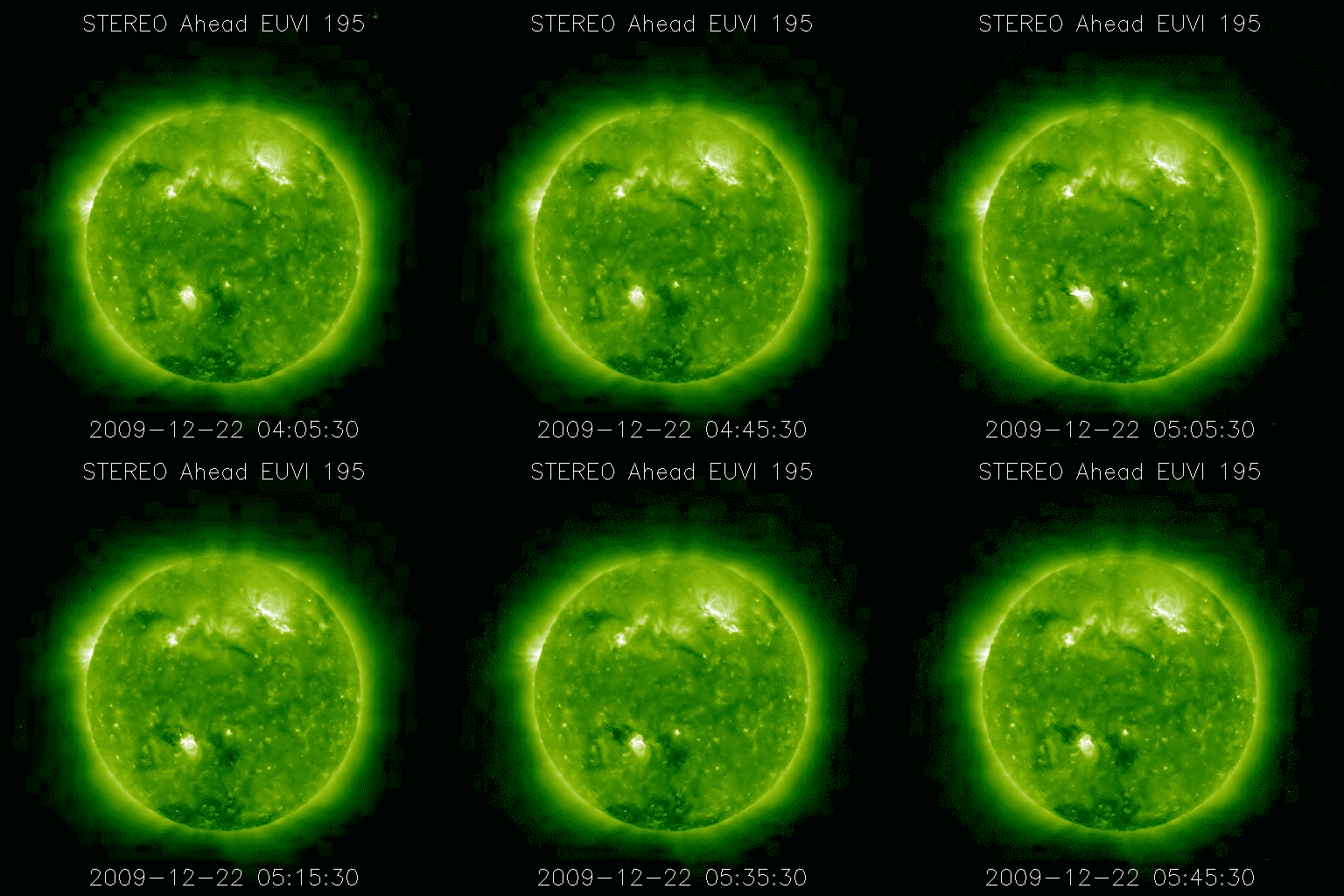
SOLAR ACTIVITY: Yesterday, Dec. 22nd at approximately 0455 UT, magnetic fields around sunspot 1036 erupted, producing a C7-class solar flare. NASA's STEREO-A spacecraft was almost directly above the sunspot at the time of the blast and recorded this extreme ultraviolet movie:
The shadowy wave racing away from the blast site is a "solar tsunami"--a swell of hot, magnetized plasma about 100,000 km high packing as much energy as a million megatons of TNT. The tsunami petered out before it went more than halfway around the sun, but another manifestation of the blast is still going. The eruption hurled a faint coronal mass ejection (CME) into space and the billion-ton cloud should cross Earth's orbit on or about Dec. 25th. A glancing blow to Earth's magnetic field could spark polar auroras for Christmas.