A solar flare could wipe out the communications and electrical grids while frying a wide variety of electronics, quickly sending us back to the 19th Century.
So this week the news is consumed with the Supreme Court, the immigration bill, Edward Snowden and the NSA scandals, and the IRS scandal and the lingering Benghazi scandal. But behind the scenes there are things going on that may be much more important. Earth-shakingly important, even.
No, I'm not talking about the threat from asteroid strikes. This time, though, I'm talking about a different kind of civilizational threat: A solar flare that could wipe out the communications and electrical grids while frying a wide variety of electronics, quickly sending us back to the 19th Century.
That's happened before. In fact, it happened in the 19th Century, with the "Carrington Event" of 1859. A massive solar flare sent a cloud of charged particles that struck the Earth squarely, creating massive currents in the Earth's magnetic field and sending brilliant auroras south as far as Cuba and Hawaii. About the only thing electrical back then was the telegraph network, and the Carrington event had a literally shocking impact -- causing some operators to be shocked, and inducing strong enough currents in the telegraph wires that operators could disconnect the batteries and operate the telegraph off of the flare-induced electrical flow. Read more >>
Scientists based in Germany and Norway today published new results about a geophysical theory known as true polar wander. That is a drifting of Earth’s solid exterior – an actual change in latitude for some land masses – relative to our planet’s rotation axis. These scientists used hotspots in Earth’s mantle as part of a computer model, which they say is accurate for the past 120 million years, to identify four possible instances of true polar wander in the past. And, they say, true polar wander is happening now. These scientists published their results in the Journal for Geophysical Research today (October 1, 2012).
The scientists – including Pavel V. Doubrovine and Trond H. Torsvik of the University of Oslo, and Bernhard Steinberger of the Helmholtz Center in Potsdam, Germany – established what they believe is a stable reference frame for tracking true polar wander. Based on this reference frame, they say that twice – from 90 to 40 million years ago – the solid Earth traveled back and forth by nearly 9 degrees with respect to our planet’s axis of rotation. What’s more, for the past 40 million years, the Earth’s solid outer layers have been slowly rotating at a rate of 0.2 degrees every million years, according to these scientists. Read more >>
IT IS midnight on 22 September 2012 and the skies above Manhattan are filled with a flickering curtain of colourful light. Few New Yorkers have seen the aurora this far south but their fascination is short-lived. Within a few seconds, electric bulbs dim and flicker, then become unusually bright for a fleeting moment. Then all the lights in the state go out. Within 90 seconds, the entire eastern half of the US is without power.
A year later and millions of Americans are dead and the nation's infrastructure lies in tatters. The World Bank declares America a developing nation. Europe, Scandinavia, China and Japan are also struggling to recover from the same fateful event - a violent storm, 150 million kilometres away on the surface of the sun.
It sounds ridiculous. Surely the sun couldn't create so profound a disaster on Earth. Yet an extraordinary report funded by NASA and issued by the US National Academy of Sciences (NAS) in January this year claims it could do just that.
Over the last few decades, western civilisations have busily sown the seeds of their own destruction. Our modern way of life, with its reliance on technology, has unwittingly exposed us to an extraordinary danger: plasma balls spewed from the surface of the sun could wipe out our power grids, with catastrophic consequences.
The projections of just how catastrophic make chilling reading. "We're moving closer and closer to the edge of a possible disaster," says Daniel Baker, a space weather expert based at the University of Colorado in Boulder, and chair of the NAS committee responsible for the report.
It is hard to conceive of the sun wiping out a large amount of our hard-earned progress. Nevertheless, it is possible. The surface of the sun is a roiling mass of plasma - charged high-energy particles - some of which escape the surface and travel through space as the solar wind. From time to time, that wind carries a billion-tonne glob of plasma, a fireball known as a coronal mass ejection (see "When hell comes to Earth"). If one should hit the Earth's magnetic shield, the result could be truly devastating.
The incursion of the plasma into our atmosphere causes rapid changes in the configuration of Earth's magnetic field which, in turn, induce currents in the long wires of the power grids. The grids were not built to handle this sort of direct current electricity. The greatest danger is at the step-up and step-down transformers used to convert power from its transport voltage to domestically useful voltage. The increased DC current creates strong magnetic fields that saturate a transformer's magnetic core. The result is runaway current in the transformer's copper wiring, which rapidly heats up and melts. This is exactly what happened in the Canadian province of Quebec in March 1989, and six million people spent 9 hours without electricity. But things could get much, much worse than that.
Worse than Katrina
The most serious space weather event in history happened in 1859. It is known as the Carrington event, after the British amateur astronomer Richard Carrington, who was the first to note its cause: "two patches of intensely bright and white light" emanating from a large group of sunspots. The Carrington event comprised eight days of severe space weather.
There were eyewitness accounts of stunning auroras, even at equatorial latitudes. The world's telegraph networks experienced severe disruptions, and Victorian magnetometers were driven off the scale.
Though a solar outburst could conceivably be more powerful, "we haven't found an example of anything worse than a Carrington event", says James Green, head of NASA's planetary division and an expert on the events of 1859. "From a scientific perspective, that would be the one that we'd want to survive." However, the prognosis from the NAS analysis is that, thanks to our technological prowess, many of us may not.
There are two problems to face. The first is the modern electricity grid, which is designed to operate at ever higher voltages over ever larger areas. Though this provides a more efficient way to run the electricity networks, minimising power losses and wastage through overproduction, it has made them much more vulnerable to space weather. The high-power grids act as particularly efficient antennas, channelling enormous direct currents into the power transformers.
The second problem is the grid's interdependence with the systems that support our lives: water and sewage treatment, supermarket delivery infrastructures, power station controls, financial markets and many others all rely on electricity. Put the two together, and it is clear that a repeat of the Carrington event could produce a catastrophe the likes of which the world has never seen. "It's just the opposite of how we usually think of natural disasters," says John Kappenman, a power industry analyst with the Metatech Corporation of Goleta, California, and an advisor to the NAS committee that produced the report. "Usually the less developed regions of the world are most vulnerable, not the highly sophisticated technological regions."
According to the NAS report, a severe space weather event in the US could induce ground currents that would knock out 300 key transformers within about 90 seconds, cutting off the power for more than 130 million people (see map). From that moment, the clock is ticking for America.
First to go - immediately for some people - is drinkable water. Anyone living in a high-rise apartment, where water has to be pumped to reach them, would be cut off straight away. For the rest, drinking water will still come through the taps for maybe half a day. With no electricity to pump water from reservoirs, there is no more after that.
There is simply no electrically powered transport: no trains, underground or overground. Our just-in-time culture for delivery networks may represent the pinnacle of efficiency, but it means that supermarket shelves would empty very quickly - delivery trucks could only keep running until their tanks ran out of fuel, and there is no electricity to pump any more from the underground tanks at filling stations.
Back-up generators would run at pivotal sites - but only until their fuel ran out. For hospitals, that would mean about 72 hours of running a bare-bones, essential care only, service. After that, no more modern healthcare. More...
spaceweather.com The solar system is passing through an interstellar cloud that physics says should not exist. In the Dec. 24th issue of Nature, a team of scientists reveal how NASA's Voyager spacecraft have solved the mystery. Get the full story from Science@NASA.
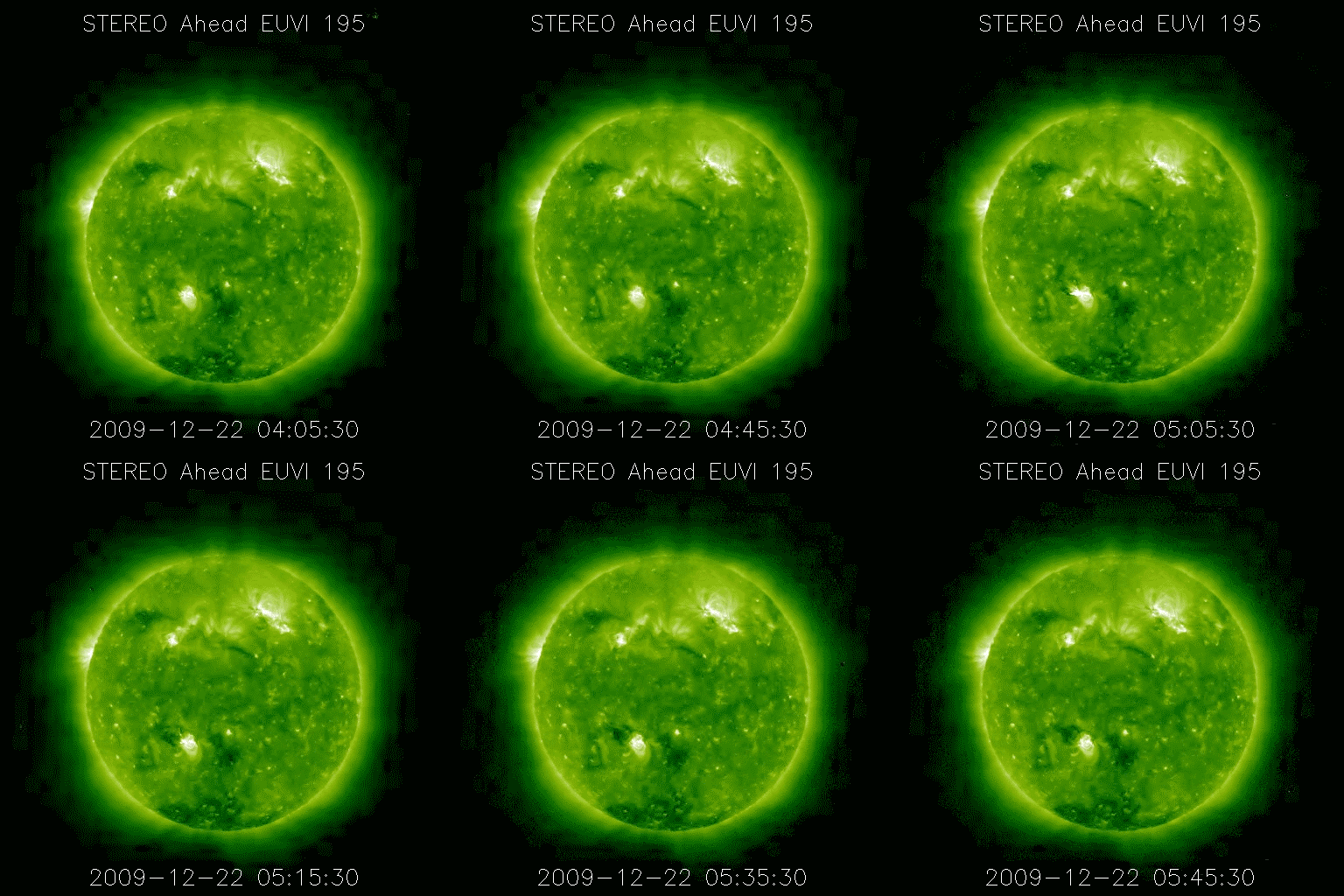
SOLAR ACTIVITY: Yesterday, Dec. 22nd at approximately 0455 UT, magnetic fields around sunspot 1036 erupted, producing a C7-class solar flare. NASA's STEREO-A spacecraft was almost directly above the sunspot at the time of the blast and recorded this extreme ultraviolet movie:
The shadowy wave racing away from the blast site is a "solar tsunami"--a swell of hot, magnetized plasma about 100,000 km high packing as much energy as a million megatons of TNT. The tsunami petered out before it went more than halfway around the sun, but another manifestation of the blast is still going. The eruption hurled a faint coronal mass ejection (CME) into space and the billion-ton cloud should cross Earth's orbit on or about Dec. 25th. A glancing blow to Earth's magnetic field could spark polar auroras for Christmas.


![Reblog this post [with Zemanta]](http://img.zemanta.com/reblog_e.png?x-id=57681477-b46e-4e73-9dff-0d4d70f989e0)


