The average price of a gallon of regular gas increased 1.5 cents nationally to $3.84 in AAA's latest reading Tuesday, the first significant move in gas prices since late August. The August run-up in prices was caused by Gulf Coast refinery disruptions as Hurricane Isaac approached.
Prices were expected to retreat quickly once the Gulf region's facilities came back online. But Tom Kloza, chief analyst at the Oil Price Information Service, said the retreat in prices following the storm is being delayed because Isaac hit so close to Sept. 15. That date is important because it is when the
United States switches from a more expensive summer blend of gasoline to a cheaper winter blend. As that date approaches, refineries don't want to be caught with too much of the more expensive gasoline. So in the week before the changeover, they cut back on their summer blend production, tightening the supply. Read more >>
Showing posts with label Gulf Coast. Show all posts
Showing posts with label Gulf Coast. Show all posts
Wednesday, September 12, 2012

Monday, December 27, 2010
Panel challenges Gulf seafood safety all-clear
 Image via Wikipedia'It is unethical to experiment with the health of the U.S. population or military members,' toxicologist says
A New Orleans law firm is challenging government assurances that Gulf Coast seafood is safe to eat in the wake of the BP oil spill, saying it poses “a significant danger to public health.”
It’s a high-stakes tug-of-war that will almost certainly end up in the courts, with two armies of scientists arguing over technical findings that could have real-world impact for seafood consumers and producers.
Citing what the law firm calls a state-of-the-art laboratory analysis, toxicologists, chemists and marine biologists retained by the firm of environmental attorney Stuart Smith contend that the government seafood testing program, which has focused on ensuring the seafood was free of the cancer-causing components of crude oil, has overlooked other harmful elements. And they say that their own testing — examining fewer samples but more comprehensively — shows high levels of hydrocarbons from the BP spill that are associated with liver damage. More.http://www.msnbc.msn.com/id/40494122/ns/us_news-environment

Tuesday, August 10, 2010
BP still using dispersants - whistleblowers receiving death threats
 Image by Geoff Livingston via Flickr
Birren also told Truthout that fishermen she knows, who are speaking out against BP dispersant practices, "are getting death threats and notes on their cars saying you better watch out, because there are people above us who want to keep this quiet. But I know entire families who are sick because of the dispersants."
Birren does not believe the crisis is over and believes the Gulf and inland waters have been "prematurely re-opened to fishing."
She and the coalition of commercial fishermen she and Guidry are a part of are concerned about the credibility of Gulf Coast fishermen being damaged by contaminated seafood being delivered to the market. Birren also wrote, "As fisherman, we know that the use of dispersants has made this crisis vastly worse for everyone. It is time that government step up and protect us, our Gulf and the American public from further and possibly irreversible harm."
"It's now down to regular people like me trying to do what the government should be doing to take care of us," she told Truthout. "It's awful, it's really bad. If Obama is not going to be a strong enough president to protect us, we'll have to do it ourselves. We're on our own down here." More...
Friday, May 21, 2010
Gulf oil spill effects to reach Arctic and Europe, expert tells congressional panel
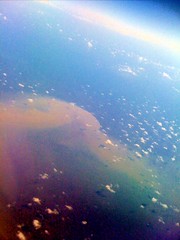 Image by zphone via Flickr
"There will be a nest empty in Newfoundland," Safina said, noting common migratory patterns. Safina warned that multiple forms of marine life in the Atlantic Ocean "come into the Gulf to breed."
Safina's briefing to representatives of the House Energy and Commerce Committee was scheduled as part of an ongoing effort to draw on a broad range of expertise for cleanup efforts. More...
Sunday, May 2, 2010
Oil blob triples in size - Florida braces for economic and environmental catastrophe
 Image via Wikipedia
Florida environmental and emergency managers acknowledged Saturday that the state can't protect every stretch of coastline threatened by an uncontrolled undersea gusher spewing a massive oil slick that has spread across the Gulf of Mexico faster than expected.
Gov. Charlie Crist, who traveled to the Panhandle to inspect preparations, warned the state could be facing an economic and environmental catastrophe.
``It's simply unbelievable, the magnitude of this,'' said Crist of a looming mess that has more than tripled in size since he surveyed it earlier in the week and is now larger than Miami-Dade and Broward counties. ``It's not a spill, it's a continuous ooze.''
President Barack Obama planned a Sunday visit to the Gulf Coast, where the first shimmering traces were already building into black clumps clinging to marsh grass in the biologically rich Louisiana Delta and darker and far more damaging slop loomed just offshore. Mississippi, Alabama and Florida all were bracing for a nightmare cleanup from the sunken drilling rig that has belched the biggest U.S. spill since the Exxon Valdez and may soon, if not already, exceed that notorious 1989 accident.
With crews struggling to contain the sloshing oil as booms failed in rough seas and chemical dispersants and burning oil showed promising but still-limited success, the Coast Guard and British Petroleum were scrambling to find some way to cap a blown-out well a daunting mile beneath the surface.
``The first thing is to stop this thing at the source,'' said Coast Guard Commandant Adm. Thad Allen, tapped Saturday by the Obama administration to take charge of containment forces. ``To continue to fight this thing on the surface and shore is not the way to do it.''
MINIMIZING DAMAGE
Florida environmental chief Michael Sole, traveling with the governor, echoed that view, saying the state's strategy would focus on minimizing damage to coastal marshes, estuaries, seagrass beds and habitats for endangered species.
``You can't boom an entire state,'' Sole said, ``and as you can see with the rough waters, the oil can easily go over or under it.''
In Bay County, one of six western Panhandle counties Crist declared under a state of emergency, there will be nothing arrayed along the famed sugary sands of Panama City Beach.
`It's not a prevention effort because you can't keep it from making landfall on the beaches,'' said Mark Bowen, director of Bay's Emergency Management Center. ``It's a clean-up effort.''
The top priority in Bay was to keep oil out of St. Andrews Bay, a fragile system ringed with shallow marshes, he said. Crews planned to employ booms, but Bowen also had requested that BP supply an oil-skimming vessel stationed at the mouth of the bay.
Bowen said he was hoping favorable winds that had pushed the slick from its closest point of 89 miles back to 127 miles on Saturday would continue.
``There's still a chance that the worst might not come,'' he said.
The official forecast track from the National Oceanic and Atmospheric Administration kept the oil off the Panhandle for at least 72 hours, but Allen warned winds were shifting and state emergency managers considered the weather merely a postponement, not a reprieve. They predicted some impacts by Wednesday. It could affect South Florida if the oil gets swept imto the Gulf's powerful Loop Current, which could steer it into the Florida Keys and then north up the East Coast.
RIPPLE EFFECTS
Some business owners in Panama City Beach were already feeling the ripple effects.
Bob and Nelly Elia, owners of Sunny Sands Motel on Panama City Beach, said two families had canceled stays.
``They're calling now, already, wondering what's going to happen and talking about refunds and all that stuff,'' Bob Elia said. ``The timing couldn't be worse because the season is one month away.''
At the Russell-Fields Pier, which extends 1,500 feet into the Gulf in Panama City, Sheila Sawyer of Dothan, Ala., came toting a fishing rod and a lot of anger.
``We knew we had to come,'' said Sawyer. ``This might be our last chance for awhile.''
In Pass Christian, Miss., 61-year-old Jimmy Rowell, a third-generation shrimp and oyster fisherman, told The Associated Press, ``It's over for us. If this oil comes ashore, it's just over for us. Nobody wants no oily shrimp.''
With estimates escalating of how much oil was flowing from the severed well of the Deepwater Horizon, there were growing concerns over the speed of the response by both BP and the federal government and the inability of an industry that has long boasted of its sophisticated technology and safety record to simply turn off a well.
One huge question -- and a major complication for emergency managers -- is just how much oil has escaped since the floating rig exploded on April 20, leaving 11 workers missing and presumed dead. The Coast Guard's estimate shot from 1,000 barrels a day initially to 5,000 barrels or about 210,000 gallons.
Environmentals have scoffed at those estimates as low-balls. Some scientists tracking the spill agree it has grown larger -- and potentially much more catastrophic -- than containment crews predicted.
SATELLITE IMAGES
Hans Graber, director of the University of Miami's Center for Southeastern Tropical Advanced Remote Sensing, said satellite and radar imagery shows the spill swelling from about 1,000 square miles to 3,500 in two days. Florida State University oceanographer Ian MacDonald, used satellite images and photos to estimate the spill at eight million to nine million gallons of oil -- as of Thursday.
By comparison, the Exxon Valdez poured 11 million gallons of light crude into pristine Alaskan water. The Coast Guard's official estimate since the April 20 explosion of Deepwater Horizon drilling rig was 1.6 million gallons.
MacDonald said he wasn't trying to play gotcha with the government's effort but simply answer a basic question: How much oil is out there already?
``This unfortunate emergency is going to test our level of preparedness,'' he said. ``The days and weeks to come will determine that. Right now, we have some catching up to do.''
Allen said it was impossible to precisely determine how much oil has fouled the Gulf but called it critical to cap the continuing flow. A permanent fix, a relief well that BP plans to soon begin drilling, could take three months to complete.
``The continued leakage of anything for that period of time is going to cause an extraordinary amount of problems.'' he said.
ROBOTS DEPLOYED
In one new test Allen called promising, BP began pumping dispersants deep underwater, which blend with the oil and sink it. An array of other measures were being considered to keep the oil from washing ashore, including increasing water flows down five rivers feeding Mobile Bay to keep the slick at bay.
BP's efforts to trigger shutoff valves with deep-diving robots have failed so far, but the company is rushing to complete an underwater dome designed to capture the oil and pump it to the surface, an approach that has worked in shallower water.
Other options include crimping the metal wellhead to reduce flow, or cutting it off and slipping a new blow-out preventer over it. Allen cautioned that crushing 5,000-foot depths added significant challenges to any repair plans and said he had asked the Department of Defense to lend help and technology for deep-sea repair. Military planes already are being used to drop chemical dispersants.
Allen and John Brennan, assistant to the president for Homeland Security, defended the Obama administration's efforts in a conference call with reporters, saying the Coast Guard and BP had ramped up efforts as the scope of the crisis became clear, shifting from fighting the rig fire and searching for missing workers to containing a fast ballooning slick.
``As the president has observed this volatile situation,'' Brennan said, ``he has directed that no effort be spared.''
Subscribe to:
Posts (Atom)