Showing posts with label Haiti. Show all posts

Friday, January 14, 2011

Global food chain stretched to the limit

110109 Algeria slashes food prices amid riots ...Image by magharebia via FlickrStrained by rising demand and battered by bad weather, the global food supply chain is stretched to the limit, sending prices soaring and sparking concerns about a repeat of food riots last seen three years ago.

Signs of the strain can be found from Australia to Argentina, Canada to Russia. On Friday, Tunisia's president fled the country after trying to quell deadly riots in the North African country by slashing prices on food staples.

The U.N.'s fear is that the latest run-up in food prices could spark a repeat of the deadly food riots that broke out in 2008 in Haiti, Kenya and Somalia. That price spike was relatively short-lived. But Abbassian said the latest surge in food stuffs may be more sustained. Read More...
Enhanced by Zemanta

Tuesday, January 26, 2010

With $50 and a plane ticket to Haiti, one can buy a slave

Author Struggles to Stay Removed from Slave Trade
NPR
March 11, 2008

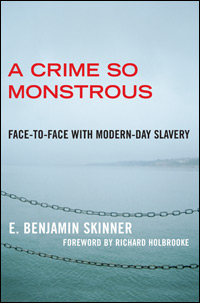
With $50 and a plane ticket to Haiti, one can buy a slave. This was just one of the difficult lessons writer Benjamin Skinner learned while researching his book, A Crime So Monstrous: Face-to-Face with Modern-Day Slavery.

Skinner met with slaves and traffickers in 12 different countries, filling in the substance around a startling fact: there are more slaves on the planet today than at any time in human history. Skinner speaks with Anthony Brooks about his experience researching slavery.

Though now illegal throughout the world, slavery is more or less the same as it was hundreds of years ago, Skinner explains. Slaves are still "those that are forced to work under threat of violence for no pay beyond sustenance."

Something disturbing has changed however — the price of a human. After adjusting for inflation, Skinner found that, "In 1850, a slave would cost roughly $30,000 to $40,000 — in other words it was like investing in a Mercedes. Today you can go to Haiti and buy a 9-year-old girl to use as a sexual and domestic slave for $50. The devaluation of human life is incredibly pronounced."

Skinner obtained this specific figure through a very hands-on process. In the fall of 2005, he visited Haiti, which has one of the highest concentrations of slaves anywhere in the world.

"I pulled up in a car and rolled down the window," he recalls. "Someone said, 'Do you want to get a person?'"

Though the country was in a time of political chaos, the street where he met the trafficker was clean and relatively quiet. A tape of the conversation reveals a calm, concise transaction. He was initially told he could get a 9-year-old sex partner/house slave for $100, but he bargained it down to $50.

"The thing that struck me more than anything afterwards was how incredibly banal the transaction was. It was as if I was negotiating on the street for a used stereo."

In the end, he agreed on the price, but told the trader not to make any moves.

"When I was talking to traffickers, I had a principle that I wouldn't pay for human life," he says.

This principle enabled him to keep a certain distance from the system, but not giving in to the temptation to free a suffering human being was an emotionally taxing struggle, he says.

"It's one thing when you are planning an effort like this, this is a work of journalism — I'm not going to interfere with my subjects. It's another thing when you are in an underground brothel in Bucharest, who has this girl with Down Syndrome, who you know is undergoing rape several times a day. When this girl is offered to me in trade for a used car ... I walk away ... it's not an easy thing to do," he says.

At one point, he did violate his principal — helping a mother free her daughter from slavery. He says he does not regret his decision, however, and continues to track her progress through a local NGO in Haiti. She's now in school, he says, and wrote him a letter over Christmas.

Slavery consumes Skinner, he says.

"When I come back to a nice loft in Brooklyn and I have to think about writing this thing — that drove me. I knew that I had to write as compelling a book as possible. This is a life-long commitment for me."

Excerpt: 'A Crime So Monstrous:

Face-to-Face with Modern-Day Slavery'

Book Cover
Courtesy of Simon and Schuster

Chapter 1: The Riches of the Poor

For our purposes, let's say that the center of the moral universe is in Room S-3800 of the UN Secretariat, Manhattan. From here, you are some five hours from being able to negotiate the sale, in broad daylight, of a healthy boy or girl. Your slave will come in any color you like, as Henry Ford said, as long as it's black. Maximum age: fifteen. He or she can be used for anything. Sex or domestic labor are the most frequent uses, but it's up to you.

Before you go, let's be clear on what you are buying. A slave is a human being who is forced to work through fraud or threat of violence for no pay beyond subsistence. Agreed? Good. You may have thought you missed your chance to own a slave. Maybe you imagined that slavery died along with the 360,000 Union soldiers whose blood fertilized the Emancipation Proclamation and the Thirteenth Amendment. Perhaps you assumed that there was meaning behind the dozen international conventions banning the slave trade, or that the deaths of 30 million people in world wars had spread freedom across the globe.

But you're in luck. By our mere definition, you are living at a time when there are more slaves than at any point in history. If -you're going to buy one in five hours, however, you've really got to stop navel—gazing over things like law and the moral advance of humanity. Get a move on.

First, hail a taxi to JFK International Airport. If you choose the Queensboro Bridge to the Brooklyn—Queens Expressway, the drive should take under an hour. With no baggage, you'll speed through security in time to make a direct flight to Port au Prince, Haiti. Flying time: three hours.

The final hour is the strangest. After disembarking, you will cross the tarmac to the terminal where drummers in vodou getup and a dancing midget greet you with song. Based on Transportation Security Administration warnings posted in the departure terminal at JFK, you might expect abject chaos at Toussaint L'Ouverture Airport. Instead, you find orderly lines leading to the visa stamp, no bribes asked, a short wait for your bag, then a breeze through customs. Outside the airport, the cabbies and porters will be aggressive, but not threatening. Assuming you speak no Creole, find an English—speaking porter and offer him $20 to translate for the day.

Ask your translator to hail the most common form of transport, a tap-tap, a flatbed pickup retrofitted with benches and a brightly colored canopy. You will have to take a couple of these, but they only cost 10 gourdes (25 cents) each. Usually handpainted with signs in broken English or Creole, tap-taps often include the words my god or jesus. my god -it's my life reads one; another announces welcome to jesus. Many are ornate, featuring windshields covered in frill, doodads, and homages to such figures as Che Guevara, Ronaldinho, or reggae legend Gregory Isaacs. The -driver's navigation is based on memory, instinct. There will be no air conditioning. Earplugs are useful, as the sound system, which cost more than the rig itself, will make your chest vibrate with the beats of Haitian pop and American hip-hop. Up to twenty people may accompany you: five square inches on a wooden bench will miraculously accommodate a woman with a posterior the size of a tractor tire. Prepare your spine.

You'll want to head up Route de Delmas toward the suburb of Pétionville, where many of the -countr''s wealthiest thirty families—who control the -nat'on's economy—maintain a—ied--à-terre. As you drive southeast away from the sea, the smells change from rotting fish to rotting vegetables. Exhaust fumes fill the ai'. You'll pass a billboard featuring a smiling girl in pigtails and the words: Give me your hand. Give me tomorrow. Down with Child Servitude. Chances are, like the majority of Haitians, yo' -can't read French or Creole. Like them, you ignore the sign.

Heading out of the airport, -you'll pass two UN peacekeepers, one with a Brazilian patch, the other with an Argentine flag. As you pass the blue helmets, smile, wave, and receive dumbfounded stares in return. The United Nations also has Jordanians and Peruvians here, parked in APVs fifteen minutes northwest, along the edge of the hyperviolent Cité Soleil slum, the poorest and most densely populated six square miles in the poorest and most densely populated country in the hemisphere. The peacekeepers -do''t go in much, neither do the national police. If they do, the gangsters that run the place start shooting. Best to steer clear, although yo''d get a cheap price on children there. You might even get offered a child gratis.

You'll notice the streets of the Haitian capital are, like the tap—taps, overstuffed, banged up, yet colorful. The road surfaces range from bad to terrible, and grind even the toughest SUVs down to the chassis. Parts of Delmas are so steep that the truck may sputter and die under the exertion.

Port au Prince was built to accommodate about 150,000 people, and hasn't seen too many centrally planned upgrades since 1804. Over the last fifty years, some 2 million people, a quarter of the nation's population, have arrived from the countryside. They've brought their animals. Chickens scratch on side streets, and boys lead prizefighting cocks on string leashes. Monstrously fat black pigs root in sooty, putrid garbage piled eight feet high on street corners or even higher in enormous pits that drop off sidewalks and wind behind houses.

A crowd swells out of a Catholic church broadcasting a fervent mass. Most Haitians are Catholic. Despite the efforts of Catholic priests, most also practice vodou. In the countryside, vodou is often all they practice.

The foregoing is excerpted from from the first chapter of A Crime So Monstrous: Face-to-Face with Modern-Day Slavery by Ben Skinner. All rights reserved. No part of this book may be used or reproduced without written permission from Simon & Schuster.

Saturday, January 16, 2010

US monopolizing Haitian airfield to evacuate their own citizens

Deborah Pasmantier (AFP)
Anger at US builds at Port-au-Prince airport
PORT-AU-PRINCE — Anger built Saturday at Haiti's US-controlled main airport, where aid flights were still being turned away and poor coordination continued to hamper the relief effort four days on.

"Let's take over the runway," shouted one voice. "We need to send a message to (US President Barack) Obama," cried another.

Control remained in the hands of US forces, who face criticism for the continued disarray at the overwhelmed airfield.

Dozens of French citizens and dual Haitian-French nationals crowded the airport Saturday seeking to be evacuated after Tuesday's massive 7.0 earthquake, which leveled much of the capital Port-au-Prince.

But at the last minute, a plane due to take them to the French island of Guadeloupe was prevented from landing, leaving them to sleep on the tarmac, waiting for a way out.

"They're repatriating the Americans and not anyone else," said Charles Misteder, 50. "The American monopoly has to end. They are dominating us and not allowing us to return home."

The crowd accused American forces, who were handed control of the airport by Haitian authorities, of monopolizing the airfield's single runway to evacuate their own citizens.

The US embassy denied it was putting the evacuation of the approximately 40,000 to 45,000 American citizens in the country first.

Others waiting for a way out were taken aback by the chaotic scenes confronted them when they arrived at the Toussaint L'Ouverture airport.

"I haven't been able to tell my family that I'm alive. The coordination is a joke," said Wilfried Brevil, a 33-year-old housekeeper.

"I was at the Christopher Hotel," said Daniele Saada, referring to the headquarters of the UN peacekeeping force in Haiti, MINUSTAH.

"I was extremely shaken up. I was pulled out, the others weren't," added Saada, 65, a MINUSTAH employee.

"I decided to return to France. I have nothing and now I am stuck," she said, caught between fury at the chaos and sheer exhaustion.

The disorder even appeared to cause diplomatic ripples, with French Secretary of State for Cooperation Alain Joyandet telling reporters he had lodged a complaint with the United States over its handling of the Port-au-Prince airport.

"I have made an official protest to the Americans through the US embassy," he said at the Haitian airport after a French plane carrying a field hospital was turned away.

A spokesman for the French foreign ministry later denied France had registered protest, saying "Franco-US coordination in emergency aid for Haiti is being handled in the best way possible given the serious difficulties."

The US ambassador to Haiti defended American efforts at the small airport, which was up-and-running 24 hours after the massive quake, even though the air traffic control tower was damaged.

"We're working in coordination with the United Nations and the Haitians," said Ambassador Kenneth Merten, though he acknowledged some difficulties.

"Clearly it's necessary to prioritize the planes. It's clear that there's a problem."

Despite the chaos, a group of French citizens was eventually able to take off on Saturday, and the French plane carrying a field hospital landed safely around noon.

Still, with aid continuing to flood into the quake-stricken country, concern remains about the lack of coordination at the airport, and across devastated Port-au-Prince.

"The Haitians haven't been notified about the arrival of planes. And when they do land, there's no one to take charge and a large amount of goods are arriving without coordination," said Haitian government official Michel Chancy.

On Port-au-Prince's streets, the consequences of the coordination breakdown are clear, as traumatized and starving quake survivors approached passing foreigner and begged them for food.

Friday, January 15, 2010

The history that “binds” the US and Haiti

Bill Van Auken
In his statement on the Haitian earthquake Wednesday, President Barack Obama referred to the “long history that binds us together.” Neither he nor the US media, however, have shown any inclination to probe the history of US-Haiti relations and its bearing on present catastrophe confronting the Haitian people.

Rather, the backwardness and poverty that have played a substantial role in driving the death toll into the tens, if not hundreds, of thousands are presented as a natural state of affairs, if not the fault of the Haitians themselves. The United States is portrayed as a selfless benefactor, ready to come to the aid of Haiti with donations, rescue teams, warships and Marines.

In a cynical and dishonest editorial, the New York Times Thursday began, “Once again the world weeps with Haiti,” a country which it goes on to describe as characterized by “poverty, despair and dysfunction that would be a disaster anywhere else but in Haiti are the norm.”

The editorial continues: “Look at Haiti and you will see what generations of misrule, poverty and political strife will do to a country.”

In a background article on the Haitian disaster, the Times adds that the country “is known for its many man-made woes—its dire poverty, political infighting and proclivity for insurrection.”

In a shorter and even more dismissive editorial, the Wall Street Journal celebrates the fact that the US military will play the leading role in Washington’s response to the earthquake as “a fresh reminder that the reach of America’s power coincides with the reach of its goodness.”

It goes on to draw an obscene comparison between the Haitian earthquake and the one that struck southern California in 1994, in which 72 people died. “The difference,” the Journal declares, “is a function of a wealth-generating and law-abiding society that can afford, among other things, the expense of proper building codes.”

The message is clear. The Haitians have only themselves to blame for the hundreds of thousands of dead and injured, because they failed to create sufficient wealth and lacked respect for law and order.

What is deliberately obscured by this comparison is the real relationship, which has evolved over more than a century, between “wealth generation” in the United States and poverty in Haiti. It is a relationship built on the use of force to pursue US imperialism’s predatory interests in a historically oppressed country.

If the Obama administration and the Pentagon carry through with reported plans to deploy a Marine expeditionary force in Haiti, it will mark the fourth time in the past 95 years that the US armed forces have occupied the impoverished Caribbean nation. This time, as in the past, rather than aiding the Haitian people, the essential purpose of such a military action will be to defend US interests and guard against what the Times refers to as the “proclivity for insurrection.”

The roots of this relationship go back to the birth of Haiti as the first independent black republic in 1804, the product of a successful slave revolution led by Toussaint Louverture, and the subsequent defeat of a French army sent by Napoleon.

The ruling classes of the world never forgave Haiti for its revolutionary victory. It was subjected to a worldwide embargo that was led by the United States, which feared the Haitian example could inspire a similar revolt in the southern slave states. It was only with southern secession and the outbreak of the Civil War that the North recognized Haiti—nearly 60 years after its independence.

From the dawn of the 20th century, Haiti fell under the domination of Washington and the US banks, whose interests were defended by sending Marines to carry out an occupation that continued for nearly 20 years, maintained through the bloody suppression of Haitian resistance.

The Marines left only after carrying out the “Haitianization”—as the New York Times referred to it at the time—of the war against the Haitian people by building an army dedicated to internal repression.

Subsequently, Washington backed the 30-year dictatorship of the Duvaliers, which began with the coming to power of Papa Doc in 1957. While tens of thousands of Haitians died at the hands of the military and the dreaded Tontons Macoute, US imperialism saw the murderous dictatorship as a bulwark against communism and revolution in the Caribbean.

Since the mass upheavals that brought down the Duvaliers in 1986, successive US governments, Democratic and Republican alike, have sought to reconstruct a reliable client state capable of defending the markets and investments of US firms attracted by starvation wages, as well as the property and wealth of the Haitian ruling elite. This entails preventing any challenge to a socio-economic order that keeps 80 percent of the population in dire poverty.

This effort continues today under the tutelage of Bill and Hillary Clinton—respectively the UN’s special representative to Haiti and the US Secretary of State—who together have Haitian blood on their hands.

Washington has backed two coups and sent US troops back into Haiti twice in the past 20 years. Both coups were organized to overthrow Jean-Bertrand Aristide, the first Haitian president to be elected by popular vote and without Washington’s approval. Together, the coups of 1991 and 2004 claimed the lives of at least 13,000 more Haitians. In the 2004 overthrow, Aristide was forcibly transported out of the country by US operatives.

Needing them in Iraq, the US withdrew its troops in 2004, contracting the job of repression out to a United Nations peacekeeping force of 9,000 under the leadership of the Brazilian army.

Despite Aristide’s capitulation to the demands of the International Monetary Fund and his willingness to compromise with Washington, the mass support he attracted with his anti-imperialist rhetoric made him anathema to the ruling elites in both Washington and Port-au-Prince. On the orders of the Obama administration, he is barred from returning to Haiti and his political party, Fanmi Lavalas, remains effectively outlawed.

This is the real and continuing history that, as Obama put it, binds Haiti to US imperialism, which bears overwhelming responsibility for the desperate conditions that have compounded the carnage inflicted by the earthquake.

There are, however, other ties that bind and are deeply felt, as the immensity of the tragedy in Haiti unfolds. There are over half a million Haitian Americans officially counted in the US and undoubtedly hundreds of thousands more who are undocumented. Their presence concretizes the class interests and solidarity that unite Haitian and American workers. Together, it is their task to sweep away the conditions of poverty and devastation in both countries, along with the capitalist profit system that has created them.