Showing posts with label Monetary policy. Show all posts

Tuesday, August 27, 2013

Economic recovery only for those in the top 5 percent

For those in the top 5 percent, the recovery has been pretty good. As for the other 95 percent, well … maybe not so much. Post-financial crisis wealth disparity has been well-chronicled.

Federal Reserve Gov. Sarah B. Raskin drew widespread attention with this speech in April that showed how poorly the lower income levels have fared during the recovery, particularly because those demographics have their wealth concentrated in housing and are hit far more severely by falling prices.

The unemployed in lower-income groups also take a hit because they have a more difficult time finding jobs that pay at a rate commensurate with the positions they lost.

Finally, history has shown that highly accommodative monetary policy widens income disparity by awarding speculators and penalizing savers. While the S&P 500 is up nearly 150 percent since the March 2009 lows, that’s most helped those heavily invested in stocks.

The University of California, Berkeley has produced some seminal research on this topic. But this series of charts, put together by Charles Hugh Smith at oftwominds.com, helps put the sharply skewed recovery into perspective. Read more >>
Enhanced by Zemanta

Tuesday, April 9, 2013

More Than Dozen States Push For Gold as Legal Tender

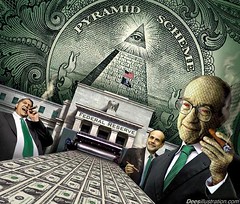
The Federal Reserve: The Biggest Scam In History
Distrust of the Federal Reserve and concern that U.S. dollars may become worthless are fueling a push in more than a dozen states to recognize gold and silver coins as legal tender.
Arizona is poised to follow Utah, which authorized bullion for currency in 2011. Similar bills are advancing in Kansas, South Carolina and other states.

The measures backed by the limited-government Tea Party movement are mostly symbolic -- you still can’t pay for groceries with gold in Utah. They reflect lingering dollar concerns, amplified by the Fed’s unconventional moves in recent years to stabilize the economy, said Loren Gatch, who teaches politics at the University of Central Oklahoma.

“The legislation is about signaling discontent with monetary policy and about what Ben Bernanke is doing,” said Gatch, who studies alternative currencies at the Edmond, Oklahoma-based school. “There is a fear that the government, or Bernanke in particular and the Federal Reserve, is pursuing a policy that will lead to the collapse of the dollar. That’s what is behind it.”

Bernanke has pushed interest rates to near zero since the 18-month recession that began in December 2007. The Fed said in March it would continue buying $85 billion in securities each month in a program known as quantitative easing that has ballooned its assets beyond $3 trillion and is aimed at keeping long-term borrowing costs low to support economic growth. Read more >>
Enhanced by Zemanta

Thursday, January 24, 2013

The High Price Of Understated Inflation

Inflation & Gold

Since the process of adjustment began in the early 1980s, the officially-reported CPI-U number has diverged ever further from the underlying figure calculated on the traditional methodology. Fig. 4.2 gives an approximate idea of quite how distorted US inflation data seems to have become over three decades. Instead of the 3.2% number reported for 2011, for example real inflation was probably at least 7%. Worse still, the official numbers probably understate the sharp pick-up in inflation which America has been experiencing. A realistic appreciation of the inflationary threat would be almost certain to have forced very significant changes in monetary policy.

Taken in aggregate, the extent to which the loss of dollar purchasing power has been understated is almost certainly enormous. Between 1985 and 2011, official data shows that the dollar lost 53% of its value, but the decrease in purchasing power might stand at more like 75% on the basis of underlying data stripped of hedonics, substitution and geometric weighting.

The ramifications of understated inflation are huge. First, of course, and since pay deals often relate to reported CPI, wage rises for millions of Americans have been much smaller than they otherwise would have been. Small wonder, then, that millions of Americans feel much poorer than official figures tell them is the case. By the same token, those Americans in receipt of index-related pensions and benefits, too, have seen the real value of their incomes decline as a result of the severe (and cumulative) understatement of inflation. Read more >>

Enhanced by Zemanta

Monday, September 17, 2012

Faber: Own Gold – “Don’t Store It In The U.S., The Fed Will Take It Away"


Marc Faber, one of the few analysts, to have predicted the current crisis correctly and to have protected his clients in the process, remains very bullish on gold. In another excellent Bloomberg interview, Faber said that “the trend for gold prices will be steady but the trend for the dollar and other currencies will be down. So in other words gold in dollar terms will trend higher.”

“How high it will go, you will have to call Mr Bernanke and at the Fed there are other people who actually make Mr Bernanke look like a hawk and so they are going to print money.” Faber is on record as to the importance of owning physical gold and he again warned about the importance of owning gold but not storing it in the U.S.

“You ought to own some gold but don’t store it in the U.S., the Fed will take it away from you one day,” Faber astutely noted. Read more >>

Tuesday, May 8, 2012

Ron Paul Is Hosting A Hearing On Ending The Federal Reserve Right Now

Texas Congressman Ron Paul will once again face off against his central bank nemesis this morning, during a Congressional hearing on monetary policy and the Federal Reserve.

The hyped-up hearing is titled "The Federal Reserve System: Mend It Or End It?," and will be hosted by the House Finance Committee's Domestic Monetary Policy and Technology Subcommittee, which oversees the Federal Reserve and which, incidentally, is chaired by Ron Paul.

The hearing will feature testimony from several economists and lawmakers, all of whom have some problem with the central bank. No one who works for the Fed is scheduled to testify. The subcommittee will also consider several bills, including Paul's Federal Reserve Board Abolition Act, which would abolish the Federal Reserve, its Board of Governors, and eliminate the Federal Reserve Act. More...

Thursday, December 16, 2010

Ron Paul: Use silver, gold as currency to defeat the Fed

Ron Paul at the 2007 National Right to Life Co...Image via WikipediaAs the incoming chairman of the House monetary policy subcommittee, Rep. Ron Paul (R-TX) will hold the bully pulpit when it comes to the nation's money woes.

He's not wasting any time getting right to the heart of the matter.

The libertarian-leaning conservative has long been a critic of the US Federal Reserve and central banking as a whole, but this may be a new one: speaking with CNBC recently, Paul said he views the Fed as a "monopoly" that could benefit from the introduction of competition.

"We should start ending the Fed by allowing competition," he said. "I don't like the fact that they have monopoly control. It's a cartel: they print the money. The Constitution really doesn't give them that authority. The Constitution said that only gold and silver can be legal tender. I want to legalize competition and allow individual Americans to use gold and silver in competition, as money. Today if you do that, you can go to jail. More...

Enhanced by Zemanta

Saturday, October 31, 2009

Audit the FED is DEAD

Bob Ivry
Representative Ron Paul, the Texas Republican who has called for an end to the Federal Reserve, said legislation he introduced to audit monetary policy has been “gutted” while moving toward a possible vote in the Democratic-controlled House.

The bill, with 308 co-sponsors, has been stripped of provisions that would remove Fed exemptions from audits of transactions with foreign central banks, monetary policy deliberations, transactions made under the direction of the Federal Open Market Committee and communications between the Board, the reserve banks and staff, Paul said today.

“There’s nothing left, it’s been gutted,” he said in a telephone interview. “This is not a partisan issue. People all over the country want to know what the Fed is up to, and this legislation was supposed to help them do that.”

The Fed, led by Chairman Ben S. Bernanke, has come under greater congressional scrutiny while attempting to end the financial crisis by bailing out financial firms and more than doubling its balance sheet to $2.16 trillion in the past year. The central bank is also buying $1.25 trillion of securities tied to home loans.

Paul, a member of the House Financial Services Committee, said Mel Watt, a Democrat from North Carolina, has eliminated “just about everything” while preparing the legislation for formal consideration. Watt is chairman of the panel’s domestic monetary policy and technology subcommittee.

Keith Kelly, a spokesman for Watt, declined to comment and said Watt wasn’t immediately available for an interview. Watt’s district includes Charlotte, headquarters of Bank of America Corp., the biggest U.S. lender.

Original Language

Paul said he intends to introduce an amendment to the bill when it comes to the House floor for a vote restoring the legislation’s original language.

Representative Barney Frank, a Democrat from Massachusetts and chairman of the committee, said in interview that he intends to ensure legislation would provide a time lag between FOMC actions and the reporting of them.

Such a provision would “lessen the market impact,” he said on Oct. 20. “The importance is to see that there are no abuses and to judge what they did.”

The legislation will probably be included in a broader Democratic package of financial-regulation changes in the House, Frank said.

Reblog this post [with Zemanta]

Thursday, October 8, 2009

Strengthening yuan, not oil trading, will dethrone dollar

1 yuan, silver commemorative coin of President...Image via Wikipedia

China Calls Time on Dollar Hegemony

By Ambrose Evans-Pritchard
The Telegraph, London
Tuesday, October 6, 2009

http://www.telegraph.co.uk/finance/china-business/6266790/China-calls-ti...

You can date the end of dollar hegemony from China's decision last month to sell its first batch of sovereign bonds in Chinese yuan to foreigners.

Beijing does not need to raise money abroad, since it has $2 trillion in reserves. The sole purpose is to prepare the way for the emergence of the yuan as a full-fledged global currency.

"It's the tolling of the bell," said Michael Power from Investec Asset Management. "We are only beginning to grasp the enormity and historical significance of what has happened."

It is this shift in China and other parts of rising Asia and Latin America that threatens dollar domination, not the pricing of oil contracts. The markets were rattled yesterday by reports -- since denied -- that China, France, Japan, Russia, and Gulf states were plotting to replace the greenback as the currency for commodity sales, but it makes little difference whether crude is sold in dollars, euros, or Venetian Ducats.

What matters is where OPEC oil producers and rising export powers choose to invest their surpluses. If they cease to rotate this wealth into US Treasuries, mortgage bonds, and other US assets, the dollar must weaken over time.

"Everybody in the world is massively overweight the US dollar," said David Bloom, currency chief at HSBC. "As they invest a little here and little there in other currencies, or gold, it slowly erodes the dollar. It is like sterling after World War I. Everybody can see it's happening."

"In the US they have near zero rates, external deficits, and public debt skyrocketing to 100 percent of GDP, and on top of that they are printing money. It is the perfect storm for the dollar," he said.

"The dollar rallied last year because we had a global liquidity crisis, but we think the rules have changed and that it will be very different this time" if there is another market selloff, he said.

The self-correcting mechanism in the global currency system has been jammed until now because China and other Asian powers have been holding down their currencies to promote exports. The Gulf oil states are mostly pegged to the dollar, for different reasons.

This strategy has become untenable. It is causing them to import a US monetary policy that is too loose for their economies and likely to fuel unstable bubbles as the global economy recovers.

Lorenzo Bini Smaghi, a board member of the European Central Bank, said China for one needs to bite bullet. "I think the best way is that China starts adopting its own monetary policy and detaches itself from the Fed's policy."

Beijing has been schizophrenic, grumbling about the eroding value of its estimated $1.6 trillion of reserves held in dollar assets while perpetuating the structure that causes them to accumulate US assets in the first place -- that is to say, by refusing to let the yuan rise at any more than a glacial pace.

For all its talk, China bought a further $25 billion of US Treasuries in June and $25 billion in July. The weak yuan has helped to keep China's factories open -- and to preserve social order -- during the economic crisis, though exports were still down 23 percent in August. But this policy is on borrowed time. Reformers in Beijing are already orchestrating a profound shift in China's economy from export reliance (38 percent of GDP) to domestic demand, and they know that keeping the dollar peg too long will ultimately cause them to lose export edge anyway -- via the more damaging route of inflation.

For the time being, Europe is bearing the full brunt of Asia's currency policy. The dollar peg has caused the yuan to slide against the euro, even as China's trade surplus with the EU grows. It reached E169 billion (L156 billion) last year. This is starting to provoke protectionist rumblings in Europe, where unemployment is nearing double digits.

ECB governor Guy Quaden said patience is running thin. "The problem is not the exchange rate of the dollar against the euro but rather the relationship between the dollar and certain Asian currencies -- to mention one, the Chinese yuan. I say no more."

France's finance minister, Christine Lagarde, said at the G7 meeting that the euro had been pushed too high. "We need a rebalancing so that one currency doesn't take the flak for the others."

Clearly this is more than a dollar problem. It is a mismatch between the old guard -- US, Europe, Japan -- and the new powers that require stronger currencies to reflect their dynamism and growing wealth. The longer this goes on, the more havoc it will cause to the global economy.

The new order may look like the 1920s, with four or five global currencies as regional anchors -- the yuan, rupee, euro, real -- and the dollar first among equals but not hegemon. The US will be better for it.

Tuesday, September 8, 2009

China issues a “Beijing Put” on Gold

Territories currently administered by two stat...Image via Wikipedia

Gold should get interesting now.

Ambrose Evans-Pritchard

China has issued what amounts to the “Beijing Put” on gold. You can make a lot of money, but you really can’t lose.

I happened to see quite a bit of Cheng Siwei at the Ambrosetti Workshop, a gathering of politicians and global strategists at Lake Como, including a dinner at Villa d’Este last night at which he listened very attentively as a number of American guests tore President Obama’s economic and health policy to shreds.

Mr Cheng was until recently Vice-Chairman of the Communist Party’s Standing Committee, and is now a sort of economic ambassador for China around the world — a charming man, by the way, who left Hong Kong for mainland China in 1950 at the age of 16, as young idealist eager to serve the revolution. Sixty years later, he calls himself simply “a survivior”.

What he said about US monetary policy and gold – this bit on the record – would appear to validate the long-held belief of gold bugs that China has fundamentally lost confidence in the US dollar and is going to shift to a partial gold standard through reserve accumulation.

He played down other metals such as copper, saying that they could not double as a proxy currency or store of wealth.

“Gold is definitely an alternative, but when we buy, the price goes up. We have to do it carefully so as not stimulate the market,” he said.

In other words, China is buying the dips, and will continue to do so as a systematic policy. His comment captures exactly what observation of gold price action suggests is happening. Every time it looks as if the bullion market is going to buckle, some big force steps in from the unknown.

Investors long-suspected that it was China. We later discovered that Beijing had in fact doubled its gold reserves to 1054 tonnes. Fait accompli first. Announcement long after.

Standing back, you can see that the steady rise in gold over the last eight years to $994 an ounce last week – outperforming US equities fourfold, even with reinvested dividends – has roughly tracked the emergence of China as a superpower in foreign reserve holdings (now $2 trillion).

As I have written in today’s paper, Mr Cheng (and Beijing) takes a dim view of Ben Bernanke’s monetary experiments at the Federal Reserve.

“If they keep printing money to buy bonds it will lead to inflation, and after a year or two the dollar will fall hard. Most of our foreign reserves are in US bonds and this is very difficult to change, so we will diversify incremental reserves into euros, yen, and other currencies,” he said.

This line of argument is by now well-known. Less understood is how much trouble the Fed’s QE policies are causing in China itself, where they have vicariously set off a speculative boom on the Shanghai exchange and in property. Mr Cheng said mid-level house prices are now ten times incomes.

“If we raise interest rates, we will be flooded with hot money. We have to wait for them. If they raise, we raise.”

“Credit in China is too loose. We have a bubble in the housing market and in stocks so we have to be very careful, because this could fall down.”


Friday, July 10, 2009

The FED Threatens Congress

The FED threatens that if Congress dare review FED actions, the whole country will fall apart -- sound familiar? Ron Paul has the support of more than half of the House of Representatives for a bill that would audit the Fed’s monetary policy decisions. Paul wants to prevent the Fed being "secret and clandestine and serving special interests”.

Remember, the FED is the core of all U.S. financial problems. As Ron Paul stated to the U.S. House of Representatives in 2002, "From the Great Depression, to the stagflation of the seventies, to the burst of the dotcom bubble...every economic downturn suffered by the country over the last 80 years can be traced to Federal Reserve policy. The Fed has followed a consistent policy of flooding the economy with easy money, leading to a misallocation of resources and an artificial 'boom' followed by a recession or depression when the Fed-created bubble bursts".


The Federal Reserve is one of the most powerful and secretive institutions in Washington, long considered beyond the reach of lawmakers. But now, as details emerge of how the Fed secretly doled out more than a trillion dollars during the financial crisis, a rare bipartisan movement in Congress demands that the Fed be held accountable.

There is a monumental power struggle taking place. The "O Team" wants to increase FED power to unprecedented levels despite the FED's obvious mob-like dictates to its field soldiers like Bank of America and the ordered takeover of Merrill Lynch.

Get a load of Donald Kohn's (vice-chairman of the US Federal Reserve) ludicrous and impudent justification for maintaining FED secrecy:

"Although Federal Reserve officials regularly explain the rationale for their policy decisions in public venues, the process of vetting ideas and proposals, many of which are never incorporated into policy decisions, could suffer from the threat of public disclosure," Mr Kohn told a House Financial Services subcommittee.

"If policymakers believed that (Government Accountability Office) audits would result in published analyses of their policy discussions, they might be less willing to engage in the unfettered and wide-ranging internal debates that are essential to identifying the best possible policy options.”


Ask yourself why that is? What have they got to hide? Who do these people think they are?

Paul has the FED up against the wall for now but I doubt his efforts will stick. The FED will most likely browbeat Congress into submission with fear tactics as Hank and friends did in the past. Better yet, many in Congress already know what the FED is up to and are complicit. The whole system is corrupt to the core; people are so accustom to the corruption, no one even bats an eye anymore. In fact the dismal weight of fascism and mass lethargy is growing so pervasive, I feel as if I'm living within Orwell's novel 1984.

Ilargi summed the situation up beautifully: "The idea that government agencies, who arguably have the best access to data, use that access to distort those same data, seems so intertwined with how society functions these days that not only are there hardly any protests, there's not even much surprise. And that, let me say it once again, depicts an all-out political crisis".