U.S. airlines collected more than $6 billion in baggage and change-in-reservation fees from passengers last year, the highest amount since the fees became common five years ago.
These fees, along with charges for boarding early or picking prime seats, have helped return the industry to profitability.
Airlines started charging for a first checked suitcase in 2008 and the fees have climbed since. Airlines typically charge $25 each way for the first checked bag, $35 for the second bag and then various extra amounts for overweight or oversize bags.
The nation's 15 largest carriers collected a combined $3.5 billion in bag fees in 2012, up 3.8 percent from 2011, according to the Bureau of Transportation Statistics. Reservation change fees totaled $2.6 billion, up 7.3 percent.
The airlines took in $159.5 billion in revenue last year and had expenses of $153.6 billion, according to the government. That 3.7 percent profit margin comes entirely from the baggage and change fees. Read more >>
Showing posts with label Airline. Show all posts
Tuesday, May 14, 2013
Friday, August 12, 2011
Gov't pays for empty flights to rural airports
Federal statistics reviewed by The Associated Press show that in 2010, just 227 passengers flew out of Ely while the airline got $1.8 million in subsidies. The travelers paid $70 to $90 for a one-way ticket. The cost to taxpayers for each ticket: $4,107.
Ely is one of 153 rural communities where airlines get subsidies through the $200 million Essential Air Service program, and one of 13 that critics say should be eliminated from it. Some call the spending a boondoggle, but others see it as a critical financial lifeline to ensure economic stability in rural areas. More...
Sunday, November 29, 2009
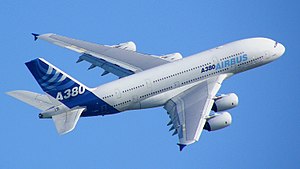
Dubai Crisis Threatens Airbus and Boeing
Image via Wikipedia
As if Airbus and Boeing didn’t have enough to worry about already, the looming debt crisis in Dubai has cast a shadow over a backlog of aircraft orders, worth more than $60 billion, from Dubai, Inc.
The biggest – but by no means the only – example is Emirates, Dubai’s government-controlled carrier. It has more than $30 billion worth of planes on order from Airbus, including 53 of the double-decker A380, for which Emirates is by far the largest customer. Emirates also has placed 70 orders for Airbus’s forthcoming A350 widebody. And Airbus has outstanding orders from state-controlled leasing outfit DAE Capital totaling about $12.6 billion.
No surprise, then, that shares in Airbus parent European Aeronautics Defence & Space Co. fell more than 3% on Nov. 26 when the Dubai government asked to postpone debt repayments.
Boeing is considerably less-exposed than Airbus to potential turmoil in Dubai, but it still has plenty at stake. Emirates has about $4 billion worth of Boeing 777s on order, while DAE Capital and low-cost carrier Flydubai have a combined $16 billion on order from Boeing. As U.S. markets reopened on Nov. 27 after Thanksgiving, Boeing shares were down 1.2%
Emirates, which in less than a decade has grown from obscurity into one of the world’s biggest airlines, has long said that it receives no government subsidies. Even so, the debt crisis could wreak havoc with its future. Travel to Dubai had already started to slump as the economy weakened earlier this year – although Emirates is cushioned somewhat because about 60% of passengers coming through its Dubai hub are on flights connecting elsewhere.
A scarier prospect for Emirates is that Dubai’s oil-rich neighbor, Abu Dhabi, might demand control of the airline as part of a deal to bail out its debt-strapped neighbor. Abu Dhabi’s state airline, Etihad, has ambitions to become a global player and turn the Abu Dhabi airport into a major hub.
If that happens, it’s unlikely Abu Dhabi would take delivery of all Emirates’ order backlog, in addition to the 100 aircraft it has ordered. Longterm market analyses by Airbus and Boeing predict that air travel in the Middle East will grow an average 6% to 7% annually over the next two decades, too little to absorb both carriers’ order books. And those estimates were made before the Dubai debt crisis.
The outlook for DAE Capital and Flydubai is worrisome, too. Both now have small fleets and have been counting on robust revenue growth to pay for new aircraft purchases. It could add up to a very bumpy ride for both Airbus and Boeing.
Thursday, August 13, 2009
FED to maintain records on all flights by US citizens
Beginning this Saturday, air travelers will be required to provide their date of birth and gender status when making airline reservations to comply with Transportation Secretary Administration's "Secure Flight"program; the program is designed to transfer responsibility for checking air passengers' identities from the airlines to the federal government.
The new Secure Flight program requires travelers making reservations -- as well as non-traveler escorts who enter secure areas -- to provide three pieces of information: the passenger's full name on government issued ID, birth date and gender. The airline will transmit that information to the TSA for screening on a "no-fly" list of people prohibited from flying or to a list of "selectees" who can fly after they pass additional physical screening.
TSA claims records for individuals who are not identified as potential matches will be retained for 7 days after the full completion on their flight itinerary, but if you happen to have a name similar to a name on the "no fly" list (don't assume all the names are Arab), even if you're eventually cleared, your identifying records, as well as your full flight itinerary, will be maintained for 7 years. Furthermore, even if you're not on the "no fly" list, the government, at their discretion, may choose to conduct additional criminal searches on travelers from state and federal law enforcement data bases.
My guess is that even if the government does purge the names of travelers who are not identified as potential matches after 7 days, those names, along with their travel itineraries, are transferred to a secondary archived data base.
Privacy Impact Assessment for the Secure Flight Program (pdf)
TSA will retain records for most individuals encountered by Secure Flight for a short period of time. Records for individuals who are not identified as potential matches by the automated matching tool, which comprise the vast majority of travel records held by TSA, will be retained for seven (7) days after the completion of the individual’s directional travel for audit purposes. Records for individuals who are potential or confirmed matches will be retained for no less than seven years after the completion of the individual’s directional travel, as outlined in section 3.0 of this PIA.
What information is to be collected?
Airlines currently collect information from passengers and non-travelers that is necessary both for security purposes and for ensuring passenger comfort during their flights to their destinations.
Under the Secure Flight Final Rule, TSA will require covered aircraft operators to send to TSA Secure Flight Passenger Data (SFPD) that will consist of the below listed elements, to the extent available.
(1) full name;
(2) date of birth;
(3) gender;
(4) redress number (if available);
(5) known traveler number (if implemented and available); and
(6) passport information (if available).
For non-traveling individuals for whom the aircraft operator seeks authorization to enter an airport sterile area (such as to escort minors or passengers with disabilities), TSA also is requiring covered aircraft operators to request from the non-traveler the same information requested from passengers and transmit to TSA that information as well as certain non-personally identifiable information used to manage messages between covered aircraft operators and TSA, including the airport code for the sterile area to which the non-traveler seeks access.
TSA will maintain records for non-traveling individuals for seven 7 days unless they are designated as potential matches, in which case they'll maintain records for 7 years.
Subscribe to:
Posts (Atom)

