Showing posts with label Transportation Security Administration. Show all posts

Wednesday, October 10, 2012

TSA Harasses Dying Michigan woman on her last trip to Hawaii

English: A TSA officer screens a piece of luggage.

A Michigan woman dying of leukemia says she hopes her embarrassment during a Seattle airport security pat-down might change the way the Transportation Security Administration treats travelers with medical conditions.

A TSA spokeswoman said late Tuesday, however, that the agency had reviewed video from the security checkpoint where Michelle Dunaj was screened for weapons and determined that the agency's procedures were followed. Dunaj, 34, was making what she expects will be the last trip of her life on Oct. 2 as she traveled through Seattle en route to Hawaii.

The Roseville, Mich., woman thought she had prepared by calling the airline ahead of time, asking for a wheelchair, carrying documentation for her feeding tubes and making sure she had prescriptions for all her medications, including five bags of saline solution.

But Dunaj said she received a full pat-down in the security line at Seattle-Tacoma Airport and had to lift her shirt and pull back bandages so agents could get a good look. She said everyone else in line got a look, too. Read more >>


Enhanced by Zemanta

Wednesday, July 25, 2012

TSA Expands Invasion To CA Train Stations & Bus Terminals

English: A TSA officer screens a piece of luggage.
Footage shot at the Oceanside Transit Center in Southern California documents how the rollout of TSA workers is expanding out of the airports and into train stations and bus terminals. The clip shows TSA inspectors standing with police and drug-sniffing dogs. The TSA agents told the film maker that he was still allowed to take video and photos at the train station but may get “questioned” for doing so.

There were about six or seven TSA agents patrolling the station according to the uploader of the video. The Transportation Security Administration was embarrassed earlier this year when Houstonians revolted over a program that would have seen TSA workers routinely ride city buses in the name of spotting terrorists and criminals.

During a trial of the program, bus passengers were harassed and interrogated by TSA workers, prompting a backlash and an anger-filled public meeting during which residents expressed resentment about being asked questions about their journey and having their bags searched. Read more >>

Thursday, May 10, 2012

TSA Flags 18 Month Old Baby as No Fly

Transportation Security Administration, an age...

Eighteen-month-old Riyanna has been called a lot of things: cute, adorable and now ... a suspected terrorist. She was called that on Tuesday night at the Ft Lauderdale Airport. She and her parents had just boarded a JetBlue flight when an airline employee approached them and asked them to get off the plane, saying representatives from the Transportation Security Agency wanted to speak to them.

"And I said, 'For what?'" Riyanna's mother told only WPBF 25 News on Wednesday. "And he said, 'Well, it's not you or your husband. Your daughter was flagged as no fly.' I said, 'Excuse me?'" Riyanna's father was flabbergasted. "It's absurd," he said. "It made no sense. Why would an 18-month-old child be on a no-fly list?"

Riyanna's parents, who asked not to be identified, said they think they know the answer to that question. They believe they were profiled because they are both of Middle Eastern descent. Riyanna's mother wears a hijab, a traditional head scarf. That's why they have asked to remain anonymous. They said they're concerned about repurcussions. That said, they are both Americans, born and raised in New Jersey, just like their daughter. More...

Wednesday, November 24, 2010

DHS makes list of all who refuse TSA Screening

Cuffed Defendant before criminal court (Transp...Image via WikipediaDHS & TSA: making a list, checking it twice
Douglas J. Hagmann

Following the publication of my article titled “Gate Rape of America,” I was contacted by a source within the DHS who is troubled by the terminology and content of an internal memo reportedly issued yesterday at the hand of DHS Secretary Janet Napolitano. Indeed, both the terminology and content contained in the document are troubling. The dissemination of the document itself is restricted by virtue of its classification, which prohibits any manner of public release. While the document cannot be posted or published, the more salient points are revealed here.

The memo, which actually takes the form of an administrative directive, appears to be the product of undated but recent high level meetings between Napolitano, John Pistole, head of the Transportation Security Administration (TSA),and one or more of Obama’s national security advisors. This document officially addresses those who are opposed to, or engaged in the disruption of the implementation of the enhanced airport screening procedures as “domestic extremists.”

The introductory paragraph of the multipage document states that it is issued “in response to the growing public backlash against enhanced TSA security screening procedures and the agents conducting the screening process.” Implicit within the same section is that the recently enhanced security screening procedures implemented at U.S. airports, and the measures to be taken in response to the negative public backlash as detailed [in this directive], have the full support of the President. In other words, Obama not only endorses the enhanced security screening, but the measures outlined in this directive to be taken in response to public objections.

The terminology contained within the reported memo is indeed troubling. It labels any person who “interferes” with TSA airport security screening procedure protocol and operations by actively objecting to the established screening process, “including but not limited to the anticipated national opt-out day” as a “domestic extremist.” The label is then broadened to include “any person, group or alternative media source” that actively objects to, causes others to object to, supports and/or elicits support for anyone who engages in such travel disruptions at U.S. airports in response to the enhanced security procedures.

For individuals who engaged in such activity at screening points, it instructs TSA operations to obtain the identities of those individuals and other applicable information and submit the same electronically to the Homeland Environment Threat Analysis Division, the Extremism and Radicalization branch of the Office of Intelligence & Analysis (IA) division of the Department of Homeland Security.

For “any person, group or domestic alternative media source” that actively objects to, causes others to object to, supports and/or elicits support for anyone who engages in such travel “disruptions” at U.S. airports (as defined above) in response to the enhanced security procedures, the [applicable DHS administrative branch] is instructed to identify and collect information about the persons or entities, and submit such information in the manner outlined [within this directive].

It would appear that the Department of Homeland Security is not only prepared to enforce the enhanced security procedures at airports, but is involved in gathering intelligence about those who don’t. They’re making a list and most certainly will be checking it twice. Meanwhile, legitimate threats to our air travel security (and they DO exist) seem taking a back seat to the larger threat of the multitude of non-criminal American citizens who object to having their Constitutional rights violated.

As I have written before, it has nothing to do with security and everything to do with control.


Enhanced by Zemanta

Tuesday, January 26, 2010

With $50 and a plane ticket to Haiti, one can buy a slave

Author Struggles to Stay Removed from Slave Trade
NPR
March 11, 2008

With $50 and a plane ticket to Haiti, one can buy a slave. This was just one of the difficult lessons writer Benjamin Skinner learned while researching his book, A Crime So Monstrous: Face-to-Face with Modern-Day Slavery.

Skinner met with slaves and traffickers in 12 different countries, filling in the substance around a startling fact: there are more slaves on the planet today than at any time in human history. Skinner speaks with Anthony Brooks about his experience researching slavery.

Though now illegal throughout the world, slavery is more or less the same as it was hundreds of years ago, Skinner explains. Slaves are still "those that are forced to work under threat of violence for no pay beyond sustenance."

Something disturbing has changed however — the price of a human. After adjusting for inflation, Skinner found that, "In 1850, a slave would cost roughly $30,000 to $40,000 — in other words it was like investing in a Mercedes. Today you can go to Haiti and buy a 9-year-old girl to use as a sexual and domestic slave for $50. The devaluation of human life is incredibly pronounced."

Skinner obtained this specific figure through a very hands-on process. In the fall of 2005, he visited Haiti, which has one of the highest concentrations of slaves anywhere in the world.

"I pulled up in a car and rolled down the window," he recalls. "Someone said, 'Do you want to get a person?'"

Though the country was in a time of political chaos, the street where he met the trafficker was clean and relatively quiet. A tape of the conversation reveals a calm, concise transaction. He was initially told he could get a 9-year-old sex partner/house slave for $100, but he bargained it down to $50.

"The thing that struck me more than anything afterwards was how incredibly banal the transaction was. It was as if I was negotiating on the street for a used stereo."

In the end, he agreed on the price, but told the trader not to make any moves.

"When I was talking to traffickers, I had a principle that I wouldn't pay for human life," he says.

This principle enabled him to keep a certain distance from the system, but not giving in to the temptation to free a suffering human being was an emotionally taxing struggle, he says.

"It's one thing when you are planning an effort like this, this is a work of journalism — I'm not going to interfere with my subjects. It's another thing when you are in an underground brothel in Bucharest, who has this girl with Down Syndrome, who you know is undergoing rape several times a day. When this girl is offered to me in trade for a used car ... I walk away ... it's not an easy thing to do," he says.

At one point, he did violate his principal — helping a mother free her daughter from slavery. He says he does not regret his decision, however, and continues to track her progress through a local NGO in Haiti. She's now in school, he says, and wrote him a letter over Christmas.

Slavery consumes Skinner, he says.

"When I come back to a nice loft in Brooklyn and I have to think about writing this thing — that drove me. I knew that I had to write as compelling a book as possible. This is a life-long commitment for me."

Excerpt: 'A Crime So Monstrous:

Face-to-Face with Modern-Day Slavery'
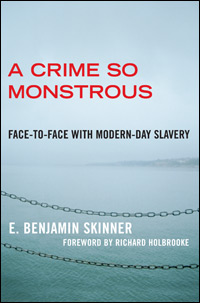
Book Cover
Courtesy of Simon and Schuster

Chapter 1: The Riches of the Poor

For our purposes, let's say that the center of the moral universe is in Room S-3800 of the UN Secretariat, Manhattan. From here, you are some five hours from being able to negotiate the sale, in broad daylight, of a healthy boy or girl. Your slave will come in any color you like, as Henry Ford said, as long as it's black. Maximum age: fifteen. He or she can be used for anything. Sex or domestic labor are the most frequent uses, but it's up to you.

Before you go, let's be clear on what you are buying. A slave is a human being who is forced to work through fraud or threat of violence for no pay beyond subsistence. Agreed? Good. You may have thought you missed your chance to own a slave. Maybe you imagined that slavery died along with the 360,000 Union soldiers whose blood fertilized the Emancipation Proclamation and the Thirteenth Amendment. Perhaps you assumed that there was meaning behind the dozen international conventions banning the slave trade, or that the deaths of 30 million people in world wars had spread freedom across the globe.

But you're in luck. By our mere definition, you are living at a time when there are more slaves than at any point in history. If -you're going to buy one in five hours, however, you've really got to stop navel—gazing over things like law and the moral advance of humanity. Get a move on.

First, hail a taxi to JFK International Airport. If you choose the Queensboro Bridge to the Brooklyn—Queens Expressway, the drive should take under an hour. With no baggage, you'll speed through security in time to make a direct flight to Port au Prince, Haiti. Flying time: three hours.

The final hour is the strangest. After disembarking, you will cross the tarmac to the terminal where drummers in vodou getup and a dancing midget greet you with song. Based on Transportation Security Administration warnings posted in the departure terminal at JFK, you might expect abject chaos at Toussaint L'Ouverture Airport. Instead, you find orderly lines leading to the visa stamp, no bribes asked, a short wait for your bag, then a breeze through customs. Outside the airport, the cabbies and porters will be aggressive, but not threatening. Assuming you speak no Creole, find an English—speaking porter and offer him $20 to translate for the day.

Ask your translator to hail the most common form of transport, a tap-tap, a flatbed pickup retrofitted with benches and a brightly colored canopy. You will have to take a couple of these, but they only cost 10 gourdes (25 cents) each. Usually handpainted with signs in broken English or Creole, tap-taps often include the words my god or jesus. my god -it's my life reads one; another announces welcome to jesus. Many are ornate, featuring windshields covered in frill, doodads, and homages to such figures as Che Guevara, Ronaldinho, or reggae legend Gregory Isaacs. The -driver's navigation is based on memory, instinct. There will be no air conditioning. Earplugs are useful, as the sound system, which cost more than the rig itself, will make your chest vibrate with the beats of Haitian pop and American hip-hop. Up to twenty people may accompany you: five square inches on a wooden bench will miraculously accommodate a woman with a posterior the size of a tractor tire. Prepare your spine.

You'll want to head up Route de Delmas toward the suburb of Pétionville, where many of the -countr''s wealthiest thirty families—who control the -nat'on's economy—maintain a—ied--à-terre. As you drive southeast away from the sea, the smells change from rotting fish to rotting vegetables. Exhaust fumes fill the ai'. You'll pass a billboard featuring a smiling girl in pigtails and the words: Give me your hand. Give me tomorrow. Down with Child Servitude. Chances are, like the majority of Haitians, yo' -can't read French or Creole. Like them, you ignore the sign.

Heading out of the airport, -you'll pass two UN peacekeepers, one with a Brazilian patch, the other with an Argentine flag. As you pass the blue helmets, smile, wave, and receive dumbfounded stares in return. The United Nations also has Jordanians and Peruvians here, parked in APVs fifteen minutes northwest, along the edge of the hyperviolent Cité Soleil slum, the poorest and most densely populated six square miles in the poorest and most densely populated country in the hemisphere. The peacekeepers -do''t go in much, neither do the national police. If they do, the gangsters that run the place start shooting. Best to steer clear, although yo''d get a cheap price on children there. You might even get offered a child gratis.

You'll notice the streets of the Haitian capital are, like the tap—taps, overstuffed, banged up, yet colorful. The road surfaces range from bad to terrible, and grind even the toughest SUVs down to the chassis. Parts of Delmas are so steep that the truck may sputter and die under the exertion.

Port au Prince was built to accommodate about 150,000 people, and hasn't seen too many centrally planned upgrades since 1804. Over the last fifty years, some 2 million people, a quarter of the nation's population, have arrived from the countryside. They've brought their animals. Chickens scratch on side streets, and boys lead prizefighting cocks on string leashes. Monstrously fat black pigs root in sooty, putrid garbage piled eight feet high on street corners or even higher in enormous pits that drop off sidewalks and wind behind houses.

A crowd swells out of a Catholic church broadcasting a fervent mass. Most Haitians are Catholic. Despite the efforts of Catholic priests, most also practice vodou. In the countryside, vodou is often all they practice.

The foregoing is excerpted from from the first chapter of A Crime So Monstrous: Face-to-Face with Modern-Day Slavery by Ben Skinner. All rights reserved. No part of this book may be used or reproduced without written permission from Simon & Schuster.

Monday, October 26, 2009

TSA teams with dogs conducting random pat downs at Greyhound Bus Stations

Nazi Kirk, Spock and Bones - Star Trek - Patte...Image by Marshall Astor - Food Pornographer via Flickr

"Your papers, please."

Orlando Sentinel
Bryce Williams wasn't expecting to walk through a metal detector or have his bags screened for explosives at the Greyhound bus terminal near downtown Orlando. But Williams and 689 other passengers went through tougher-than-normal security procedures Thursday as part of a random check coordinated by the U.S.

The idea is to keep off guard terrorists and others who mean harm, thereby improving safety for passengers and workers. There was no specific threat to the bus station on John Young Parkway south of Colonial Drive.

Although the TSA is best known for its agents at airports, the agency's Visible Intermodal Prevention and Response, or VIPR, teams stage periodic operations at bus and train stations, ports and other transportation centers. They began work in December 2006.

Thursday's daylong event was the first at a Greyhound station in Florida, said John Daly, TSA security director for the Orlando region. Ashley Hartman, 23, arrived in the late afternoon from Tampa and was planning to transfer in Orlando to a bus bound for her home in Delaware. She told a security agent about the stun gun in her book bag that she carries for protection, and officials at the terminal helped her ship it home; stun guns are prohibited on buses, a TSA spokeswoman said.

"I think they have to have that with everything that's going on after 9-11," said Hartman, who was on her way home from a seasonal job running carnival games. Normally, two security agents are on duty at the bus terminal, said Emma J. Gray, Greyhound district manager. They use a hand-held metal detector to scan people and also inspect luggage by hand, she said.

On Thursday, 50 officials from agencies including TSA, Orlando police, the Orange County Sheriff's Office, and U.S. Customs and Border Protection patted down passengers. Behavior and explosives experts and dogs trained to sniff out bombs and drugs also were used. Everyone who walked into the terminal went through a metal detector like those at airports, and baggage was screened for explosives.

Saturday, August 15, 2009

Orwellian Behavior Detection Officers Roam Airports

"There was of course no way of knowing whether you were being watched at any given moment. How often, or on what system, the Thought Police plugged in on any individual wire was guesswork. It was even conceivable that they watched everybody all the time. But at any rate they could plug in your wire whenever they wanted to. You had to live—did live, from habit that became instinct—in the assumption that every sound you made was overheard, and, except in darkness, every movement scrutinized."

-- George Orwell


Since 2006, the U.S. Transportation Security Administration employs a technique know as (SPOT) -- Screening of Passengers by Observation Technique. According to TSA's 2006 Federal Security Director, "This system is conducted by trained personnel and closely monitored by supervisors."

TSA Website:

The SPOT program utilizes behavior observation and analysis techniques to identify potentially high-risk passengers. Individuals that exhibit suspicious behaviors, such as physical and physiological reactions, may be required to undergo additional screening. The SPOT program serves as additional layer of security and is highly beneficial to all modes of transportation security in that it maximizes the effectiveness of TSOs already deployed, and requires no additional specialized screening equipment. The SPOT program has been deployed to an initial number of airports. A nationwide rollout is planned for the near future.

Three years ago, Time's Sally B. Donnelly described it this way: "Select TSA employees will be trained to identify suspicious individuals who raise red flags by exhibiting unusual or anxious behavior, which can be as simple as changes in mannerisms, excessive sweating on a cool day, or changes in the pitch of a person's voice. Racial or ethnic factors are not a criterion for singling out people, TSA officials say. Those who are identified as suspicious will be examined more thoroughly; for some, the agency will bring in local police to conduct face-to-face interviews and perhaps run the person's name against national criminal databases and determine whether any threat exists. If such inquiries turn up other issues countries with terrorist connections, police officers can pursue the questioning or alert Federal counterterrorism agents. And of course the full retinue of baggage x-rays, magnetometers and other checks for weapons will continue."

In 2007, SOP Newswire claimed "TSA's SPOT-trained security officers are screening travelers for involuntary physical and physiological reactions that people exhibit in response to a fear of being discovered...Individuals exhibiting specific observable behaviors may be referred for additional screening at the checkpoint to include a handwanding, limited pat down and physical inspection of one's carry-on baggage."

Last Thursday Ian MacLeod, with Canwest News Service reported that beginning next year, some air travellers will be scrutinized by airport "behaviour detection officers" for physiological signs of hostile intent -- in other words: screening for dangerous people rather than just for dangerous objects.

Planning for the training and deployment of the plainclothes security officers is to begin this fall, with a pilot project expected to roll out at a major airport in 2010, the Canadian Air Transport Security Authority said yesterday. The project's budget is about $400,000.

If successful, "behaviour pattern recognition" could land at major airports across the country.

Similar programs operate in the United States, the United Kingdom and Israel, which pioneered spying on people's expressions and body movements for involuntary and fleeting "micro-expressions" and movements suggesting abnormal stress, fear or deception.

"This might indicate a passenger has malicious intentions," said Mathieu Larocque, spokesman for the security authority, which is responsible for pre-board screening of airport passengers. "It offers an additional security layer for the aviation system."

The largest pilots' union in the world has been lobbying the federal government to adopt these procedures for several years.

"We're very, very pleased," said Captain Craig Hall, Canadian director of the national security committee of Air Line Pilots Association International.

The U.S. Transportation Security Administration says its "Screening Passengers by Observation Techniques" program has been so successful, it now has more than 2,000 behavioural detection officers patrolling concourses and departure lounges for unusual, anxious or otherwise "suspicious" passenger behaviour.

Without revealing details, the U.S. agency said the officers are trained to discount the typical nervousness, anger and confusion that many travellers experience.

It insists the officers do not use racial, ethnic or religious profiling.

An independent panel of security and aviation experts that reviewed Canadian Air Transport Security Authority operations cautiously recommended to Transport Canada in 2007 that behavioural profiling might work in Canada.

The panel attached some conditions, including that the concept must be planned and implemented so that offensive forms of profiling by front-line personnel are minimized, if not eliminated, and that it not be a substitute for pre-board screening of carry-on luggage.

The U.S. boasts that between January and December 2006, their behavioural screening program stopped 70,000 people for questioning, resulting in upwards of 700 arrests.

But that one-in-100 hit rate involved everything from alleged money-laundering, drug and weapons possession to immigration violations and outstanding arrest warrants. None of the incidents was terrorism related.

The Transportation Security Administration said some did lead to counter-terrorism investigations, but has not elaborated.

Thursday, August 13, 2009

FED to maintain records on all flights by US citizens

Airbus A380Image via

Beginning this Saturday, air travelers will be required to provide their date of birth and gender status when making airline reservations to comply with Transportation Secretary Administration's "Secure Flight"program; the program is designed to transfer responsibility for checking air passengers' identities from the airlines to the federal government.

The new Secure Flight program requires travelers making reservations -- as well as non-traveler escorts who enter secure areas -- to provide three pieces of information: the passenger's full name on government issued ID, birth date and gender. The airline will transmit that information to the TSA for screening on a "no-fly" list of people prohibited from flying or to a list of "selectees" who can fly after they pass additional physical screening.

TSA claims records for individuals who are not identified as potential matches will be retained for 7 days after the full completion on their flight itinerary, but if you happen to have a name similar to a name on the "no fly" list (don't assume all the names are Arab), even if you're eventually cleared, your identifying records, as well as your full flight itinerary, will be maintained for 7 years. Furthermore, even if you're not on the "no fly" list, the government, at their discretion, may choose to conduct additional criminal searches on travelers from state and federal law enforcement data bases.

My guess is that even if the government does purge the names of travelers who are not identified as potential matches after 7 days, those names, along with their travel itineraries, are transferred to a secondary archived data base.

Privacy Impact Assessment for the Secure Flight Program (pdf)

TSA will retain records for most individuals encountered by Secure Flight for a short period of time. Records for individuals who are not identified as potential matches by the automated matching tool, which comprise the vast majority of travel records held by TSA, will be retained for seven (7) days after the completion of the individual’s directional travel for audit purposes. Records for individuals who are potential or confirmed matches will be retained for no less than seven years after the completion of the individual’s directional travel, as outlined in section 3.0 of this PIA.

What information is to be collected?

Airlines currently collect information from passengers and non-travelers that is necessary both for security purposes and for ensuring passenger comfort during their flights to their destinations.

Under the Secure Flight Final Rule, TSA will require covered aircraft operators to send to TSA Secure Flight Passenger Data (SFPD) that will consist of the below listed elements, to the extent available.

(1) full name;
(2) date of birth;
(3) gender;
(4) redress number (if available);
(5) known traveler number (if implemented and available); and
(6) passport information (if available).

For non-traveling individuals for whom the aircraft operator seeks authorization to enter an airport sterile area (such as to escort minors or passengers with disabilities), TSA also is requiring covered aircraft operators to request from the non-traveler the same information requested from passengers and transmit to TSA that information as well as certain non-personally identifiable information used to manage messages between covered aircraft operators and TSA, including the airport code for the sterile area to which the non-traveler seeks access.

TSA will maintain records for non-traveling individuals for seven 7 days unless they are designated as potential matches, in which case they'll maintain records for 7 years.