Showing posts with label Fox News. Show all posts

Monday, April 19, 2010

Noam Chomsky Has ‘Never Seen Anything Like This’

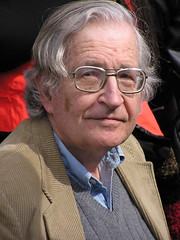
Noam ChomskyImage by thelastminute via Flickr

Chris Hedges
Noam Chomsky is America’s greatest intellectual. His massive body of work, which includes nearly 100 books, has for decades deflated and exposed the lies of the power elite and the myths they perpetrate. Chomsky has done this despite being blacklisted by the commercial media, turned into a pariah by the academy and, by his own admission, being a pedantic and at times slightly boring speaker. He combines moral autonomy with rigorous scholarship, a remarkable grasp of detail and a searing intellect. He curtly dismisses our two-party system as a mirage orchestrated by the corporate state, excoriates the liberal intelligentsia for being fops and courtiers and describes the drivel of the commercial media as a form of “brainwashing.” And as our nation’s most prescient critic of unregulated capitalism, globalization and the poison of empire, he enters his 81st year warning us that we have little time left to save our anemic democracy.

“It is very similar to late Weimar Germany,” Chomsky told me when I called him at his office in Cambridge, Mass. “The parallels are striking. There was also tremendous disillusionment with the parliamentary system. The most striking fact about Weimar was not that the Nazis managed to destroy the Social Democrats and the Communists but that the traditional parties, the Conservative and Liberal parties, were hated and disappeared. It left a vacuum which the Nazis very cleverly and intelligently managed to take over.”

“The United States is extremely lucky that no honest, charismatic figure has arisen,” Chomsky went on. “Every charismatic figure is such an obvious crook that he destroys himself, like McCarthy or Nixon or the evangelist preachers. If somebody comes along who is charismatic and honest this country is in real trouble because of the frustration, disillusionment, the justified anger and the absence of any coherent response. What are people supposed to think if someone says ‘I have got an answer, we have an enemy’? There it was the Jews. Here it will be the illegal immigrants and the blacks. We will be told that white males are a persecuted minority. We will be told we have to defend ourselves and the honor of the nation. Military force will be exalted. People will be beaten up. This could become an overwhelming force. And if it happens it will be more dangerous than Germany. The United States is the world power. Germany was powerful but had more powerful antagonists. I don’t think all this is very far away. If the polls are accurate it is not the Republicans but the right-wing Republicans, the crazed Republicans, who will sweep the next election.”

“I have never seen anything like this in my lifetime,” Chomsky added. “I am old enough to remember the 1930s. My whole family was unemployed. There were far more desperate conditions than today. But it was hopeful. People had hope. The CIO was organizing. No one wants to say it anymore but the Communist Party was the spearhead for labor and civil rights organizing. Even things like giving my unemployed seamstress aunt a week in the country. It was a life. There is nothing like that now. The mood of the country is frightening. The level of anger, frustration and hatred of institutions is not organized in a constructive way. It is going off into self-destructive fantasies.”

“I listen to talk radio,” Chomsky said. “I don’t want to hear Rush Limbaugh. I want to hear the people calling in. They are like [suicide pilot] Joe Stack. What is happening to me? I have done all the right things. I am a God-fearing Christian. I work hard for my family. I have a gun. I believe in the values of the country and my life is collapsing.”

Chomsky has, more than any other American intellectual, charted the downward spiral of the American political and economic system, in works such as “On Power and Ideology: The Managua Lectures,” “Rethinking Camelot: JFK, the Vietnam War, and US Political Culture,” “A New Generation Draws the Line: Kosovo, East Timor and the Standards of the West,” “Understanding Power: The Indispensable Chomsky,” “Manufacturing Consent” and “Letters From Lexington: Reflections on Propaganda.” He reminds us that genuine intellectual inquiry is always subversive. It challenges cultural and political assumptions. It critiques structures. It is relentlessly self-critical. It implodes the self-indulgent myths and stereotypes we use to elevate ourselves and ignore our complicity in acts of violence and oppression. And it makes the powerful, as well as their liberal apologists, deeply uncomfortable.

Chomsky reserves his fiercest venom for the liberal elite in the press, the universities and the political system who serve as a smoke screen for the cruelty of unchecked capitalism and imperial war. He exposes their moral and intellectual posturing as a fraud. And this is why Chomsky is hated, and perhaps feared, more among liberal elites than among the right wing he also excoriates. When Christopher Hitchens decided to become a windup doll for the Bush administration after the attacks of 9/11, one of the first things he did was write a vicious article attacking Chomsky. Hitchens, unlike most of those he served, knew which intellectual in America mattered. [Editor’s note: To see some of the articles in the 2001 exchanges between Hitchens and Chomsky, click here, here, here and here.]

“I don’t bother writing about Fox News,” Chomsky said. “It is too easy. What I talk about are the liberal intellectuals, the ones who portray themselves and perceive themselves as challenging power, as courageous, as standing up for truth and justice. They are basically the guardians of the faith. They set the limits. They tell us how far we can go. They say, ‘Look how courageous I am.’ But do not go one millimeter beyond that. At least for the educated sectors, they are the most dangerous in supporting power.”

Chomsky, because he steps outside of every group and eschews all ideologies, has been crucial to American discourse for decades, from his work on the Vietnam War to his criticisms of the Obama administration. He stubbornly maintains his position as an iconoclast, one who distrusts power in any form.

“Most intellectuals have a self-understanding of themselves as the conscience of humanity,” said the Middle East scholar Norman Finkelstein. “They revel in and admire someone like Vaclav Havel. Chomsky is contemptuous of Havel. Chomsky embraces the Julien Benda view of the world. There are two sets of principles. They are the principles of power and privilege and the principles of truth and justice. If you pursue truth and justice it will always mean a diminution of power and privilege. If you pursue power and privilege it will always be at the expense of truth and justice. Benda says that the credo of any true intellectual has to be, as Christ said, ‘my kingdom is not of this world.’ Chomsky exposes the pretenses of those who claim to be the bearers of truth and justice. He shows that in fact these intellectuals are the bearers of power and privilege and all the evil that attends it.”

“Some of Chomsky’s books will consist of things like analyzing the misrepresentations of the Arias plan in Central America, and he will devote 200 pages to it,” Finkelstein said. “And two years later, who will have heard of Oscar Arias? It causes you to wonder would Chomsky have been wiser to write things on a grander scale, things with a more enduring quality so that you read them forty or sixty years later. This is what Russell did in books like ‘Marriage and Morals.’ Can you even read any longer what Chomsky wrote on Vietnam and Central America? The answer has to often be no. This tells you something about him. He is not writing for ego. If he were writing for ego he would have written in a grand style that would have buttressed his legacy. He is writing because he wants to effect political change. He cares about the lives of people and there the details count. He is trying to refute the daily lies spewed out by the establishment media. He could have devoted his time to writing philosophical treatises that would have endured like Kant or Russell. But he invested in the tiny details which make a difference to win a political battle.”

“I try to encourage people to think for themselves, to question standard assumptions,” Chomsky said when asked about his goals. “Don’t take assumptions for granted. Begin by taking a skeptical attitude toward anything that is conventional wisdom. Make it justify itself. It usually can’t. Be willing to ask questions about what is taken for granted. Try to think things through for yourself. There is plenty of information. You have got to learn how to judge, evaluate and compare it with other things. You have to take some things on trust or you can’t survive. But if there is something significant and important don’t take it on trust. As soon as you read anything that is anonymous you should immediately distrust it. If you read in the newspapers that Iran is defying the international community, ask who is the international community? India is opposed to sanctions. China is opposed to sanctions. Brazil is opposed to sanctions. The Non-Aligned Movement is vigorously opposed to sanctions and has been for years. Who is the international community? It is Washington and anyone who happens to agree with it. You can figure that out, but you have to do work. It is the same on issue after issue.”

Chomsky’s courage to speak on behalf of those, such as the Palestinians, whose suffering is often minimized or ignored in mass culture, holds up the possibility of the moral life. And, perhaps even more than his scholarship, his example of intellectual and moral independence sustains all who defy the cant of the crowd to speak the truth.

“I cannot tell you how many people, myself included, and this is not hyperbole, whose lives were changed by him,” said Finkelstein, who has been driven out of several university posts for his intellectual courage and independence. “Were it not for Chomsky I would have long ago succumbed. I was beaten and battered in my professional life. It was only the knowledge that one of the greatest minds in human history has faith in me that compensates for this constant, relentless and vicious battering. There are many people who are considered nonentities, the so-called little people of this world, who suddenly get an e-mail from Noam Chomsky. It breathes new life into you. Chomsky has stirred many, many people to realize a level of their potential that would forever been lost.”

Saturday, October 31, 2009

After taking on Fox and the Chamber, the WH takes on Edmunds.com

CSM
Edmunds.com CEO Jeremy Anwyl is defending his company’s claim that the Cash for Clunkers program was basically a lemon, saying a recent report simply reiterated what’s well known in the car industry: Incentive programs are “eyewateringly expensive.”

After taking on Fox News and the US Chamber of Commerce as part of a new media strategy aimed at perceived political opponents, the White House turned its blog on Edmunds’ critical report of the $3 billion Cash for Clunkers program. In a post titled “Busy covering car sales on Mars, Edmunds.com gets it wrong (again) on Cash for Clunkers,” the White House charged the firm with “trying to grab headlines and get on cable TV” while the analysis doesn’t withstand “basic scrutiny.”

So what did Edmunds do to warrant a snarl from the White House? For one thing, its report did grab headlines, including a well-read Monitor report.

According to Edmunds, only 125,000 of the 690,000 cars sold during the taxpayer-funded promotion were sales inspired by the program as opposed to those that would have happened anyway. Edmunds then divided that number by the total price tag and voilĂ : Each car purchased cost the American taxpayer $24,000.

Besides the no-nonsense price tag (an Edmunds’ specialty) there’s nothing new about the premise of the report, Anwyl contends. (The White House used dealer reports to highlight the program’s success while Edmunds used comparative historical sales figures to get its numbers.)

“We got real math behind this for the first time,” says Mr. Anwyl in a phone interview, before landing a friendly jab referencing this summer’s “Beer Summit” at the White House. “We need to send an invitation to the President to come out, we’ll have a beer and a photo opportunity, and walk him through the data. He might find it eye-opening.”

More seriously, Anwyl says: “It’s shocking and somewhat troubling that this is something the White House would pick up. This administration more than any other administration is invested heavily in the auto industry, so you would hope that they would had done a little more homework than their response suggests.”

Reblog this post [with Zemanta]

Friday, October 23, 2009

Major Networks Threatened Boycott of White House in Support of Fox

Obama has resorted to paranoid Stalinist tactics which simply cannot be tolerated. What's next, dissident concentration camps?

Minneapolis Conservative Examiner

Officials invited the White House press pool to 5 minute interviews with Pay Czar Kenneth Feinberg to discuss Feinberg's announcement to cut executive pay at at least 7 companies.

The press pool is made up of the 5 major news organizations including CNN, ABC, NBC, CBS, and FOX. FOX has been a member of the White House press pool since 1997.


Officials invited the entire press corps to the round robin interview process with the express exception of FOX News. The Washington Bureau Chiefs of all of the 5 major networks consulted. The group agreed that if FOX were not allowed to participate, that they would boycott the interview with Feinberg in protest.

The White House eventually relented and granted 2 minute interviews for each network including FOX.

This comes on the heels of several Obama administration officials making the rounds on the weekend talk shows on the other 4 major networks and claiming that FOX News is more like "talk radio" and "not really a news organization" like ABC or CNN.

http://www.examiner.com/x-2927-Minne...corps-protests

Tuesday, September 15, 2009

Poll: Public Distrust in Media At All Time High

Stars posing for photographers were a part of ...Image via Wikipedia

The public is finally walking up to media bias, corruption, and cowardice in the face of political power. For years, main stream media have served as nothing more than stenographers for those in power, and handmaidens for the government.

Last December, for the first time in a Pew Research Center survey, more people said they got most of their national and international news from the internet than said newspapers were their main source.

Pew Research reports:

The public's assessment of the accuracy of news stories is now at its lowest level in more than two decades of Pew Research surveys, and Americans' views of media bias and independence now match previous lows.

Just 29% of Americans say that news organizations generally get the facts straight, while 63% say that news stories are often inaccurate. In the initial survey in this series about the news media's performance in 1985, 55% said news stories were accurate while 34% said they were inaccurate. That percentage had fallen sharply by the late 1990s and has remained low over the last decade.

Similarly, only about a quarter (26%) now say that news organizations are careful that their reporting is not politically biased, compared with 60% who say news organizations are politically biased. And the percentages saying that news organizations are independent of powerful people and organizations (20%) or are willing to admit their mistakes (21%) now also match all-time lows.

Republicans continue to be highly critical of the news media in nearly all respects. However, much of the increase in negative attitudes toward the news media over the last two years is driven by increasingly unfavorable evaluations by Democrats.

On several measures, Democratic criticism of the news media has grown by double-digits since 2007. Today, most Democrats (59%) say that the reports of news organizations are often inaccurate; just 43% said this two years ago. Democrats are also now more likely than they were in 2007 to identify favoritism in the media: Two-thirds (67%) say the press tends to favor one side rather than to treat all sides fairly, up from 54%. And while just a third of Democrats (33%) say news organizations are "too critical of America," that reflects a 10-point increase since 2007.

The partisan gaps in several of these opinions, which had widened considerably over the past decade, have narrowed. There are some notable exceptions to these trends, however, as Republicans increasingly see news organizations as influenced by powerful people and organizations and not professional, while Democrats' views have changed little.

The Pew Research Center for the People & the Press' biennial media attitudes survey, conducted July 22-26 among 1,506 adults reached on landlines and cell phones, finds that even as the party gaps in several criticisms of the press have lessened over the past few years, views of many individual media sources are deeply divided along party lines.

Democrats hold considerably more positive views than Republicans of CNN, MSNBC, The New York Times and the news operations of the broadcast networks, and their views of National Public Radio are somewhat more favorable than those of Republicans. By contrast, views of Fox News -- and to a lesser extent The Wall Street Journal -- are more positive among Republicans than Democrats.

Partisan differences in views of Fox News have increased substantially since 2007. Today, a large majority of Republicans view Fox News positively (72%), compared with just 43% of Democrats. In 2007, 73% of Republicans and 61% of Democrats viewed Fox News favorably. Three-quarters (75%) of Democrats assess CNN favorably, while just 44% of Republicans do so, which is little changed from two years ago. MSNBC also rates substantially higher among Democrats (60%) than among Republicans (34%).

But the starkest partisan division is seen in assessments of The New York Times. Although most Americans are not familiar enough with the Times to express an opinion, Republicans view The New York Times negatively by a margin of nearly two-to-one (31% to 16%), while Democrats view it positively by an almost five-to-one margin (39% to 8%). More independents rate the Times favorably (29%) than unfavorably (18%).

More favorable Republican ratings are reserved for The Wall Street Journal. Within the GOP, the balance of favorable to unfavorable assessments of the Journal is second only to that for Fox News. Democratic and independent assessments of The Wall Street Journal are also, on balance, positive. And the balance of opinion regarding National Public Radio is favorable across the board; however, Democratic opinions of NPR are somewhat more positive than those of Republicans (50% favorable vs. 39% favorable).

The poll finds that television remains the dominant news source for the public, with 71% saying they get most of their national and international news from television. More than four-in-ten (42%) say they get most of their news on these subjects from the internet, compared with 33% who cite newspapers. Last December, for the first time in a Pew Research Center survey, more people said they got most of their national and international news from the internet than said newspapers were their main source.

However, online news lags behind newspapers as a source for news about local issues. As with national and international news, most people (64%) cite television as their main source for local news. Yet despite declines in newspaper readership over the last several years, about four-in-ten people (41%) turn to newspapers for news about issues and events in their local area, more than twice the number that turn to the internet for local news (17%).

The public's impressions of which news organizations do the most to uncover local news stories largely mirror the top sources for local news. More than four-in-ten (44%) say that local television stations do the most to uncover and report on important local issues, while a quarter (25%) identify local newspapers as the primary sources of local news reporting. Far fewer people identify local independent online organizations (11%) or radio stations (10%) as responsible for uncovering most local news stories. Even among those who get most of their local news from newspapers, about as many say most original local reporting is done by television stations (41%) as by newspapers (38%).

Long-Term Views of Press Performance

The public has long been critical of the press in several areas: in 1985, majorities said that news organizations tried to cover up mistakes, tended to favor one side on political and social issues and were influenced by the powerful.

However, in that initial survey on press performance, conducted by the Times-Mirror Center, most people (55%) said that news organizations "get the facts straight," while 34% said stories were often inaccurate.

Opinions about the accuracy of news stories fluctuated over the next decade, but by the late 1990s majorities said that news stories are often inaccurate. That has been the case for the past decade as well, with the exception of a brief period in fall 2001, when coverage of 9/11 and terrorism boosted the press's positive ratings. In the current survey, 63% say news stories are often inaccurate.

Similarly, the proportion saying news organizations "try to cover up their mistakes" has reached a high of 70%, up from 63% two years ago. In 1985, a smaller majority (55%) said news organizations tried to cover up their mistakes. And while most Americans (59%) see news organizations as "highly professional," the proportion expressing this view also has slipped since 2007 (66%). In 1985, 72% said news organizations were highly professional.

The pattern is the same regarding public attitudes about whether the press is biased, deals with all sides fairly, and is independent.

In 1985, fewer than half (45%) said news organizations were politically biased, while 36% said they were careful to avoid bias. Today, by greater than two-to-one (60% to 26%), more say the press is biased.

Nearly three-quarters (74%) say news organizations tend to favor one side in dealing with political and social issues, while just 18% say they deal fairly with all sides. The proportion saying the press favors one side has risen eight points since 2007 (from 66%). In 1985, a much smaller majority (53%) said the press favored one side.

There has been a comparable shift in views of the press's independence. Nearly three-quarters (74%) now say news organizations are influenced by powerful people and organizations compared with 20% who say they are pretty independent. In 1985, by a far smaller margin, more said that news organizations were influenced by the powerful than said they were pretty independent (53% to 37%).

Notably, the balance of opinion about whether news organizations are liberal or conservative has changed little since 1985. At that time, about twice as many said the press was liberal than conservative (40% vs. 19%). That continues to be the case today (50% vs. 22%), although somewhat more people offer an opinion about this issue than did so then.

Continue reading the full report at people-press.org.

Reblog this post [with Zemanta]