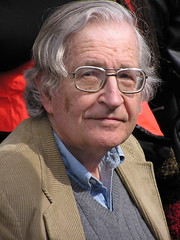
 Image by thelastminute via Flickr
Noam Chomsky is America’s greatest intellectual. His massive body of work, which includes nearly 100 books, has for decades deflated and exposed the lies of the power elite and the myths they perpetrate. Chomsky has done this despite being blacklisted by the commercial media, turned into a pariah by the academy and, by his own admission, being a pedantic and at times slightly boring speaker. He combines moral autonomy with rigorous scholarship, a remarkable grasp of detail and a searing intellect. He curtly dismisses our two-party system as a mirage orchestrated by the corporate state, excoriates the liberal intelligentsia for being fops and courtiers and describes the drivel of the commercial media as a form of “brainwashing.” And as our nation’s most prescient critic of unregulated capitalism, globalization and the poison of empire, he enters his 81st year warning us that we have little time left to save our anemic democracy.
“It is very similar to late Weimar Germany,” Chomsky told me when I called him at his office in Cambridge, Mass. “The parallels are striking. There was also tremendous disillusionment with the parliamentary system. The most striking fact about Weimar was not that the Nazis managed to destroy the Social Democrats and the Communists but that the traditional parties, the Conservative and Liberal parties, were hated and disappeared. It left a vacuum which the Nazis very cleverly and intelligently managed to take over.”
“The United States is extremely lucky that no honest, charismatic figure has arisen,” Chomsky went on. “Every charismatic figure is such an obvious crook that he destroys himself, like McCarthy or Nixon or the evangelist preachers. If somebody comes along who is charismatic and honest this country is in real trouble because of the frustration, disillusionment, the justified anger and the absence of any coherent response. What are people supposed to think if someone says ‘I have got an answer, we have an enemy’? There it was the Jews. Here it will be the illegal immigrants and the blacks. We will be told that white males are a persecuted minority. We will be told we have to defend ourselves and the honor of the nation. Military force will be exalted. People will be beaten up. This could become an overwhelming force. And if it happens it will be more dangerous than Germany. The United States is the world power. Germany was powerful but had more powerful antagonists. I don’t think all this is very far away. If the polls are accurate it is not the Republicans but the right-wing Republicans, the crazed Republicans, who will sweep the next election.”
“I have never seen anything like this in my lifetime,” Chomsky added. “I am old enough to remember the 1930s. My whole family was unemployed. There were far more desperate conditions than today. But it was hopeful. People had hope. The CIO was organizing. No one wants to say it anymore but the Communist Party was the spearhead for labor and civil rights organizing. Even things like giving my unemployed seamstress aunt a week in the country. It was a life. There is nothing like that now. The mood of the country is frightening. The level of anger, frustration and hatred of institutions is not organized in a constructive way. It is going off into self-destructive fantasies.”
“I listen to talk radio,” Chomsky said. “I don’t want to hear Rush Limbaugh. I want to hear the people calling in. They are like [suicide pilot] Joe Stack. What is happening to me? I have done all the right things. I am a God-fearing Christian. I work hard for my family. I have a gun. I believe in the values of the country and my life is collapsing.”
Chomsky has, more than any other American intellectual, charted the downward spiral of the American political and economic system, in works such as “On Power and Ideology: The Managua Lectures,” “Rethinking Camelot: JFK, the Vietnam War, and US Political Culture,” “A New Generation Draws the Line: Kosovo, East Timor and the Standards of the West,” “Understanding Power: The Indispensable Chomsky,” “Manufacturing Consent” and “Letters From Lexington: Reflections on Propaganda.” He reminds us that genuine intellectual inquiry is always subversive. It challenges cultural and political assumptions. It critiques structures. It is relentlessly self-critical. It implodes the self-indulgent myths and stereotypes we use to elevate ourselves and ignore our complicity in acts of violence and oppression. And it makes the powerful, as well as their liberal apologists, deeply uncomfortable.
Chomsky reserves his fiercest venom for the liberal elite in the press, the universities and the political system who serve as a smoke screen for the cruelty of unchecked capitalism and imperial war. He exposes their moral and intellectual posturing as a fraud. And this is why Chomsky is hated, and perhaps feared, more among liberal elites than among the right wing he also excoriates. When Christopher Hitchens decided to become a windup doll for the Bush administration after the attacks of 9/11, one of the first things he did was write a vicious article attacking Chomsky. Hitchens, unlike most of those he served, knew which intellectual in America mattered. [Editor’s note: To see some of the articles in the 2001 exchanges between Hitchens and Chomsky, click here, here, here and here.]
“I don’t bother writing about Fox News,” Chomsky said. “It is too easy. What I talk about are the liberal intellectuals, the ones who portray themselves and perceive themselves as challenging power, as courageous, as standing up for truth and justice. They are basically the guardians of the faith. They set the limits. They tell us how far we can go. They say, ‘Look how courageous I am.’ But do not go one millimeter beyond that. At least for the educated sectors, they are the most dangerous in supporting power.”
Chomsky, because he steps outside of every group and eschews all ideologies, has been crucial to American discourse for decades, from his work on the Vietnam War to his criticisms of the Obama administration. He stubbornly maintains his position as an iconoclast, one who distrusts power in any form.
“Most intellectuals have a self-understanding of themselves as the conscience of humanity,” said the Middle East scholar Norman Finkelstein. “They revel in and admire someone like Vaclav Havel. Chomsky is contemptuous of Havel. Chomsky embraces the Julien Benda view of the world. There are two sets of principles. They are the principles of power and privilege and the principles of truth and justice. If you pursue truth and justice it will always mean a diminution of power and privilege. If you pursue power and privilege it will always be at the expense of truth and justice. Benda says that the credo of any true intellectual has to be, as Christ said, ‘my kingdom is not of this world.’ Chomsky exposes the pretenses of those who claim to be the bearers of truth and justice. He shows that in fact these intellectuals are the bearers of power and privilege and all the evil that attends it.”
“Some of Chomsky’s books will consist of things like analyzing the misrepresentations of the Arias plan in Central America, and he will devote 200 pages to it,” Finkelstein said. “And two years later, who will have heard of Oscar Arias? It causes you to wonder would Chomsky have been wiser to write things on a grander scale, things with a more enduring quality so that you read them forty or sixty years later. This is what Russell did in books like ‘Marriage and Morals.’ Can you even read any longer what Chomsky wrote on Vietnam and Central America? The answer has to often be no. This tells you something about him. He is not writing for ego. If he were writing for ego he would have written in a grand style that would have buttressed his legacy. He is writing because he wants to effect political change. He cares about the lives of people and there the details count. He is trying to refute the daily lies spewed out by the establishment media. He could have devoted his time to writing philosophical treatises that would have endured like Kant or Russell. But he invested in the tiny details which make a difference to win a political battle.”
“I try to encourage people to think for themselves, to question standard assumptions,” Chomsky said when asked about his goals. “Don’t take assumptions for granted. Begin by taking a skeptical attitude toward anything that is conventional wisdom. Make it justify itself. It usually can’t. Be willing to ask questions about what is taken for granted. Try to think things through for yourself. There is plenty of information. You have got to learn how to judge, evaluate and compare it with other things. You have to take some things on trust or you can’t survive. But if there is something significant and important don’t take it on trust. As soon as you read anything that is anonymous you should immediately distrust it. If you read in the newspapers that Iran is defying the international community, ask who is the international community? India is opposed to sanctions. China is opposed to sanctions. Brazil is opposed to sanctions. The Non-Aligned Movement is vigorously opposed to sanctions and has been for years. Who is the international community? It is Washington and anyone who happens to agree with it. You can figure that out, but you have to do work. It is the same on issue after issue.”
Chomsky’s courage to speak on behalf of those, such as the Palestinians, whose suffering is often minimized or ignored in mass culture, holds up the possibility of the moral life. And, perhaps even more than his scholarship, his example of intellectual and moral independence sustains all who defy the cant of the crowd to speak the truth.
“I cannot tell you how many people, myself included, and this is not hyperbole, whose lives were changed by him,” said Finkelstein, who has been driven out of several university posts for his intellectual courage and independence. “Were it not for Chomsky I would have long ago succumbed. I was beaten and battered in my professional life. It was only the knowledge that one of the greatest minds in human history has faith in me that compensates for this constant, relentless and vicious battering. There are many people who are considered nonentities, the so-called little people of this world, who suddenly get an e-mail from Noam Chomsky. It breathes new life into you. Chomsky has stirred many, many people to realize a level of their potential that would forever been lost.”


