Showing posts with label Income tax. Show all posts

Wednesday, January 30, 2013

Consumer confidence plunges to lowest level in more than a year

Tax
Consumer confidence plunged in January to its lowest level in more than a year, reflecting higher Social Security taxes that left Americans with less take-home pay.

The Conference Board said Tuesday that its consumer confidence index dropped to 58.6 in January. That's down from 66.7 in December and the lowest since November 2011.

Conference Board economist Lynn Franco said the tax increase was a key reason confidence tumbled and made Americans less optimistic about the next six months.

Congress and the White House reached a deal to prevent income taxes from rising on most Americans Jan. 1. But they allowed a temporary cut in Social Security taxes to expire. For a worker earning $50,000 a year, take-home pay will shrink this year by about $1,000. Read more >>
Enhanced by Zemanta

Thursday, July 5, 2012

The Real-World Middle Class Tax Rate: 75%

Taxes
Charles Hugh Smith from Of Two Minds

The Real-World Middle Class Tax Rate: 75%
If we include all taxes, the real-world tax rate is much higher than the "official" income tax rate.

For those Americans earning between $34,500 and $106,000, the real-world middle class tax burden in high-tax locales is 15% + 25% + 5% + 15% + 15% = 75%. Yes, 75%.

Before you start listing the innumerable caveats and quibbles raised by any discussion of taxes, please hear me out first. Let's start by defining "taxes" as any fee that is mandated by law or legal necessity. In other words, taxes are what is not optional.

Wednesday, May 2, 2012

5 States That Tax The Poor The Most

Tax
MSNBC
In an effort to help families work their way out of poverty, most of the United States do not tax the incomes of working-poor families. A handful of states do, however.

1. Alabama

Alabama is one of the country’s poorest states, and it taxes its poor residents’ incomes the most. The state has a poverty rate of 17.4 percent, which is among the nation’s highest. It also has the fifth-lowest median household income. A family of four at the poverty line must pay $548 in income taxes. This amount has consistently increased since 1994. Additionally, Alabama has the second-lowest tax threshold in the country. A single-parent family of three making $9,800 -- or 55 percent of the group’s poverty level of $17,922 -- remains subject to income tax.

2. Illinois

Illinois taxes families of four making 57 percent of the poverty level. This means that a family earning $13,100 a year must pay income tax. Due to state fiscal issues, Illinois raised its flat income tax rate from 3 percent to 5 percent in 2011. This caused income taxes for a family of four at the poverty line to increase by $322. However, the state plans to fully implement tax credits for low-income families by 2013, which “will almost completely offset the impact of the income tax increase for poor families,” according to CBPP.

3. Hawaii

Hawaii has a particularly low poverty rate of 10 percent. It also has one of the highest median household incomes in the country. The state continues to tax families at the poverty line at one of the highest rates in the country. However, the amount a family of four at the poverty line pays in income tax has decreased since 1994. That year, the amount was $406. Today, it is $331. The state also taxes families making 77 percent of the poverty line or more.

4. Oregon

A family of four in Oregon living at the poverty line pays the fourth-most taxes in the country at $274. For a family that size making 125 percent of the poverty line, the amount of tax owed jumps to $869 -- the third most in the country. State lawmakers have considered extending tax breaks for low-income households in recent years, but significant action has not yet taken place.

5. Georgia

Georgia has among the highest rates of residents living below the poverty line in the country. It also has the fourth-lowest tax threshold in the county. Families making just 69 percent of the poverty line or more are taxed. For those low-income families, taxes are generally getting worse. The amount that a family of four living on the poverty line must pay in income tax has more than doubled since 1994, from $116 to $273. More...

Friday, December 9, 2011

The Governments Hidden $500 Billion Inflation Tax on Savings

TaxImage by 401K via FlickrThere is a hidden and deeply unfair "tax" that is costing US savers in excess of $500 billion per year. Through forcing interest rates far below the rate of inflation, the government has effectively created a tax on savings that not only takes all real interest income, but quite deliberately confiscates wealth from tens of millions of savers every year - for the direct benefit of the government.

As will be demonstrated with step by step, simple illustrations, the government is imposing the economic equivalent of a 90% income tax on savers. The amount taken annually from savers is equal to more than half of all individual income taxes, and is nearly three times as large as total corporate income taxes.

The tax is not uniformly imposed, but instead targets older middle class savers in particular. The effects include invalidating decades of financial planning, and potentially impoverishing millions of current and future retirees. More...
Enhanced by Zemanta

Wednesday, July 21, 2010

Amendment Slipped Into Health Care Legislation Would Track, Tax Coin and Bullion Transactions

Those already outraged by the president's health care legislation now have a new bone of contention -- a scarcely noticed tack-on provision to the law that puts gold coin buyers and sellers under closer government scrutiny.

The issue is rising to the fore just as gold coin dealers are attracting attention over sales tactics.

Section 9006 of the Patient Protection and Affordable Care Act will amend the Internal Revenue Code to expand the scope of Form 1099. Currently, 1099 forms are used to track and report the miscellaneous income associated with services rendered by independent contractors or self-employed individuals.

Coin Dealers Flipping

Starting Jan. 1, 2012, Form 1099s will become a means of reporting to the Internal Revenue Service the purchases of all goods and services by small businesses and self-employed people that exceed $600 during a calendar year. Precious metals such as coins and bullion fall into this category and coin dealers have been among those most rankled by the change.

This provision, intended to mine what the IRS deems a vast reservoir of uncollected income tax, was included in the health care legislation ostensibly as a way to pay for it. The tax code tweak is expected to raise $17 billion over the next 10 years, according to the Joint Committee on Taxation.

Taking an early and vociferous role in opposing the measure is the precious metal and coin industry, according to Diane Piret, industry affairs director for the Industry Council for Tangible Assets. The ICTA, based in Severna Park, Md., is a trade association representing an estimated 5,000 coin and bullion dealers in the United States.

"Coin dealers not only buy for their inventory from other dealers, but also with great frequency from the public," Piret said. "Most other types of businesses will have a limited number of suppliers from which they buy their goods and products for resale." More...

Wednesday, May 19, 2010

Despite a 24/7 campaign of carefully managed "good news," 76% do not believe the U.S. "recovery

oftwominds.com
Suppressing the Cognitive Dissonance of a Bogus Recovery

A massive outbreak of economic cognitive dissonance is being suppressed with wave after wave of manufactured "good news." Every visibly negative bit of data is run through a media and Central State assembly line to refashion it as "good news" and "evidence" that the "nascent recovery is taking hold." Whatever cannot be rejiggered is simply buried or suppressed.

The fact that five corporations control the the vast majority of the U.S. mainstream media certainly aids that manufacturing process.

Let's run through a few of the most blatant examples of suppressed dissonance:

1. If the economy is recovering so strongly ( +3% GDP growth in the first quarter!) then why are tax revenues down? Federal budget deficit hits April record: The April deficit soared to $82.7 billion. Total revenues for April were down 7.9 percent from a year ago. In the seven months of this year, corporate tax receipts are up 8.9% to $77.1 billion. The same cannot be said of individual income tax revenue, which is down 11.6% in the first seven months to $500.8 billion.

Through the first seven months of the current budget year, which began on Oct. 1, the deficit totals nearly $800 billion. That is down only slightly from last year's deficit during the same period of $802 billion. Revenues total $1.2 trillion in those seven months, down 4.5 percent from the same period last year.

How can tax revenues be falling when the economy is "growing strongly"? As for those corporate profits: corporate profits register biggest year-over-year gain in 25 years.

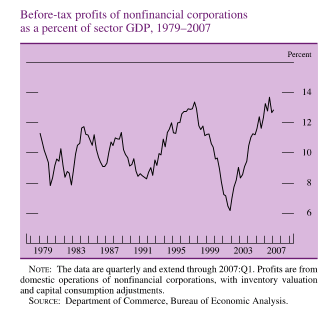
As this chart from the Federal Reserve shows, non-financial corporate profits were almost 14% of GDP before the global meltdown. In a $13 trillion economy, that's $1.8 trillion.

But much of the "good news" in Corporate America is not quite as rosy as presented.

2. Rising corporate profits mask falling sales. Consider Walmart's last report, which caused the financial media to quiver in ecstasy because the retailer logged a 10% increase in profits. But behind the hype, (profits rose $0.3 billion on $99 billion in sales, whoopie), Walmart same-store sales drop; gross margins decline.

You have to read to the very last line to get to the sobering reality: same-store sales dropped in the U.S. and gross margins declined. Both are bad news, yet you'd never know it from the lead paragraphs and talking heads.

3. Corporate profits are boosted with special charges and other accounting trickery. It takes a forensic accounting analysis of corporate filings to discern what's real and what's been juiced to boost quarterly "earnings."

Meanwhile, corporations are loading up on debt again: Junk bonds-- essentially risky bets on future corporate earnings--made up the biggest share of corporate debt sales on record last year. That hardly suggests prudence on the part of the companies loading up on tens of billions of dollars of high-interest debt. Load the company with debt, goose profits, cash out the big bonuses and then let the balance sheet implode. More...


Thursday, April 8, 2010

Volcker on the VAT - The middle class is where the money is

wsj.com

Kudos for candor to Paul Volcker, the former Federal Reserve Chairman and current White House economic adviser, for admitting what other Democrats also know but don't want to admit until after the November election: The political class is preparing to pass a European-style value-added tax.

Answering a question at the New York Historical Society on Tuesday, Mr. Volcker said that a VAT—a consumption tax levied along stages of production—"was not as toxic an idea" as it has been, and that both a VAT and some kind of tax on energy need to be on the table. "If at the end of the day we need to raise taxes, we should raise taxes," he said.

We've long predicted that this would be the White House fiscal strategy, and its new deficit commission is bound to propose something along these lines. In Europe, a VAT rate that reaches 20% in some countries applies to countless products and services, so the middle class would be hit especially hard.

Though Mr. Volcker didn't say this, he is acknowledging that taxes on the rich can't begin to finance the levels of new spending that the current government has unleashed. Even the expiration of the Bush tax rates next January and the new taxes in the health-care bill won't be enough.

In recent decades, the current tax code has yielded revenue on average of 18.5% or so of GDP, whether tax rates go up or down. The wealthy adjust their behavior or shield more income via loopholes, so income-tax increases never gain as much revenue as politicians claim. With spending as a share of GDP now at 25%, Democrats have to soak the middle class because that's where the real money is.

Look for media Democrats to begin explaining why a VAT is essential to U.S. well-being, even as they fail to recall Mr. Obama's 2008 pledge not to raise taxes on the middle class. We told you that the U.S. can't have a European welfare state without European tax rates, and so France, here we come.

Tuesday, February 2, 2010

Obama Seeks Increased Taxes on Middle Class

Reuters
Backdoor taxes to hit middle class
The Obama administration's plan to cut more than $1 trillion from the deficit over the next decade relies heavily on so-called backdoor tax increases that will result in a bigger tax bill for middle-class families.

In the 2010 budget tabled by President Barack Obama on Monday, the White House wants to let billions of dollars in tax breaks expire by the end of the year -- effectively a tax hike by stealth.

While the administration is focusing its proposal on eliminating tax breaks for individuals who earn $250,000 a year or more, middle-class families will face a slew of these backdoor increases.

The targeted tax provisions were enacted under the Bush administration's Economic Growth and Tax Relief Reconciliation Act of 2001. Among other things, the law lowered individual tax rates, slashed taxes on capital gains and dividends, and steadily scaled back the estate tax to zero in 2010.

If the provisions are allowed to expire on December 31, the top-tier personal income tax rate will rise to 39.6 percent from 35 percent. But lower-income families will pay more as well: the 25 percent tax bracket will revert back to 28 percent; the 28 percent bracket will increase to 31 percent; and the 33 percent bracket will increase to 36 percent. The special 10 percent bracket is eliminated.

Investors will pay more on their earnings next year as well, with the tax on dividends jumping to 39.6 percent from 15 percent and the capital-gains tax increasing to 20 percent from 15 percent. The estate tax is eliminated this year, but it will return in 2011 -- though there has been talk about reinstating the death tax sooner.

Millions of middle-class households already may be facing higher taxes in 2010 because Congress has failed to extend tax breaks that expired on January 1, most notably a "patch" that limited the impact of the alternative minimum tax. The AMT, initially designed to prevent the very rich from avoiding income taxes, was never indexed for inflation. Now the tax is affecting millions of middle-income households, but lawmakers have been reluctant to repeal it because it has become a key source of revenue.

Without annual legislation to renew the patch this year, the AMT could affect an estimated 25 million taxpayers with incomes as low as $33,750 (or $45,000 for joint filers). Even if the patch is extended to last year's levels, the tax will hit American families that can hardly be considered wealthy -- the AMT exemption for 2009 was $46,700 for singles and $70,950 for married couples filing jointly.

Middle-class families also will find fewer tax breaks available to them in 2010 if other popular tax provisions are allowed to expire. Among them:

* Taxpayers who itemize will lose the option to deduct state sales-tax payments instead of state and local income taxes;

* The $250 teacher tax credit for classroom supplies;

* The tax deduction for up to $4,000 of college tuition and expenses;

* Individuals who don't itemize will no longer be able to increase their standard deduction by up to $1,000 for property taxes paid;

* The first $2,400 of unemployment benefits are taxable, in 2009 that amount was tax-free.

Wednesday, November 11, 2009

10 states face financial peril

CNN reports:
Dropping tax revenue, rising unemployment and yawning budget gaps are wreaking havoc in states from Arizona to Wisconsin, a new report shows.

The same economic pressures that pushed California to the brink of insolvency are wreaking havoc on other states, a new report has found.

And how state officials deal with their fiscal problems could reverberate across the United States, according to the Pew Center on the States' analysis released Wednesday.

The 10 most troubled states are: Arizona, California, Florida, Illinois, Michigan, Nevada, New Jersey, Oregon, Rhode Island and Wisconsin.

Other states -- including Colorado, Georgia, Kentucky, New York and Hawaii -- were not far behind.

The list is based on several factors, including the loss of state revenue, size of budget gaps, unemployment and foreclosure rates, poor money management practices, and state laws governing the passage of budgets.

These troubles have forced these states -- as well as many others -- to raise taxes, lay off or furlough state workers and slash services. These actions can slow down the nation's recovery, especially since these 10 states account for one-third of the country's population and economic output.

"Decisions these states make as they try to navigate the recession will play a role in how quickly the entire nation recovers," said Susan Urahn, managing director of Pew Center on the States.

In a separate study released Wednesday, the Center on Budget and Policy Priorities found that states will likely have to make steep cuts in their fiscal 2011 budgets, which start next July 1 in most states. That's because the critical federal stimulus dollars will run out by the end of 2010.

These cuts could take nearly a percentage point off the national gross domestic product and cost the nation 900,000 jobs, the study found.

10 troubled states

Here's a summary of what Pew found is plaguing each of the states:

California: The Golden State's housing collapse -- and resulting unemployment surge -- has plagued the state's economy. The weakening economy prompted revenue to fall by nearly a sixth between the first quarters of 2008 and 2009. State lawmakers have limited ability to deal with California's massive budget gap due to several voter-imposed restrictions, including requirements that all budgets and tax increases pass the legislature by a two-thirds majority.

Arizona: The state depends heavily on a growing economy to bring in tax revenue, and lawmakers don't have a lot of leeway to address budget deficits thanks to voter-imposed spending constraints. Lawmakers relied on one-time fixes to balance its budget instead of making long-term changes.

Rhode Island: The Ocean State has among the highest unemployment rates in the nation and among the highest foreclosure rates in New England. High tax rates, big budget deficits and a lack of high tech jobs are hurting its chances to pull out of the doldrums. State government has a poor record of managing its finances

Michigan: The state never climbed out of the recession that started in 2001, and matters only became worse during the Great Recession. Two of the Big Three Detroit-based automakers went bankrupt in 2009, sending shockwaves through a state on track to lose a quarter of its jobs this decade. The recession accelerated drops in state revenue, and has left Michigan's government trying to deal with today's problems on a 1960s-sized budget.

Nevada: Nevada is one of the recession's big losers as its gaming-based economy suffered. Year-over-year revenue has fallen for two consecutive years, a record. But changing tax laws is tough because some are written into the state constitution.

Oregon: Oregon's leading industries, such as timber and computer-chip manufacturing, have been hit hard in the recession. Lawmakers have approved more than $1 billion in new taxes to keep it afloat. But voters in January will have the final say on another $733 million in new income taxes.

Florida: For the first time since World War II, Florida's population is shrinking -- bad news for an budget built on new residents flocking to the Sunshine State. Lawmakers raised $2 billion in new revenue this year, but could face a similar shortfall next year.

New Jersey: The Garden State, which has been plagued by years of fiscal mismanagement, spends more than it collects in revenue. The collapse of Wall Street, which supports about one-third of New Jersey's economy, has only made matters worse.

Illinois: Since the last recession earlier this decade, the state piled up huge backlogs of Medicaid bills and borrowed money to pay its pension obligations. The state's current budget still relies heavily on borrowing and paying bills late.

Wisconsin: Wisconsin has a long history of budget shortfalls. It also borrows frequently to cover operating expenses, among other measures. Unemployment is climbing as manufacturing, the state's largest sector, sputters.

More...
Sunday, October 18, 2009

Decline in State Revenue "Unprecedented in Modern Times”

Bloomberg reports U.S. state tax collections tumbled the most in almost half a century in the second quarter as the economic recession curbed levies on incomes and sales.

The 16.6 percent plunge was the biggest since at least 1963, the Nelson A. Rockefeller Institute of Government said today. For the 12 months to June 30, the fiscal year for most states, revenue declined 8.2 percent, or $63 billion, about twice what states got from the $787 billion U.S. economic stimulus package, the institute said.

State revenue has dwindled for two straight quarters and continued to decline in July and August, the Albany-based research organization said. Budgets for the year that began July 1 already face $26 billion of deficits, the Washington, D.C.- based Center on Budget and Policy Priorities said Aug. 12, forcing state lawmakers to confront additional spending cuts.

“We’re looking at a multiyear problem hitting essentially every state,” Robert Ward, the institute’s deputy director, told reporters. “It has happened during recessions before, but the depth of this decline is unprecedented in modern times.”

Collections dropped in 49 states in the second quarter as sales and personal-income taxes slid for the third consecutive period, the institute said. Income tax was down 27.5 percent and sales tax fell down 9.5 percent, its study said. Both categories fell by the most in 45 years.

“Many economists believe that the national recession has ended and that a tepid recovery is now underway,” Rockefeller analysts Lucy Dadayan and Donald J. Boyd wrote. “Unfortunately for states, an emerging economic recovery does not spell instant budget relief.”

‘Considerably More’

Figures for July and August for 36 early-reporting states showed tax collections down 8 percent, the Rockefeller Institute said. At least 17 states have announced budget shortfalls since July, with “considerably more” expected, Boyd said.

New York’s tax revenue from April 1 to Sept. 15 was $634.5 million below projections and $3.6 billion less than a year ago, Comptroller Thomas DiNapoli said yesterday. California reported last week that revenue trailed a forecast made less than three months earlier by $1.1 billion, or 5.3 percent.

States are anticipating more cuts to current-year budgets, already pared once to bring them into balance. Mississippi Governor Haley Barbour told managers on Oct. 13 to cut spending 5 percent because tax collections in the first three months of fiscal 2010 were 7.7 percent below estimates. Florida Governor Charlie Crist told department heads on Oct. 12 not to request more money for next year, when the state faces a $2.6 billion deficit.

“It’s clear that when governors propose their budgets in January, the vast preponderance will be looking for more spending cuts and tax increases,” Boyd said.

Sunday, September 6, 2009

Americans Printing Their Own Money

BerkSharesImage via Wikipedia

It short-circuits banks and recharges local economies. A growing number of communities are printing their own money. Under the BerkShares system, a buyer goes to one of 12 banks and pays $95 for $100 worth of BerkShares, which can be spent in 370 local businesses. Since its start in 2006, the system, the largest of its kind in the country, has circulated $2.3 million worth of BerkShares. In Detroit, three business owners are printing $4,500 worth of Detroit Cheers, which they are handing out to customers to spend in one of 12 shops.

When someone pays for goods or services with local money, the income to the business is taxable, says Tom Ochsenschlager of the American Institute of Certified Public Accountants. "It's not a way to avoid income taxes, or we'd all be paying in Detroit dollars," he says.

Pittsboro, N.C., is reviving the Plenty, a defunct local currency created in 2002. It is being printed in denominations of $1, $5, $20 and $50. A local bank will exchange $9 for $10 worth of Plenty. "We're a wiped-out small town in America," says Lyle Estill, president of Piedmont Biofuels, which accepts the Plenty. "This will strengthen the local economy. The nice thing about the Plenty is that it can't leave here."

Source