 Image via Wikipedia
Andre DamonDocuments relating to the investigation of Bernard Madoff released last Friday by the Securities and Exchange Commission (SEC) highlight the complicity of the US regulatory agencies in one of the biggest financial frauds in history.
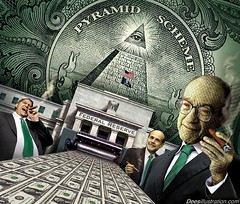
Madoff pleaded guilty on March to 11 felonies, for which he was sentenced to 150 years in jail. From the late 1980s or early 1990s, Madoff turned his well-connected investment firm into the largest pyramid scheme in history. When the fraud collapsed in December 2008, it wiped out $61 billion in investments. Prominent and wealthy investors, induced to invest with Madoff because of his stature as a major figure on Wall Street and his phenomenal record of providing healthy returns of 12 percent of more in good times and bad, lost millions.
Banks and hedge funds around the world lost hundreds of millions and even billions. University endowments, charities and other institutions that entrusted their money to Madoff or to hedge funds that invested in Madoff’s firm suffered massive losses. Numerous charities were forced to close. Thousands of retirees of modest means whose life savings were tied to Madoff’s operations lost everything.
The first chairman of the NASDAQ Stock Exchange and a member of the board of governors of the National Association of Securities Dealers, Madoff was something of a Wall Street legend. In 2000, he was appointed by then-SEC Chairman Arthur Levitt to a committee of academics, regulators and executives formed to advise the SEC on new stock market rules in response to the growth of electronic trading.
The documents released last week show that Madoff’s firm was investigated at least five times by the SEC, but that each time the commission failed to take rudimentary steps that would have revealed his Ponzi scheme. The SEC repeatedly gave Madoff’s firm a clean bill of health, which he used to reassure his clients that his operation was legitimate.
Had regulators made an even minimal effort, they would have found that Madoff made no trades with his clients’ money over a period of decades. Rather, in a classic Ponzi scheme, he used money from new investors to pay dividends to his previous clients.
SEC investigators relied solely on Madoff’s own records, and did not check either with Madoff’s counterparties or with Wall Street’s major clearing house, which kept records of his transactions, or lack thereof.
In one of the documents, a jailhouse interview between Madoff and David Kotz, inspector-general of the SEC, Madoff said that finding a Ponzi scheme of his type is “very easy if you want. You must do a third-party check. It’s absolutely a must.” He added, “It’s Accounting 101.”
Madoff told Kotz that after being interviewed by SEC investigators, he fully expected to be arrested within days, and was “amazed” when nothing happened.
The regulators merely went through the motions, despite suspicions about Madoff’s operation among professional investors and dealers. In 1999, Harry Markopolos, a securities industry executive, wrote to the SEC, saying, “Madoff Securities is the world’s largest Ponzi Scheme.” Markopolos repeatedly pressed the SEC to expose Madoff, but to no avail.
Internal records show that Madoff lied to the SEC about whether he gave investment advice to clients. Even though lying to investigators is a prosecutable offense, the SEC took no action. As one SEC investigator wrote in a 2006 e-mail, “I don’t think we should worry about Bernie finding out to whom we speak…. [W]e are not telling anybody that we have found anything improper (except for his lies to us, of course).”
These documents confirm that the SEC instigations were merely pro-forma operations that did not aim to find or prosecute any wrongdoing. “When potential investors expressed hesitation about investing with Madoff, he cited the prior SEC examinations to establish credibility and allay suspicions on investor doubts,” Kotz told the Senate Banking Committee two months ago.
During his interview with Kotz, Madoff said that Mary Shapiro, the current head of the SEC, is his “dear friend.” Madoff also said that he knew Arthur Levitt, head of the SEC from 1993 to 2001, “very well” and had lunched with him.
Madoff on a number of occasions prior to the collapse of his scam boasted of his influence in regulatory circles. He told Kotz that he “wrote good portions of the rules when it comes to trading.”
The entire episode is an example of the corruption that pervades Wall Street and the relations between major Wall Street players and the government. In his interview, Madoff admitted that he did not know how to properly record a credit default swap. He said he called a number of major banks, and none of them knew either. They had just been keeping their transactions off their official records. Madoff said that “today, lots of trades are done off the books because people don’t know what to do with them.”
Such practices are common and are protected by the government agencies that supposedly regulate the banks and financial institutions.
In an op-ed piece published Tuesday, Washington Post columnist Richard Cohen sets out to whitewash the role of the government in the Madoff fraud by attributing the complicity of financial regulators to the incompetence of individual investigators. He writes: “It would be reassuring if the IG [inspector-general] discovered that some of the investigators were on the take or that Madoff had offered them Wall Street jobs when they grew up. But this was not the case. The investigators were honest—just blazingly incompetent.”
This is an example of damage control by the media, including liberal pundits such as Cohen. The attempt to reduce the government’s role in the Madoff fraud to the mistakes of low-level operatives is absurd.
The issue is not whether individual SEC investigators were directly bribed by Madoff. They were carrying out a long-established policy emanating from the highest echelons of the regulatory system, at the direction of both Republican and Democratic administrations and Congress, to shield major players on Wall Street from prosecution for dubious and outright illegal practices that are standard operating procedure within the financial establishment. Madoff’s fraud was only a particularly crude form of the type of financial speculation and swindling that plays a major role in generating huge profits by banks and finance houses and sustaining the eight-digit bonuses awarded to top executives and traders.
Investigators and regulatory officials who “play ball” with the likes of Madoff are routinely rewarded with jobs on Wall Street that make them overnight multimillionaires.
One example of the direct role of the government in running interference for Wall Street was documented last month in an episode of the PBS series “Frontline.” Entitled “The Warning,” the program dealt with the brief career of Brooksley Born as head of the Commodities Futures Trading Commission during the Clinton administration. Born was forced out by then-Federal Reserve Chairman Alan Greenspan and top Clinton financial officials Robert Rubin and Lawrence Summers when she pressed for regulation of the derivatives market.
In the documentary, sources around Born describe her first meeting with Greenspan, during which the Fed chairman was said to have announced that the two of them were destined to disagree, particularly on the need to make rules against fraud. He was reported to tell Born “you feel that there need to be rules against it and I feel that the market will sort it out.”
In December 2008, after Madoff turned himself in, the World Socialist Web Site wrote, “Madoff’s scam could not have been carried out without the complicity of the highest echelons of the financial elite and the government…. The role of the SEC epitomizes the transformation of government regulatory agencies into the facilitators of financial fraud on a colossal scale. Its job has become running interference for the skullduggery of brokerage houses, hedge funds and banks.
“The removal of any regulatory restraint on the operations of the banks and finance houses over the past three decades is itself an expression of the crisis and decay of American capitalism. The hallmark of this process is the growth of financial parasitism. It is the other side of the coin of the systematic dismantling of large sections of industry and the relentless attack on the jobs and wages of the working class. This assault, in tandem with the unfolding economic crisis, is entering a new and even more brutal stage.”
The presence of figures such as SEC head Mary Shapiro, National Economic Council Director Lawrence Summers and former New York Federal Reserve Bank President Timothy Geithner at the summit of the Obama administration’s financial and regulatory apparatus makes clear that the government’s role in shielding Wall Street remains intact.


![Reblog this post [with Zemanta]](http://img.zemanta.com/reblog_e.png?x-id=54e2adc2-d5f3-400f-94d4-91f5ff99a46e)