Image via WikipediaIncluding the $1.3 billion loss on its Chrysler investment, announced Thursday, the United States government has lost about $14 billion on the auto industry bail-out. GM is now mostly owned by the U.S. Treasury. Chrysler is mostly owned by the United Auto Workers union and Italian automaker Fiat SpA, which controls the Auburn Hills, Mich., automaker. Read more...
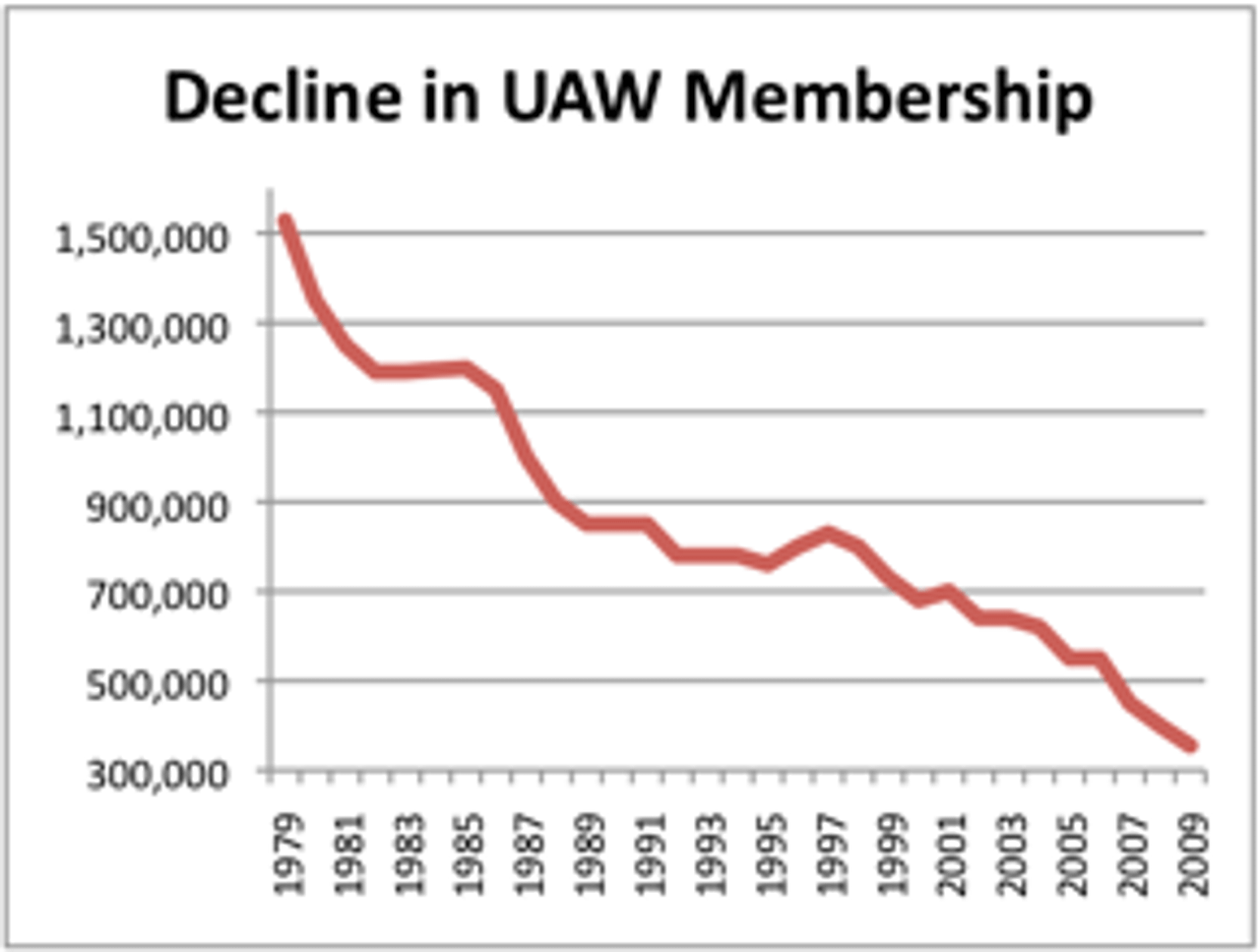
The United Auto Workers union lost another 76,000 members last year, bringing its total membership to 355,000. This is the lowest level since the late 1930s, just after the fledgling organization had won recognition at General Motors.
UAW membership fell by 18 percent in 2009, according to the union’s annual report filed Monday with the US Department of Labor. The losses were chiefly the result of the tens of thousands of job cuts the UAW accepted under the terms of the Obama administration’s forced bankruptcies of GM and Chrysler.
The UAW will lose another 4,600 members next week when the former GM-Toyota plant in Fremont, California, closes its doors, eliminating the last auto assembly factory on the US West Coast.
UAW membership has fallen by nearly half since 2001, when it had 701,818 members. Since reaching its peak of 1.53 million members in 1979, the union has lost 1.14 million members, or 77 percent of its membership.
The UAW largest local is no longer Local 600 at Ford’s River Rouge complex in Dearborn, Michigan, but a unit representing state public employees—which is also losing members due to state budget cuts.
According to the Detroit News, the UAW shut down 50 locals last year, reducing the total from 800 to 750, as plants closed and the organization’s Detroit headquarters consolidated locals to cut costs.
Michigan, long the center of the UAW, saw thousands of job losses in 2009 and continues to have the highest jobless rate in the nation. The restructuring of the auto industry—which has led to more than a 70 percent decline in Michigan’s auto-related employment since 1989—and the economic downturn over the last two years have led to sharp falloff in the membership of the UAW and other unions. The number of union members in Michigan fell by 60,000 last year.
Earlier in the year, the Bureau of Labor Statistics reported that the number of unionized hourly and salaried workers in the US declined by 771,000 to 15.3 million in 2009. Only 12.3 percent of all US workers were unionized—including just 7.2 percent in the private sector, compared to 35.7 percent of private sector workers in 1953 and 22 percent as late as 1979.
The disintegration of the UAW—a process that has been duplicated by trade unions throughout the US and in country after country—is the result of the reactionary policies and nationalist outlook that has long guided this organization.
The UAW emerged in the mass social upheavals of the 1930s, including the sit-down strikes in Flint and Detroit. By the 1940s, however, the socialist and other left-wing militants who pioneered the building of the UAW were purged from its leadership by the Reuther bureaucracy, which consolidated the UAW on the basis of an explicit defense of the capitalist system and an alliance with the Democratic Party.
Having tied the fate of the working class to what the UAW leadership perceived as the permanent dominance of American capitalism in the world economy, the UAW reacted to the rising challenge by Asian and European automakers in the 1980s and the globalization of auto production by abandoning any resistance to the attack on jobs and living standards and imposing the dictates of corporate management. In the name of increasing the “competitiveness” of the Detroit automakers the UAW suppressed every struggle against plant closings, mass layoffs and the unending demands for concessions.
The culmination of its corporatist program of “labor-management partnership” and “Buy American” nationalism was its collaboration with the Obama administration in the restructuring and drastic cost-cutting at GM and Chrysler. Over the past four years the UAW forced tens of thousands of older, higher-paid workers to leave the industry through so-called buyouts and agreed to contracts with GM, Chrysler and Ford that would put labor costs in line with Asian producers operating nonunion plants in the US South by reducing the wages of younger new hires by half. In addition, the UAW relieved the auto companies of billions in health care obligations owed to more than 1 million retirees and their dependents.
As the dues-based income of the UAW apparatus declined, it increasingly sought alternative means to secure the financial position and privileges of the army of union executives that run the organization. In exchange for its collaboration with the auto companies and the White House, the UAW was granted a substantial ownership stake of the US automakers, including 55 percent of Chrysler and 17.5 percent of GM, and essentially transformed itself into a business enterprise.
Despite the continuing hemorrhaging of its membership rolls last year, the UAW suffered only a small decline in net worth, the Labor Department reported. UAW assets were worth $1.13 billion in 2009, down slightly from $1.2 billion the year before.
On Tuesday, the UAW carried out a sale—conducted by Deutsche Bank Securities—of 362 million warrants in Ford Motor stock, representing an 11 percent ownership stake in the company. Ford issued the warrants—certificates entitling the bearer to buy securities at a given price—to the UAW in December, after the organization relieved Ford of $13.6 billion in medical cost obligations to 200,000 retirees and their spouses.
The sale was expected to raise $1.3 billion for the UAW-controlled retiree health care trust fund, known as the Voluntary Employees’ Beneficiary Association or VEBA. Commenting on the sale, the Financial Times of London wrote, “The union’s move to cash in the warrants comes after Ford’s share price has surged over the past year amid growing optimism about the company’s chances of emerging successfully from the crisis in its industry.”
The UAW has a direct financial stake in driving up the value of Ford shares through increasing the exploitation of auto workers and imposing further cost-cutting measures on its so-called members.
This only underscores the fact that auto workers can only defend themselves by breaking with this rotten organization and building a powerful political movement in opposition to the profit system and its defenders in the union apparatus.
Tom Eley Anger among workers at the New United Motor Manufacturing Inc. (NUMMI) plant in Fremont, California, toward the United Auto Workers (UAW) exploded at a January 24 meeting discussing the imminent closure of the facility. Nearly 5,000 workers will lose their jobs when the plant, formerly a joint venture of General Motors and Toyota, closes on March 31. Four hundred or so workers were present at the meeting
Several attendees captured the eruption on video, which began during comments by UAW Local 2244 Bargaining Chairman Javier Contreras. Contreras was booed, jeered, and interrupted as he attempted to present details of the severance package. At one point an outraged older worker demanded to know “where the hell” the union official had been for the last six months. Contreras burst out, “Shut the f— up, you motherf——!” At that point, furious workers rushed to the front of the room. Contreras and other local UAW personnel were defended by a few union officials. Local union leaders pleaded for calm and called in the police in a bid to control the workers.
Workers present say that the yelling began because union officials would not allow them to speak. Workers are angry that they have been kept in the dark over UAW negotiations with NUMMI.
The video footage reveals that the UAW, on the one hand, and rank-and-file auto workers, on the other, make up two mutually hostile camps. The workers bristle with mistrust and contempt for the union; the UAW officials are defensive and thuglike. The episode exposes the UAW’s role in executing the layoff and wage cut dictates of business—as well as their unmistakable contempt for the workers they nominally represent.
General Motors ended its participation in NUMMI in June 2009 as part of its forced bankruptcy at the hands of the Obama administration. Toyota then announced it would no longer continue operations there as of March 2010, blaming GM’s unilateral withdrawal from the partnership.
The UAW, which played a critical role in the bankruptcy process for GM and Chrysler by imposing plant closures and wage and benefit cuts while stifling worker opposition, has fallen back on its usual stock-in-trade of chauvinism and jingoism. It has singled out Toyota for attack, recently organizing a nationalist rally in Washington, D.C., outside the Japanese consulate that was attended by a handful of officials and their hangers-on.
Many workers at NUMMI have emphatically rejected the anti-Japanese rhetoric. Speaking of the explosive meeting, a long-time auto worker, Ken Villegas, told the San Francisco Chronicle that “the general tenor of the rank-and-file complaints were that union leaders should go after GM, as well as Toyota,” along with complaints over secretive severance negotiations.
Another Chronicle report confirms that the anger at the union meeting stemmed in part from the one-sided attack on Toyota. “Rank-and-file members harangued leaders that day for conducting a campaign against Toyota over the impending closure while not going after General Motors,” it wrote.
A NUMMI worker, when asked by a reporter with the left publication Monthly Review about the UAW protest outside the Japanese consulate in Washington, expressed outrage. “That was these guys,” he said of the local union officials. “I don’t know what the hell that is! Why blame Toyota? One of the reasons they don’t blame GM—I don’t know what the percentage is—but they own a portion of GM. Are you going to shoot yourself in the foot? No, they’re not going to do that. The problem is the membership doesn’t have a voice.”
Another worker denounced the UAW and the Obama along similar lines. “If Toyota owes us doesn’t that mean General Motors owes us too?” he asked. “And does the fact that [UAW President Ron] Gettelfinger sold us out for 17.5 percent of General Motors stock have anything to do with violating our charter and the severe conflict of interest? How can you trust your representatives? They’ve got to look at both ledgers. They’ve got to make sure those 17.5 percent of shares grow—and at whose expense?”
“We know they’re going on trips to Palm Springs,” another worker said of the UAW officials. “There was a photograph circulating in the plant of them laying on lawn chairs and drinking margaritas.”
The UAW is trying to handcuff workers until the plant is shut down, while it seeks to secure more perks for union officials from Toyota. It is pushing a severance package that would bar workers from taking action in the plant’s last two months, a proposal that “would link workers’ departure payouts to the continued, smooth operation of the factory through its closing,” according to the Chronicle. Workers are also outraged that the UAW is demanding a share of whatever severance pay they receive.
Negotiations with NUMMI have been strung out by the UAW demand that the maximum severance package be increased to more than $60,000. This would benefit only a handful of workers and, of course, union officers. Union executives are also demanding a $72 million contribution from NUMMI to a health insurance program controlled by the UAW. “Most of the people working at the plant won’t even be eligible for it,” one worker told a reporter. “It’s mainly for the UAW as a whole rather than for the local.”
Local 2244 president Sergio Santos declared that if NUMMI does not meet the bureaucracy’s demands for cash, it “would be a slap in the face to American workers.”
The UAW has in fact done nothing to keep the plant open. In interviews, workers derided a local UAW petition drive, noting that while it was being circulated, machinery was being removed from the plant.
The NUMMI closure will lead directly to 1,400 more layoffs in the local parts industry, and indirectly to thousands more. This is in California, where the unemployment rate is already at 12.4 percent and where vital social services have been scaled back due to the worst of the nation’s state budget crises.
NUMMI’s suppliers have in recent days announced their own major layoffs. Johnson Controls has said it will close its Livermore plant, resulting in 321 layoffs, with 240 of these coming in late March, timed to coincide with the closure of NUMMI. In addition to the 4,700 jobs lost at NUMMI, Fremont will see an additional 314 parts and supply jobs vanish. The city of Hayward will lose 387 jobs after the closure of Injex Industries. Modesto will lose 186 jobs with the shutdown of Trim Master, Inc. Stockton will suffer 154 job losses after Kyoho Manufacturing closes, and Merced will lose 53 jobs after Arvin Sango shuts its doors.
 Image via WikipediaIncluding the $1.3 billion loss on its Chrysler investment, announced Thursday, the United States government has lost about $14 billion on the auto industry bail-out. GM is now mostly owned by the U.S. Treasury. Chrysler is mostly owned by the United Auto Workers union and Italian automaker Fiat SpA, which controls the Auburn Hills, Mich., automaker. Read more...

 UAW membership fell by 18 percent in 2009, according to the union’s annual report filed Monday with the US Department of Labor. The losses were chiefly the result of the tens of thousands of job cuts the UAW accepted under the terms of the Obama administration’s forced bankruptcies of GM and Chrysler.