Showing posts with label Chrysler. Show all posts

Wednesday, September 18, 2013

Taxpayers set to lose $15 Billion on auto bailout

English: Logo of General Motors Corporation. S...
The U.S. Treasury is accelerating its sell-off of stock in General Motors Co., which likely will be free of the moniker “Government Motors” by spring.

The pace of the sell-off has picked up: The government sold an average of 19 million shares in the early part of the year, but since May has sold more than 25 million a month — plus a one-time special sale of 30 million in June, worth more than $1 billion, to coincide with GM’s return to the S&P 500.

U.S. taxpayers acquired 912 million shares of GM in exchange for a $49.5 billion bailout that began in 2008, under President George W. Bush, and mushroomed the following year under his successor, President Barack Obama.

“We remain on track to complete our exit from GM by early next year,” Tim Massad, the Treasury’s assistant secretary for financial stability, said Tuesday.

GM’s stock closed Tuesday at $36.71. At current trading prices, the government’s remaining stake is worth about $3.7 billion. From previous stock sales, the Treasury has recovered $35.4 billion of its GM bailout, and at current stock prices, taxpayers would have lost about $10 billion on the bailout.

The Treasury estimates taxpayers will have lost $15 billion on their $85 billion auto industry bailout, which also included aid to bankrupt Chrysler. Auburn Hills-based Chrysler has repaid its debt. Read more >>
Enhanced by Zemanta

Wednesday, September 4, 2013

Average price of new car hits record

English: Two clean vehicle versions of the Hon...
The average transaction price for a new vehicle set a record of $31,252 in August, according to TrueCar.com, up 3.2% from a year ago.

The new high is up 0.5%, or $164, from July, the auto data research and shopping site reports.

The record was powered by five car companies that each had record prices in the month: Chrysler, Ford, Honda, Nissan and Volkswagen.

TrueCar's transaction price is meant to include everything – price of the vehicle, discounts, add-ons, taxes and license fees – all the amounts that total to the out-the-door price. Read more >>
Enhanced by Zemanta

Tuesday, August 27, 2013

US automakers fall further behind foreign brands

Audi TTS at the 2008 North American Internatio...
For the first time since 2010, Americans are less satisfied with the cars and trucks they're driving, according to the 2013 American Consumer Satisfaction Index.

The latest (ACSI) also finds the satisfaction gap between the Big 3—Ford, General Motors, and Chrysler—and foreign automakers has widened with domestic brands falling further behind import brands.

David VanAmburg, Director of the ACSI said the drop in scores should be a concern for the Big 3, "This could become problematic once demand slackens, making further sales growth more challenging unless customer satisfaction improves."

Overall, satisfaction with 20 different auto brands fell 1.2 percent to a score of 83 on a 0 to 100 scale. ACSI researchers believe customer satisfaction is slipping in part because vehicle reliability may be suffering as automakers ramp up production. Read more >>
Enhanced by Zemanta

Saturday, July 23, 2011

U.S. lost $14B on auto bailout

Logo of General Motors Corporation. Source: 20...Image via WikipediaIncluding the $1.3 billion loss on its Chrysler investment, announced Thursday, the United States government has lost about $14 billion on the auto industry bail-out. GM is now mostly owned by the U.S. Treasury. Chrysler is mostly owned by the United Auto Workers union and Italian automaker Fiat SpA, which controls the Auburn Hills, Mich., automaker. Read more...

Enhanced by Zemanta

Friday, July 22, 2011

Tarp Repayments a Farce - Banks Pay Back TARP Funds by Borrowing from Treasury

CNB mrizImage via WikipediaMost of the big banks have repaid the government funds they received under the Capital Purchase Program (CPP), the pillar of TARP under which Treasury bought preferred shares in the nation's banks. Enough so that, combined with dividends and sales of warrants, Treasury has declared that taxpayers have earned a profit on the CPP. Thus far, $245 billion has gone out, and $255 billion in repayments, interest and warrants has come back, yielding a profit to taxpayers of $10 billion. And there's several billion more where that came from.

Many of the small banks that took relatively small chunks of capital have been slower to exit. Last week, however, there was a mini stampede. The transactions are reported here. Eight banks paid back their funds on July 14. They were:

Eagle Bancorp of Bethesda, MD: $23.235 million
First California Financial, Westlake Village, CA: $25 million
Cache Valley Bank, Logan, UT: $4.77 million, plus $263,000 to buy back preferred shares granted to Treasury in lieu of warrants
Security Business Bancorp, San Diego, CA: $5.8 million, plus $290,000 to buy back preferred shares granted to Treasury in lieu of warrants
BOH Holdings of Houston, Houston, TX: $10 million, plus $500,000 to buy back preferred shares granted to Treasury in lieu of warrants
BancIndependent, Sheffield, AL: $21.1 million, plus $1.055 million to buy back preferred shares granted to Treasury in lieu of warrants
York Traditions Bank, York, PA: $4.871 million, plus $244,000 to buy back preferred shares granted to Treasury in lieu of warrants
Centric Financial, Harrisburg, PA: $6.056 million, plus $182,000 to buy back preferred shares granted to Treasury in lieu of warrants

That adds up to a total of $103.3 million.

But sometimes there's less than meets the eye. Generally, banks that repaid CPP funds did so with cash raised from earnings, or by raising new outside capital. In finance and banking you always have to read the fine print. And if you go back to the report, you'll notice that the fine print accompanying the entries for each of the above exits makes reference either to Footnote 49 or Footnote 50. Footnote 49 reads: "Repayment pursuant to Title VII, Section 7001(g) of the American Recovery and Reinvestment Act of 2009 using proceeds received in connection with the institution's participation in the Small Business Lending Fund." Footnote 50 reads: "Repayment pursuant to Title VII, Section 7001(g) of the American Recovery and Reinvestment Act of 2009 — part of the repayment amount obtained from proceeds received in connection with the institution's participation in the Small Business Lending Fund."

All of which is to say that these banks repaid cash owed to a program run by the Treasury Department by. . . borrowing from another program run by the Treasury Department. More...
Enhanced by Zemanta

Friday, June 3, 2011

Govt to lose $14B of auto bailout funds

Logo of General Motors Corporation. Source: 20...Image via WikipediaThe Obama administration said Wednesday that the government will lose about $14 billion in taxpayer funds from the bailout of the U.S. auto industry.

In a report from the president's National Economic Council, officials said that figure is down from the 60 percent the Treasury Department originally estimated the government would lose following its $80 billion bailout of Chrysler and General Motors in 2009.

The report's release coincides with the administration's efforts to tout the bailout's role in the revitalization of the U.S. auto industry after last week's announcement that Chrysler is repaying $5.9 billion in U.S. loans and a $1.7 billion loan from the Canadian government. Those payments cover most of the federal bailout money that saved the company after it nearly ran out of cash in and went through a government-led bankruptcy. More...


Enhanced by Zemanta

Thursday, April 1, 2010

UAW membership continues to plummet

Jerry White
1 April 2010

The United Auto Workers union lost another 76,000 members last year, bringing its total membership to 355,000. This is the lowest level since the late 1930s, just after the fledgling organization had won recognition at General Motors.
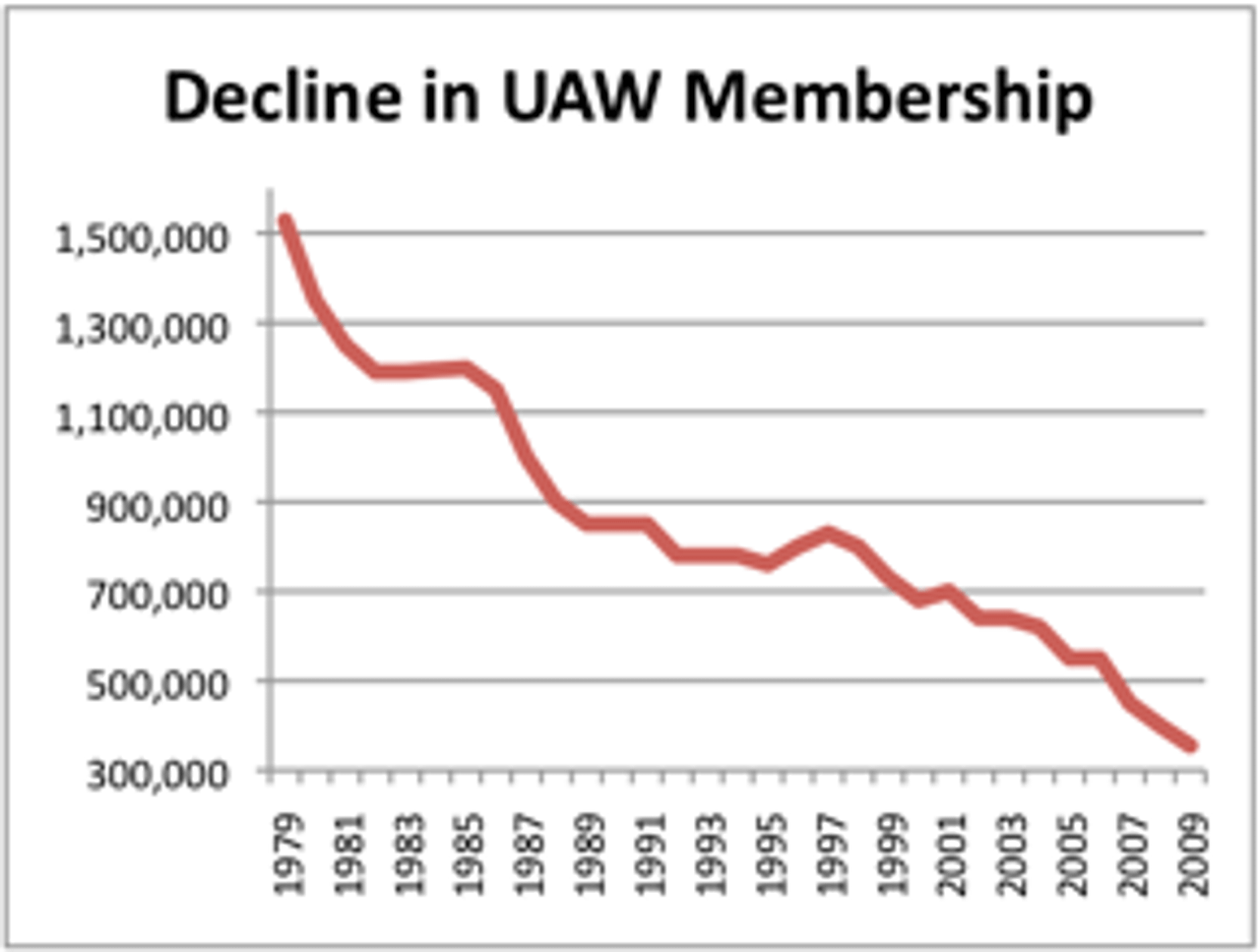
GraphUAW membership fell by 18 percent in 2009, according to the union’s annual report filed Monday with the US Department of Labor. The losses were chiefly the result of the tens of thousands of job cuts the UAW accepted under the terms of the Obama administration’s forced bankruptcies of GM and Chrysler.

The UAW will lose another 4,600 members next week when the former GM-Toyota plant in Fremont, California, closes its doors, eliminating the last auto assembly factory on the US West Coast.

UAW membership has fallen by nearly half since 2001, when it had 701,818 members. Since reaching its peak of 1.53 million members in 1979, the union has lost 1.14 million members, or 77 percent of its membership.

The UAW largest local is no longer Local 600 at Ford’s River Rouge complex in Dearborn, Michigan, but a unit representing state public employees—which is also losing members due to state budget cuts.

According to the Detroit News, the UAW shut down 50 locals last year, reducing the total from 800 to 750, as plants closed and the organization’s Detroit headquarters consolidated locals to cut costs.

Michigan, long the center of the UAW, saw thousands of job losses in 2009 and continues to have the highest jobless rate in the nation. The restructuring of the auto industry—which has led to more than a 70 percent decline in Michigan’s auto-related employment since 1989—and the economic downturn over the last two years have led to sharp falloff in the membership of the UAW and other unions. The number of union members in Michigan fell by 60,000 last year.

Earlier in the year, the Bureau of Labor Statistics reported that the number of unionized hourly and salaried workers in the US declined by 771,000 to 15.3 million in 2009. Only 12.3 percent of all US workers were unionized—including just 7.2 percent in the private sector, compared to 35.7 percent of private sector workers in 1953 and 22 percent as late as 1979.

The disintegration of the UAW—a process that has been duplicated by trade unions throughout the US and in country after country—is the result of the reactionary policies and nationalist outlook that has long guided this organization.

The UAW emerged in the mass social upheavals of the 1930s, including the sit-down strikes in Flint and Detroit. By the 1940s, however, the socialist and other left-wing militants who pioneered the building of the UAW were purged from its leadership by the Reuther bureaucracy, which consolidated the UAW on the basis of an explicit defense of the capitalist system and an alliance with the Democratic Party.

Having tied the fate of the working class to what the UAW leadership perceived as the permanent dominance of American capitalism in the world economy, the UAW reacted to the rising challenge by Asian and European automakers in the 1980s and the globalization of auto production by abandoning any resistance to the attack on jobs and living standards and imposing the dictates of corporate management. In the name of increasing the “competitiveness” of the Detroit automakers the UAW suppressed every struggle against plant closings, mass layoffs and the unending demands for concessions.

The culmination of its corporatist program of “labor-management partnership” and “Buy American” nationalism was its collaboration with the Obama administration in the restructuring and drastic cost-cutting at GM and Chrysler. Over the past four years the UAW forced tens of thousands of older, higher-paid workers to leave the industry through so-called buyouts and agreed to contracts with GM, Chrysler and Ford that would put labor costs in line with Asian producers operating nonunion plants in the US South by reducing the wages of younger new hires by half. In addition, the UAW relieved the auto companies of billions in health care obligations owed to more than 1 million retirees and their dependents.

As the dues-based income of the UAW apparatus declined, it increasingly sought alternative means to secure the financial position and privileges of the army of union executives that run the organization. In exchange for its collaboration with the auto companies and the White House, the UAW was granted a substantial ownership stake of the US automakers, including 55 percent of Chrysler and 17.5 percent of GM, and essentially transformed itself into a business enterprise.

Despite the continuing hemorrhaging of its membership rolls last year, the UAW suffered only a small decline in net worth, the Labor Department reported. UAW assets were worth $1.13 billion in 2009, down slightly from $1.2 billion the year before.

On Tuesday, the UAW carried out a sale—conducted by Deutsche Bank Securities—of 362 million warrants in Ford Motor stock, representing an 11 percent ownership stake in the company. Ford issued the warrants—certificates entitling the bearer to buy securities at a given price—to the UAW in December, after the organization relieved Ford of $13.6 billion in medical cost obligations to 200,000 retirees and their spouses.

The sale was expected to raise $1.3 billion for the UAW-controlled retiree health care trust fund, known as the Voluntary Employees’ Beneficiary Association or VEBA. Commenting on the sale, the Financial Times of London wrote, “The union’s move to cash in the warrants comes after Ford’s share price has surged over the past year amid growing optimism about the company’s chances of emerging successfully from the crisis in its industry.”

The UAW has a direct financial stake in driving up the value of Ford shares through increasing the exploitation of auto workers and imposing further cost-cutting measures on its so-called members.

This only underscores the fact that auto workers can only defend themselves by breaking with this rotten organization and building a powerful political movement in opposition to the profit system and its defenders in the union apparatus.

Tuesday, January 5, 2010

GM sales down 30 percent for the year

General Motors CompanyImage via Wikipedia

pacific.bizjournals.com
Toyota sales in December rose to 187,860 from 141,949 a year earlier. For all of 2009, sales fell to 1.8 million from 2.2 million in 2008. Lexus sales were down 17 percent for the year.

Honda sold 1.15 million vehicles in 2009, down from 1.42 in 2008.

For Detroit, the numbers were worse. General Motors sales were down 30 percent for the year. Ford was off 15 percent. Chrysler sales plunged 36 percent and the company sold fewer than 1 million vehicles for the first time since 1962.

Subaru, Kia and Hyundai were the only automakers to report sales gains in 2009. Each set new sales records.

Wednesday, October 28, 2009

GMAC Asks for Third Bailout

American lender GMAC is asking for a third injection of taxpayer cash from the U.S. government, a Treasury Department spokesperson confirmed Wednesday.

GMAC is the former lending arm of General Motors and remains an important provider of financing for GM and Chrysler dealers to pay for vehicles for their lots. It's also a significant player in the U.S. residential mortgage market.

GMAC lends to GM and Chrysler dealers so they can buy cars for their lots.
(Canadian Press)

It has received two packages of bailout money totaling $12.5 billion already, and the government holds 35 per cent ownership. While other banks have been able to raise capital from private investors, GMAC has been forced to go back to the government.

If the cash were approved, GMAC would be the only company to receive three bailouts. The move would also represent a further entrenchment for the U.S. government into the auto industry.

The government also owns a majority-stake in GM and a smaller stake in Chrysler. The Treasury spokesperson declined to comment on whether the government's ownership stakes in the two automakers make it more willing to again help GMAC.

Reblog this post [with Zemanta]

Saturday, October 3, 2009

Toyota ‘grasping for salvation'

HANS GREIMEL, AUTOMOTIVE NEWS
Toyota Motor Corp. President Akio Toyoda said his money-losing automaker is “grasping for salvation” as it struggles to return to profit.

The world's largest car company was once targeting annual sales of 10 million vehicles but now expects sales of 7.3 million this year, down from 8.97 million in 2008, Toyoda said today at a news conference.

Citing the five stages of corporate decline outlined by Jim Collins, author of How the Mighty Fall, the Toyota chief warned that his company has slumped to stage four, which Collins calls “grasping for salvation.”

“We are grasping for salvation,” Toyoda said, adding that the company already has spiraled through the first three stages: (1) hubris born of success, (2) undisciplined pursuit of more and (3) denial of risk and peril. His self-admonitions echoed the apologies commonly made by Japanese executives who take responsibility for financial turmoil or corporate scandal.

Grim assessment

While Toyota is far from entering the fifth stage--capitulation to irrelevance or death--Toyoda's grim assessment was clearly meant to underscore the challenges he faces after only three months as president. They also seemed aimed at ensuring customers that he grasped the severity of the situation and was committed to reversing Toyota's malaise.

“Toyota has become too big and distant from its customers,” the grandson of the automaker's founder said as he prepares for a second-straight year of substantial financial and unit-sale decreases.

In the United States, Toyota's sales fell 13 percent in September from a year earlier as the market suffered a sharp letdown after the government-funded cash-for-clunkers program ran out. Total U.S. sales tumbled 23 percent. Toyota is down 28 percent for the year.

Separately, Toyoda called the current dollar-yen rate "very tough," saying the weak U.S. currency made it difficult to return to profit on an unconsolidated level.

"When you get to this level, it makes it difficult to return to profit on sales growth alone," he said.

Toyoda repeated Toyota's aim to return to profit at the parent level "as soon as possible," even as it expects global sales to fall 18 percent from 2008 to 7.34 million vehicles this year. That would leave about 30 percent of the company's production capacity unused.

Toyoda took the helm in June as the world's biggest automaker faced one of its biggest crises in history amid a global credit crunch and an industrywide sales slump that forced General Motors and Chrysler into bankruptcy.

For the financial year to March, Toyota has projected a consolidated operating loss of ¥750 billion ($8.4 billion), assuming a dollar rate of ¥92. It has forecast a parent-only operating loss of ¥600 billion.

Monday, July 13, 2009

French Workers Threaten to Blow Up Factory Unless Paid


GOING OUT WITH A BANG? Fake graves outside the bankrupt New Fabris factory show the number of years that people have been with the company. Ex-employees are threatening to blow up the plant if their requests for lost-job compensation and indemnity from prosecution are not met by July 31, 2009. Image: AFP

As media talking heads and government officials continue deceiving the public with "green shoot" lies, the anger-wrought masses are beginning to take things into their own hands. Employees of New Fabris in central-eastern Chatellerault -- a bankrupt French car-parts supplier -- are threatening to blow up their factory unless Renault and Peugeot pay them compensation. AFP reports a union official said on Sunday that the 366 employees of New Fabris were occupying the plant and demanding that the automakers, which accounted for 90 percent of their business, pay €30 000 - nearly R350 000 - to each worker.

"The gas bottles are in the factory. Everything has been planned for it to blow up unless there is an accord by July 31," Guy Eyermann, CGT union official and secretary of the company works council, told AFP. The Chatellerault factory is believed to have car parts worth some two million euros, as well as a new Renault machine estimated at another two million.

"We are not going to let Peugeot and Renault [ both of which received public funds] wait until August or September to recover the spare parts and machines still in the factory," a union leader warned. "If we get nothing, they get nothing at all."

Commercial banks have frozen lending to hundreds of Europe's auto suppliers -- which are on the brink of bankruptcy -- because of the perceived high risk. Sales for European auto suppliers have fallen between 25% and 35% from a year ago, according to WSJ.

"Of Europe's 5,000 or so auto suppliers, 200 have filed for bankruptcy since December and 700 to 800 suppliers are now facing 'acute liquidity problems,'"said Lars Holmqvist, Chief Executive of European Association of Automotive Suppliers. "The summer vacation period, which most car makers are extending because of weak sales, will exacerbate the problem for suppliers."

As GM emerges from bankruptcy eight major suppliers have filed for their own bankruptcy, including Lear Corp -- one of GM's biggest automotive seat and interiors providers. "Supplier health will be the wild card for the next 90 days, not only for GM but all of the auto makers," said Mike Robinet, vice president of global vehicle forecasts for CSM Worldwide.

The French workers' militant tactics including "bossnappings" where managers have been held hostage in their offices, may become viral around the globe.