Thursday, May 2, 2013
U.S. Mint Sales of Gold Coins Jump to Highest in Three Years
Last month, sales totaled 209,500 ounces, up from 62,000 ounces in March, data on the mint’s website show. The amount for December 2009 was 231,500 ounces. Silver-coin sales rose to 4.2 million ounces from 3.36 million in March.
Demand surged at mints from Australia to the U.K. and the U.S. after futures slumped 13 percent in two days through April 15. Gold futures tumbled 7.8 percent last month and dropped into a bear market as some investors lost faith in the metal as a store of value.
Perth Mint, which refines almost all of the nation’s bullion, said that demand jumped to the highest in five years after prices plunged, with the factory kept open through the weekend to meet orders.
“People are flocking to buy physical gold,” Todd Dutkevitch, a senior account executive at Los Angeles-based American Bullion Inc., said in a phone interview. “The price drop has made it possible for many retail buyers to add gold.” Read more >>
Tuesday, April 16, 2013
Arizona Becomes Second State to Approve Gold and Silver as Legal Tender
The bill comes hot off the heels of one of the largest drops in the price of gold. The metal fell 9% yesterday -- its biggest one-day drop in 30 years. Gold’s volatility may make it hard to go to a grocery store and pay for milk and eggs with bullion coins.
Related: Gold Tumbles Again: Is the Era of Gold Over?
“Yeah, I know gold is down right now,” Arizona State Senator Chester Crandell and sponsor of Senate bill 1439, tells The Daily Ticker. “People are still buying gold and using it as a commodity and I think they want to use it as actual legal tender instead of the dollar."
Senator Crandell says that the differences between gold as a commodity and gold as legal tender are pronounced. Read more >>
Tuesday, December 18, 2012
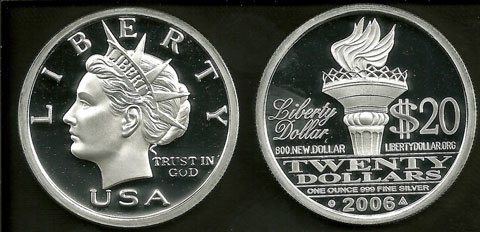
U.S. Secret Service Bans Sale of Silver and Gold Liberty Dollars on Ebay
In early 2011 Bernad Von Nothaus was convicted by the US government and identified as a domestic terrorist by Federal prosecutors for minting his own silver and gold coinage, and then offering those coins for sale to clients. He dubbed the coins “Liberty Dollars” and by doing so brought upon himself the ire of the U.S. Secret Service, Federal Reserve and a host of other government agencies.
According to the government, Von Nothaus was a counterfeiter, though he made no attempts to actually counterfeit U.S. currency, but rather, provide another mechanism of exchange through the use of precious metals.
After Von Nothaus’ conviction, the Secret Service warned they would be confiscating all Liberty Dollar coins manufactured by Nothaus’ company, NorFed.
Since the shutdown of VonNothaus’ operation, many of the coins have been offered for sale or trade on mega-auction site Ebay, and this week the Secret Service took action. They contacted Ebay, which in turn advised sellers of the coins on their site that they could no longer engage in the trade of silver coins with the Norfed Liberty Dollar hallmark. Read more >>
Wednesday, December 12, 2012
Gold Coin Worth $500 Wrapped In $100 Bill Found In Salvation Army Kettle
A gold coin worth $500 wrapped in a $100 bill has been found in a Salvation Army red kettle set up at an upstate New York shopping plaza.
The American Eagle coin was wrapped in a C-note and a memo that read: "This coin is solid gold and worth around $500. God Bless."
Salvation Army officials say about 400 gold coins have been found in red kettles over the past 30 years. Gold coins have found recently in kettles in Iowa, Nebraska, Illinois, North Carolina and Florida.
Source
Tuesday, December 11, 2012
Sales of American Eagle gold coins soar
Demand for gold coins in the US has soared since the presidential election, as small investors fret about the lack of action to address America’s ballooning debt. The US Mint’s sales of American Eagles, one of the most popular gold coins, leapt 131 per cent in November, hitting their highest level in more than two years. The Royal Canadian Mint also had its strongest month of sales this year.
Terry Hanlon, president of metals at Dillon Gage, one of the largest bullion dealers in the country, said sales had risen sharply “within a day or two” of the election.
“You’ve got a lot of people who are very worried about the economy. With the election they saw that nothing was going to change,” he said.
While coins are a small part of the overall gold market, the jump in sales highlights gold’s role as the favoured investment of disenchanted Americans. The political gridlock in Washington and the prospect of further quantitative easing when the Federal Reserve’s “operation twist” expires at the end of this year have fuelled demand for precious metals among small investors. “They don’t believe in Uncle Sam any more,” said the head of precious metals at a large bank. Read more >>
Sunday, May 22, 2011
Gold, silver coins to be legal currency in Utah
Wednesday, July 21, 2010
Amendment Slipped Into Health Care Legislation Would Track, Tax Coin and Bullion Transactions
Those already outraged by the president's health care legislation now have a new bone of contention -- a scarcely noticed tack-on provision to the law that puts gold coin buyers and sellers under closer government scrutiny.
The issue is rising to the fore just as gold coin dealers are attracting attention over sales tactics.
Section 9006 of the Patient Protection and Affordable Care Act will amend the Internal Revenue Code to expand the scope of Form 1099. Currently, 1099 forms are used to track and report the miscellaneous income associated with services rendered by independent contractors or self-employed individuals.
Coin Dealers Flipping
Starting Jan. 1, 2012, Form 1099s will become a means of reporting to the Internal Revenue Service the purchases of all goods and services by small businesses and self-employed people that exceed $600 during a calendar year. Precious metals such as coins and bullion fall into this category and coin dealers have been among those most rankled by the change.
This provision, intended to mine what the IRS deems a vast reservoir of uncollected income tax, was included in the health care legislation ostensibly as a way to pay for it. The tax code tweak is expected to raise $17 billion over the next 10 years, according to the Joint Committee on Taxation.
Taking an early and vociferous role in opposing the measure is the precious metal and coin industry, according to Diane Piret, industry affairs director for the Industry Council for Tangible Assets. The ICTA, based in Severna Park, Md., is a trade association representing an estimated 5,000 coin and bullion dealers in the United States.
"Coin dealers not only buy for their inventory from other dealers, but also with great frequency from the public," Piret said. "Most other types of businesses will have a limited number of suppliers from which they buy their goods and products for resale." More...
Tuesday, January 19, 2010
Why Is HSBC Clearing Out So Much Physical Gold?
That’s the directive that came down from HSBC USA in late November.
It seems that everyone these days wants gold. Real, physical gold coins that they can hold in their hands, or bars that they’re assured are resting safely in a well-guarded vault. HSBC’s New York vault, for example, buried deep below its 5th Avenue tower, where it has stored people’s gold since it inherited the facility from Republic Bank a decade ago.
But no more.
HSBC has served notice to its retail customers — many of whom are simply middle-men and custodial services which store gold with HSBC on behalf of hundreds of their own account holders — that all their gold must be out of its facility by July 2010. Otherwise, folks, prepare for an unwelcome knock at your door. HSBC’s letter says that, in the absence of directions to the contrary, clients’ metal “will be returned to the address of record… at your expense.”
Picture, if you will, what the Wall Street Journal reported: “fleets of armoured cars laden with gold, ferrying the precious metal out of New York.”
Where to? That’s a good question. One destination is a pair of warehouses operated by FideliTrade, the parent company of Delaware Depository Service Co. Its vaults in Wilmington have been filling up quickly, leading Jonathan Potts, the managing director, to comment that, “I have never seen any relocation like this.” Other depositories have seen a similar run.
The logic behind HSBC’s decision, according to the Journal, is simple. The vaults are being cleared of smaller clients in order to make more room for institutional holdings, because “retail customers tend to be more expensive [to service] in part because of their diverse holdings. They usually buy American Eagle or Canadian Maple Leaf coins, and bars of various weights and sizes, all of which need to be categorized and stored separately. In contrast, institutions typically buy standardized bars of 100 or 400 ounces, making them easier to store. Institutions also tend to hold the metal for long periods.”
HSBC itself didn’t say why it’s doing this (in fact, its letter wasn’t intended for public release). So, predictably, the Internet exploded with rumors that its action had more sinister motives.
Chief among them has been the tungsten story. That one, in case you haven’t already heard it, maintains that a foreign gold buyer — some say Indian, some say Chinese — found to its dismay that bars it recently purchased were merely gold-plated tungsten. (Tungsten would be the metal of choice for a counterfeiter because it’s the closest metal to gold in specific gravity, and can fool the most basic test for purity.) Some go as far as to claim that Fort Knox is full of fakes, deliberately placed there to make our official stash appear bigger than it is. A suspicion that’s easily stoked since no outside auditor has inspected U.S. gold holdings in over 50 years.
Be that as it may, the latest rumor claims that the appearance of tungsten bars at this time is going to cause widespread chemical testing of gold bars, and HSBC doesn’t want to be caught with anything bogus. Thus they’re preemptively moving their gold out, protecting themselves and at the same time laying off the need to do any testing onto someone else.
This is a great tale, but it ignores the fact that it’s largely coins and small bars that are being moved, and those are not cost effective to counterfeit in tungsten. In addition, that the story is presently confined to the Net means it’s fiction until proven otherwise. As Ed Steer — GATA activist and author of Casey Research’s Gold and Silver Daily — points out, “If it were true, Bloomberg would be all over it in a heartbeat.”
Or someone would. And even if the mainstream media failed to do their job, there’s still the absence of a smoking gun. Who’s seen the tungsten bars? What are the names of officials who can confirm the fraud? Why aren’t the Indians who’ve been ripped off waving the phonies in front of a TV camera? These questions don’t yet have satisfactory answers. Thus the rumor will have to remain just that.
Rumor #2: HSBC has less gold on deposit than it promises, and it’s doling out what it does have to its best friends. This one might make some sense if HSBC were getting out of the gold business entirely. But it isn’t. And if it does have any physical shortages, it can cover them indefinitely with paper “equivalents.”
Rumor #3: HSBC is going under. Those storing large amounts of gold know it, and they’re protecting their assets from future claims by creditors. HSBC is hiding the mass exodus of gold by claiming to have ordered it. No way to confirm this, of course, but the volume of gold that’s leaving means an awful lot of people know what’s happening. Word of the bank’s fragility would surely have leaked out by now. That it hasn’t makes this one highly doubtful — not to mention that HSBC likely falls into the “too big to fail” category and would be propped up if it faced collapse.
Rumor #4: The most outlandish of all. Under this scenario, Washington suspects an attack in conjunction with the terrorist trials, and it’s ordered gold moved out of New York so it isn’t contaminated in the event of a dirty bomb. (Those with the deepest, darkest level of cynicism claim that this would also provide the government with a handy excuse to default on foreign claims to physical metal — as in, sorry, it’s gone, but here’s what you’re owed in dollars.)
All of these make for spicy Web chatter, but after checking with our own sources, we believe that the truth is far more mundane, yet quite exciting in its own right. In essence, we think the WSJ’s analysis is pretty close, with a twist.
It all has to do with the COMEX. That exchange, which handles futures activity in gold, has to maintain a cache of metal with which to settle trades. As a courtesy, it will also arrange to store gold for buyers who don’t want to take physical delivery. But it has no vaults of its own. It contracts with four banks to do the actual storage, though only two maintain significant amounts: of the 9.73 million ounces of COMEX gold, Scotia Mocatta has the most, nearly 5.1 million; HSBC USA is next, with over 4.1 million.
The amount of gold warehoused by the COMEX has exploded since the metal’s bull run began in 2001, as you can see from the following chart (where “registered stocks” are sitting there with someone’s name already on them, and “eligible stocks” are awaiting either registration or delivery):
The trend is obvious, and what it means is that HSBC needs an ever-increasing amount of space for its COMEX gold. Provided, of course, that the trend remains in place. Or accelerates.
HSBC has cast its vote. It clearly believes that it’s going to be getting more gold from the COMEX, maybe a lot more, and it’s making room by giving the boot to other depositors. Perhaps the bank knows something we don’t know, or perhaps it’s just acting out of reasonable expectation.
Either way, it’s telling us that the demand for gold is going to continue rising. And coming from a major bullion bank, that’s about as bullish a signal as anyone could want. If you don’t own any physical gold, it’s time.
Monday, December 7, 2009
US Mint Runs Out Of Tenth-Ounce Gold Coin Inventory Day After Its Release For Broad Purchase
Image via Wikipedia
The sad state of affairs in gold land: the premium for the 1 ounce Gold Eagle coins has expanded from $59 to $99, Krugerrands are not available for sale in most places, and this most recent development just out of the US Mint: the one-tenth ounce American Eagle inventory at the mint has been depleted, almost instantaneously after the coin was made available for purchase. This occurred the day after the mint announced the release of fractional Eagle Gold Bullion Coins in one-half ounce, one-quarter ounce, and one-tenth ounce weights. As Coin News reports:
The Mint sold 345,000 coins to its authorized purchasers for a total of 58,000 ounces of gold. That, without a single one-ounce size leaving Mint doors.
Sales of 2009 one-ounce sized gold eagles are expected to resume in "early December" while the production of the 2010-dated American Eagle Gold and Silver One Ounce Bullion Coin are expected to begin in Jan., 2010.
So no sooner did the Mint start selling the new 1/10 ounce denominated gold pieces, than they ran out.
The US Mint ran out of one ounce 2009 American Gold Eagle coins last week which caused their temporary suspension, and now the fractional sizes that were just launched are either gone or being allocated following record one-day sales.
This is the notice sent out by the Mint to authorized purchasers:
Due to strong demand, the American Eagle Gold Tenth-Ounce Coin inventory was depleted. The inventory for the half-ounce and quarter-ounce coins remains very limited. We will offer the remaining half-ounce and quarter-ounce coins for sale via the United States Mint standard allocation process.
And indicative of the massive gold demand, the 24-karat one ounce Buffalo coin inventory was depleted as well:
"The United States Mint has depleted its inventory of 2009 American Buffalo One Ounce Gold Bullion Coins," the US Mint stated in a memorandum to authorized purchasers of the precious metal coins. "No additional inventory will be made available. As additional information becomes available regarding 2010-dated American Buffalo One Once Gold Bullion Coins, you will be notified."
Following their launch on Oct. 15, the selling pace was fierce. US Mint figures have the 2009-dated coins at 198,000. By comparison, the Mint has said 172,000 were sold in all of 2008 while 167,500 were purchased in 2007.
It appears the 79% of the US population that disapproves of Bernanke and is asking for his head, is not sitting idly and every single day continues expressing its "vote" of no confidence in the Chairman by making gold increasingly scarcer. In the meantime, the massive demand for silver coins is also starting to hit the Mint, which as of today had none in store.
Wednesday, October 7, 2009
United States Mint Cancells Gold and Silver Eagles
Image via Wikipedia
Yesterday at Noon, the United States Mint issued a press release with some shocking and disappointing news. The collectible 2009 Proof and Uncirculated Gold and Silver Eagles will not be offered this year. As partial consolation, the press release also announced plans to offer the 2009 Proof Gold Buffalo, the 2009 Proof Platinum Eagle, and fractional weight Gold Eagle bullion coins.
As it now stands, the following collector coins are now canceled:
- 2009 Proof Silver EagleThis is in addition to many other collector gold and platinum coins that had previously been announced as discontinued.
- 2009-W Uncirculated Silver Eagle
- 2009 Annual Uncirculated Dollar Coin Set
- 2009 Proof $50 Gold Eagle (one ounce)
- 2009 Proof $25 Gold Eagle (one-half ounce)
- 2009 Proof $10 Gold Eagle (one-quarter ounce)
- 2009 Proof $5 Gold Eagle (one-tenth ounce)
- 2009 Proof Gold Eagle 4 Coin Set
On the bullion front, the US Mint has canceled all 2009 American Platinum Eagle bullion coins. These coins are typically available in one ounce, one-half ounce, one-quarter ounce, and one-tenth ounce sizes.
The following collector coins will be offered:
- 2009 Proof $50 Gold Buffalo (release date October 29)The reason cited for the canceled products is a familiar one: "the unprecedented demand for American Eagle Gold and Silver Bullion Coins." This reason has been cited on numerous occasions over the past two years to explain bullion coin rationing, bullion and collector coin suspensions, and bullion and collector coin cancellations.
- 2009 Proof $100 Platinum Eagle (release date December 3)
Under law, the United States Mint is required to produce Gold and Silver Eagle bullion coins in quantities sufficient to meet public demand. Accordingly, the US Mint has been using all 22-karat gold and silver blanks to produce bullion coins, in lieu of collector coins, which they are not legally required to produce.
The status of this year's collectible Gold Eagles, Platinum Eagles, Silver Eagles, and Gold Buffaloes has been a topic of constant discussion and speculation. Way back in January, I had mentioned the possibility that these coins might not be issued in 2009. My reasoning was validated a few months later when the US Mint finally announced that the products were suspended (see posts here and here). In mid-June, there was a brief revival of hope for the collector coins when the US Mint finally ended bullion allocation programs, but apparently this was to no avail.
This is clearly an unhappy resolution to the situation for collectors. I will have further thoughts on this situation in the coming days.