Showing posts with label eBay. Show all posts

Wednesday, September 4, 2013

Why Amazon Is on a Warehouse Building Spree

Image representing Amazon as depicted in Crunc...
For a company whose showrooms are all online, Amazon.com (AMZN) spends a staggering amount on bricks and mortar. The e-commerce giant has invested roughly $13.9 billion since 2010 to build 50 new warehouses, more than it had cumulatively spent on storage facilities since its 1994 founding, bringing the total to 89 at the end of 2012.

(It’s announced five more in the U.S. this year.) Amazon aims to be able to deliver most items the day they’re ordered, so it can keep rivals such as EBay (EBAY) and Wal-Mart Stores (WMT) from peeling off customers. EBay offers same-day delivery in some cities, and Wal-Mart is moving more sales online.

“What Wal-Mart and EBay are working on is, can they be faster than Amazon?” says Wells Fargo (WFC) analyst Matt Nemer. “It might not be the highest-margin sale in the world, but they can potentially get something to you in an hour.”

Amazon introduced its expedited-shipping program, Prime, in 2005. Prime offers two-day service for $79 a year, plus $3.99 or more per order for same-day or one-day delivery; non-Prime Amazon customers pay $8.99 and up for same-day delivery. But Amazon can’t guarantee top speed for most items or locations. Read more >>
Enhanced by Zemanta

Thursday, June 27, 2013

PAYPAL wants to launch intergalactic currency

English: Logo of PayPal. EspaƱol: Logotipo de ...
PayPal wants to explore space — or at least begin to figure out how payments and commerce will work beyond Earth's realm once space travel and tourism take off.

PayPal, which is eBay Inc.'s payments business, says it is launching an initiative called PayPal Galactic with the help of the nonprofit SETI Institute in Mountain View, Calif., and the Space Tourism Society, an industry group focused on space travel. Its goal, PayPal says, is to work out how commerce will work in space.

Questions to be answered include how commerce will be regulated and what currency will be used. PayPal's president, David Marcus, said the company is very serious about the idea. He says that while space tourism was once the stuff of science fiction, it's now becoming a reality.

"There are lots of important questions that the industry needs to answer," he said. There are regulatory and technical issues, along with safety and even what cross-border trade will look like when there are not a lot of borders.

"We feel that it's important for us to start the conversation and find answers," Marcus added. "We don't have that much time." Read more >>
Enhanced by Zemanta

Tuesday, December 18, 2012

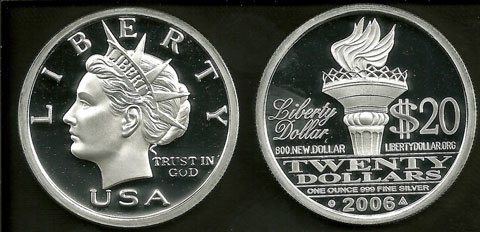
U.S. Secret Service Bans Sale of Silver and Gold Liberty Dollars on Ebay


In early 2011 Bernad Von Nothaus was convicted by the US government and identified as a domestic terrorist by Federal prosecutors for minting his own silver and gold coinage, and then offering those coins for sale to clients. He dubbed the  coins “Liberty Dollars” and by doing so brought upon himself the ire of the U.S. Secret Service, Federal Reserve and a host of other government agencies.


According to the government, Von Nothaus was a counterfeiter, though he made no attempts to actually counterfeit U.S. currency, but rather, provide another mechanism of exchange through the use of precious metals.

After Von Nothaus’ conviction, the Secret Service warned they would be confiscating all Liberty Dollar coins manufactured by Nothaus’ company, NorFed.

Since the shutdown of VonNothaus’ operation, many of the coins have been offered for sale or trade on mega-auction site Ebay, and this week the Secret Service took action. They contacted Ebay, which in turn advised sellers of the coins on their site that they could no longer engage in the trade of silver coins with the Norfed Liberty Dollar hallmark. Read more >>

Wednesday, October 24, 2012

DuPont and United Technologies plan massive job cuts


Foxbusiness.com
Faced with weakening revenue, two big companies warned on Tuesday that they would cut jobs as a way of protecting their profits. DuPont Co said it planned to lay off about 1,500 workers - roughly 2% of its global headcount - as the chemical company grapples with weakening demand from the construction and renewable energy sectors.

United Technologies Corp did not specify the magnitude of the cuts it was considering but said it would raise its full-year restructuring budget by 20% to $600 million as demand for its military equipment declines. Both companies reported weaker-than-expected sales for the third quarter, following an overall trend.

Of the companies in the broad Standard & Poor's 500 index that had reported results for the quarter as of Monday, 62% came in below analysts' revenue forecasts - well above the 38% sales-miss rate in a typical earnings season, according to Thomson Reuters I/B/E/S.

"Obviously we're looking carefully at the macro environment," United Tech Chief Executive Louis Chenevert told Reuters. "In Europe, the economy continues to be very sluggish, and in North America, it's a slow recovery.

DuPont and United Tech are by no means the only big U.S. companies to begin cutting jobs. Most dramatically, chipmaker Advanced Micro Devices said last week that it would reduce its 12,000-person workforce by 15% as it copes with weak demand and a consumer shift towards tablet computers.

Engine maker Cummins Inc , the PayPal arm of eBay Inc and for-profit college operator Apollo Group Inc announced smaller rounds of cuts earlier this month. Read more >>


Enhanced by Zemanta

Wednesday, August 31, 2011

CEO's Earn More Than Firms Pay in US Taxes

At least 25 top United States companies paid more to their chief executives in 2010 than they did to the federal government in taxes, according to a study released on Wednesday.

The companies — which include household names like eBay, Boeing, General Electric (Msnbc.com is a joint venture of Microsoft Corp. and NBC Universal, which is jointly owned by Comcast Corp. and General Electric) and Verizon — averaged $1.9 billion each in profits, according to the study by the Institute for Policy Studies, a liberal-leaning research group. But a variety of shelters, loopholes and tax reduction strategies allowed the companies to average more than $400 million each in tax benefits — which can be taken as a refund or used as write-off against earnings in future years. More...
Enhanced by Zemanta