Showing posts with label Solar flare. Show all posts

Friday, June 28, 2013

Solar Flare could quickly send us back to the 19th Century

English: A Solar Flare, image taken by the TRA...
A solar flare could wipe out the communications and electrical grids while frying a wide variety of electronics, quickly sending us back to the 19th Century.

So this week the news is consumed with the Supreme Court, the immigration bill, Edward Snowden and the NSA scandals, and the IRS scandal and the lingering Benghazi scandal. But behind the scenes there are things going on that may be much more important. Earth-shakingly important, even.

No, I'm not talking about the threat from asteroid strikes. This time, though, I'm talking about a different kind of civilizational threat: A solar flare that could wipe out the communications and electrical grids while frying a wide variety of electronics, quickly sending us back to the 19th Century.

That's happened before. In fact, it happened in the 19th Century, with the "Carrington Event" of 1859. A massive solar flare sent a cloud of charged particles that struck the Earth squarely, creating massive currents in the Earth's magnetic field and sending brilliant auroras south as far as Cuba and Hawaii. About the only thing electrical back then was the telegraph network, and the Carrington event had a literally shocking impact -- causing some operators to be shocked, and inducing strong enough currents in the telegraph wires that operators could disconnect the batteries and operate the telegraph off of the flare-induced electrical flow. Read more >>
Enhanced by Zemanta

Thursday, February 21, 2013

NASA Sees Monster Sunspot Growing Fast, Solar Storms Possible

A sunspot viewed close-up in ultraviolet light...
A colossal sunspot on the surface of the sun is large enough to swallow six Earths whole, and could trigger solar flares this week, NASA scientists say.

The giant sunspot was captured on camera by NASA's Solar Dynamics Observatory as it swelled to enormous proportions over the 48 hours spanning Tuesday and Wednesday (Feb. 19 and 20). SDO is one of several spacecraft that constantly monitor the sun's space weather environment.

"It has grown to over six Earth diameters across, but its full extent is hard to judge since the spot lies on a sphere, not a flat disk," wrote NASA spokeswoman Karen Fox, of the agency's Goddard Space Flight Center in Greenbelt, Md., in an image description.

The sunspot region is actually a collection of dark blemishes on the surface of the sun that evolved rapidly over the last two days. Sunspots form from shifting magnetic fields at the sun's surface, and are actually cooler than their surrounding solar material.

According to Fox, some of the intense magnetic fields in the sunspot region are pointing in opposite directions, making it ripe for solar activity. Read more >>
Enhanced by Zemanta

Monday, November 26, 2012

Could a solar event spark food riots and meltdowns - one scientist says yes

C3-class Solar Flare Erupts on Sept. 8, 2010 [...
C3-class Solar Flare Erupts on Sept. 8, 2010 [Detail] (Photo credit: NASA Goddard Photo and Video)

Read about “The Carrington Event” -- a massive solar flare that hit Earth in 1859. 

If Earth is struck by a large solar flare, some in the scientific community believe:

* The planet will be hit with a widespread loss of power.
* Air travel would be grounded.
* Nuclear plants would be crippled and without sufficient back-up power, dozens could meltdown.
* Satellites would be disabled, causing a serious loss of communication in all areas (military and civilian).
* Food and medicine would be in short supply, setting up the potential for food riots within days of an outage.

The same scientists who believe that a large solar strike could lead to a very rapid societal breakdown say that steps to avoid the problem are available and at a relatively low cost to all of us. What is a “relatively low cost?” They estimate the amount of money needed to insulate the power grid (and ourselves) from trouble to be less than one dollar per American. But Congress said “no” to their proposal.


Is there really cause for concern?

Over the next fourteen months Earth will be on high alert for a huge burst of electromagnetic energy from the sun. This powerful pulse is known as a “Solar Maximum” – an event that could cause catastrophic damage to power grids and communications systems. The peak time for the next big flare is sometime between now and the end of 2013. This possibility has scientists at the National Oceanic and Atmospheric Administration (NOAA) on alert. Tom Bogdan, the director of NOAA’s Space Weather Prediction Center, is monitoring the situation as closely as possible. Read more >>

Enhanced by Zemanta

Monday, August 27, 2012

Extreme conditions threaten power grid

High-voltage lines for the long distance trans...

Extreme weather is putting America's power grid to the test, with a yearlong run of violent storms and record heat battering a system built for fairer skies.

As the eastern United States struggles to recover from yet another weather shock, energy officials are acknowledging climate change as a force that finally has to be reckoned with -- even as concern grows about other threats that can set off catastrophic blackouts.

Winter storms, chains of heat waves and late June's "super derecho" -- a thunderstorm with straight-line winds that snapped electrical transmission towers and shredded power poles -- have forced the climate change issue and electric supply vulnerability to the top of an already-daunting list of blackout triggers. Those threats range from computer-hacking cyber terrorists to solar flares, utility mistakes and plain bad luck. Read more >>

Tuesday, August 21, 2012

Strong solar storms until 2014

English: An artist's concept depicts a flare e...

Late last month, the sun let off another solar flare—and the particles associated with the storm were some of the fastest NASA has ever recorded, reaching speeds of up to 2,200 miles per second, or 7.92 million miles per hour. NASA scientist Phillip Chamberlin, with the solar physics laboratory, called the July 23 "coronal mass ejection," or CME, a "huge" event and said the storm also caused one of the largest magnetic fields ever measured. Luckily, the storm was "directed away from the Earth," so nothing terrestrial was likely affected.

Because it wasn't facing Earth, NASA scientists weren't able to determine the size of the flare that caused the particle ejection. CMEs are associated with large solar storms and are the charged particles that can knock satellites and power grids offline. According to NASA's "SCORE" system, which rates CMEs according to their speed, last month's event was "extremely rare." More common CMEs clock in at about 620 miles per second.

The sun has been extremely volatile this year, Chamberlin says, because the sun is likely entering the peak of its "solar cycle." Strong solar storms are expected to happen with increasing frequency until the beginning of 2014. Read more >>

Wednesday, December 23, 2009

Solar Tsunami

spaceweather.com
The solar system is passing through an interstellar cloud that physics says should not exist. In the Dec. 24th issue of Nature, a team of scientists reveal how NASA's Voyager spacecraft have solved the mystery. Get the full story from Science@NASA.

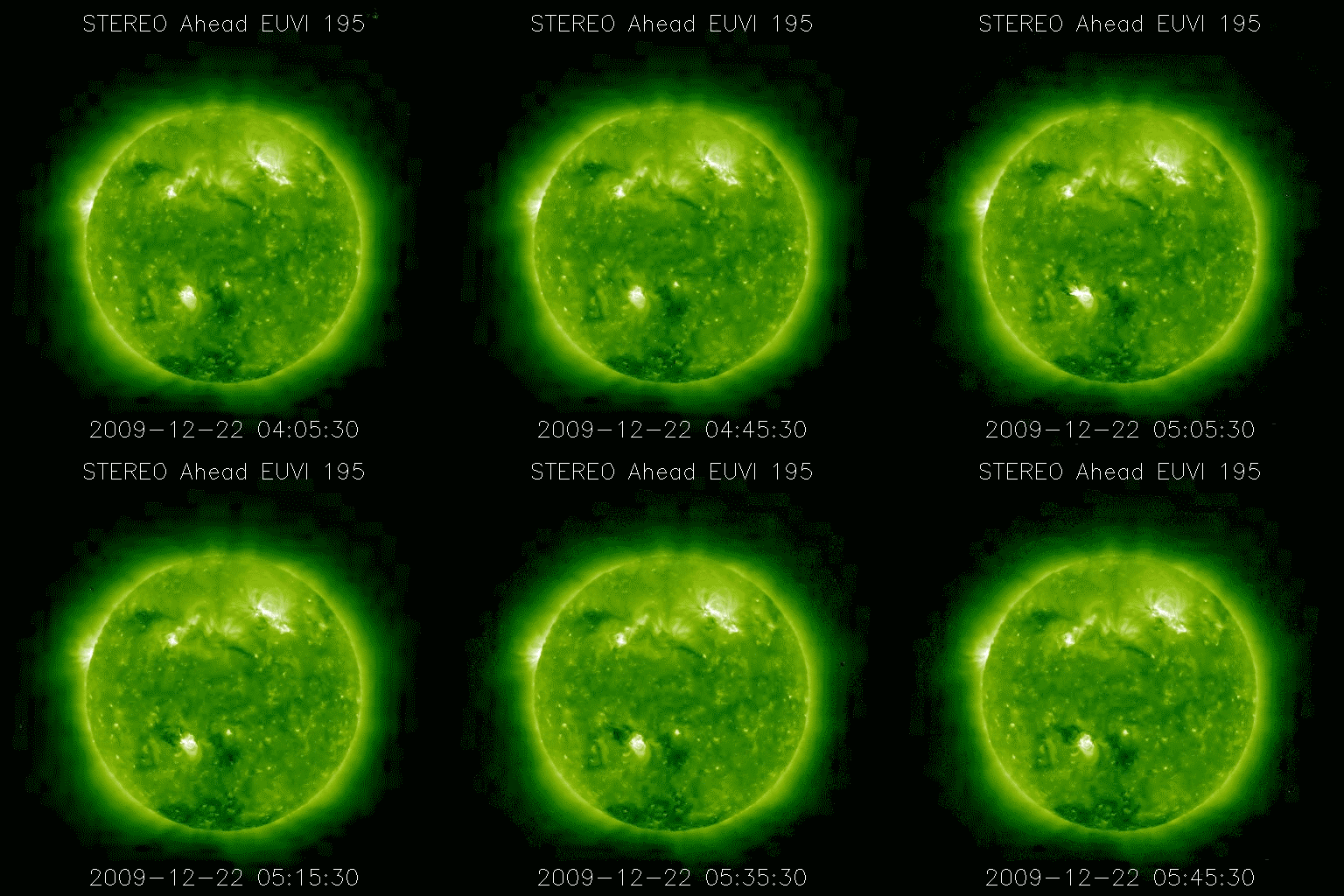
SOLAR ACTIVITY: Yesterday, Dec. 22nd at approximately 0455 UT, magnetic fields around sunspot 1036 erupted, producing a C7-class solar flare. NASA's STEREO-A spacecraft was almost directly above the sunspot at the time of the blast and recorded this extreme ultraviolet movie:

The shadowy wave racing away from the blast site is a "solar tsunami"--a swell of hot, magnetized plasma about 100,000 km high packing as much energy as a million megatons of TNT. The tsunami petered out before it went more than halfway around the sun, but another manifestation of the blast is still going. The eruption hurled a faint coronal mass ejection (CME) into space and the billion-ton cloud should cross Earth's orbit on or about Dec. 25th. A glancing blow to Earth's magnetic field could spark polar auroras for Christmas.

more images: from Pete Lawrence of Selsey, West Sussex, UK; from C. Swiger and J. Stetson of South Portland, Maine; from Robert Arnold of Isle of Skye, Scotland

Reblog this post [with Zemanta]