US scientists say they have moved a step closer to being able to grow a complete human ear from a patient's cells. In a new development in tissue engineering, they have grown a human-like ear from animal tissue.
The ear has the flexibility of a real ear, say researchers at Massachusetts General Hospital in Boston. The technique may one day be used to help people with missing or deformed outer ears, they believe.
Tissue engineering is a growing field in medical science, where substitute organs are made in the laboratory in the hope of using them to replace damaged ones. Read more >>
The Monsanto company has forged a new partnership with Alnylam Pharmaceuticals, Inc., a biopharmaceutical company whose primary focus seems to be on figuring out how to best crack the genetic code so as to manipulate the way genes inherently express themselves. And based on the agreement the two companies have made publicly with one another, it appears as though Monsanto is planning to utilize Alnylam's proprietary gene-silencing technologies in its emerging agricultural pursuits, which will likely spawn a whole new category of problems for humanity and the planet at large.
In a recent press release, Monsanto disclosed that it has officially obtained "worldwide, exclusive rights" to use Alnylam's platform technology and intellectual property (IP) in its own agricultural products, and particularly in its new "BioDirect" line of products designed to treat seeds and crops with what the company has dubbed "biopesticides" (http://www.monsanto.com/products/Pages/biodirect-ag-biologicals.aspx). Monsanto apparently sees something exceptionally valuable in Alnylam's technologies that it does not currently possess, and is now seeking to leverage it for the purpose of expanding its own market share. But what is it? Read more >>
As we are experiencing a furious regime change, the sellside positional updates are coming fast and furious. The latest major recommendation change comes again from Goldman which has just reiterated its belief gold will reach its 3 month target of $1,480 shortly. Of course, after a Cramer recommendation to buy the metal, this is the only call for a higher gold price that should be of great concern to everyone. From Goldman: "We expect gold prices to rally toward our 3-month price target of $1480/toz, and continue to recommend a long gold trade. More...
Image via WikipediaGold is rapidly approaching its all time high intraday high (and someone please inform Dennis Gartman that Gold in euro terms is close to its record again), as spot has surged $12 in a few minutes and is now near $1,260 (record intraday was $1,265 set back in June). In addition to the CHF and the JPY, gold is once again the safety trade. This comes hot on the heels of the recent report issued by UniCredit SpA’s Jochen Hitzfeld, the most accurate gold forecaster tracked by Bloomberg in the last three quarters, in which the analyst raised his estimate for the metal’s average price next year by 12 percent to $1,400 an ounce, and for 2012 to $1,600. More...
IT IS midnight on 22 September 2012 and the skies above Manhattan are filled with a flickering curtain of colourful light. Few New Yorkers have seen the aurora this far south but their fascination is short-lived. Within a few seconds, electric bulbs dim and flicker, then become unusually bright for a fleeting moment. Then all the lights in the state go out. Within 90 seconds, the entire eastern half of the US is without power.
A year later and millions of Americans are dead and the nation's infrastructure lies in tatters. The World Bank declares America a developing nation. Europe, Scandinavia, China and Japan are also struggling to recover from the same fateful event - a violent storm, 150 million kilometres away on the surface of the sun.
It sounds ridiculous. Surely the sun couldn't create so profound a disaster on Earth. Yet an extraordinary report funded by NASA and issued by the US National Academy of Sciences (NAS) in January this year claims it could do just that.
Over the last few decades, western civilisations have busily sown the seeds of their own destruction. Our modern way of life, with its reliance on technology, has unwittingly exposed us to an extraordinary danger: plasma balls spewed from the surface of the sun could wipe out our power grids, with catastrophic consequences.
The projections of just how catastrophic make chilling reading. "We're moving closer and closer to the edge of a possible disaster," says Daniel Baker, a space weather expert based at the University of Colorado in Boulder, and chair of the NAS committee responsible for the report.
It is hard to conceive of the sun wiping out a large amount of our hard-earned progress. Nevertheless, it is possible. The surface of the sun is a roiling mass of plasma - charged high-energy particles - some of which escape the surface and travel through space as the solar wind. From time to time, that wind carries a billion-tonne glob of plasma, a fireball known as a coronal mass ejection (see "When hell comes to Earth"). If one should hit the Earth's magnetic shield, the result could be truly devastating.
The incursion of the plasma into our atmosphere causes rapid changes in the configuration of Earth's magnetic field which, in turn, induce currents in the long wires of the power grids. The grids were not built to handle this sort of direct current electricity. The greatest danger is at the step-up and step-down transformers used to convert power from its transport voltage to domestically useful voltage. The increased DC current creates strong magnetic fields that saturate a transformer's magnetic core. The result is runaway current in the transformer's copper wiring, which rapidly heats up and melts. This is exactly what happened in the Canadian province of Quebec in March 1989, and six million people spent 9 hours without electricity. But things could get much, much worse than that.
Worse than Katrina
The most serious space weather event in history happened in 1859. It is known as the Carrington event, after the British amateur astronomer Richard Carrington, who was the first to note its cause: "two patches of intensely bright and white light" emanating from a large group of sunspots. The Carrington event comprised eight days of severe space weather.
There were eyewitness accounts of stunning auroras, even at equatorial latitudes. The world's telegraph networks experienced severe disruptions, and Victorian magnetometers were driven off the scale.
Though a solar outburst could conceivably be more powerful, "we haven't found an example of anything worse than a Carrington event", says James Green, head of NASA's planetary division and an expert on the events of 1859. "From a scientific perspective, that would be the one that we'd want to survive." However, the prognosis from the NAS analysis is that, thanks to our technological prowess, many of us may not.
There are two problems to face. The first is the modern electricity grid, which is designed to operate at ever higher voltages over ever larger areas. Though this provides a more efficient way to run the electricity networks, minimising power losses and wastage through overproduction, it has made them much more vulnerable to space weather. The high-power grids act as particularly efficient antennas, channelling enormous direct currents into the power transformers.
The second problem is the grid's interdependence with the systems that support our lives: water and sewage treatment, supermarket delivery infrastructures, power station controls, financial markets and many others all rely on electricity. Put the two together, and it is clear that a repeat of the Carrington event could produce a catastrophe the likes of which the world has never seen. "It's just the opposite of how we usually think of natural disasters," says John Kappenman, a power industry analyst with the Metatech Corporation of Goleta, California, and an advisor to the NAS committee that produced the report. "Usually the less developed regions of the world are most vulnerable, not the highly sophisticated technological regions."
According to the NAS report, a severe space weather event in the US could induce ground currents that would knock out 300 key transformers within about 90 seconds, cutting off the power for more than 130 million people (see map). From that moment, the clock is ticking for America.
First to go - immediately for some people - is drinkable water. Anyone living in a high-rise apartment, where water has to be pumped to reach them, would be cut off straight away. For the rest, drinking water will still come through the taps for maybe half a day. With no electricity to pump water from reservoirs, there is no more after that.
There is simply no electrically powered transport: no trains, underground or overground. Our just-in-time culture for delivery networks may represent the pinnacle of efficiency, but it means that supermarket shelves would empty very quickly - delivery trucks could only keep running until their tanks ran out of fuel, and there is no electricity to pump any more from the underground tanks at filling stations.
Back-up generators would run at pivotal sites - but only until their fuel ran out. For hospitals, that would mean about 72 hours of running a bare-bones, essential care only, service. After that, no more modern healthcare. More...
spaceweather.com The solar system is passing through an interstellar cloud that physics says should not exist. In the Dec. 24th issue of Nature, a team of scientists reveal how NASA's Voyager spacecraft have solved the mystery. Get the full story from Science@NASA.
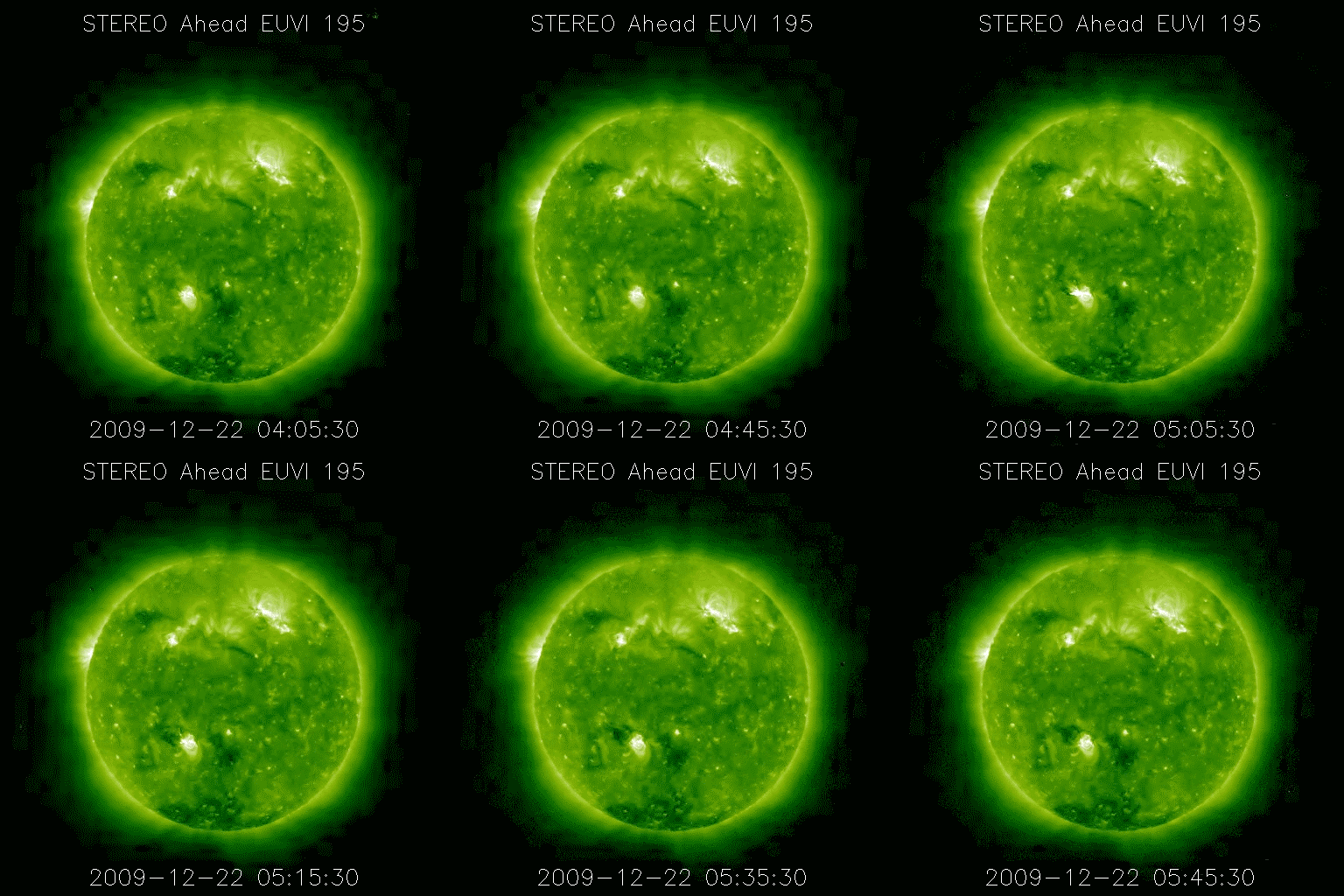
SOLAR ACTIVITY: Yesterday, Dec. 22nd at approximately 0455 UT, magnetic fields around sunspot 1036 erupted, producing a C7-class solar flare. NASA's STEREO-A spacecraft was almost directly above the sunspot at the time of the blast and recorded this extreme ultraviolet movie:
The shadowy wave racing away from the blast site is a "solar tsunami"--a swell of hot, magnetized plasma about 100,000 km high packing as much energy as a million megatons of TNT. The tsunami petered out before it went more than halfway around the sun, but another manifestation of the blast is still going. The eruption hurled a faint coronal mass ejection (CME) into space and the billion-ton cloud should cross Earth's orbit on or about Dec. 25th. A glancing blow to Earth's magnetic field could spark polar auroras for Christmas.
Inspired by the success of the "Cash for Clunkers" program, the U.S. Department of Energy will launch a "Cash for Appliances" program this fall.
The program will provide nearly $300 million in stimulus funds from the American Recovery and Reinvestment Act to consumers who buy new, energy-efficient kitchen appliances.
"These rebates will help families make the transition to more efficient appliances, making purchases that will directly stimulate the economy and create jobs," Energy Secretary Steven Chu says.
This new rebate program is in addition to a number of U.S. tax credits on energy-efficient products for homes introduced earlier this year. This includes many gas, oil, electric and solar water heaters, which are reimbursed at 30 percent of their purchase price up to $1,500. Many energy-efficient windows, skylights, exterior doors, insulation and HVAC systems are also eligible for a 30 percent tax credit, up to $1,500 per home. (This $1,500 limit is the total for all credits applied to the home across all categories of eligible products).
A 27-year-old Australian tech worker and CEO of EBank, EVE Online's largest player-run financial institution which has thousands of depositors, embezzled about 200 billion of EVE Online's interstellar kredits, the game's virtual currency. EVE Online -- a massive multiplayer online roleplaying space game -- has more than 300,000 subscribers who pay $15 a month to play. The players earn money killing rivals (among other things) in a distant future where humans have colonized the stars in a game similar to World of Warcraft and Second Life. The CEO of EBank, who used the online name Ricdic, exchanged the embezzled virtual funds for $5,100 on the black market, according to Yahoo Tech's JaShong King.
"It was a very on the spot decision," said Ricdic, who's married and has two children. "I saw that as an avenue that could be taken, and I decided to skim off the top, you could say, to overcome real life (difficulties)."
"Basically this character was one of the people that had been running EBank for a while. He took a bunch of (virtual) money out of the bank, and traded it away for real money," said Ned Coker, of the Icelandic company CCP, which developed the game.
People are doing anything they can think of to survive. In the U.S. the average workweek hit 33.0 hours, a record low since the data were first collected 45 years ago. "At no time in the 1990 or 2001 recessions did we ever come close to seeing such a detonating jobs figure," said David Rosenberg from Glukin Sheff. "We have lost a record nine million full-time jobs this cycle." Ambrose Evans-Pritchard claims Sheriffs in Michigan & Illinois are quietly refusing to toss families on to the streets.


![Reblog this post [with Zemanta]](https://lh3.googleusercontent.com/blogger_img_proxy/AEn0k_vaHmB2JcWws02DK2FDVUynq-fObFVoyM41paj1pVRtZ01jkYXKTBmJ1tmoe1FgUylpO0QvRGfvZzyTZtAjT1qI4tVu_VsmxPFcYtMitS7IXhlCb_S6W1wj0W-ClqdfvTdtyWRxc0qviSzJ7vA7l12R=s0-d)


