Third-quarter bank earnings will feel an unwelcome jolt as mortgage volume has fallen off a cliff. Banks large and small have been preparing investors for difficult revenue comparisons by preannouncing the bad news. JPMorgan Chase CFO Marianne Lake at a conference on Sept. 9 said the bank expected its mortgage origination business to post a net operating loss for the second half of 2013.
Cardinal Financial of McLean, Va., late on Thursday announced that its third-quarter mortgage loan originations had declined by roughly 40 percent from the second quarter, and that "the marketing gain percentage for mortgages sold has decreased during the third quarter due to increasing competitive pressure related to the changing market conditions."
Cardinal also said "Expense reduction and revenue enhancement measures have been and will continue to be implemented to offset the decrease in mortgage production and the decline in the marketing gain percentage," but that the bulk of the benefit of the cost declines wouldn't be realized until the fourth quarter. The bank was downgraded by several sell-side analysts on Thursday and Friday, and its shares dropped 5 percent Friday to close at $16.76 Read more >>
Showing posts with label Business. Show all posts
Tuesday, September 24, 2013
Friday, September 13, 2013
Consumer Confidence Collapses - Biggest Miss On Record
This is the first consecutive monthly drop in 14 months and the largest miss vs expectations on record. Printing at 76.8 (against an expectation of 82.0), ths is the lowest in 5 months and points to the picture we have been painting of a consumer increasingly affected by rising rates and saoring gas prices amid stagnant incomes.
As Citi notes below, this is the exact same pattern we have seen play out in the last 2 cycles and suggest significant downside risk to US equities. The economic outlook sub-index collapsed to its lowest since January. Read more >>
Tuesday, September 10, 2013
Business Owners May Face $100-Per-Day Penalty Under ObamaCare
Beginning Oct. 1, any business with at least one employee and $500,000 in annual revenue must notify all employees by letter about the Affordable Care Act’s health-care exchanges, or face up to a $100-per-day fine.
The requirement applies to any business regulated under the Fair Labor Standards Act, regardless of size. Going forward, letters are to be distributed to any new hires within 14 days of their starting date, according to the Department of Labor.
Earlier this summer, the employer mandate, which states that every business with at least 50 or more full-time employees must offer workers acceptable coverage or face a $2,000 penalty per-worker, per-year, was pushed back until 2015.
But the Oct. 1 employee-notification deadline stands. Keith McMurdy, partner at FOX Rothschild LLP, says the $100 per-day fine has been “unfortunately overlooked” by many small businesses, and the dollar amount on the penalty comes from the general per-day penalty under the ACA. Read more >>
Thursday, September 5, 2013
Employers announced 50,462 layoffs last month
The number of planned layoffs at U.S. firms surged in August to their highest in half a year, with industrial goods manufacturers the hardest hit, a report on Thursday showed.
Employers announced 50,462 layoffs last month, up 33.8 percent from 37,701 in July, according to the report from consultants Challenger, Gray & Christmas.
The August job cuts were up 57 percent from the same time a year ago. For 2013 so far, employers have announced 347,095 job losses, close to the 352,185 that were seen in the first eight months of last year.
Industrial goods manufacturers saw the biggest layoffs, cutting 22,162 employees, the largest total for the sector since January 2009.
"Heavy job cuts in the industrial goods sector are never a good thing, as they can be indicative of widening cracks in the economy's foundation," said John A. Challenger, chief executive officer of Challenger, Gray & Christmas.
"However, the August surge in industrial goods job cuts was driven largely by falling global demand for mining equipment," he said. Read more >>
Employers announced 50,462 layoffs last month, up 33.8 percent from 37,701 in July, according to the report from consultants Challenger, Gray & Christmas.
The August job cuts were up 57 percent from the same time a year ago. For 2013 so far, employers have announced 347,095 job losses, close to the 352,185 that were seen in the first eight months of last year.
Industrial goods manufacturers saw the biggest layoffs, cutting 22,162 employees, the largest total for the sector since January 2009.
"Heavy job cuts in the industrial goods sector are never a good thing, as they can be indicative of widening cracks in the economy's foundation," said John A. Challenger, chief executive officer of Challenger, Gray & Christmas.
"However, the August surge in industrial goods job cuts was driven largely by falling global demand for mining equipment," he said. Read more >>
Friday, August 30, 2013
Decline in homeownership is changing neighborhoods
CNBC
Beneath the spreading shade tree in Laura Holcomb's front yard, there are some 70 varieties of hosta, stands of elephant ear and a Japanese maple. For the 17 years she has owned the brick house on Rose Trail Drive in Memphis' Hillshire subdivision, Ms. Holcomb has devoted herself to her home and garden.
Across the street, Carl Osborne and his family have been tenants for two years, moving in after the previous owner lost the house in a foreclosure. They are happy to have a decent place to call home but, like many renters, they have not done much to improve the appearance or join the community.
They are not alone: the family behind Ms. Holcomb, the one two doors down, and several in the cul-de-sac across the way are among the renters who have been supplanting homeowners in this blue-collar, suburban neighborhood as investors buy single-family homes and convert them to rentals.
"Used to, we knew our neighbors," Ms. Holcomb said. Then she gestured toward the few remaining owner-occupied houses nearby. "Except for the two that have been here, I don't know any of my neighbors."
Across the country, a growing number of single-family rentals provide an option for many who lost their homes in the housing crash through foreclosure and for those who cannot obtain a mortgage under today's tougher credit conditions.
But the decline in homeownership is also changing many neighborhoods in profound ways, including reduced home values, lower voter turnout and political influence, less social stability and higher crime. Read more >>
Beneath the spreading shade tree in Laura Holcomb's front yard, there are some 70 varieties of hosta, stands of elephant ear and a Japanese maple. For the 17 years she has owned the brick house on Rose Trail Drive in Memphis' Hillshire subdivision, Ms. Holcomb has devoted herself to her home and garden.
Across the street, Carl Osborne and his family have been tenants for two years, moving in after the previous owner lost the house in a foreclosure. They are happy to have a decent place to call home but, like many renters, they have not done much to improve the appearance or join the community.
They are not alone: the family behind Ms. Holcomb, the one two doors down, and several in the cul-de-sac across the way are among the renters who have been supplanting homeowners in this blue-collar, suburban neighborhood as investors buy single-family homes and convert them to rentals.
"Used to, we knew our neighbors," Ms. Holcomb said. Then she gestured toward the few remaining owner-occupied houses nearby. "Except for the two that have been here, I don't know any of my neighbors."
Across the country, a growing number of single-family rentals provide an option for many who lost their homes in the housing crash through foreclosure and for those who cannot obtain a mortgage under today's tougher credit conditions.
But the decline in homeownership is also changing many neighborhoods in profound ways, including reduced home values, lower voter turnout and political influence, less social stability and higher crime. Read more >>
Monday, August 12, 2013
Gold Shorts Cover At Fastest Pace In 13 Years
The last time shorts collapsed at this fast a rate was in the 1999/2000 period which saw a considerable 33% squeeze ramp in gold prices over the space of 3 weeks in the fall of 1999. Notably, the gold short position still remains huge compared to historical values - having fallen back only to the previous all-time record high levels (i.e. plenty of room for moar squeeze). In addition to this surge in covering, Gold ETFs saw their first inflows in 2 months. Read more >>
Friday, August 2, 2013
Ten Times More Waiter And Bartender Than Manufacturing Jobs Added In 2013
* There have been 246.5K Waiter and Bartender (Food Service and Drinking Places) jobs added
* There have been 24.0K Manufacturing jobs added
The ratio of waiters and bartenders to manufacturing jobs: 10 to 1.
Sadly, most of those now record waiters and bartenders are just sitting there, twiddling their thumbs. Recall: "According to this week's very weak retail sales report, Food-service sales fell 1.2% in June, the largest decline since February 2008 and the year over year change in "eating out" rose by just 3.1% - the lowest annual increase since June 2010. But at least all those empty restaurant seats have a record number of waiters catering to the non-existent clients which on the surface should mean the speediest service in history." Read more >>
Labels:
Barack Obama,
Bartender,
Business,
Central bank,
Foodservice,
June,
Medal bar,
Waiting staff
Wednesday, July 24, 2013
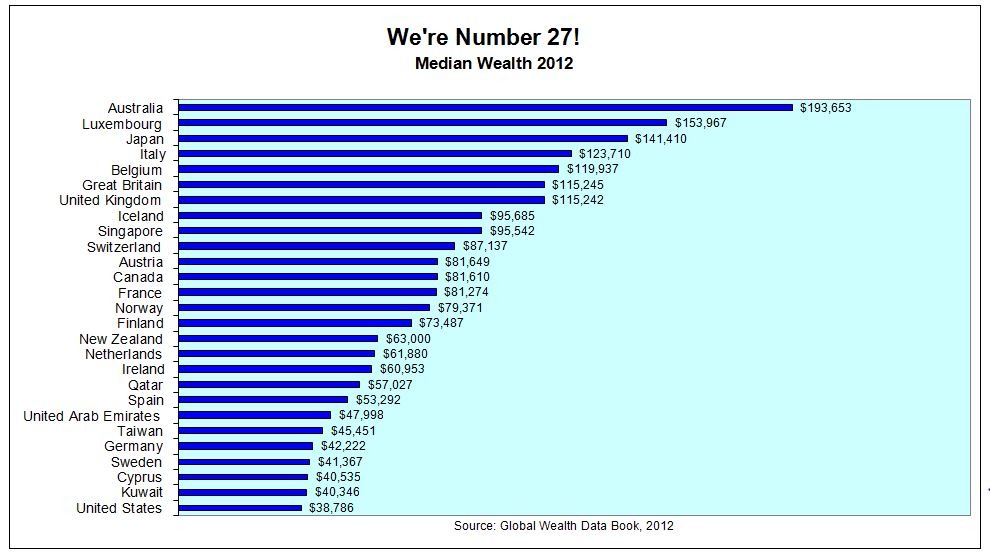
America’s Middle Class Ranks #27 on Global Scale
America is the richest country on Earth. We have the most millionaires, the most billionaires and our wealthiest citizens have garnered more of the planet’s riches than any other group in the world. We even have hedge fund managers who make in one hour as much as the average family makes in 21 years!
This opulence is supposed to trickle down to the rest of us, improving the lives of everyday Americans. At least that’s what free-market cheerleaders repeatedly promise us.
Unfortunately, it’s a lie, one of the biggest ever perpetrated on the American people.
Our middle class is falling further and further behind in comparison to the rest of the world. We keep hearing that America is number one. Well, when it comes to middle-class wealth, we’re number 27.
The most telling comparative measurement is median wealth (per adult). It describes the amount of wealth accumulated by the person precisely in the middle of the wealth distribution — fifty percent of the adult population has more wealth, while fifty percent has less. You can’t get more middle than that. Read more >>
Labels:
Business,
Earth,
Free market,
Investing,
Middle class,
United States,
Wall Street,
Wealth
Monday, July 22, 2013
Gold Surges To Its Best Day In 13 Months
Of course, this surge is disappointing to many (including China we suspect) as the 'transitory' end of the price beatdown means we can buy less physical (and take immediate possession) now than at the June lows of $1180. With gold testing its 50DMA for the first time since February, we suspect the momo crowd will be quick to jump ship should we push on through. Read more >>
Labels:
Ben Bernanke,
Bernanke,
Business,
China,
Gold,
Gold Investment,
June,
Precious metal
Lowest-Paying, Most Dangerous Jobs
Taxi drivers and roofers are two of the most dangerous jobs--and they aren't rewarded for it. Here we look at the top ten lowest-paying, most dangerous jobs in the U.S.
10. Structural Iron & Steel Workers
Dead-end-job score: 17.2
Annual fatality rate per 100,000: 26.9
Median annual wages: $46,140
9. Driver/Sales Workers & Truck Drivers
Dead-end-job score: 14.4
Annual fatality rate per 100,000: 24.0
Median annual wages: $34,550
8. Grounds Maintenance Workers
Dead-end-job score: 14.3
Annual fatality rate per 100,000: 16.8
Median annual wages: $23,970
7. Taxi Drivers & Chauffeurs
Dead-end-job score: 11.6
Annual fatality rate per 100,000: 19.7
Median annual wages: $22,820
6. Roofers
Dead-end-job score: 11.1
Annual fatality rate per 100,000: 31.8
Median annual wages: $35,290
Read more >>
10. Structural Iron & Steel Workers
Dead-end-job score: 17.2
Annual fatality rate per 100,000: 26.9
Median annual wages: $46,140
9. Driver/Sales Workers & Truck Drivers
Dead-end-job score: 14.4
Annual fatality rate per 100,000: 24.0
Median annual wages: $34,550
8. Grounds Maintenance Workers
Dead-end-job score: 14.3
Annual fatality rate per 100,000: 16.8
Median annual wages: $23,970
7. Taxi Drivers & Chauffeurs
Dead-end-job score: 11.6
Annual fatality rate per 100,000: 19.7
Median annual wages: $22,820
6. Roofers
Dead-end-job score: 11.1
Annual fatality rate per 100,000: 31.8
Median annual wages: $35,290
Read more >>
Wednesday, July 17, 2013
Tech layoffs more than doubled in 2nd quarter
Layoffs announced by U.S. employees in the technology sector more than doubled in the second quarter, reaching the highest level in a year, according to new data from consulting firm Challenger Gray & Christmas Inc.
During the period, the computer, electronics and telecommunications industries announced plans to cut a combined 20,491 positions, up from 8,392 during the first quarter, but down from 39,164 a year earlier.
The second quarter included layoff plans from tech giant International Business Machines Corp. IBM -0.08% , which is expected to cut as many as 8,000 workers after the company posted disappointing first-quarter earnings, according to Challenger.
Computer firms reported the highest number of planned job cuts--at 16,404--up sharply from 3,526 during the first quarter. Cuts by electronics firms surged 68% to 2,344 from the previous quarter. However, planned telecom cuts were down by half at 1,743. Read more >>
During the period, the computer, electronics and telecommunications industries announced plans to cut a combined 20,491 positions, up from 8,392 during the first quarter, but down from 39,164 a year earlier.
The second quarter included layoff plans from tech giant International Business Machines Corp. IBM -0.08% , which is expected to cut as many as 8,000 workers after the company posted disappointing first-quarter earnings, according to Challenger.
Computer firms reported the highest number of planned job cuts--at 16,404--up sharply from 3,526 during the first quarter. Cuts by electronics firms surged 68% to 2,344 from the previous quarter. However, planned telecom cuts were down by half at 1,743. Read more >>
74% of small businesses will fire workers, cut hours under Obamacare
"Small businesses expect the requirement to negatively impact their employees. Twenty-seven percent say they will cut hours to reduce full time employees, 24 percent will reduce hiring, and 23 percent plan to replace full time employees with part-time workers to avoid triggering the mandate," said the Chamber business survey provided to Secrets.
Under Obamacare, just 30 hours — not the nationally recognized 40 hours — is considered full-time. Companies with 50 full-time workers or more are required to provide health care, or pay a fine.
The administration recently decided to wait a year before businesses had to comply, but many are trying to get ready anyway. The president did not delay the mandate that Americans must have health insurance or pay a fine, however. Read more >>
Friday, July 5, 2013
Part-Time Jobs Surge To All Time High
As a reminder: jobs have quantity and quality components. The quantity component was good enough to convince the 10 Year the taper is imminent (if not stocks, which continue to trade dislocated from any and all fundamentals).
But how about the quality? In a word: not good. In June, the household survey reported that part-time jobs soared by 360,000 to 28,059,000 - an all time record high. Full time jobs? Down 240,000.
And looking back at the entire year, so far in 2013, just 130K Full-Time Jobs have been added, offset by a whopping 557K Part-Time jobs. And there is your jobs "quality" leading to today's market euphoria (if only for now). Read more >>
But how about the quality? In a word: not good. In June, the household survey reported that part-time jobs soared by 360,000 to 28,059,000 - an all time record high. Full time jobs? Down 240,000.
And looking back at the entire year, so far in 2013, just 130K Full-Time Jobs have been added, offset by a whopping 557K Part-Time jobs. And there is your jobs "quality" leading to today's market euphoria (if only for now). Read more >>
Friday, June 21, 2013
Marc Faber Sees Further Downside
There's plenty of room for the stock market to decline, noted bear Marc Faber said Thursday on CNBC. "Yes, I see further downside," said the editor of "The Gloom Boom & Doom Report."
However, Faber said that there were plenty of reasons for stocks to head lower other than what the Federal Reserve was doing in terms of quantitative easing. "I think the markets are worried about something else," he said on "Fast Money."
Faber noted that interest rates have been rising for a year, pointing to the 30-year U.S. Treasury bond and the 10-year U.S. Treasury note bottoming out in July. "So, we've been in an uptrend in interest rates," he added. But that wasn't the whole bear case. "The Chinese economy is much weaker than the official statistics suggest," Faber said.
"My view would be that at the present time, the Chinese economy is growing at something like 4 percent per annum, and without huge credit expansion there would probably be no growth at all."
Other emerging market economies were also poised for poor growth, he added. The outlook for gold and other metals were not great, either.
"Technically, commodities look horrible," Faber said, adding that for precious metals "some technical factiors would suggest that we're approaching at least an intermediate low." Read more >>
However, Faber said that there were plenty of reasons for stocks to head lower other than what the Federal Reserve was doing in terms of quantitative easing. "I think the markets are worried about something else," he said on "Fast Money."
Faber noted that interest rates have been rising for a year, pointing to the 30-year U.S. Treasury bond and the 10-year U.S. Treasury note bottoming out in July. "So, we've been in an uptrend in interest rates," he added. But that wasn't the whole bear case. "The Chinese economy is much weaker than the official statistics suggest," Faber said.
"My view would be that at the present time, the Chinese economy is growing at something like 4 percent per annum, and without huge credit expansion there would probably be no growth at all."
Other emerging market economies were also poised for poor growth, he added. The outlook for gold and other metals were not great, either.
"Technically, commodities look horrible," Faber said, adding that for precious metals "some technical factiors would suggest that we're approaching at least an intermediate low." Read more >>
Wednesday, June 19, 2013
FedEx offers glum outlook on economic growth
FedEx might offer the clearest look at the disconnect between the soaring stock market and the listless global economy. The world's largest freight carrier posted a 45% drop in its fourth quarter profits and offered its investors a cautious outlook for 2014, noting that customers are looking for lower-cost carriers internationally. FedEx said its outlook was based on expectations of just 2.3% GDP growth for the United States. Read more >>
Thursday, June 6, 2013
Companies Spending Cash on Investors, Not Workers
Companies flush with cash remain reluctant to hire or make capital purchases, choosing to reward investors rather than expand their businesses.
Recent economic data exemplify the trend: Private payrolls grew by just 135,000 during May, according to ADP, while employment components both for the Institute of Supply Management's manufacturing and nonmanufacturing indexes show a flat jobs outlook.
The grim hiring prospects come as nonfinancial firms hold nearly $1.8 trillion in cash on their balance sheets. Rather than look to expand, though, they've chosen to participate in aggressive share buybacks and dividend increases to reward investors.
According to TrimTabs, companies have spent $290.7 billion this year on buybacks, which are aimed at decreasing the amount of available shares—or float—thus driving up stock prices. That effort, at least, has been a success. Read more >>
Recent economic data exemplify the trend: Private payrolls grew by just 135,000 during May, according to ADP, while employment components both for the Institute of Supply Management's manufacturing and nonmanufacturing indexes show a flat jobs outlook.
The grim hiring prospects come as nonfinancial firms hold nearly $1.8 trillion in cash on their balance sheets. Rather than look to expand, though, they've chosen to participate in aggressive share buybacks and dividend increases to reward investors.
According to TrimTabs, companies have spent $290.7 billion this year on buybacks, which are aimed at decreasing the amount of available shares—or float—thus driving up stock prices. That effort, at least, has been a success. Read more >>
Labels:
Business,
Equities,
Investing,
Investor,
May,
Motley Fool,
Share repurchase,
Stocks and Bonds
Wednesday, May 8, 2013
5 Best & 5 Worst States for Business
It appears CEOs prefer doing business in states run by Republican governors, or so says Chief Executive magazine’s ninth annual “The Best and Worst States for Business” survey.
The survey asked 736 CEOs to grade states on a variety of “competitive metrics that CEOs themselves regard as critical,” including taxation and regulation, quality of workforce, and living environment.
“The tax and regulatory grade includes a measure of how CEOs grade a state’s attitude toward business, a key indicator,” the report write-up notes.
“In the minds of most leaders, a state’s friendliness is closely aligned with its tax and regulatory regime. Similarly, workforce quality also measures the perceived cooperativeness of workers with management, as well as the people’s general work ethic and education attainment,” the write-up reads.
“The living environment metric measures the perceived quality of education and public health facilities, as well as the affordability and quality of real estate, the transportation system and related environmental factors,” it adds.
And although three of the top 10 worst states for business are controlled by Republican governors, the top 10 best states, as noted by the Washington Examiner’s Charlie Spiering, are all run by Republican governors.
Here are the top five best states for business:
The survey asked 736 CEOs to grade states on a variety of “competitive metrics that CEOs themselves regard as critical,” including taxation and regulation, quality of workforce, and living environment.
“The tax and regulatory grade includes a measure of how CEOs grade a state’s attitude toward business, a key indicator,” the report write-up notes.
“In the minds of most leaders, a state’s friendliness is closely aligned with its tax and regulatory regime. Similarly, workforce quality also measures the perceived cooperativeness of workers with management, as well as the people’s general work ethic and education attainment,” the write-up reads.
“The living environment metric measures the perceived quality of education and public health facilities, as well as the affordability and quality of real estate, the transportation system and related environmental factors,” it adds.
And although three of the top 10 worst states for business are controlled by Republican governors, the top 10 best states, as noted by the Washington Examiner’s Charlie Spiering, are all run by Republican governors.
Here are the top five best states for business:
Tuesday, April 23, 2013
Senate bill jeopardizes tax-free online shopping
States could force Internet retailers to collect sales taxes under a bill that overwhelmingly passed a test vote in the Senate Monday.
Under current law, states can only require stores to collect sales taxes if the store has a physical presence in the state. As a result, many online sales are essentially tax-free, giving Internet retailers a big advantage over brick-and-mortar stores.
The bill would allow states to require online retailers to collect state and local sales taxes for purchases made over the Internet. The sales taxes would be sent to the states where shoppers live.
The Senate voted 74 to 20 to begin debating the bill. If that level of support continues, the Senate could pass the bill as early as this week.
Supporters say the bill is about fairness for businesses and lost revenue for states. Opponents say it would impose complicated regulations on retailers and doesn't have enough protections for small businesses. Businesses with less than $1 million a year in online sales would be exempt. Read more >>
Under current law, states can only require stores to collect sales taxes if the store has a physical presence in the state. As a result, many online sales are essentially tax-free, giving Internet retailers a big advantage over brick-and-mortar stores.
The bill would allow states to require online retailers to collect state and local sales taxes for purchases made over the Internet. The sales taxes would be sent to the states where shoppers live.
The Senate voted 74 to 20 to begin debating the bill. If that level of support continues, the Senate could pass the bill as early as this week.
Supporters say the bill is about fairness for businesses and lost revenue for states. Opponents say it would impose complicated regulations on retailers and doesn't have enough protections for small businesses. Businesses with less than $1 million a year in online sales would be exempt. Read more >>
Monday, April 15, 2013
Gold Drops Most In 30 Years
Previously, levered hedge funds were forced to sell gold on stock margin calls. How long until today's gold plunge, the largest 2-day drop in the past 30 years, forces funds to start selling stocks to meet margin clerks vocal demands some time around 2pm today?
John Bougearel of Structural Logic chimes in:
Today is the largest one day decline from the previous day's close @ -9.6%. Volume is already north of 530,000 - another record with another 6 hours of electronic trade to go. There have been three rounds of liquidations. The first round was the Asian liquidation that ended at 9 am. The second round was the European liquidation that ended at 5 am. They are spaced 8 hours apart. At this rate, the US liquidation phase won't be complete until the London closing at 1230 pm CST, at least this is what that behavioral model suggests. You are witnessing an historical selling climax folks. Read more >>
John Bougearel of Structural Logic chimes in:
Today is the largest one day decline from the previous day's close @ -9.6%. Volume is already north of 530,000 - another record with another 6 hours of electronic trade to go. There have been three rounds of liquidations. The first round was the Asian liquidation that ended at 9 am. The second round was the European liquidation that ended at 5 am. They are spaced 8 hours apart. At this rate, the US liquidation phase won't be complete until the London closing at 1230 pm CST, at least this is what that behavioral model suggests. You are witnessing an historical selling climax folks. Read more >>
Friday, April 12, 2013
All Alterantive Currencies Must Be Crushed
Gold prices just entered a bear market. Down 21% from their mid-2011 highs. Today's drop is the largest since 2/29/12 - LTRO2 and takes the price of the barbarous relic back to July 2011 lows. Silver is also seeing its biggest down-day since LTRO2 as it tests 2012 lows. Must. Destroy. All alternative currencies. Read more >>
Subscribe to:
Posts (Atom)