


Thank you for visiting. Dr. Michael Burry has liquidated Scion Capital, LLC and is currently focusing on his private investments. Dr. Burry is not accepting outside investors. If you have an interest, Dr. Burry has made Scion Capital's earliest investor reports available.
____________________________________________
Further, Dr. Burry feels the financial crises originating in the United States and elsewhere were eminently predictable and preventable. The following timeline regarding developments at Fannie Mae and Freddie Mac is illustrative of why the crises were not prevented.
July 2003 (Scion Capital Quarterly Report to Investors): "Freddie Mac and Fannie Mae warrant special comment. Interestingly, Fannie Mae, when it was a much less significant force, was declared insolvent on a mark-to-market basis by the U.S. General Accounting Office back in 1981. As well, each of the two predecessors to the just- fired CEO of Freddie Mac left Freddie to run S&L’s that they subsequently ran into the ground during the 1980s. Yet the market reserved a muted reaction for Freddie Mac firing its top three executives last month over an accounting scandal and, with a straight face, blaming the mess on a lack of accounting expertise within the company.
After hearing from Fannie, Freddie and representatives of the President, U.S. Rep. Richard Baker, a longtime and vehement critic of these two companies, has elected to withhold any knockout punch. Fannie Mae’s CEO in particular lacked subtlety. Citing the company’s primary importance to the national housing market and relying on Fannie’s formidable political connections, he publicly dared the U.S. Congress to act. Not so much as one peep of indignation was heard in response. To the extent the national housing market is untouchable, we have evidence not of strength but of fragility."
October 2004 (Scion Capital Quarterly Report to Investors): "I recently watched Mr. Franklin Raines, CEO and Chairman of Fannie Mae, defend himself before a House subcommittee against allegations of fraudulent financial reporting brought by its regulator, OFHEO. I have already read OFHEO’s interim report on the matter, and you know from prior letters that I have had a dim view of Fannie Mae and its CEO for some time. My impression: Fannie Mae is unregulated, and they are very likely committing fraud.
An entity is not being regulated if it takes subpoenas and threats from the Department of Justice in order to obtain management’s cooperation in a regulatory review. Too, an entity is not being regulated if a Congressional investigation cannot be performed due to wholly inadequate knowledge of the business at issue on the part of the investigators. Watching our representatives flail at questioning Mr. Raines was rather shocking. They were in no manner capable of getting past the headline issues, and even those were covered only in superficial fashion. Remarkably, these particular representatives were members of the House subcommittee specifically charged with regulating the GSEs.
Then there are Fannie’s friends, with whom Mr. Raines apparently spends most of his days. Rep. Artur Davis suggested OFHEO was putting Fannie in more danger with the release of the report. Rep. Barney Frank, the House Financial Services subcommittee’s lead Democrat, went so far as to charge that OFHEO was "irresponsible." Yet, how can a regulator be irresponsible simply by letting the public know it suspects foul play on the part of the regulated?"
On the subject of fraud, OFHEO’s report makes clear Fannie’s intent to deceive. The report details not gray areas of accounting, but rather specific acts to manipulate earnings. Per the testimony of Armando Falcon, Jr., head of OFHEO, “The accounting violations cannot be dismissed as mere differences of interpretation in accounting rules. Fannie Mae understood the rules and simply chose not to follow them.” Time and again, the ethics of men and women have proven no match for a lucrative incentive structure.”
November 11, 2004 (The Washington Post): A senior House Democrat said yesterday that he will not support a budget increase for the federal regulator of Fannie Mae until questions raised in a confidential report have been addressed. Rep. Barney Frank (Mass.), senior Democrat on the committee overseeing Fannie and its regulator, said in a letter to colleagues that an inspector general's report on how the Office of Federal Housing Enterprise Oversight examined the mortgage funding company's accounting "raises very serious issues which must be thoroughly discussed and addressed." Frank said in an interview that the issues involve "the role that OFHEO has played." The report "has major public policy implications," but he could not be more specific because the report has not been made public, he said. OFHEO has said recently that budget restrictions threaten to hamper its continuing investigation of Fannie Mae's accounting...
2006 (The Washington Post): “Fannie Mae engaged in "extensive financial fraud" over six years by doctoring earnings so executives could collect hundreds of millions of dollars in bonuses, federal officials said yesterday in a report that portrayed a company determined to play by its own rules. Regulators at the Securities and Exchange Commission and the Office of Federal Housing Enterprise Oversight, in announcing a settlement with Fannie Mae that includes $400 million in penalties, provided the most detailed picture yet of what went wrong at the congressionally chartered firm.”
2009 (Reuters): "The Obama administration on December 24 pledged to backstop all future losses for the mortgage giants, without limit, through the end of 2012. The Christmas eve announcement also eased earlier requirements for Fannie and Freddie to reduce the size of their portfolios. The 2010 limits on their portfolios, in fact, would allow their investment holdings to grow.”
2010 (Associated Press): “Freddie Mac, which has lost a total of almost $80 billion since the housing crisis started in 2007, is bracing for more pain. The McLean, Va.-based company said a record 4 percent of its borrowers are at least three months behind on their payments and facingforeclosure.Its chief executive, Charles Haldeman, warned Wednesday of a "potential large wave of foreclosures" still to come. This is a major problem for the federal government, which seized control of Freddie and Fannie in September 2008. The two companies have already siphoned $111 billion from the government to stay afloat. That number is expected to hit $188 billion by fall 2011.And while Freddie Mac didn't ask for any more bailout money last quarter, the company said it will likely need more financial aid and might never repay it.”
U.S. investors oppose federal initiatives that would force them to give up control over their 401(k) accounts, the Investment Company Institute said.
Seven in 10 U.S. households object to the idea of the government requiring retirees to convert part of their savings into annuities guaranteeing a steady payment for life, according to an institute-funded report today.
Annuity Conversion, aka Theft
The U.S. Treasury and Labor Departments will ask for public comment as soon as next week on ways to promote the conversion of 401(k) savings and Individual Retirement Accounts into annuities or other steady payment streams, according to Assistant Labor Secretary Phyllis C. Borzi and Deputy Assistant Treasury Secretary Mark Iwry, who are spearheading the effort.
The coming theft of retirement accounts is one of the most obvious trends for the next 20 years. I mean seriously, the American public stood shell-shocked like 5 year olds while getting looted to the tune of trillions of dollars- what makes you think the government isn't going to steal your retirement accounts?
The government is going to try to sell the move into annuities as a "safe" way to protect the public from the vagaries of the stock market. The truth is, the government is damn broke, which means they will have their hand in every person's pocket. The confiscation will function like this. American citizens will be forced to buy a worthless asset (in this case U.S. Treasuries) and receive a paltry return on capital. Factoring in inflation, returns are likely to be negative.
That the government has to resort to such measures indicates the severity of the current funding crisis. First, the insane monetization of debt. Now, Americans will be compelled to prop up the Treasury market. 5 years ago you couldn't make this stuff up; today, it is a reality.
Stock Market Collapse + Retirement Hopes Destroyed
Ok. So the government is basically telling us they are going to confiscate 401(k)'s. Now think for a second what happens when massive forced inflows of capital into stocks turn into massive forced outflows. It doesn't take a genius to figure out stocks are going to crater, and with it, the retirement hopes of millions of Americans.
When a critical mass of the population realizes this, then you will really know what a panic is. 401(k)’s were always structurally deficient products. The standard line is that with tax benefits and company matches, nothing can possibly go wrong! 401(k)'s are for the "wise" investor who is in it for the mythical "long-term". Whenever I hear this ridiculous line from someone, I know the person hasn't looked at a single "long-term" chart in his life. Sorry to ruin the party, but in the "long-term" (at least for Baby Boomers) stocks are going to go down in real terms and taxes are going to rise. And oh yea, you're getting taxed on income, which means if your 401(k) is actually worth something, the only person who will be celebrating is Uncle Sam. This is a disaster in the making for the disappearing middle class in America.
2010-2020: Major Paradigm Shifts Coming
These are interesting times. I can tell you this much: a lot of paradigms are about to change in the next 10 years. Most people are already skeptical of our government, which is clearly evidenced by the plunging approval ratings of both Congress and President Obama. However, most people are ignorant about the lengths governments always go to in order to prevent insolvency.
The current forced bond purchase scheme by our government reminds me a lot of what happened in France during the French Revolution, when church property was confiscated in return for assignats- which functioned as bonds. It didn't take long for those assignats to be worthless in value. I expect the same thing to happen eventually with U.S. Treasuries.
There will be a crisis of sorts in the near future. This is just one of the many reasons I am extremely bullish on gold.

While working on the Street in the early 1980s, thanks to reading people like Joe Granville, Richard Ney (The Wall Street Jungle), and Charles Mackay (Extraordinary Popular Delusions, etc.) I realized that the financial media was nothing more than the marketing arm of the Wall Street retail distribution network. Wall Street’s job is to distribute paper and transfer wealth from the many to the few, including, most importantly, itself. The media’s job is to transmit the sales pitch.
The financial infomercial media plays a crucial and integral role in that system, providing a platform for Wall Street’s professional shills to reach the masses. It is the greatest manipulative system in the world since Goebbels, mastering the art of repeating the Big Lie to perfection. When a shill comes on CNBC and says buy XYZ, his in house traders are the ones doing the selling.
One of the Big Lies is that the stock market discounts the future. We’ve had a big rally, so the economy must be about to get a lot better, so the story goes. But the truth is that the stock market is nothing more than a liquidity meter. It measures a very particular type of liquidity. It mostly measures how much cash is burning a hole in the pockets of the dealer community.
Right now, thanks to the Fed, the dealer community, particularly the Fed’s Primary Dealers who dominate not only the Treasury market but the stock market as well, are rolling in oceans of cash, pumped directly to them by the Fed. They are using most of it to pay down debt by selling much of their questionable assets to the Fed, particularly mortgage debt and corporate debt, but they are using some of it to manipulate stocks higher. They do that because, one, it’s easy for them to do it, and two, because it’s much easier to get the suckers, oops, I mean the buy side institutions, to take the other side of the trade when prices are rising.
So as long as the Fed pumps this cash to them, stock prices will go up. It has nothing to do with the economy. It has nothing to do with discounting the future. The idea that stock prices discount the future is ridiculous. Stock markets are comprised of people, or at least the people who wrote the computer programs that do most of the millisecond trading that dominates price action. People, by and large, are not very good at predicting the future. That’s especially true of economists, pundits, and most of all, portfolio managers, whose only real interest is in not doing anything different than what the majority of portfolio managers are doing. How in the world can a portfolio manager properly manage money when one of the mandates of the industry is to stay fully invested. The best they can hope for is to do better than their peers. They can do nothing to protect your assets in the event of systemic collapse, such as we are now facing.
In continuing to spread the lies this time around, the media helps to insure that for the foreseeable future there will be no recovery from this economic and financial mess. The media continues to feature the same people telling the same idiotic stories, pursuing the same tried and true practices of distributing insider stock, especially their own, at high prices to the masses. The cash goes right from our pockets to the pockets of the financiers, with the media getting a huge cut in the process. They are co conspirators in a massive criminal scheme, some of it legal, some of it not, to separate people from their money.
This time they did it a little too well, and therein lies a problem for the economy. Few have any money left to transfer. The Fed and Treasury have set up a scam over the past year to make it look as if there’s still money, but what they have actually done is to transfer risk from the private sector to the public sector, in other words us, current and future generations of US taxpayers. In the process they’ve pumped a couple of trillion of new government debt into the economy and the markets over the past couple of months making it look as though everything is gonna be all right.
All right.
All ri-i-ight.
But it’s not gonna be all right. In fact, things are getting worse as we speak, and they will continue to get worse for the short term, the intermediate term, and the long term– for as long as the same people are in charge who caused this mess in the first place; for as long as the media continues to give a platform to those same people who were responsible for all the–let’s call them what the are–crimes– that put us where we are. For as long as those in power in Washington give those same people the same power they have always had, rather than punishing them for their “mistakes”, we are going to be in this mess.
So now we have transferred trillions of bad debt, some of it completely worthless paper, on to the books of the Fed and the Federal Government. What can the outcome possibly be? Ultimately default? Devaluation? Hyperinflation? Slow motion economic collapse such as that which is currently under way? Even finally the collapse of government and society? Anything is possible, given how insane these policies are and how clueless our policy makers have been and continue to be.
For example, the government has committed to take on $1.45 trillion of mortgage debt in various forms. In most cases the equity has been wiped out. There’s no margin of safety in those mortgages. The government will lose countless billions on its investments. We, the people, will somehow have to pay for that. Meanwhile, the financiers in the middle of the mess in the first place are still there. If they’re not still running the show, they’ve run off somewhere with the billions that they have skimmed and scammed off the top.
Now the media reports that, gee! the government is actually making money from the investments it has made in bailing out the banks. But the Fed and the Government are just playing the same game the banks played, reporting the “operating profit” while not reporting the mushrooming mountain of bad debt on their books. This is the very same garbage that got us here in the first place, except now the government is taking a page from the banks and financial institutions that mastered the art of hiding bad debt. It’s sickening, but no one in the mainstream media questions it.
Where are the real journalists? Not working for the mainstream media, that’s for sure. They’re still giving a free pass to the power brokers.
Forbes has asked me what data I like to look at. One of the things I featured just today in one of my reports to subscribers is Federal tax collections so far in August. They were down 13% versus last August to date. July was down less than 6% year to year. Where are the green shoots? The government has disbursed $227 billion more into the economy this month than it did at the same point last August. And yet tax collections continue to collapse, indicating that economic activity is doing likewise.


Click to enlarge
Source: Federal Reserve

Click to enlarge
Meanwhile lending institutions and now the government pretend that the losses don’t exist, reporting unbelievably, that the money supply hasn’t collapsed along with everything else. They have no choice. They have to keep the con going, lest there be one final, fatal run on the banks and/or the money market funds.
The Fed’s zero interest rate policy is causing the very contraction it is seeking to avoid because it does not allow anyone to earn a fair and reasonable return on their investments. In order to pay the bills people and business must liquidate assets. At the same time, they are desperately trying to pay off debt. So the pie shrinks and money disappears.
The media is fond of saying that no one in the mainstream saw this coming except Roubini. How stupid is this? The media is the sole decision maker about who we get to pay attention to. If they feature only liars and fools, then of course it will seem that no one saw this coming. And they feature almost entirely liars, fools, and criminal manipulators.
Let’s consider who got this right in addition to Roubini. How about Professors Case and Shiller, and Niall Ferguson. How about Nassim Taleb. What about Warren Buffet’s warnings about derivatives? How about George Soros? Jimmy Rodgers?
What about Ron Paul, whose warnings fell on deaf ears for years. Congressional hearings? Ron Paul? Oops, time to cut to a commercial!
What about Doug Noland of the Prudent Bear Funds’ Credit Bubble Bulletin who has correctly been chronicling and forecasting this mess for a decade. What about Bill Fleckenstein and David Tice, and Peter Shiff? What about John Hussman? What about Robert Prechter? Bill Bonner of the Daily Reckoning? Mark Faber? What about Martin Weiss? There were many more like them. Why did we almost never see these guys on the tube or in print. And why, when we did see them, was the usual purpose to ridicule and harass them?
Because the media was and is a co-conspirator, witting or unwitting, with the Wall Street criminal distribution machine. The media is populated by conformist morons, too fat and lazy, too coddled by their Wall Street sponsors to be bothered by anything so mundane as to search for the truth. I mean, it’s not like it was hard to find.
What about all those guys in the wackosphere like my colleague Russ Winter, or Mike Shedlock, or even me for goodness sakes? I know I don’t count because only a few thousand people have ever heard of me, and half of them only know me as Dr. Stepan N. Stool. But there were dozens, if not hundreds, of bloggers who saw this coming for years. I was far from alone.
What about all the thousands of ordinary people who have participated on our message boards down through the years? They knew. But again, the media decides what the public gets to see and hear. The media decided that the “Cassandras” were only to be featured on occasion as objects of ridicule. And now that the economic data has stopped going down for a couple of months and the stock market has been going up, they are once again the subject of scorn.
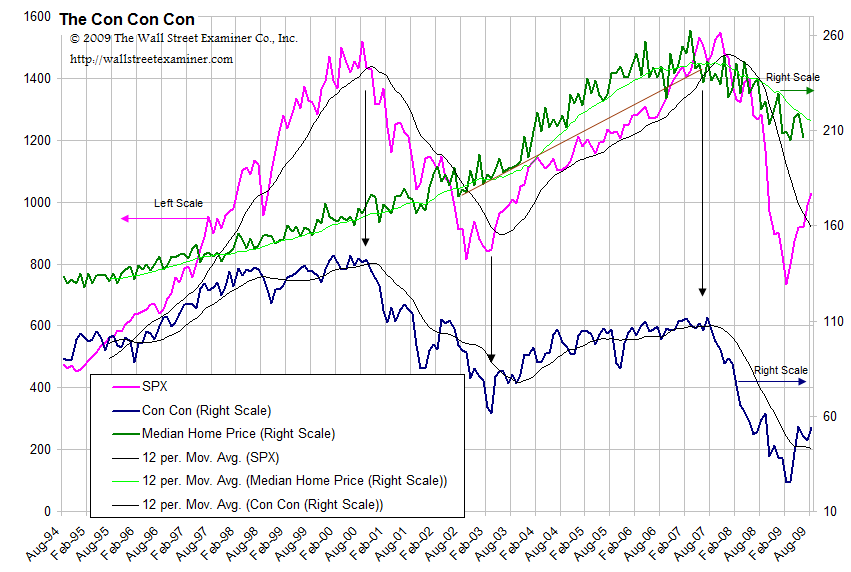
Click to enlarge
Then there’s the 5,000 people surveyed by the Conference Board every month. Look at how many of them had soured on things in 2006 and 2007, versus their level of optimism in 1999 and 2000.
A whole lot of ordinary people “got it.” Only the mainstream infomercial media didn’t get it, because they are, after all, on the payroll of the Wall Street Mob.
The fact is that the economy is not getting better. It is not healing. Nothing goes down in a straight line, especially when a government throws a couple trillion in debt at it. But those trillions are not endless. The kindness of strangers, namely foreign central banks who buy that debt, is not without limit. The time will come when the government will not be able to float more debt to pay off the existing debt, when the burden of paying back these wildly reckless bets will fall directly on the back of the US taxpayer.
We are facing a crisis much greater than any we have faced so far. The Fed will not continue to pump cash into the pockets of the Primary Dealers indefinitely as they have been doing since March. When that cash gusher stops, or even slows, the stock market will again collapse. It simply cannot be sustained at these levels without that subsidy.
As for the economy, over the next year, it will get worse, for all the reasons enumerated above. How much worse, I have no clue. I’m not an economist, thank goodness. What an embarrassment that would be. Obviously they have no clue either. They pretend. That’s all. They missed the biggest collapse in the last 75 years. Knowing what’s likely to happen is not their job. Their job is to talk a good game so that Wall Street can continue its game.
Ripping off the rest of us.
So Good Night, and Good Luck.
You’re going to need it.
Stay up to date with the machinations of the Fed, Treasury, and foreign central banks in the US market in the Fed Report in the Professional Edition, Money Liquidity, and Real Estate Package. Try it risk free for 30 days. Don’t miss another day. Get the research and analysis you need to understand these critical forces. Be prepared. Stay ahead of the herd. Click this link and get in RIGHT NOW!
For more great articles visit the Wall Street Examiner home page.
