Showing posts with label Mortgage loan. Show all posts

Wednesday, September 25, 2013

U.S. government to sue JPMorgan in mortgage case

English: Mortgage debt
The U.S. Justice Department is preparing to sue JPMorgan Chase & Co over mortgage bonds it sold in the run-up to the financial crisis, a sign the bank's legal troubles are not yet over.
A lawsuit, first reported by Reuters, could come as early as Tuesday, people familiar with the matter said on Monday.
JPMorgan spokesman Brian Marchiony and Justice Department spokeswoman Adora Andy Jenkins declined to comment.
The bank disclosed in August that federal prosecutors in California were conducting criminal and civil investigations into the bank's mortgage securities.
In those investigations, government lawyers have concluded that JPMorgan committed civil violations of securities laws in offering mortgage bonds from 2005 to 2007 that were backed by subprime and other risky residential mortgages.

The expected charges come less than one week after the largest U.S. bank paid $1 billion to resolve investigations into its "London Whale" trading scandal and issues surrounding the wrongful billing of credit-card customers. Read more >>
Enhanced by Zemanta

Tuesday, September 24, 2013

Long-feared mortgage meltdown is here

Third-quarter bank earnings will feel an unwelcome jolt as mortgage volume has fallen off a cliff. Banks large and small have been preparing investors for difficult revenue comparisons by preannouncing the bad news. JPMorgan Chase CFO Marianne Lake at a conference on Sept. 9 said the bank expected its mortgage origination business to post a net operating loss for the second half of 2013.

Cardinal Financial of McLean, Va., late on Thursday announced that its third-quarter mortgage loan originations had declined by roughly 40 percent from the second quarter, and that "the marketing gain percentage for mortgages sold has decreased during the third quarter due to increasing competitive pressure related to the changing market conditions."

Cardinal also said "Expense reduction and revenue enhancement measures have been and will continue to be implemented to offset the decrease in mortgage production and the decline in the marketing gain percentage," but that the bulk of the benefit of the cost declines wouldn't be realized until the fourth quarter. The bank was downgraded by several sell-side analysts on Thursday and Friday, and its shares dropped 5 percent Friday to close at $16.76  Read more >>
Enhanced by Zemanta

Friday, August 16, 2013

Report: Half of All Homes Are Being Purchased With Cash

More than half of all homes sold last year and so far in 2013 have been financed without a mortgage, according to an analysis by economists at Goldman Sachs Group.

The analysis estimates that around 20% of all homes sold before the housing crash were “all-cash” sales (or around 30% of sales by dollar volume). But over the past seven years, the all-cash share of sales has more than doubled, increasing by more than 30 percentage points, according to economists Hui Shan, Marty Young and Charlie Himmelberg.

The Goldman study analyzed home sales figures from the Census Bureau and the National Association of Realtors and mortgage-origination data from the Mortgage Bankers Association and Lender Processing Services.

The surprisingly large cash-share of purchases helps to explain why home sales have jumped over the past two years despite more muted increases in broad measures of new mortgage activity, such as the MBA’s mortgage application index.

There’s no exact way to know who is responsible for all of these cash purchases, though they are likely to include some combination of investors, foreign buyers, and wealthy homeowners that don’t want to go through the hassle of getting a mortgage before closing on a sale. Mortgage lending standards have sharply tightened up since the housing bubble, with banks scrutinizing borrowers’ tax returns and bank statements to verify their incomes and the source of their down payment. Read more >>
Enhanced by Zemanta

Wednesday, August 7, 2013

U.S. accuses Bank of America of mortgage-backed securities fraud

The U.S. government on Tuesday filed two civil lawsuits against Bank of America that accuse the bank of investor fraud in its sale of $850 million of residential mortgage-backed securities.

The lawsuits are the latest legal headache for the second-largest U.S. bank, which has already agreed to pay in excess of $45 billion to settle disputes stemming from the 2008 financial crisis.

While most of the cases Bank of America has already confronted pertain to its acquisitions of brokerage Merrill Lynch and home lender Countrywide, the lawsuits filed on Tuesday pertain to mortgages the government said were originated, securitized and sold by Bank of America's legacy businesses.

The residential mortgage-backed securities at issue, known as RMBS, were of a higher credit quality than subprime mortgage bonds and date to about January 2008, the government said, months after many Wall Street banks first reported billions of dollars in write-downs on their holdings of subprime mortgage securities. Read more >>
Enhanced by Zemanta

Wednesday, July 31, 2013

American Dream Slipping as Homeownership at 18-Year Low

English: An icon from the Crystal icon theme. ...
The U.S. homeownership rate, which soared to a record high 69.2 percent in 2004, is back where it was two decades ago, before the housing bubble inflated, busted and ripped more than 7 million Americans from their homes.

With ownership at 65 percent and home values rising, housing industry and consumer groups are pressing lawmakers to make the American Dream more inclusive by ensuring new mortgage standards designed to prevent another crash are flexible enough that more families can benefit from the recovery. Regulators are close to proposing a softened version of a rule requiring banks to keep a stake in risky mortgages they securitize, according to five people familiar with the discussions.

Lawmakers currently shaping housing finance are seeking to reduce the government’s role in keeping rates affordable for riskier borrowers while ensuring homeownership is within reach of minorities and first-time buyers who could be needed to sustain the housing recovery as borrowing costs rise from record lows. Who will be able to buy property depends on the balance they reach, according to Anthony Sanders, a professor of real estate finance at George Mason University in Fairfax Virginia. Read more >>
Enhanced by Zemanta

Friday, June 21, 2013

Every Asset That Depends on Cheap, Abundant Credit (Housing, Bonds, Stocks) Is Doomed

Doomed
Four words: financialization, debtocracy, diminishing returns. The entire global economy, developed and developing nations alike, is now dependent on cheap, abundant credit for everything: for "growth," for asset inflation, and ultimately for central state deficit spending, which props up all the cartels, rentier arrangements, fiefdoms and armies of toadies, lackeys, apparatchiks and embezzlers that suck off the Status Quo.

I have long endeavored to explain the harsh reality of neofeudal, neocolonial financialization: Neofeudalism and the Neocolonial-Financialization Model (May 24, 2012) and the neofeudal debtocracy that depends on low yields (interest rates) to enable enormous deficit spending: Why Krugman and the Keynesians Are Lackeys for the Neofeudal Debtocracy (April 24, 2013).

The wheels fall off the entire financialized debtocracy wagon once yields rise.There's nothing mysterious about this:

1. As interest rates/yields rise, all the existing bonds paying next to nothing plummet in market value

2. As mortgage rates rise, there's nobody left who can afford Housing Bubble 2.0 prices, so home prices fall off a cliff

3. Once you can get 5+% yield on cash again, few people are willing to risk capital in the equities markets in the hopes that they can earn more than 5% yield before the next crash wipes out 40% of their equity

4. As asset classes decline, lenders are wary of loaning money against these assets; if the collateral for the loan (real estate, bonds, stocks, etc.) are in a waterfall decline, no sane lender will risk capital on a bet that the collateral will be sufficient to cover losses should the borrower default.

Let's take a look at four charts about housing and household net worth. ------->>>
Enhanced by Zemanta

Tuesday, June 4, 2013

Reverse Mortgages Backfiring on Seniors

English: An icon from the Crystal icon theme. ...
As America's population ages, the hard sell is on for reverse mortgages. Promising happier days ahead, the former "Fonz," actor Henry Winkler, is giving the hard sell in relentless television ads. But the housing crash and the fiscal state of today's seniors are causing many of these loans to backfire.

Reverse mortgages were originally designed for seniors who wanted to take out their home equity to spend during retirement. Unlike a regular mortgage, they require no monthly payments, and the borrower can take out a lump sum or receive regular payments.

"The wealth in the home is, in most cases, wealth that is sitting idly when people have a hard time making ends meet on a day-to- day basis, so having access to that allows people to basically tap that cash to pay needs or to do more comprehensive financial planning," said Peter Bell, of the National Reverse Mortgage Association. Read more >>
Enhanced by Zemanta

Friday, May 24, 2013

Underwater Borrowers Becoming Accidental Landlords

Maria Wells said she never intended to be a landlord. She sells real estate; she doesn't invest in it. Now the Florida resident owns two properties. One was her son's, but he had to move to take a new job.

The other was hers, but she got married and moved in with her husband. She can't sell either because she is underwater on both mortgages, so she rents them. Maria is one of a growing cadre of what the Realtors have dubbed, "Accidental Landlords."

"When I get enough equity, I will definitely sell," said Wells, who has been able to manage the properties because the rental market is so good that the income covers the mortgage payments and taxes. She does not use a property manager, as she wants to make sure the homes are well-maintained and keep their value. She's had some good tenants, but also some nightmares.

"One of the tenants certainly surprised me. They decided to change a water filter and go out of town, and then I got the call that 500 gallons of water had gone into my home. Fifty thousand dollars later…," she recalled. Read more >>
Enhanced by Zemanta

Friday, August 24, 2012

Half of mortgage borrowers under 40 are underwater

Rising home prices helped nearly one million homeowners emerge from being underwater on their mortgages during the second quarter. But younger homeowners are still struggling to stay afloat, according to report from Zillow.

The percentage of borrowers who owed more on their homes than they were worth fell to 30.9% during the second quarter, down from 31.4% three months earlier, according to Zillow. Of the 15 million borrowers who were underwater during the quarter, a disproportionately large number are under the age of 40, said Zillow chief economist, Stan Humphries.

Nearly half, or 48%, of all mortgage borrowers under age 40 are underwater, about twice the rate of borrowers who are older. And that has created a sort of gridlock that could hinder the housing market's recovery, he said.

"We hear about tight inventory in many markets, and it's clear where this is coming from," he said. "Negative equity is trapping young people in their homes, preventing them from selling. These homes are like the very starter homes potential first-time homebuyers are seeking." Read more >>

Wednesday, May 30, 2012

Pending Sales of U.S. Homes Decrease by Most in a Year

The number of Americans signing contracts to buy previously owned homes fell in April by the most in a year, indicating the U.S. housing recovery remains uneven.

The index of pending home resales dropped 5.5 percent following a revised 3.8 percent gain the prior month, figures from the National Association of Realtors showed today in Washington. The median forecast of 42 economists surveyed by Bloomberg News called for no change in the measure.

Mortgage rates at record lows failed to sustain the pace of demand as some buyers may have waited for home prices to decline further. Limited access to credit and persistent foreclosures still weigh on housing, adding to concern it will remain a source of weakness for the world’s largest economy. Read more >>

Wednesday, May 9, 2012

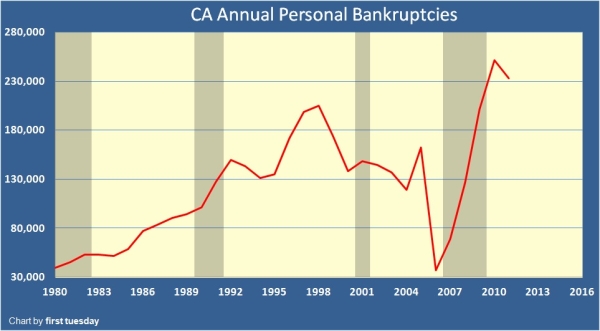
California Bankruptcies Increased 557% From 2006 to 2011

You essentially have a sub-group of folks with equity in their homes trying to trade to one another and first time buyers trying to scrape together enough for that 3.5 percent down payment FHA insured loan.  This is a reflection of a poor economy more than a healthy one.  Take a look at bankruptcies in the state:

bankruptcies in california

Keep in mind that the falloff in 2006 hit because of the rush to file in 2005 before bankruptcy law became tougher and more difficult to process.  We are very much near peak levels under these new stringent requirements.  In 2006 we were closer to 35,000 bankruptcy filings while last year we hit 230,000 (an increase of 557%). 

What this dramatic change signifies is that the underlying economy is still very weak and many people are unable to meet their current debts.  A large part of this is driven by housing debt via mortgages or HELOCs or other forms of debt based spending.  Keep in mind over 30 percent of California mortgage holders are currently underwater owing more on their home than it is currently worth. More...

Saturday, April 28, 2012

More Than 1 Million Americans Underwater on Home

House for sale Most options seem to be covered...
 (Photo credit: Wikipedia)
More than 1 million Americans who have taken out mortgages in the past two years now owe more on their loans than their homes are worth, and Federal Housing Administration loans that require only a tiny down payment are partly to blame.

That figure, provided to Reuters by tracking firm CoreLogic, represents about one out of 10 home loans made during that period.

It is a sobering indication the U.S. housing market remains deeply troubled, with home values still falling in many parts of the country, and raises the question of whether low-down payment loans backed by the FHA are putting another generation of buyers at risk.

As of December 2011, the latest figures available, 31 percent of the U.S. home loans that were in negative equity - in which the outstanding loan balance exceeds the value of the home - were FHA-insured mortgages, according to CoreLogic. More...

Friday, April 27, 2012

Mortgages Now On Sale at Costco

costco feeding frenzy
costco feeding frenzy (Photo credit: jovino)
Not only can Costco shoppers find bulk-packs of chicken wings, 24-rolls of toilet paper and large-screen TVs at a discount, they can now land themselves a mortgage.

After a year of testing, Costco is rolling out a full-service mortgage lending program on its website in partnership with First Choice Bank, a New Jersey-based community bank, and 10 other lenders.

Costco's partners have issued more than 10,000 mortgages to members under the program. But Lauren Kutschka, Costco's manager of financial services, expects that number to swell as the warehouse retailer markets the service more aggressively to millions of members in its stores and in its weekly publication Connection. More...

Wednesday, April 25, 2012

Student Loans: The Next Bailout?

Here’s what we do know about student loan debt: it’s roughly $1 trillion in size, greater than either auto or credit-card debt and second only to mortgage debt in the U.S.

Borrowers in their 30s today owe $28,500, on average. The debt burden has soared just as — and partly because — the recession hit, so younger graduates carrying the highest balances are hit with the double whammy of a weak job market (that still isn’t showing any sign of rapid improvement).

And this all comes as globalization and technological change have upended once-reliable career paths, wiped out many mid-level professional jobs and leave low-paying fields in health, food and beverage services, and retail as among the fastest growing job markets over the next decade. More...
Enhanced by Zemanta

Tuesday, July 19, 2011

Mortgage industry employees still signing unread documents and using fake signatures

Sign of a mortgage centre in East LondonImage via WikipediaMortgage industry employees are still signing documents they haven't read and using fake signatures more than eight months after big banks and mortgage companies promised to stop the illegal practices that led to a nationwide halt of home foreclosures.

County officials in at least three states say they have received thousands of mortgage documents with questionable signatures since last fall, suggesting that the practices, known collectively as "robo-signing," remain widespread in the industry.

The documents have come from several companies that process mortgage paperwork, and have been filed on behalf of several major banks. One name, "Linda Green," was signed almost two dozen different ways.

Lenders say they are working with regulators to fix the problem but cannot explain why it has persisted. More...
Enhanced by Zemanta

Wednesday, October 27, 2010

Bill Black On Foreclosuregate

Mortgage debtImage via WikipediaMust reading from ZeroHedge:

Bill Black On Foreclosuregate: Calls For The Immediate Termination Of Bernanke, Geithner And Holder

Bill Black, who will soon, together with Neil Barofsky, be a guaranteed shoe-in for the POTUS/VP position (both as independents, of course), was on the Ratigan show today, following on his op-ed from last week (here and here) calling for the long-overdue nationalization of Bank of America, and discussing the rampant fraud at the heart of mortgage gate. And contrary to ongoing lowball estimates from the like of JPM and Goldman, Black provides numbers about the bank liability that are simply stunning: "Credit Suisse says that by 2006 49% of all mortgage originations were liars loans. When independent folks study fraud, it is in the 80-90% fraud range. That means there were millions of acts of fraud.

Those loan frauds occurred because the banks created incentive structure for the loan brokers to bring them the absolute worst of the worst loans, and to lie on the application forms... These frauds came from the banks, and they propagated through the system through a series of echo epidemics...This fraud spread through the system and that's why we have a crisis in foreclosures. This stems from the underlying fraud by the lenders in mortgage loans to the tune of well over a million cases a year by 2005."

Furthermore, Black points out the glaringly obvious, that the Fed should not be in charge of any investigation into mortgage fraud, due to its "massive" conflict of interest, to the tune of $1.5 trillion in MBS/agencies held on the Fed's books, which would be immediately null and voided if rampant MBS fraud is indeed uncovered. Which is precisely why the entitlement of the Fed as supreme regulator (as inspired by the financial generosity of the Wall Street lobby) as part of Frank-Dodd was the one single most destructive decision ever made, and equivalent in many ways with electing America's very own tyrannical despot, whose only interest is making the multi billionaires, into trillionaires, and leaving everyone else in the cold through the eliminating of the savings class and the destruction of the reserve currency. More...
Enhanced by Zemanta

Wednesday, September 15, 2010

Home Loan Demand Drops, Refinancing Loses Luster

U.S. mortgage applications for home loan refinancing fell for a second straight week, dropping to its lowest level since early August, as rock-bottom interest rates failed to boost demand.

While historically low mortgage rates have been a glimmer of hope for a housing market that has struggled to find footing in the absence of government support, it failed to foster demand for loans to purchase a home last week.

The Mortgage Bankers Association on Wednesday said its seasonally adjusted index of mortgage applications, which includes both purchase and refinance loans, for the week ended Sept. 10 decreased 8.9 percent.

The four-week moving average of mortgage applications, which smooths the volatile weekly figures, was down 0.8 percent.

The MBA's seasonally adjusted index of refinancing applications decreased 10.8 percent, reaching its lowest level since the week ended August 6. More...

Saturday, September 11, 2010

Federal government funds nearly 100 percent of new mortgage loans

A stat which may be of great interest is the prediction by the average of the indexes that our fall in prices is only half-way accomplished – a forecast which, if true, will elicit fear in the hearts of homeowners, buyers, bankers and government officials.

A natural fall-back in prices is a matter of the highest gravity to the Federal Reserve Bank and the Treasury and to current and future homeowners. The federal government has massively intervened in the housing market. It funds nearly 100 percent of new mortgage loans originated today.

Fed and Treasury are attempting to preserve bubble values for homeowners and save mortgage investors. Absent government intervention, housing prices would have fallen 50 percent or 75 percent by now. Probably one-of-three or one-of-two mortgages would be in default. Global depression would surely have followed such a fall. More...

Sunday, August 29, 2010

One in 10 mortgage holders faces foreclosure

Half million dollar house in Salinas, Californ...Image via WikipediaOne in 10 American households with a mortgage was at risk of foreclosure this summer as the government's efforts to help have had little impact stemming the housing crisis.

About 9.9 percent of homeowners had missed at least one mortgage payment as of June 30, the Mortgage Bankers Association said Thursday.

That number, which is adjusted for seasonal factors, was down slightly from a record-high of more than 10 percent as of April 30.

In a worrisome sign, the number of homeowners starting to have problems with their mortgages rose after trending downward last year. The number of homes in the foreclosure process fell slightly, the first drop in four years.

More than 2.3 million homes have been repossessed by lenders since the recession began in December 2007, according to foreclosure listing service RealtyTrac Inc. Economists expect the number of foreclosures to grow well into next year.

The number of Americans missing payments and falling into foreclosure has followed the upward trend in unemployment, which has been near double digits all year and has shown no sign of dropping soon. More...

Thursday, December 31, 2009

Banks Spend Millions to buy off Congress

IMF Report: Lobbying and the Financial Crisis

Introduction:
On December 31, 2007, the Wall Street Journal reported that Ameriquest Mortgage and Countrywide Financial, two of the largest mortgage lenders in the nation, spent respectively $20.5 million and $8.7 million in political donations, campaign contributions, and lobbying activities from 2002 through 2006. The sought outcome, according to the article, was the defeat of anti-predatory lending legislation. In other words, timely regulatory response that could have mitigated reckless lending practices and the consequent rise in delinquencies and foreclosures was shut down by some mortgage lenders.

Such anecdotal evidence suggests that the political influence of the financial industry contributed to the 2007 mortgage crisis,which, in the fall of 2008, generalized in the worst bout of financial instability since the Great Depression. However, formal analysis of these assertions has so far remained scant. To the best of our knowledge, this is the first study to examine empirically the relationship between lobbying by financial institutions and mortgage lending in the run-up to the financial crisis.

We construct a unique dataset combining information on mortgage lending activities and lobbying at the federal level by the financial industry. By going through individual lobbying reports, we identify lobbying activities on issues specifically related to rules and regulations of consumer protection in mortgage lending, underwriting standards, and securities laws (henceforth, the “specific issues”).

The paper focuses on the mortgage lending behavior and performance of financial institutions. First, we analyze the relationship between lobbying and ex-ante characteristics of loans originated. We focus on three measures of mortgage lending: loan-to-income ratio(which we consider as a proxy for lending standards), proportion of loans sold (measuring recourse to securitization), and mortgage loan growth rates (positively correlated with risktaking).

Next, we analyze measures of ex-post performance of lobbying lenders. In particular, we explore whether, at the Metropolitan Statistical Area (MSA) level, delinquency rates – an indicator of loan quality - are associated with the expansion of lobbying lenders’ mortgage lending. More...