Showing posts with label Real estate. Show all posts

Friday, August 30, 2013

Decline in homeownership is changing neighborhoods

CNBC
Beneath the spreading shade tree in Laura Holcomb's front yard, there are some 70 varieties of hosta, stands of elephant ear and a Japanese maple. For the 17 years she has owned the brick house on Rose Trail Drive in Memphis' Hillshire subdivision, Ms. Holcomb has devoted herself to her home and garden.

Across the street, Carl Osborne and his family have been tenants for two years, moving in after the previous owner lost the house in a foreclosure. They are happy to have a decent place to call home but, like many renters, they have not done much to improve the appearance or join the community.

They are not alone: the family behind Ms. Holcomb, the one two doors down, and several in the cul-de-sac across the way are among the renters who have been supplanting homeowners in this blue-collar, suburban neighborhood as investors buy single-family homes and convert them to rentals.

"Used to, we knew our neighbors," Ms. Holcomb said. Then she gestured toward the few remaining owner-occupied houses nearby. "Except for the two that have been here, I don't know any of my neighbors."

Across the country, a growing number of single-family rentals provide an option for many who lost their homes in the housing crash through foreclosure and for those who cannot obtain a mortgage under today's tougher credit conditions.

But the decline in homeownership is also changing many neighborhoods in profound ways, including reduced home values, lower voter turnout and political influence, less social stability and higher crime. Read more >>
Enhanced by Zemanta

Wednesday, July 31, 2013

American Dream Slipping as Homeownership at 18-Year Low

English: An icon from the Crystal icon theme. ...
The U.S. homeownership rate, which soared to a record high 69.2 percent in 2004, is back where it was two decades ago, before the housing bubble inflated, busted and ripped more than 7 million Americans from their homes.

With ownership at 65 percent and home values rising, housing industry and consumer groups are pressing lawmakers to make the American Dream more inclusive by ensuring new mortgage standards designed to prevent another crash are flexible enough that more families can benefit from the recovery. Regulators are close to proposing a softened version of a rule requiring banks to keep a stake in risky mortgages they securitize, according to five people familiar with the discussions.

Lawmakers currently shaping housing finance are seeking to reduce the government’s role in keeping rates affordable for riskier borrowers while ensuring homeownership is within reach of minorities and first-time buyers who could be needed to sustain the housing recovery as borrowing costs rise from record lows. Who will be able to buy property depends on the balance they reach, according to Anthony Sanders, a professor of real estate finance at George Mason University in Fairfax Virginia. Read more >>
Enhanced by Zemanta

Friday, May 24, 2013

Underwater Borrowers Becoming Accidental Landlords

Maria Wells said she never intended to be a landlord. She sells real estate; she doesn't invest in it. Now the Florida resident owns two properties. One was her son's, but he had to move to take a new job.

The other was hers, but she got married and moved in with her husband. She can't sell either because she is underwater on both mortgages, so she rents them. Maria is one of a growing cadre of what the Realtors have dubbed, "Accidental Landlords."

"When I get enough equity, I will definitely sell," said Wells, who has been able to manage the properties because the rental market is so good that the income covers the mortgage payments and taxes. She does not use a property manager, as she wants to make sure the homes are well-maintained and keep their value. She's had some good tenants, but also some nightmares.

"One of the tenants certainly surprised me. They decided to change a water filter and go out of town, and then I got the call that 500 gallons of water had gone into my home. Fifty thousand dollars later…," she recalled. Read more >>
Enhanced by Zemanta

Wednesday, May 1, 2013

NYC Realtor Offers Employees Pay Raise For Getting Tattoo Of Company Logo

English: Tattoo parlor shop. New York City 2005
If your company offered you a pay raise to tattoo its logo on your body, would you do it? A New York City real estate company made the offer and dozens of employees are getting inked.

As CBS 2′s Emily Smith reported Tuesday, a tattoo can be a way to show off your personality. For Rapid Realty employees, it is the fast track to a 15 percent pay raise if you get inked with the company logo.

There are no size or location restrictions. Brooke Koropatnick got hers behind the ear.

“I had a paycheck coming in what was a substantial amount of money different, so it was nice,” she told Smith.

Stephanie Barry got tattooed two weeks ago and, along with it, a permanent pay raise for every real estate transaction. Read more >>
Enhanced by Zemanta

Friday, June 1, 2012

26% of U.S. Home Sales in First Quarter Were Foreclosures

English: Foreclosure Sign, Mortgage Crisis
Homes in some stage of foreclosure accounted for more than one in four home sales during the first three months of the year, according to a report released Thursday. Distressed properties that were either in default, scheduled for auction or bank-owned accounted for 26% of all residential sales during the first quarter, up from 22% in the previous quarter and 25% a year earlier, RealtyTrac said.

Altogether, 233,299 distressed properties were purchased during the quarter, an 8% increase from the previous quarter. Those homes sold for an average of $161,214, 27% below the average price of a home not in foreclosure.

"Foreclosure-related sales picked up in the first quarter, particularly pre-foreclosure sales where a distressed homeowner is selling to avoid foreclosure -- typically via a short sale," Brandon Moore, chief executive of RealtyTrac said in a statement. Read more >>

Wednesday, May 9, 2012

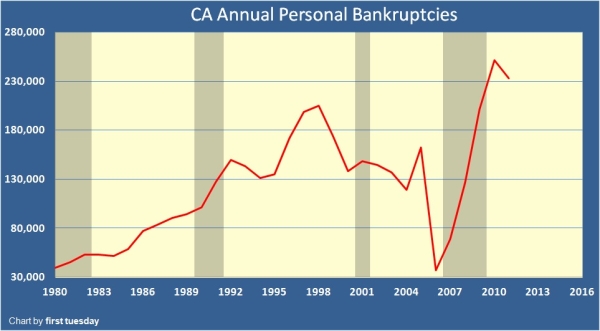
California Bankruptcies Increased 557% From 2006 to 2011

You essentially have a sub-group of folks with equity in their homes trying to trade to one another and first time buyers trying to scrape together enough for that 3.5 percent down payment FHA insured loan.  This is a reflection of a poor economy more than a healthy one.  Take a look at bankruptcies in the state:

bankruptcies in california

Keep in mind that the falloff in 2006 hit because of the rush to file in 2005 before bankruptcy law became tougher and more difficult to process.  We are very much near peak levels under these new stringent requirements.  In 2006 we were closer to 35,000 bankruptcy filings while last year we hit 230,000 (an increase of 557%). 

What this dramatic change signifies is that the underlying economy is still very weak and many people are unable to meet their current debts.  A large part of this is driven by housing debt via mortgages or HELOCs or other forms of debt based spending.  Keep in mind over 30 percent of California mortgage holders are currently underwater owing more on their home than it is currently worth. More...

Friday, April 27, 2012

U.S. Homeownership Hits Decade Low

PRINCETON, NJ - The 62% of Americans who say they own their own home marks a new low since Gallup began tracking self-reported homeownership in 2001.
U.S. Homeownership Rates, 2001-2012 Trend
The current level of homeownership marks a decline from 68% in 2011. For most of the prior decade, roughly seven in 10 Americans reported owning their own home. While the recession and financial crisis took place in 2008-2009, homeownership rates didn't begin to reflect the bursting of the housing bubble until 2010, when 65% of Americans reported owning their own home -- the lowest level recorded before this year. More...
Enhanced by Zemanta

Wednesday, December 14, 2011

Realtors: We Overcounted Home Sales for Five Years

Logo of the National Association of Realtors.Image via WikipediaData on sales of previously owned U.S. homes from 2007 through October this year will be revised down next week because of double counting, indicating a much weaker housing market than previously thought.

The National Association of Realtors said a benchmarking exercise had revealed that some properties were listed more than once, and in some instances, new home sales were also captured.

"All the sales and inventory data that have been reported since January 2007 are being downwardly revised. Sales were weaker than people thought," NAR spokesman Walter Malony told Reuters.

"We're capturing some new home data that should have been filtered out and we also discovered that some properties were being listed in more than one list." More...
Enhanced by Zemanta

Monday, October 31, 2011

Home prices heading for triple-dip

Willowood Townhomes in Salinas, California.Image via WikipediaThe besieged housing market has even further to fall before home prices really hit rock bottom. According to Fiserv, a financial analytics company, home values are expected to fall another 3.6% by next June, pushing them to a new low of 35% below the peak reached in early 2006 and marking a triple dip in prices.

Several factors will be working against the housing market in the upcoming months, including an increase in foreclosure activity and sustained high unemployment, explained David Stiff, Fiserv's chief economist.

Should home values meet Fiserv's expectations, it would make it the third (and lowest) trough for home prices since the housing bubble burst.

The first post-bubble bottom was hit in 2009, when prices fell to 31% below peak. The First-Time Homebuyer Credit helped perk prices up by mid-2010, but by the time the credit expired, prices fell again. More...
Enhanced by Zemanta

Friday, October 28, 2011

Shanghai Homeowners Smash Showroom in Protest Over Falling Prices

SHANGHAI, CHINA - OCTOBER 14:  An security gua...Image by Getty Images via @daylifeA weekend scuffle in Shanghai over a drop in apartment prices adds to increasing evidence that China’s efforts to tame a surging property market are having an impact – even as it offers a hint of what could happen if the measures go too far.

A group of around 400 homeowners in Shanghai demonstrated publicly and damaged a showroom operated by their property developer after the company said it cut prices. Home buyers had wanted to speak with the developer to refund or cancel their contracts but were unsuccessful, according to local media. One report said the price cuts exceeded 25% per square meter.

The local media reports said an unspecified number of people were injured. The property developer, a unit of China Overseas Holdings Ltd., didn’t respond to requests for comment. Photos of the event showed broken glass in the sales office, homeowners marching with banners and a phalanx of police watching over. More...
Enhanced by Zemanta

Tuesday, September 27, 2011

Hundreds sell their own burial plots to make some quick cash


Holly Purkey, 28, is one of many Floridians trying to sell her pre-purchased burial plots for some quick cash. She is selling two burial plots in Forest Hills Memorial Park in Palm City. "This is new to me. Kind of a weird investment," said Purkey, of Port St. Lucie.

The side-by-side plots belonged to her grandparents, who had moved out of state. She bought them seven years ago. Now Purkey, a stay at home mother, wants this cemetery real estate off her hands. She would like $3,000 for the pair of plots in return. "The money would help. That's the reason why I should get these on Craigslist and do something about it," she said.

Sellers are posting online, using burial plot brokers, and also funeral homes to market the real estate. Some of those advertisements show single plots starting at about $1,000, while family plots can go for up to $50,000. More...


Enhanced by Zemanta

Wednesday, July 6, 2011

Foreign buyers lifting U.S. home sales

Foreign buyers are helping to stoke home sales in U.S. vacation hot spots decimated by the real estate crash, especially in southern Florida.

For the 12 months ending in March, 31% of Florida's home sales were to foreign buyers, up from 10% in 2007, according to a survey by the National Association of Realtors.

In Arizona, 6% of sales in the same period were to foreigners. That was down from 11% last year but still up from 5% in 2007, the data show.

Foreign buyers are being enticed by low U.S. home prices, down 30% nationwide since peaking in 2006, and the weakened dollar, which makes their money go further. Since the start of 2006, the Canadian dollar has soared 18% against the U.S. dollar, while the euro has gained 22%, says data tracker Oanda.

U.S. home prices, meanwhile, have fallen far more than the national average in some places — down 55% from their peaks in Miami-Fort Lauderdale and Phoenix and 36% in Los Angeles, says Zillow.com. Those are three of the most popular areas for foreigners searching for real estate on Trulia's website, that company says. More...
Enhanced by Zemanta

Tuesday, May 24, 2011

Nation’s biggest banks and mortgage lenders acquire a glut of foreclosed homes

MIAMI - DECEMBER 07:  A bank owned sign is see...Image by Getty Images via @daylifeThe nation’s biggest banks and mortgage lenders have steadily amassed real estate empires, acquiring a glut of foreclosed homes that threatens to deepen the housing slump and create a further drag on the economic recovery.

All told, they own more than 872,000 homes as a result of the groundswell in foreclosures, almost twice as many as when the financial crisis began in 2007, according to RealtyTrac, a real estate data provider. In addition, they are in the process of foreclosing on an additional one million homes and are poised to take possession of several million more in the years ahead.

Five years after the housing market started teetering, economists now worry that the rise in lender-owned homes could create another vicious circle, in which the growing inventory of distressed property further depresses home values and leads to even more distressed sales. With the spring home-selling season under way, real estate prices have been declining across the country in recent months. More...
Enhanced by Zemanta

Monday, May 9, 2011

‘Underwater’ Homeowners Rise to 28 Percent

More than 28 percent of U.S. homeowners owed more than their properties were worth in the first quarter as values fell the most since 2008, Zillow Inc. said today.

Homeowners with negative equity increased from 22 percent a year earlier as home prices slumped 8.2 percent over the past 12 months, the Seattle-based company said. About 27 percent of homes were “underwater” in the fourth quarter, according to Zillow, which runs a website with property-value estimates and real-estate listings.

Home prices fell 3 percent in the first quarter and will drop as much as 9 percent this year as foreclosures spread and unemployment remains high, Zillow Chief Economist Stan Humphries said. Prices won’t find a floor until 2012, he said.

“We get tired of telling such a grim story, but unfortunately this is the story that needs to be told,” Humphries said in a telephone interview. “Demand is still quite anemic due to unemployment and the fact that home values are still falling. And that tends to make people more cautious about buying.” More...
Enhanced by Zemanta

Friday, February 11, 2011

Homeownership falling at alarming pace - 11 Percent of US Houses Empty

America's home ownership rate, after holding steady for a while, took a pretty big plunge in Q4, from 66.9 percent to 66.5 percent. That's down from the 2004 peak of 69.2 percent and the lowest level since 1998.
Homeownership is falling at an alarming pace, despite the fact that home prices have fallen, affordability is much improved and inventories of new and existing homes are still running quite high.
Bargains abound, but few are interested or eligible to take advantage.

More concerning than the home ownership rate is the vacancy rate. The Census tables don't tell the entire story, but they tell a lot of it. Of the nearly 131 million housing units in this country, 112.5 million are occupied. 74.8 million are owned, and that's only dropped by about 30 thousand in the past year. 38 million are rented, but that's up by over a million year over year. That means more new households are choosing to rent. Read more...
Enhanced by Zemanta

Thursday, October 14, 2010

More Than 100,000 Homes Repossessed in September

Foreclosure Sign, Mortgage CrisisImage via WikipediaThe number of homes repossessed by banks reached a record total of 102,134, crossing the 100,000 mark for the first time in a single month, according to real estate data company RealtyTrac.

"Lenders foreclosed on a record number of properties in September and in the third quarter, taking a bite out of the backlog of distressed properties where the foreclosure process was delayed by foreclosure prevention efforts over the past 20 months," said CEO of RealtyTrac James Saccacio.

Foreclosure filings, which include default notices, scheduled auctions and bank repossessions, rose 3% in September to 347,420, and increased almost 1% from September 2009.

See full article from DailyFinance: http://srph.it/9pOC9u

Wednesday, August 25, 2010

The trillion dollar bailout you didn’t hear about

Commercial real estate values plummet again yet banks hide losses. A $3.5 trillion financial disaster in the making. We are now proud owners of an AMC theater and Chick-fil-A.

The latest data on existing home sales should tell you exactly where we are in this so called recovery. Average Americans are unable to purchase big ticket items without massive government subsidies. It is also the case that all the too big to fail banks are standing only because of the generous support of taxpayer money. Without large tax credits and the Federal Reserve buying down mortgage rates the housing market is extremely weak. Yet very few of the housing “analysts” actually bother to ask why they are weak in the first place. The employment market is in disarray and wages have fallen for everyone outside of the top 1 percent of income earners. The bailout fatigue is running out of steam but banks are using clandestine methods to offload trillions of dollars of commercial real estate to taxpayers. The next giant bailout is already happening but you probably haven’t heard about it.

For the latest month of data prices fell an additional 4 percent. Now this is coming at a seasonal time when real estate values usually see price increases. But people are pulling back and spending less money on discretionary items. This is happening for a couple of reasons including the fact that wages have been stagnant for over a decade and the underemployment rate is still near peak levels. Commercial real estate in places like Las Vegas has crashed because who is out buying million dollar condos in this market? Very few and that is why you are seeing many places having vacancy rates of 50, 60, or even 70 percent. More...

Sunday, August 1, 2010

Foreclosures Continue To Increase Dramatically In 2010

LAS VEGAS - NOVEMBER 13:  A sign welcoming peo...Image by Getty Images via @daylife

Michael Snyder
In a very alarming sign for the U.S. economy, foreclosures have continued to dramatically increase in 2010. But there has been a shift. Back in 2007 and 2008, experts tell us that most foreclosures were due to toxic mortgages. People were being suckered into mortgages that they couldn't afford with "teaser rates" or with payments that would dramatically escalate after a few years, and when those mortgages reset, the people who had agreed to them no longer could make the payments.

But now RealtyTrac says that unemployment has become the major reason for foreclosures. Millions of Americans have become chronically unemployed during the economic downturn and many of them are losing their homes as a result. But whatever the cause, one thing is certain - foreclosures have continued to skyrocket at a staggering rate.

According to a new report from RealtyTrac, foreclosure filings climbed in 75% of the nation's metro areas during the first half of 2010. At a time when the Obama administration believes that we are "turning the corner", things just seem to get even worse.

Some areas of the country continue to be complete and total disaster areas when it comes to real estate. For example, you have got to feel really sorry for anyone trying to sell a house down in Florida right now. According to RealtyTrac, Florida led the way with nine of the top 20 metro foreclosure rates in the country during the first half of 2010.

But the worst city for foreclosures continues to be Las Vegas.

According to RealtyTrac spokesman Rick Sharga, unemployment has replaced bad loans as the number one cause of foreclosures there....

"Las Vegas has seamlessly shifted from having a high level of foreclosures due to bad loans to defaults caused by a high level of unemployment."

But other cities with high unemployment rates are having huge problems as well.

For those who believe that the economy is supposed to be "improving", it must seem really odd that foreclosure rates in major cities such as Chicago continue to soar.

RealtyTrac says that foreclosure filings in Chicago have increased 23 percent year-over-year to one out of every 48 households.

But it isn't just cities like Las Vegas and Chicago that are nightmares right now.

The truth is that this is a national crisis.

The Mortgage Bankers Association recently announced that more than 10% of all U.S. homeowners with a mortgage had missed at least one mortgage payment during the January to March time period. That was a new all-time record and represented an increase from 9.1 percent a year ago.

Unfortunately, new all-time records are being set all over the place....

*The number of home foreclosures set a record for the second consecutive month in May.

*Banks repossessed 269,962 U.S. homes during the second quarter of 2010, which was a new all-time record.

*As of March, U.S. banks had an inventory of approximately 1.1 million foreclosed homes, which was a new record and which was up 20 percent from a year ago. More...

Thursday, July 29, 2010

Foreclosures up in 75 percent of top U.S. metro areas

ALTADENA, CA - JULY 25:  A foreclosed home is ...Image by Getty Images via @daylife

Foreclosures rose in 3 of every four large U.S. metro areas in this year's first half, likely ruling out sustained home price gains until 2013, real estate data company RealtyTrac said on Thursday.

Unemployment was the main culprit driving foreclosure actions on more than 1.6 million properties, the company said.

"We're not going to see meaningful, sustainable home price appreciation while we're seeing 75 percent of the markets have increases in foreclosures," RealtyTrac senior vice president Rick Sharga said in an interview.

Foreclosure actions -- which include notice of default, scheduled auction and repossession -- in the first half rose in 154 of the 206 metro areas with populations 200,000 or more.

"We're not going to see real price appreciation probably until 2013," said Sharga. "We don't see a double dip in housing but we think it's going to be a long painful recovery for the next three years."

Nine of the 10 areas slammed hardest by the foreclosure tidal wave improved from the first half of 2009, suggesting a peak at rates that are still up to five times the national average, RealtyTrac said in its midyear 2010 metropolitan foreclosure report.

Cities with the 20 highest foreclosure rates were all in Florida, California, Nevada and Arizona. More...

Tuesday, July 20, 2010

Home construction sinks to lowest level since Oct.

Big single-family homeImage via Wikipedia

Home construction plunged last month to the lowest level since October as the economy remained weak and demand for housing plummeted.

But driving the June decline was a more than 20 percent drop in condominium and apartment construction, which makes up a small but volatile portion of the housing market. Construction of single-family homes, the largest part of the market, was down slightly. It dropped 0.7 percent.

Overall, construction of new homes and apartments in June fell 5 percent from a month earlier to a seasonally adjusted annual rate of 549,000, the Commerce Department said Tuesday. May's figure was revised downward to 578,000.

One bright area of the report was an increase in building permit applications, which are a sign of future activity. They rose 2.1 percent from a month earlier to an annual rate of 586,000, however this was also driven by apartment construction.

A slumping job market and competition from foreclosed properties have forced builders to limit construction, especially after tax credits that spurred sales expired at the end of April.

"The housing market remains the Achilles heel of the recovery," said M. Cary Leahey, a senior economist at Decision Economics. "It is hard to imagine confidence recovering to healthy levels until the housing market experiences much less distress." More...