Showing posts with label Mortgages. Show all posts

Wednesday, May 9, 2012

California Bankruptcies Increased 557% From 2006 to 2011

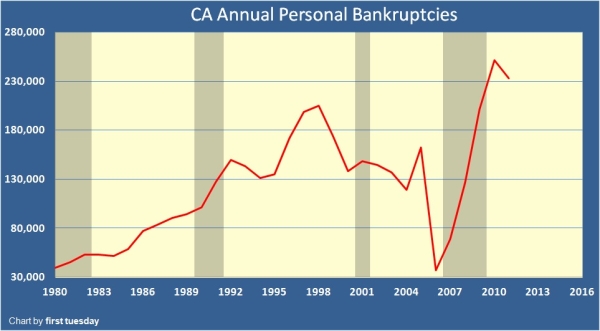
You essentially have a sub-group of folks with equity in their homes trying to trade to one another and first time buyers trying to scrape together enough for that 3.5 percent down payment FHA insured loan.  This is a reflection of a poor economy more than a healthy one.  Take a look at bankruptcies in the state:

bankruptcies in california

Keep in mind that the falloff in 2006 hit because of the rush to file in 2005 before bankruptcy law became tougher and more difficult to process.  We are very much near peak levels under these new stringent requirements.  In 2006 we were closer to 35,000 bankruptcy filings while last year we hit 230,000 (an increase of 557%). 

What this dramatic change signifies is that the underlying economy is still very weak and many people are unable to meet their current debts.  A large part of this is driven by housing debt via mortgages or HELOCs or other forms of debt based spending.  Keep in mind over 30 percent of California mortgage holders are currently underwater owing more on their home than it is currently worth. More...

Wednesday, September 15, 2010

Home Loan Demand Drops, Refinancing Loses Luster

U.S. mortgage applications for home loan refinancing fell for a second straight week, dropping to its lowest level since early August, as rock-bottom interest rates failed to boost demand.

While historically low mortgage rates have been a glimmer of hope for a housing market that has struggled to find footing in the absence of government support, it failed to foster demand for loans to purchase a home last week.

The Mortgage Bankers Association on Wednesday said its seasonally adjusted index of mortgage applications, which includes both purchase and refinance loans, for the week ended Sept. 10 decreased 8.9 percent.

The four-week moving average of mortgage applications, which smooths the volatile weekly figures, was down 0.8 percent.

The MBA's seasonally adjusted index of refinancing applications decreased 10.8 percent, reaching its lowest level since the week ended August 6. More...

Saturday, September 11, 2010

Federal government funds nearly 100 percent of new mortgage loans

A stat which may be of great interest is the prediction by the average of the indexes that our fall in prices is only half-way accomplished – a forecast which, if true, will elicit fear in the hearts of homeowners, buyers, bankers and government officials.

A natural fall-back in prices is a matter of the highest gravity to the Federal Reserve Bank and the Treasury and to current and future homeowners. The federal government has massively intervened in the housing market. It funds nearly 100 percent of new mortgage loans originated today.

Fed and Treasury are attempting to preserve bubble values for homeowners and save mortgage investors. Absent government intervention, housing prices would have fallen 50 percent or 75 percent by now. Probably one-of-three or one-of-two mortgages would be in default. Global depression would surely have followed such a fall. More...

Thursday, December 31, 2009

Banks Spend Millions to buy off Congress

IMF Report: Lobbying and the Financial Crisis

Introduction:
On December 31, 2007, the Wall Street Journal reported that Ameriquest Mortgage and Countrywide Financial, two of the largest mortgage lenders in the nation, spent respectively $20.5 million and $8.7 million in political donations, campaign contributions, and lobbying activities from 2002 through 2006. The sought outcome, according to the article, was the defeat of anti-predatory lending legislation. In other words, timely regulatory response that could have mitigated reckless lending practices and the consequent rise in delinquencies and foreclosures was shut down by some mortgage lenders.

Such anecdotal evidence suggests that the political influence of the financial industry contributed to the 2007 mortgage crisis,which, in the fall of 2008, generalized in the worst bout of financial instability since the Great Depression. However, formal analysis of these assertions has so far remained scant. To the best of our knowledge, this is the first study to examine empirically the relationship between lobbying by financial institutions and mortgage lending in the run-up to the financial crisis.

We construct a unique dataset combining information on mortgage lending activities and lobbying at the federal level by the financial industry. By going through individual lobbying reports, we identify lobbying activities on issues specifically related to rules and regulations of consumer protection in mortgage lending, underwriting standards, and securities laws (henceforth, the “specific issues”).

The paper focuses on the mortgage lending behavior and performance of financial institutions. First, we analyze the relationship between lobbying and ex-ante characteristics of loans originated. We focus on three measures of mortgage lending: loan-to-income ratio(which we consider as a proxy for lending standards), proportion of loans sold (measuring recourse to securitization), and mortgage loan growth rates (positively correlated with risktaking).

Next, we analyze measures of ex-post performance of lobbying lenders. In particular, we explore whether, at the Metropolitan Statistical Area (MSA) level, delinquency rates – an indicator of loan quality - are associated with the expansion of lobbying lenders’ mortgage lending. More...