Wake Up, America: Forced vaccinations, quarantine camps, health care interrogations and mandatory "decontaminations"
(NaturalNews) The United States of America is devolving into medical fascism and Massachusetts is leading the way with the passage of a new bill, the "Pandemic Response Bill" 2028, reportedly just passed by the MA state Senate and now awaiting approval in the House. This bill suspends virtually all Constitutional rights of Massachusetts citizens and forces anyone "suspected" of being infected to submit to interrogations, "decontaminations" and vaccines.
It's also sets fines up to $1,000 per day for anyone who refuses to submit to quarantines, vaccinations, decontamination efforts or to follow any other verbal order by virtually any state-licensed law enforcement or medical personnel. You can read the text yourself here: http://www.mass.gov/legis/bills/sen...
Here's some of the language contained in the bill:
(Violation of 4th Amendment: Illegal search and seizure)
During either type of declared emergency, a local public health authority... may exercise authority... to require the owner or occupier of premises to permit entry into and investigation of the premises; to close, direct, and compel the evacuation of, or to decontaminate or cause to be
decontaminated any building or facility; to destroy any material; to restrict or prohibit assemblages of persons;
(Violation of 14th Amendment; illegal arrest without a warrant)
...an officer authorized to serve criminal process may arrest without a warrant any person whom the officer has probable cause to believe has violated an order given to effectuate the purposes of this subsection and shall use reasonable diligence to enforce such order. [Gunpoint]
(Government price controls)
The attorney general, in consultation with the office of consumer affairs and business regulation, and upon the declaration by the governor that a supply emergency exists, shall take appropriate action to ensure that no person shall sell a product or service that is at a price that unreasonably exceeds the price charged before the emergency.
"Involuntary Transportation" (also known as kidnapping)
Law enforcement authorities, upon order of the commissioner or his agent or at the request of a local public health authority pursuant to such order, shall assist emergency medical technicians or other appropriate medical personnel in the involuntary transportation of such person to the tuberculosis treatment center.
$1,000 / day in fines
Any person who knowingly violates an order, as to which noncompliance
poses a serious danger to public health as determined by the commissioner or the local public health authority, shall be punished by imprisonment for not more than 30 days or a fine of not more than one thousand dollars per day that the violation continues, or both.
Forced vaccinations
Furthermore, when the commissioner or a local public health authority within its jurisdiction determines that either or both of the following measures are necessary to prevent a serious danger to the public health the commissioner or local public health authority may exercise the following authority: (1) to vaccinate or provide precautionary prophylaxis to individuals as protection against communicable disease...
Forced quarantine for those who refuse (illegal imprisonment without charge)
An individual who is unable or unwilling to submit to vaccination or treatment shall not be required to submit to such procedures but may be isolated or quarantined pursuant to section 96 of chapter 111 if his or her refusal poses a serious danger to public health or results in uncertainty whether he or she has been exposed to or is infected with a disease or condition that poses a serious danger to public health, as determined by the commissioner, or a local public health authority operating within its jurisdiction.
Read it yourself. Toggle to full screen at top right.
Massachusetts : Quarantine or 30 day jail for refusing the toxic H1N1 vaccine
Saturday, August 29, 2009

Friday, August 28, 2009
Barney Frank Says House Will Pass Audit the Fed Bill
Yeah, promises, promises. Barney Frank Says House Will Pass Ron Paul's HR1207 to Audit the Fed in October.
Economic Collapse: Bank Runs, China, Peter Schiff, Gerald Celente, Max Keiser
Max Kaiser speaks about the predicted bank run and currency destruction of the US economy. He also speaks about how China will be on top of the depression because they are spending their stimulus on domestic growth.
![Reblog this post [with Zemanta]](http://img.zemanta.com/reblog_e.png?x-id=a97fdb03-41e8-4144-8159-174b1b9c5fd2)
Allen Stanford May Have Ties To Satanic Cult and Drug Money
 Image by Getty Images via Daylife
At a meeting in 2003, they became blood brothers, cutting their wrists and mixing their blood in a “brotherhood ceremony” that Mr. Stanford’s chief financial officer said promoted an elaborate scheme to hide a multibillion-dollar fraud from American and other regulators.
The assertion that the two took a “blood oath” was laid out in a plea agreement signed by the officer, James M. Davis, and filed Thursday. After the pact, Leroy King, Antigua’s chief banking supervisor, called Mr. Stanford “Big Brother.” He received Super Bowl tickets, valued at thousands of dollars, for himself and his girlfriend. And he accepted regular bribe payments from a secret Swiss bank account that Mr. Davis said he was told to handle by Mr. Stanford....the plea agreement offered an assortment of new details, particularly about the relationship between Mr. Stanford and Mr. King, who ran Antigua’s Financial Services Regulatory Commission for much of the last decade. He has been arrested in Antigua and is awaiting extradition to the United States. Shortly after their 2003 blood-brother ceremony, which also included a second, unnamed Antiguan regulator...
Mr. Justin Simon [Attorney General of Antigua and Barbuda] said in an interview that he had become aware of the blood-brotherhood ceremony from his own sources. “It is believable,” he said. “As far as how many people are involved, we are still investigating.”
The FBI and other agencies have been conducting an ongoing investigation of Stanford since 2008 for possible involvement in money laundering for Mexico's Gulf Cartel.
Background on Gulf Cartel:
The Gulf Cartel (Spanish: Cártel del Golfo) is a Mexican drug trafficking cartel based in Matamoros, Tamaulipas. The cartel is present in 13 states with important areas of operation in the cities of Nuevo Laredo, Miguel Alemán, Reynosa and Matamoros in the northern state of Tamaulipas; it also has important operations in the states of Nuevo León and in Michoacán.[1] The Gulf Cartel traffics cocaine, marijuana, methamphetamine and heroin across the U.S.-Mexico border to major cities in the United States. The group is known for its violent methods and intimidation, and works closely with corrupt law officials and business people in Mexico as well as in the United States.
Aside from earning money from the sales of narcotics, the cartel also extorts "taxes" from local businesses in exchange of "protection". Anyone passing narcotics or aliens through Gulf Cartel territory is subject to payment of these "taxes" to the cartel. The Gulf cartel does not limit itself solely to narcotics trafficking, as they are known to kidnap people for ransom money."
Investigative sources told ABC...that mexican authorities had seized one of Sir Allen's private jets as part of an inquiry into the cartel's activities. Inside the cabin of the Gulfstream jet police found cheques connected to it.
In February 2009, the Guardian reported:
An FBI source close to the investigation would not give exact details but confirmed the agency was looking at links to international drug gangs as part of the huge investigation into Stanford's banking activities. Reports in the US have said Mexican authorities have detained one of Stanford's private planes as part of an investigation into possible links to the Gulf Cartel. It has been alleged cheques found inside the plane were linked to the cartel, which is one of the most violent criminal organisations in the world.
Sources in the US Drug Enforcement Administration also confirmed that while the investigations into Stanford's affairs were "with the FBI and Securities Exchange Commission, there may well have been a trail connecting his Mexican affairs to narco-trafficking interests. So far as we understand from information partially in the public domain, this has pertained to the Gulf Cartel, and items found aboard a private light aircraft. I think we'll find that any possible drug-related trail and SEC priorities are not all in the same frame."
Asked whether the aircraft seizures were an isolated incident in the overall investigation, the official said: "It's not going to be as if they would check every plane. Any connections to the narcos would have been followed for some time, and US law enforcement has been working with Mexico's banking regulators on a vast range of investigations, including Stanford's interests, for some time.
Also in February 2009, Barbados Money Laundering and Offshore Business Advisory reported:
Stanford May Have Laundered Drug Money for Mexican Cartel
I have been following the Sir Allen Stanford scandal for a while, and now the talk has turned to money laundering, which is the topic of this blog.
An ABC News article (see below) said:
“Authorities say Stanford could potentially face criminal charges of money laundering and bribery of foreign officials.“
The article continued:
“… checks found inside the [Stanford's] plane were believed to be connected to the Gulf cartel, reputed to be Mexico’s most violent gang.”
At least one high-level member of the previous Barbados Labour Party Government has had official business dealings with Sir Allen. I am not casting aspersions, I am just making the point that Sir Allen touched many lives. People from all over the Caribbean, including Barbados, are involved, legitimately or otherwise, with Sir Allen’s business. Probing questions are likely to be asked.
At this point in time, there are probably a few Barbadians who are sick with worry over this investigation. The problem is that even if a person acted in good faith in his/her dealings with Sir Allen, suspicions may arise. Will the FBI’s investigation reach the shores of Barbados? Does the US have an extradition treaty with Barbados?
ABC News: Accused Financier Under Federal Drug Investigation, by JUSTIN ROOD and BRIAN ROSS – February 18, 2009
Authorities tell ABC News that as part of the investigation, which has been ongoing since last year, Mexican authorities detained one of Stanford’s private planes. According to officials, checks found inside the plane were believed to be connected to the Gulf cartel, reputed to be Mexico’s most violent gang. Authorities say Stanford could potentially face criminal charges of money laundering and bribery of foreign officials.
Authorities say the SEC action against Stanford Tuesday may have complicated the federal drug investigation.
The ABC article continues:
A video posted on the firm’s web-site shows Stanford, now sought by U.S. Marshals, being hugged by Speaker of the House Nancy Pelosi and praised by former President Bill Clinton for helping to finance a convention-related forum and party put on by the National Democratic Institute.
Sir Allen’s generosity was not confined to Democrats. He is reported to have helped the disgraced Former House Majority Leader Tom DeLay (R-Texas).
Are Barbadian politicians required to report political donations? Barbados Free Press irreverently asks the question: “How Many “Political Donations” Did Sir R. Allen Stanford Give To Barbados Politicians?”
Sir Allen lived in the Caribbean, and demonstrated an interest in local affairs. He had close ties with P.M. Bird of Antigua [NY Times]:
Around that time, Mr. Stanford had also become an adviser to Lester Bird, then Antigua’s prime minister, who formed a banking advisory board to clean up the country’s image. Mr. Stanford’s bank was the largest bank regulated by the board. The project was paid for by the Antiguan government from money lent or granted by Mr. Stanford.
This man has gone from being a hero to a villain in a very short space of time. This reminds me of the “Lord Conrad Black” story. Here are the similarities:
- both men were fabulously rich and from rich countries
- both settled in a poor Caribbean countries, where they were involved with politics
- both are reported to have made political contributions to multiple political candidates in different countries
- both received titles
- both were charged with fraud
In March 2009, "Illuminati Under the Microscope" writes:
The following article provides linkage between a ruthless drug gang in Mexico, known as the Gulf Cartel and its close association with the suspected satanic cult known as "Saint Death" or in Spanish "La Santa Muerte" and the Bush and Biden clans.
BACKGROUND ON GULF CARTEL:
This Mexican organized crime syndicate has its roots in bootlegging booze / alcohol into the USA through smuggling routes in northern Mexico. www.en.wikipedia.org/wiki/Gulf_Cartel .
See also:
www.janes.com/news/lawenforcement/jir/jir071205_1_n.shtml
BACKGROUND ON LA SANTA MUERTE CULT:
The image is that of a skeleton dressed in clothing similar to that worn by the Virgin of Guadalupe, the Catholic patroness of Mexico for the past 500 years. www.witchesbrew.builderspot.com/page/page/2215114.htm / http://www.santamuerte.galeon.com/ /
www.time.com/time/nation/article/0,8599,1671984,00.html / www.en.wikipedia.org/wiki/Santa_Muerte .
GULF CARTEL EXTENSIVE LINKS TO LA SANTA MUERTE HUMAN SACRIFICE:
"...they were taken there by members of the Gulf Cartel and they were executed at the Santa
Muerte shrine. ... I believe it was an offering to Santa Muerte at the same time." www.freerepublic.com/focus/f-news/2177281/posts .
ELEVEN DECAPITATED BODIES - "Police say they acknowledged belonging to the Zetas, a
group of hit men tied to the Gulf Cartel. The suspects have not yet been charged." www.azstarnet.com/sn/byauthor/255507 .
STANFORD FINANCIAL alleged links to GULF CARTEL:
www.bloggingstocks.com/2009/02/19/stanford-financial-as-drug-money-launderer/ and www.newsbizarre.com/2009/02/allen-stanford-gulf-cartel-drug-lord.html also www.abcnews.go.com/Blotter/story?id=6907429&page=1 .
BIDEN FAMILY employment with a subsidiary of STANFORD:
This particular link shows that Biden's son runs AMTRAK. www.trainorders.com/discussion/read.php?4,1881353 / Multiple stories on the Biden Crime.
BUSH FAMILY LINKS TO MEXICO GULF CARTEL:
www.elandar.com/bush/amigos.html /
JEB BUSH links to STANFORD:
www.larouchepac.com/news/2009/02/19/bush-pioneer-goes-down-drug-money-laundering-scandal.html .
BUSH FAMILY ties to suspected SATANIC CULT - Yale SKULL AND BONES SOCIETY:
www.hereinreality.com/familyvalues.html
NEW YORK - Federal investigators are probing several brokerage firms on suspicion of laundering illegal drug profits, The Wall Street Journal reported today.
People close to the investigation told the paper and court documents show that $10 million has been seized from accounts at Merrill Lynch, Dean Witter, Prudential Securities and PaineWebber for alleged violations of the Racketeer Influenced and Corrupt Organizations Law.
Federal agents from the Treasury Department's U.S. Customs Service and the Internal Revenue service are also investigating transactions at Bear Stearns, the paper said.
Federal agents told the paper that brokerage firms are becoming the choice for drug dealers to make their profits look like they were made legally, because of the globalization of the securities business and a loophole in how cash is defined in the 1970 Bank Secrecy Act.
Banks have fallen out of favor for drug profits because all transactions that exceed $10,000 have to be reported to the IRS under the 1970 Bank Secrecy Act, the paper said.
The Banking Industry´s Dirty Little Secret: Money Laundering For The Drug Cartels
The United Nation´s Office on Drugs and Crime Executive Director Antonio Maria Costa recently told the Austrian magazine Profil that drug money has been the only thing that has kept many major banks in business.Costa said: "In many instances, drug money is currently the only liquid investment capital. In the second half of 2008, liquidity was the banking system´s main problem and hence liquid capital became an important factor."
Costa went on to say that UNODC has discovered that "interbank loans were funded by money that originated from drug trade and other illegal activities." Incredibly, he said there were "signs that some banks were rescued in that way."
In the last few years, large banks have been getting into the remittance industry, which sends over $50 billion annually from the U.S. to Latin America. While much of the money is sent from laborers in this country back home to their families, drug traffickers heavily use remittances as a way to send their profits south of the border.
The banks charge very high fees for the service.
In 2008, the Wall Street Journal reported that the U.S. Justice Department has opened an investigation into money transfers conducted by Wachovia bank. It is alleged that Wachovia transferred funds from drug deals in the United States to Mexican and Columbian money-exchange houses, or casas de cambio.
There are countless casas de cambio just inside the Mexican border.
The following is a portion of the report which appeared in the Wall Street Journal on April 26, 2008:
"Wachovia built up its ties to casas de cambio as a way to tap the Hispanic market, which doesn´t always bank through traditional Main Street outlets. Wachovia served as a larger partner, holding the foreign-exchange houses´ deposits and providing back-office services. In 2005, it introduced the Dinero Directo card to facilitate cross-border remittances."
"The bank pushed into the business despite concerns from U.S. law enforcement that such firms were sometimes used to launder drug money. Wachovia declined to discuss why it pursued this business despite the warnings."
"Internal emails and documents filed in federal courts in Miami, Chicago and New York describe former ties between Wachovia and money-changing firms. In a case in U.S. court in Miami, federal agents seized more than $11 million in 23 Wachovia accounts belonging to Casa de Cambio Puebla…Mexican police raided Puebla offices last fall, alleging relationships with a major drug cartel."
However, Wachovia is only one of many U.S. banks to come under investigation for laundering drug cartel profits.
The following is a short list of banks which have resolved cases of money laundering, to avoid federal prosecution (Source: U.S. Justice Dept.):
2008, Sigue Corp. was alleged to be part of $24.7 million in suspicious funds in processed remittances. They forfeited $15 million and avoided prosecution.
2007, Union Bank of California was discovered to be laundering drug cartel profits through casas de cambio. The bank forfeited $21.6 million and avoided prosecution.
2007, American Express International Bank failed to report $55 million passing through the accounts of known drug traffickers. They paid $65 million in fines and avoided prosecution.
2006, Bank Atlantic paid a $10 million fine to avoid prosecution, when an undercover investigation discovered that drug profits were being laundered through one of their branch locations.
As part of their deferred prosecution, the banks agreed to reform their practices as well as submit to federal oversight.
Of course, this practice involves very large banks and very large amounts of money.
After an investigation of Union Bank of California, the Justice Department claimed that the bank failed "to maintain an effective anti-money-laundering program."
One case involved two drug traffickers using accounts from Ribadeo Casa de Cambio in order to transfer millions of dollars in drug proceeds. Federal prosecutors discovered $295 million in transfers from several Union Bank accounts back to their account, with only $29 million ever being repaid.
Prosecutors faulted Union Bank not only for failing to corroborate the legitimacy of the transfers, but prosecutors allege, the bank ignored the large volumes of traveler's checks with sequential numbers, large cash deposits and wire transfers strategically structured below federal reporting limits.
While ignorance may be bliss, it would be difficult for the banks to declare it as a defense. Since the mid-1990s, U.S. bank regulators and drug enforcement investigators have been warning U.S. banks that Mexican casas de cambio pose a great money-laundering risk.
Recently, both U.S. and Mexican authorities have taken a much tougher approach in policing the operations of the foreign-exchange firms. The Mexican Attorney General's office says some of the casas de cambio are part of an elaborate system which funnels drug money through U.S. banks, on to European banks and then back to the U.S. and Latin America.
This new and vigorous effort is undoubtedly in response to not only the extreme violence taking place in Mexico, as that nation´s powerful drug cartels threaten to topple the government, but to the growing presence the cartels now have in the U.S. as well.
Of course, it is not only the drug traffickers and low-level operatives who transfer drug profits through U.S. banks.
In 1998, the brother of former Mexican President Carlos Salinas, Raul Salinas was caught transferring hundreds of millions of dollars out of Mexico to Citibank in New York. Citibank was then sending the money to banks in Switzerland.
The Salinas family is believed by both U.S. and Mexican law enforcement to have received nearly a billion dollars from Mexican and Columbian drug cartels. Raul Salinas was released from prison in 2005, after serving ten years for the murder of his brother-in-law.
Upon consideration of the fact that many U.S. banks have engaged in laundering drug profits for the powerful and violent cartels, the $700 billion bank bailout engineered by Bush administration Treasury Secretary Hank Paulson seems even more questionable.
The fact that none of that bailout money went to help homeowners facing foreclosure, combined with the Treasury´s refusal to specifically tell Congress where $200 billion of it went makes you wonder if the relationship between the banks and the drug cartels goes far beyond what we are being told by the Justice Department.
![Reblog this post [with Zemanta]](http://img.zemanta.com/reblog_e.png?x-id=5710f275-ba42-40ab-ba59-ddf06cba3ea2)
Thursday, August 27, 2009
Catastrophic Unemployment Just Beginning
 Image by Getty Images via Daylife
"Most people forget that the worst unemployment numbers during the Great Depression did not occur until years after the initial 1929 crash . Specifically, unemployment did not hit 25% until at least 3 years after the start of the Depression. We are only a year into the current economic crisis."
Washingtonsblog
Unemployment is disastrous on both the individual and societal level. Individuals who look for work but can't find it are miserable. On the national level, high unemployment is both cause and effect concerning other problems with the economy. As we'll see below, high unemployment results from a weak economy and - in turn - weakens the economy. Until the causes of, and solutions to, high levels of unemployment are understood, we will not be able to solve the problem.
Before we can even start looking at causes or solutions, we have to understand what the current level of unemployment really is, and what the trends portend for the future.
Let's use America as an example. With the largest economy in the world, it has often been said that "when America sneezes, the rest of the world catches cold". And much of the rest of the world has adopted the "Washington Consensus" - America's neoliberal view of economics.[1] Moreover, the rest of the world has been infected by many types of "toxic assets" invented in America, such as credit default swap derivatives[2], as well as Wall Street style banking strategies. So I will use the United States has a case example, but will also touch on global trends.
Specifically, the official unemployment reports of the Department of Labor's Bureau of Labor Statistics (BLS) provide conventional "U-3" figures and various alternative measures including "U-6". [3]
For example, as of December 2008, U-3 unemployment was 7.2 percent, while U-6 was 13.5 percent. [4]
U-6 is actually more accurate, because it includes those who would like full-time work, but can only find part-time work, or have given up looking for work altogether.
As can be seen by the December 2008 figures, U-6 unemployment rate can almost double the more commonly-cited U-3 figures.
But those in the know argue that the real rate is actually even higher than the U-6 figures.
For example, PhD economist John Williams [5] and Paul Craig Roberts [6] - former Assistant Secretary of the Treasury and former editor of the Wall Street Journal - both said in December 2008 that - if the unemployment rate was calculated as it was during the Great Depression - the December 2008 unemployment figure would actually have been 17.5%.Williams says [7] that unemployment figures for July 2009 rose to 20.6% [8].
According to an article [9] summarizing the projections of former International Monetary Fund Chief Economist and Harvard University Economics Professor Kenneth Rogoff and University of Maryland Economics Professor Carmen Reinhart, U-6 unemployment could rise to 22% within the next 4 years or so.
As the New York Times pointed out in July[10] :
Include [those who have given up looking for a job and those part-time workers who want to be working full time] — as the Labor Department does when calculating its broadest measure of the job market — and the rate reached 23.5 percent in Oregon this spring, according to a New York Times analysis of state-by-state data. It was 21.5 percent in both Michigan and Rhode Island and 20.3 percent in California. In Tennessee, Nevada and several other states that have relied heavily on manufacturing or housing, the rate was just under 20 percent this spring and may have since surpassed it.
Indeed, the chief of the Atlanta Federal Reserve Bank -Dennis Lockhart - said in August 2009:
If one considers the people who would like a job but have stopped looking -- so-called discouraged workers -- and those who are working fewer hours than they want, the unemployment rate would move from the official 9.4 percent to 16 percent. [11]
Many people - including economists and financial reporters - say that unemployment is much lower than it was during the Great Depression. What they mean when they say that is that current U-3 figures in America are under 10%, while unemployment hit 25% during the Great Depression.
But most people forget that the worst unemployment numbers during the Great Depression did not occur until years after the initial 1929 crash . Specifically, unemployment did not hit 25% until at least 3 years after the start of the Depression.[12]
As of this writing (2009), we are only a year into the current economic crisis. Therefore, we have at least 2 more years to go until we hit the same period that unemployment peaked during the Great Depression.
Indeed, former Secretary of Labor Robert Reich wrote in April that the unemployment figures show that we are already in a depression.[13]
And Chris Tilly - director of the Institute for Research on Labor and Employment at UCLA - points out that some populations, such as African-Americans and high school dropouts, have been hit much harder than other populations, and that these groups are already experiencing depression-level unemployment.[14]
U.S. Consumers, Retailers in a "Death Spiral"
Retail maven Howard Davidowitz paid another visit to Tech Ticker this week. And despite signs of improvement in consumer confidence and retail stocks rising, Davidowitz is steadfast in his belief the consumer is dead.
Rather than summarize, let me just highlight some of his best one-liners:
On retail:- "The retail business is terrible... It's almost all negative."
- "We're going to close hundreds of thousands of stores."
On the consumer:
- "They’re still over leveraged, they're losing jobs, their credit has been cut back."
On America:
- "We are in the tank forever. As a country we are out of control, we're in a death spiral."
On the stock market:
- "We're in terrible shape. That's what the fundamentals tell me. I can't explain the stock market."
Military intelligence: a list of essential readings

Tom Ricks with Foreign Policy.com says a young acquaintance of his due to report to the Army's military intelligence school later this year asked for some reading recommendations to prepare for the classes. Ricks asked some knowledgeable friends, and here are their picks. Should make for some interesting reading since it will be the military who will act as guardians for the U.S. financial aristocracy once the system collapses and the streets are filled with angry pitchfork-armed Americans -- it's all going to happen sooner than you think.
Army Reserve Maj. Kyle Teamey, a counterinsurgency expert:
If this is a brand new lieutenant with no previous service experience, he/she should focus first on learning the basics of soldiering, tactics, and leadership .... [and] start with the same books a young infantry or armor officer might read:
- The Defense of Duffer's Drift, Swinton (and the various knock-offs)
- Once an Eagle, Myrer
- The Bear Went Over the Mountain and/or The Other Side of the Mountain, Grau and Jalali
- Infantry Attacks, Rommel
Retired Army Col. John Collins, who enlisted as a private in 1942, served in three wars, and also is author of Military Geography and Military Strategy :
My top candidate is Sherman Kent's classic, a golden oldie titled Strategic Intelligence for American World Policy."
Carson Morris, a career intelligence officer:
Kent's is very good; hence naming the school after him. I would add:
- Roger George & Jim Bruce's Analyzing Intelligence: Origins, Obstacles, and Innovations
- Col. John Hughes-Wilson's MI Blunders and Cover-ups
- The Army's Recce and Surveillance Handbook
- Abe Shulsky & Gary Schmitt's Silent Warfare: Understanding the World of Intelligence, latest (think is 3rd) edition
- Allen Dulles' The Craft of Intelligence
- John Keegan's Intelligence in War
- Steve O'Hern's Intelligence Wars: Lessons from Baghdad
Retired Marine Col. T.X. Hammes, author of The Sling and the Stone:
Stuart Herrington's Silence Was a Weapon. Amazon has it used for under $10. Obviously good for COIN. For conventional tactical, the Marine Corps republished a small manual called ‘Intelligence for Frontline Units.' Not sure where he can get that one."
Lani Elliott, teaches at the National Defense Intelligence College:
Sandler, Todd, et. al., 'Terrorist Signalling and the Value of Intelligence' (British Journal of Political Science, October 2007), Brian Dunmire's recent article from Military Intelligence, ‘Army Strategic Intelligence,' and Don Hanle's Terrorism: The Newest Face of War, would be my recommendations. The Dunmire article is very helpful on the career field itself and some key issues strategic intelligence faces, especially in the Army. Insightful and informed. Hanle's book provides the most immediately applicable and functional method of analyzing terrorism that I know about. The book is especially valuable when read with T.X. Hammes' The Sling and The Stone."
James Hailer, founder, Hailer Publishing, a specialty house for military classics:
Compton McKenzies' Water on the Brain. a comedy/satire written about rivalry between competing intelligence agencies in England in 1933. It was based on MacKenzies' experience as a MI6 agent during WWI and was his revenge for being prosecuted under the official secrets act for trying to publish his memoir of the war in 1932. He nails the war between bureaucracies better than anyone I have read, and it is one of the few books that I have consistently laughed out loud as I read it. Frankly it should be required reading for any person in a large organization."
Lin Todd, a specialist in counterterrorism in the Middle East:
Richards Heuer's ‘Psychology of Intelligence Analysis' is a classic primer on analysis of intel of all sorts. In addition, Front Line Intelligence by COL Robert Robb and LTC Stedman Chandler, which is an S2 AAR of intelligence from WWII, might be useful."
Shawn Brimley, one of the brains behind the QDR:
Three additional books that have influenced my thinking on this issue are:
- Intelligence: From Secrets to Policy -- by Mark Lowenthal
- Anticipating Surprise: Analysis for Strategic Warning - by Cynthia Grabo
- Surprise Attack: Lessons for Defense Planning -- by Richard Betts."
Aussie Govt refuses to underwrite doctors' liability for vaccinations
SMH
Julie Robotham Medical Editor
THE Federal Government's plan to immunize the population against swine flu is in chaos because insurers may not cover doctors who administer the jab. Inadequate testing and the possibility of spreading other infections means there is too high a risk patients will sue, the insurers say.
Despite weeks of crisis talks, the Government has refused to underwrite doctors' liability for the vaccinations and medical groups say the program - due to start as early as mid-September - cannot proceed unless doctors are insured. The president of the Australian Medical Association, Andrew Pesce, said: ''The indemnity issue needs to be sorted out or else the vaccination program won't go ahead … In the environment we're in, someone has to be held accountable for rare vaccine reactions that may occur …
''If the Government decides there is a priority need to roll out the vaccine, then it has a duty to indemnify the doctors who provide it.'' A spokesman for the Royal Australian College of General Practitioners, Ronald McCoy, said the wrangling could undermine community confidence in the vaccine's safety. ''It's the public's health that's at risk here,'' he said.
The Health Minister, Nicola Roxon, announced in May an order with vaccine supplier CSL for 21 million doses - enough to protect at least half the population from the flu strain. Analysts' estimates suggest that contract may be worth up to $120 million.
But the insurers believe the distribution of the vaccine in multiple-dose vials exposes people to unnecessary risk of blood-borne infection from other recipients. As well, they believe the possibility of rare side-effects has been inadequately explored. These issues, they say, will make it hard for doctors to advise people whether or not to have the injection, exposing them to patient complaints that they were not properly informed.
The chief executive of the Medical Indemnity Industry Association of Australia, Ellen Edmonds-Wilson, said it was up to individual insurers ''to make an assessment of the risk [from] the drug'', which she noted had not yet been approved by the Therapeutic Goods Administration.
Medical defence organisations MDA National Insurance and Avant Mutual Group said they were still considering whether to indemnify members who gave patients the vaccinations. Avant's general manager of claims, Lisa Clarke, said the entire industry was ''in ongoing discussions with the [health department] on the proposed roll-out.''
A spokeswoman for the Medical Indemnity Protection Society, Elda Rebechi, said the company would cover doctors, but warned them to ''appropriately advise patients that the vaccine is untested and may have [currently] unknown consequences … We do not know the risk [or] benefit of the vaccine versus contracting the disease.''
Other companies told the Herald they would insist on a federally funded doctors' insurance scheme.
Julie Robotham Medical Editor
THE Federal Government's plan to immunize the population against swine flu is in chaos because insurers may not cover doctors who administer the jab. Inadequate testing and the possibility of spreading other infections means there is too high a risk patients will sue, the insurers say.
Despite weeks of crisis talks, the Government has refused to underwrite doctors' liability for the vaccinations and medical groups say the program - due to start as early as mid-September - cannot proceed unless doctors are insured. The president of the Australian Medical Association, Andrew Pesce, said: ''The indemnity issue needs to be sorted out or else the vaccination program won't go ahead … In the environment we're in, someone has to be held accountable for rare vaccine reactions that may occur …
''If the Government decides there is a priority need to roll out the vaccine, then it has a duty to indemnify the doctors who provide it.'' A spokesman for the Royal Australian College of General Practitioners, Ronald McCoy, said the wrangling could undermine community confidence in the vaccine's safety. ''It's the public's health that's at risk here,'' he said.
The Health Minister, Nicola Roxon, announced in May an order with vaccine supplier CSL for 21 million doses - enough to protect at least half the population from the flu strain. Analysts' estimates suggest that contract may be worth up to $120 million.
But the insurers believe the distribution of the vaccine in multiple-dose vials exposes people to unnecessary risk of blood-borne infection from other recipients. As well, they believe the possibility of rare side-effects has been inadequately explored. These issues, they say, will make it hard for doctors to advise people whether or not to have the injection, exposing them to patient complaints that they were not properly informed.
The chief executive of the Medical Indemnity Industry Association of Australia, Ellen Edmonds-Wilson, said it was up to individual insurers ''to make an assessment of the risk [from] the drug'', which she noted had not yet been approved by the Therapeutic Goods Administration.
Medical defence organisations MDA National Insurance and Avant Mutual Group said they were still considering whether to indemnify members who gave patients the vaccinations. Avant's general manager of claims, Lisa Clarke, said the entire industry was ''in ongoing discussions with the [health department] on the proposed roll-out.''
A spokeswoman for the Medical Indemnity Protection Society, Elda Rebechi, said the company would cover doctors, but warned them to ''appropriately advise patients that the vaccine is untested and may have [currently] unknown consequences … We do not know the risk [or] benefit of the vaccine versus contracting the disease.''
Other companies told the Herald they would insist on a federally funded doctors' insurance scheme.
Wednesday, August 26, 2009
The Coming Media Bailout
 Image by Ambrosiana Pictures (P) via Flickr
"The commission is planning two days of workshops in December – titled ‘From Town Criers to Bloggers: How Will Journalism Survive the Internet Age?’ – to examine the state of the news industry."
This ominous development ought to scare the pants off of anyone concerned with the maintenance of a free society – and the continued existence of dissent in an increasingly conformist profession where "journalists" are often reduced to the status of mere stenographers as they eagerly communicate to the masses the words, wishes, wit, and wisdom of government officials.
The FTC was the progeny of the "Progressive" Era, which, as Murray Rothbard reminds us, "begins around 1900 with Teddy Roosevelt and so forth. Woodrow Wilson cements it with his so-called reforms which totally subject the banking system to federal power and with the Federal Trade Commission, which did for business what the Interstate Commerce Commission did for the railroads. In other words, he imposed a system of monopoly capitalism, or corporate state monopoly, which we now call the partnership of the government and of big business and industry, which means essentially a corporate state, or we can call it economic fascism."
The creation of the FTC was occasioned by a campaign for the radical expansion of the federal government, and, not coincidentally, the beginning of World War I – a set of circumstances that roughly resembles what we are experiencing today. This gives a particularly sinister edge to the FTC’s sudden interest in the struggling newspaper industry and remarks by FTC chairman Jon Leibowitz to the effect that "Competition among news organizations involves more than just price."
That’s indubitably true: it’s all about content. Yet one fails to see how – in a free society – the government can concern itself with such matters. Or why it should. That is, until one reads onward in the Times piece, and discovers that Leibowitz "is married to Ruth Marcus, an editorial writer at the Washington Post."
The Post, like all newspapers, is losing money hand over fist: apparently its niche as the voice of elite opinion and the conventional wisdom isn’t paying off. Those "lunches" with powerful politicians and grasping lobbyists might have made some big bucks, if the whole shady business hadn’t blown up in their faces and forced them to cancel. So, when all else fails, these sorts instinctively turn to the government for some advantage or handout, although the exact nature of the "newspaper bailout" that all too many journalists have been talking about has yet to take shape. That’s what these "workshops" are for: they’ll figure out a way to feed at the public trough and no doubt come up with a credible-sounding rationale, as per the Times piece:
"Though some may be uncomfortable with government oversight of any aspect of journalism, the F.T.C. seems to be ‘attempting to play a facilitating and public educational role in gathering together various disciplines and perspectives to talk about the crisis in mainstream journalism,’ said Neil Henry, a professor and dean at the graduate school of journalism at the University of California, Berkeley. ‘The government’s willingness to raise the profile of this issue, and to help explain why it is important for a national conversation, I think in general is welcome.’"
The tone is unmistakable: those few archaic types who may experience discomfort at the thought of some Washington bureaucrat prescribing a cure for what ails journalistic enterprise are living fossils, ungrateful wretches, and paranoid to boot. No need to worry, though: Professor Henry assures us the Feds are just "facilitating" the "national conversation" – but who started this conversation, anyway? A bunch of self-styled "mainstream" journalists and a government bureaucrat married to one, who have a pecuniary interest in finagling federal funding for their cash-strapped employers and stifling the competition, i.e., Internet-based news organization (such as, say, this one).
As the FTC Web site puts it:
"The workshops will consider a wide range of issues, including: the economics of journalism and how those economics are playing out on the Internet and in print … online news aggregators, and bloggers; and the variety of governmental policies – including antitrust, copyright, and tax policy – that have been raised as possible means of finding new ways for journalism to thrive."
So what this means is that the Old Journalism is going to deploy an agency of the federal government to regulate the industry in order to save these tired old dinosaurs who don’t deserve to survive in the first place. They’ll use every weapon in the government’s arsenal to do it: antitrust laws (watch out, Craigslist!), copyright laws (forget about linking to an Associated Press story: that’s copyright infringement!), and "tax policy" – if we can’t get them by hook or by crook, we’ll just tax the New Media to death. That‘ll teach them to respect their elders!
Note, also, that the professor is very specific in his concerns: it’s "the crisis in mainstream journalism" he’s oh-so-worried about and that the government is going to find a solution to – as opposed to, you know, the other kind of journalism, which is all icky, not to mention downright disreputable.
So what is it about "mainstream journalism," anyway, that led to this supposed "crisis," which government facilitators – such as a man married to a Washington Post columnist – are going to lead us out of?
Well, I’m just guessing, but maybe "consumers" – i.e., readers – weren’t at all happy with the level and nature of the coverage provided by the Old Journalism. Maybe they began to distrust and finally abandon completely all those "news" organizations that reported with a straight face the Bush administration’s claims that Iraq had weapons of mass destruction. Maybe the social and political collusion that goes on in Washington between government officials and "journalists" led them to distrust the latter as much as they disdain the former. It hardly matters that these consumers don’t need or want "protection" from bloggers and non-"mainstream" news sources – but you can bet your bottom dollar they’re going to get it anyway. After all, the Nanny State knows best: we’re from the government, and we’re here to help…
Yeah, right!
The "mainstream" media is, by definition, the instrument and servant of the state. The Washington Post, for example, doesn’t challenge the conventional wisdom; rather, it lives to enforce it as accepted fact. And when the "facts" turn out to be otherwise, as in the case of Iraq’s WMDs – well, then, "Oops! That’s what everybody thought!"
And, of course, the media did a lot to ensure the election of our current president. Without all that favorable – even fawning – coverage, he might not have gotten the Democratic nomination and sailed to victory quite as easily as he did. So this sudden interest in the preservation of "mainstream" journalism is the payoff. In the American spoils system, all the victor’s foot soldiers are rewarded with their fair share of the pelf.
The idea that the FTC is going to start regulating the journalism business – or even start a "national conversation" about the prospect of doing so – ought to send chills down the spines of every real journalist in this country. Unfortunately, it won’t: most of these guys and gals are self-styled "progressives" who can’t very well make an argument against government intervention in their industry while they endorse bailing out the rest of the economy. Why, the government is our friend – and if you don’t believe that, you’re a wacko extremist who’s probably bringing guns to town hall meetings.
The way they’ll lull liberals into accepting this unprecedented FTC "interest" in journalism is to aver that this is Obama’s government we’re talking about here, and he would never countenance government control of the news industry. Our guy is in the saddle – so don’t worry about that whip he’s carrying, because of course he won’t actually use it…
A media bailout is coming. They’ll think up some sort of half-a**ed rationale for it. Leave it to Professor Henry and his trendy confreres; that’s what they get paid for. They won’t call it government control of the news, they won’t acknowledge that’s what they want, but when the first news aggregator gets prosecuted by the FTC for "copyright infringement" and the indispensable Craigslist is slapped with a fine for "unfair competition," please don’t say I didn’t warn you.
The FTC couldn’t regulate Bernie Madoff, in spite of being tipped off about his activities and presented with evidence of crimes – but they sure can start a "national conversation" about saving the sorry a**es of the Washington Post and the New York Times. Well, I’d like to start a "national conversation" of my own – all about how scared, clueless, and terminally lazy "journalists" and their friends in high places are angling for advantage, at our expense. That’s one conversation Leibowitz, his fellow bureaucrats, and their journalistic handmaidens would never permit.
Read more by Justin Raimondo
- War Coverage and the Obama Cult – August 23rd, 2009
There is Going to be an Uprising in America
Georgia Congressman Sanford Bishop faces steep opposition to government run heath care and the single payer option. One participant said, "There is going to be an uprising in this country that will make the Boston Tea Party look like a picnic!"
Vaccine refusal by doctors and nurses increases worldwide
 Image via Wikipedia
According to a study published online by the British Medical Journal, more than half of healthcare workers surveyed in Hong Kong said they would refuse to be vaccinated against swine flu because of a fear of side effects and doubts as to efficacy.
Additionally, GP newspaper, a weekly newspaper for UK family doctors, conducted a survey of UK physicians regarding the swine flu vaccine and found that up to 60% of GPs may choose not to be vaccinated against swine flu, with many concerned about the safety of the vaccine.
The Daily Mail reported that a week ago, a poll of nurses showed that a third would turn down the opportunity of being vaccinated against swine flu. The Mail also claimed a poll of doctors for Pulse magazine found that 49 per cent would reject the vaccine with 9 per cent undecided.
Richard Hoey, editor of Pulse, said: 'The medical profession has yet to be convinced by the Government's whole approach to swine flu, with most GPs now feeling that the Department of Health overreacted in its policy on blanket use of Tamiflu. Inevitably, that has coloured feelings about the planned immunisation campaign. The view among many doctors is that the Government hasn't yet made its case for why such a huge vaccination program needs to be rushed in for what seems to be an unusually mild illness."
Health officials in Japan have recommended against prescribing Tamiflu to teenagers over fears it causes a rise in “neuropsychiatric events”. The researchers said that clinical trials had shown that about 20 per cent of adults reported side-effects of either nausea or vomiting after taking Tamiflu.
There are also concerns regarding cases of Guillain Barre Syndrome, which can lead to paralysis and even death. A mass swine flu vaccination programme in the U.S. in 1976 caused far more deaths than the disease it was designed to combat, and Britain's Health Protection Agency watchdog has asked doctors to look out for cases of GBS when the vaccinations begin.
According to Dr. Mercola, who publishes a natural health news letter, "[Tamiflu]...is part of a group of anti-influenza drugs called neuraminidase inhibitors, which work by blocking a viral enzyme that helps the influenza virus to invade cells in your respiratory tract. Serious side effects include convulsions, delirium or delusions, and 14 deaths in children and teens have been reported as a result of neuropsychiatric problems and brain infections. Japan actually banned Tamiflu for children in 2007 because of the steep risks. It was also around this time that the U.S. FDA began reviewing reports of abnormal behavior and other brain effects in more than 1,800 children who had taken Tamiflu.
AFP reports a team of researchers led by Paul Chan from the Chinese University of Hong Kong surveyed over 8,500 doctors, nurses, and other health professionals working at 31 hospital departments in Hong Kong. Participants were questioned first in early 2009, when the WHO influenza pandemic alert was at level 3, and again in May, when level had just be raised to 5. Results were virtually the same both times, with only 47 and 48 percent saying they would get vaccinated.
Tuesday, August 25, 2009
Michael Pento Senior Market Strategist: End The FED
Michael Pento says abolish the FED. Michael Pento serves as Senior Market Strategist for the California-based investment firm, Delta Global Advisors, an S.E.C.-registered investment advisor. He is a well established specialist in the Austrian School of economic theory, and his commentaries are read on various forums across the Web.
Murdoch forming syndicate against free web
 Image via CrunchBase
"The reality is that unless a lot of people who produce news act in unison to start charging for content, then individually they will fail," said Alan D. Mutter, a former newspaper columnist and editor and consultant on new media ventures.
LATimesSteve Brill's Journalism Online initiative garnered attention this spring when it announced plans to create the tools to allow publishers to collect fees for digital distribution, and recently announced that more than 500 newspapers had joined. Others who have been offering competing approaches in meetings with news executives include Borders Books and Webvan co-founder Louis Borders, according to people who have attended the briefings.
The notion of charging for digital access to news, either online or on devices, has been gaining momentum ever since the Associated Press' annual meeting in San Diego in April. William Dean Singleton, chairman of the AP and chief executive of MediaNews Group Inc., railed against the "misappropriation" of news on the Internet -- a reference widely interpreted as a swipe at search giant Google Inc.
"We can no longer stand by and watch others walk off with our work under misguided legal theories," he said. "We are mad as hell, and we are not going to take it anymore."
Wall Street Journal Editor Robert Thomson added to the invective, saying Google and other news aggregators who believe that content should be free are "parasites or tech tapeworms in the intestines of the Internet."
The hot rhetoric has yielded to more cold-eyed assessment of how to make money from the digital distribution of news. News Corp. chief Rupert Murdoch said in an analyst call this month that he hoped to "build significant revenues from the digital delivery." News Corp. is among the world's largest newspaper publishers, as the owner of the New York Post, the Times of London and nearly two dozen papers in Australia.
The formation of this syndicate is an overt attempt to monopolize news content across the web; it reduces competition and is in violation of antitrust laws.
Proof Positive Obama's Health Plan is a Disaster
 Image by Earl - What I Saw 2.0 via Flickr
WASHINGTON, Aug. 25 (UPI)
The U.S. Veterans Affairs Department says a computer glitch was responsible for more than 1,200 veterans being notified in error that they were seriously ill.
The National Gulf War Resource Center said the VA sent letters to those veterans informing them they had be diagnosed with amyotrophic lateral sclerosis, commonly known as Lou Gehrig's disease, Modern Healthcare reported Monday.
The center posted a statement on it Web site saying the mistake proved costly for many veterans, who went to private clinicians for a second opinion.
"This second opinion outside of the VA is very expensive and can range from $1,000 to $3,000 or more," the center said.
The center said the VA should reimburse veterans who spent money to determine whether they have ALS, and that the agency "has an obligation" to get the word to veterans that they should not be "overly alarmed."
"In addition, each veteran that was notified should be rescreened by the (VA) for neurological issues that are undiagnosed."
A spokesman for the center told Modern Healthcare VA officials were aware of the problem and were trying to fix it, but VA officials were unavailable for comment, the report said.
Monday, August 24, 2009
Insurance industry's reaction to Obama's healthcare initiative is "Hallelujah!"
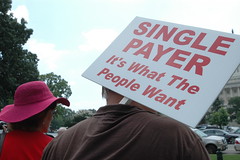 Image by Public Citizen via Flickr
According to the LA Times, insurance industry rallied its lobbying and grass-roots resources so successfully in the early stages of the healthcare overhaul deliberations that it is poised to reap a financial windfall. Some insurance company leaders continue to profess concern about the unpredictable course of President Obama's massive healthcare initiative, and they vigorously oppose elements of his agenda. But Laszewski said the industry's reaction to early negotiations boiled down to a single word: "Hallelujah!"
"The insurers are going to do quite well," said Linda Blumberg, a health policy analyst at the nonpartisan Urban Institute, a Washington think tank. "They are going to have this very stable pool, they're going to have people getting subsidies to help them buy coverage and . . . they will be paid the full costs of the benefits that they provide -- plus their administrative costs."
The proposal that most concerns insurers is the "public option" insurance plan, so the industry launched a campaign on Capitol Hill against it, "grounded in a study published by the Lewin Group, a health policy consulting firm that is owned by UnitedHealth Group. The lobbyists contended that a government-run plan, which would have favorable tax and regulatory treatment, would undermine private insurers. Recent support for the public option has declined, and the stock prices of health insurance firms have been rising."
Bailouts, stimulus packages, debt piled upon debt, where will it all end?
How did we get into a situation where there has never been more material wealth & productivity and yet everyone is in debt to bankers? And now, all of a sudden, the bankers have no money and we the taxpayers, have to rescue them by going even further into debt! Money as Debt II Explores the baffling, fraudulent and destructive arithmetic of the money system that holds us hostage to a forever growing DEBT...and how we might evolve beyond it into a new era.
Sunday, August 23, 2009
Quarantine or $1000 a day fine for refusing the vaccine
Quarantine or $1000 a day fine for refusing the vaccine, and 30 days jail time. Passed in Senate state of Massachusetts. House will take up bill next week.
Peter Schiff Was Right
Parody using a clip with Hitler as the real estate investor. He bought a house to flip, faces foreclosure, and now wants to get bailed out.
Subscribe to:
Posts (Atom)