Friday, April 5, 2013
As economy flails, debtors' prisons thrive
If that sounds like a debtors' prison, a legal relic which was abolished in this country in the 1830s, that's because it is. And courts and judges in states across the land are violating the Constitution by incarcerating people for being unable to pay such debts.
Ask Jack Dawley, 55, an unemployed man in Ohio who between 2007 and 2012 spent a total of 16 days in jail in a Huron County lock-up for failing to pay roughly $1,500 in legal fines he'd incurred in the 1990s. The fines stemmed from Dawley's convictions for driving under the influence and other offenses. After his release from a Wisconsin correctional facility, Dawley, who admits he had struggled with drugs and alcohol, got clean. But if he put his substance problems behind him, Dawley's couldn't outrun his debts.
Struggling to find a job and dealing with the effects of a back injury, he fell behind on repayments to the municipal court in Norwalk, Ohio. He was arrested six years ago and sent to jail for not paying his original court fines. Although Dawley was put on a monthly payment plan, during his latest stint behind bars in 2012 the court ordered him to pay off his entire remaining debt. Read more >>
Tuesday, March 19, 2013
Retirement confidence at record low
They're worried about their jobs, high debt levels and rising living expenses, according to a survey released Tuesday by the Employee Benefit Research Institute.
Only 13% of workers surveyed said they "feel very confident" that they will be able to retire comfortably — less than half the percentage reported in 2007. Nearly half -- 49% -- said they were "not too" or "not at all" confident.
A large chunk of the workers surveyed have little or no retirement savings. Of those who provided estimates, 57% reported household savings and investments of less than $25,000, which included 28% of respondents who said they had less than $1,000. Only 24% reported savings of $100,000 or more.
Debt is standing in the way of saving. More than half of workers reported having a problem with their level of debt, while only about half of those surveyed said they could definitely cover $2,000 worth of unexpected expenses within the next month. Read more >>
Wednesday, February 27, 2013
Young adults too broke to get loans
"It's a sign of economic struggle, not economic success," said Richard Fry, senior economist at the Pew Research Center. "They don't have the mortgage, but they don't have the house."
The center found that young adults' debt levels dropped nearly 14% between 2001 and 2010, while rising 63% for those age 35 and older, according to a recent Pew study.
The real-world ramifications are eye-popping. The share of younger households owning their primary residence fell to 34% in 2011, down from 40% in 2007. Only 66% owned or leased at least one vehicle in 2011, down from 73% four years earlier, as car loans plunged. Credit card balances have also fallen.
The only debt on the rise is student loans. In 2007, just over a third of young households had outstanding student debt. That jumped to 40% in 2010. Read more >>
Wednesday, January 30, 2013
US debt headed toward 200 percent of GDP even after 'fiscal cliff' deal
The "fiscal cliff" deal, combined with the debt-limit agreement of August 2011, only slightly delays the United States reaching debt-to-gross domestic product levels that would damage the economy and risk another fiscal crisis, according to a report from the Peter G. Peterson Foundation released on Tuesday.
The agreement "may have prevented the immediate threats that the fiscal cliff posed to our fragile economic recovery, but we haven’t remotely fixed the nation’s debt problem," said Michael A. Peterson, president and COO of the Peterson Foundation.
"The primary goal of any sustainable fiscal policy is to stabilize the debt as a share of the economy and put it on a downward path, and yet our nation is still heading toward debt levels of 200 percent of GDP and beyond," he said. Read more >>
Tuesday, January 15, 2013
Younger Americans Have More Credit-Card Debt Problems: Study
Researchers that people born between 1980 and 1984 have on average $5,689 more debt than their parents had at the same stage of their lives, and $8,156 more than their grandparents.
"If what we found continues to hold true, we may have more elderly people with substantial financial problems in the future," said Lucia Dunn, a co-author of the study and a professor of economics at Ohio State University.
"Our projections are that the typical credit card holder among younger Americans who keep a balance will die still owning money on their cards," she added in a statement.
Dunn, and Sarah Jiany, of Capital One Financial in McLean, Virginia and a co-author of the study, analyzed two large monthly surveys which included data on borrowing and repayment, enabling them to estimate when Americans will be able to repay their credit cards. Read more >>
Monday, November 19, 2012
Delinquencies Rise as Consumers Load Up on Debt
Americans cranked up their use of credit cards in the third quarter, racking up more debt than a year ago, while also being less diligent about making payments on time, an analysis of consumer-credit data shows.
The average credit card debt per borrower in the U.S. grew 4.9 percent in the July-to-September period from a year earlier to $4,996, credit reporting agency TransUnion said Monday.
At the same time, the rate of credit card payments at least 90 days overdue hit 0.75 percent, up from 0.71 percent in the third quarter of last year, the firm said.
While higher, the late payment rate is rising from historically low levels. The lowest late payment rate on TransUnion records going back to the mid-1990s was 0.56 percent, set in the third quarter of 1994. More recently, it was at 0.60 percent in the second quarter of last year.
During the last recession, many Americans reined in spending in favor of paying off debt, particularly credit card balances. The housing downturn also prompted many homeowners to make paying their credit card accounts on time a priority at the expense of other financial obligations, such as their mortgage payments. Read more >>
Thursday, August 16, 2012
Percentage of disposable income spent on eating-out has plunged
Tuesday, July 24, 2012
Companies Defaulting on Debt Skyrockets
This is happening despite record low interest rates that should allow companies to refinance and reduce their interest costs. While most companies continue to be in good health, investors are paying close attention to the:
•Increasing default rate. The past 12 months, 2.6% of companies with the lowest credit ratings have defaulted. That's up from 2.5% in March yet still well below the long-term average of 4.5%.
But given the rash of defaults, S&P predicts the default rate will rise to 3.6% by March. If problems persist in Europe and China, S&P says, defaults could jump to 5.5%.
•Danger of more downgrades. During the second quarter, 87 U.S. companies saw their credit ratings lowered, while 78 were upgraded. Most of the strain is being felt by media and entertainment companies, which accounted for 17 of the downgrades.
•Increased profit strain. For the first time in years, companies are facing the prospect of shrinking profits, says Bonnie Baha of DoubleLine. Earnings are expected to contract 0.9% in the second quarter, marking the lowest growth rate since the third quarter of 2009, says S&P Capital IQ. Read more >>
Friday, May 18, 2012
Study: China Corporate Debt At “Alarming levels”
After a one-year study on China's government debt, corporate debt and individual borrowing, a research team led by Yang will publish their research results next month and will also submit the results to the International Monetary Fund. Yang warned that China's leverage ratio is increasing, and the pace at which the country’s debt is rising will continue unabated if the current global financial crisis persists.
According to the study findings, China's debt-to-GDP ratio stands at 168.9 percent, which is lower than the global average of more than 200 percent. However, the debt-to-asset ratio of Chinese enterprises has reached 105.4 percent, ranking the highest among 20 countries which were studied by the CASS. More...
Thursday, May 3, 2012
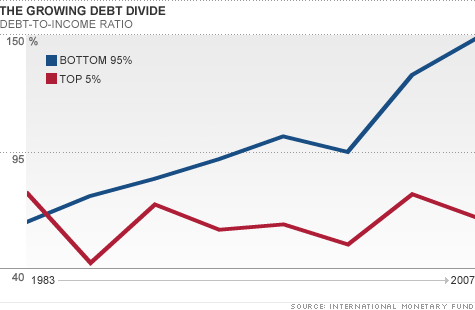
The Rich Are Getting Richer And Everyone Else is Going Deeper Into Debt

Growing income inequality has led to ballooning debt loads for the bottom 95% of Americans.
The bottom 95% of Americans have seen debt levels balloon compared to their earnings over the past 20 years or so, as falling incomes made them more dependent on credit to maintain their lifestyles. In 1983, the bottom 95% had 62 cents of debt for every dollar they earned, according to research by two International Monetary Fund economists. But by 2007, the ratio had soared to $1.48 of debt for every $1 in earnings.
The bottom 95% had incomes of roughly $160,000 or less in 2007, including capital gains. And then there's the top 5%. Their debt-to-income level actually fell during the same period, from 76 cents of debt for every dollar earned in 1983, to just 64 cents in 2007. And experts say the picture hasn't changed much since then.
The debt divide is a result of the growing income gap between the wealthiest Americans and everyone else. The top 5% saw their share of total income rise to 34% in 2007, up from 22% in 1983. This excludes capital gains, which pump up the income of the rich even more since they are more likely to invest. More...
Sunday, April 29, 2012
The Return of Debtors' Prisons
Although the U.S. abolished debtors' prisons in the 1830s, more than a third of U.S. states allow the police to haul people in who don't pay all manner of debts, from bills for health care services to credit card and auto loans. In parts of Illinois, debt collectors commonly use publicly funded courts, sheriff's deputies, and country jails to pressure people who owe even small amounts to pay up, according to the AP.
Under the law, debtors aren't arrested for nonpayment, but rather for failing to respond to court hearings, pay legal fines, or otherwise showing "contempt of court" in connection with a creditor lawsuit. That loophole has lawmakers in the Illinois House of Representatives concerned enough to pass a bill in March that would make it illegal to send residents of the state to jail if they can't pay a debt. The measure awaits action in the senate.
"Creditors have been manipulating the court system to extract money from the unemployed, veterans, even seniors who rely solely on their benefits to get by each month," Illinois Attorney General Lisa Madigan said last month in a statement voicing support for the legislation. "Too many people have been thrown in jail simply because they're too poor to pay their debts. We cannot allow these illegal abuses to continue." More...
Wednesday, April 25, 2012
Student Loans: The Next Bailout?
Borrowers in their 30s today owe $28,500, on average. The debt burden has soared just as — and partly because — the recession hit, so younger graduates carrying the highest balances are hit with the double whammy of a weak job market (that still isn’t showing any sign of rapid improvement).
And this all comes as globalization and technological change have upended once-reliable career paths, wiped out many mid-level professional jobs and leave low-paying fields in health, food and beverage services, and retail as among the fastest growing job markets over the next decade. More...
Monday, January 9, 2012
Guaranteed mayhem, riots, violent protests in 2012
Image by Friends of the Earth International via FlickrIn order to have an understanding of what could happen in the coming year, it is essential to keep the big picture in focus. As we enter the fifth year of this twenty year Crisis period, there is absolutely no chance that 2012 will see an improvement in our economy, political atmosphere or world situation. Fourth Turnings never de-intensify. They exhaust themselves after years of chaos, conflict and turmoil. I can guarantee you that 2012 will see increased mayhem, riots, violent protests, recessions, bear markets, and a presidential election that will confound the establishment. All the episodes which will occur in 2012 will have at their core one of the three elements described by Strauss & Howe in 1997: Debt, Civic Decay, or Global Disorder.In order to have an understanding of what could happen in the coming year, it is essential to keep the big picture in focus. As we enter the fifth year of this twenty year Crisis period, there is absolutely no chance that 2012 will see an improvement in our economy, political atmosphere or world situation. Fourth Turnings never de-intensify. They exhaust themselves after years of chaos, conflict and turmoil. I can guarantee you that 2012 will see increased mayhem, riots, violent protests, recessions, bear markets, and a presidential election that will confound the establishment. All the episodes which will occur in 2012 will have at their core one of the three elements described by Strauss & Howe in 1997: Debt, Civic Decay, or Global Disorder.
Any critical thinking person can look at the chart above and realize that creating more debt out of thin air to solve a debt problem is foolish, dangerous, and self serving to only bankers and politicians. The debt crisis took decades of terrible choices and bogus promises to produce. The world is now in the midst of a debt driven catastrophe. At best, the excessive levels of sovereign debt will slow economic growth to zero or below in 2012. At worst, interest rates will soar as counties attempt to rollover their debt and rolling defaults across Europe will plunge the continent into a depression. The largest banks in Europe are leveraged 40 to 1, therefore a 3% reduction in their capital will cause bankruptcy. Once you pass 90% debt to GDP, your fate is sealed. More...
Tuesday, October 4, 2011
Greece Falls Into 'Death Spiral': Rising Debt, No Growth
Image by rad(ish)labs via FlickrDrowning in red ink, Greece has nowhere to turn to revive the economic growth that might put its debt on a sustainable trajectory, reassure angry foreign creditors and offer hope to its recession-weary citizens.Instead, the country finds itself in a vicious circle—a death spiral, some would say—in which it is borrowing ever more to keep up on its existing debts, crushing growth in the process and thereby worsening its all-important ratio of debt-to-gross domestic product.
Springing the debt trap would not be a miracle cure either: a manageable level of borrowing is a necessary but not a sufficient condition for Greece to start restoring competitiveness and resume growth after three years of economic contraction. More...
Wednesday, July 13, 2011
US Default Inevitable
"It's inevitable that the U.S. will default—it's essentially an empire which is overextended and in decline—and that its financial system will go with it," he said.
The question is: Does the U.S. default when it is forced to by the outside world, probably the Chinese, or does it take the option to default on its own terms in such a way that it may have a strategic advantage, Murrin said.
Republicans and Democrats are currently locked in a debate on how to cut the U.S. budget deficit, and on whether the $14.3 trillion debt ceiling should be raised. Both parties need to come to a consensus by Aug. 2, otherwise the country will be in a state of technical default.
In his book "Breaking the Code of History," Murrin argues that the balance of power has shifted away from the West, with America as the superpower, towards the East, led by China.
He believes the U.S. cannot afford to compete with the rise of Eastern powers. More...
Monday, December 27, 2010
European Sovereign Debt Crisis Set to Spread
Claus Vogt
According to its homepage, the Bank for International Settlements (BIS) is an organization that fosters international monetary and financial cooperation and serves as a bank for central banks.
The BIS fulfils this mandate by acting as:
• A forum to promote discussion and policy analysis among central banks and within the international financial community,
• A center for economic and monetary research,
• A prime counterparty for central banks in their financial transactions, and
• An agent or trustee in connection with international financial operations.
In short, the BIS is the central bank of central banks. So if you want to know what’s on the mind of the international central banking community, the BIS is the right place to start. Indeed, an organization you should regularly follow.
Sometimes BIS economists point out problems certain central bankers refuse to acknowledge, or they’ll come to conclusions some members of the central banking tribe would rather refute.
And on Sunday, December 12, that’s exactly what happened when the BIS reported that …
Foreign Exposure to PIGS Debt
Is a Major Threat
The BIS’s latest quarterly review contains a tabulation of exposure, broken down by nationality, to debt of the four most problematic countries: Portugal, Ireland, Greece, and Spain.
|
These are humongous numbers.
Conservatively speaking, these debts will need at least a 30 percent haircut for the PIGS to have a realistic opportunity of getting out of the hole they’re in. And if that 30 percent is the result of defaults, the international banking system would again be severely wounded.
That’s why I called the Greek bailout earlier this year another banking system bailout. And that’s why the international community claims bailouts are the best choice.
There is always an alternative. But in this case, the political will is obviously lacking. So as analysts and investors we have to accept it as a reality and ask ourselves where this may lead.
The Difference between a Liquidity Crisis
and a Solvency Crisis
I have always made the case that the political reaction to the housing and banking crisis of 2007-2009 was not solving, nor addressing, the underlying problem of too much debt. By adding more debt you can buy some time and kick the can. But in doing so the problem only gets bigger, which is what has happened.
Back then we had banks and other corporations on the brink of collapse. Now many countries are in the same boat!
To understand what was going wrong then and what is going wrong now you have to distinguish between a liquidity crisis and a solvency crisis …
A liquidity crisis is a temporary inability to pay. The debtor is sound enough to service the debt. In such a case you might have a good reason for a bailout.
A solvency crisis is a different story …
The debtor does not have the wherewithal to service the debt. Therefore, additional credit can only aggravate the situation — it’s throwing good money after bad. More...
Friday, July 2, 2010
Bankruptcy filings surged 14% during the first half of 2010
Image via Wikipedia
It's tough out there -- no jobs, home values plummeting -- and Americans are reacting by heading to bankruptcy court.
Bankruptcy filings surged 14% during the first half of 2010, according to the American Bankruptcy Institute. Filings totaled 770,117 through June, compared to 675,351 during the same period last year.
"Years of rising consumer debt and low savings rates, combined with the housing and unemployment crisis, are causing bankruptcy levels not seen since the 2005," said Samuel Gerdano, executive director of the institute, in a press release.
In 2005 Congress amended the Bankruptcy Code, making it harder for Americans to file and sparking a rush to file by October of 2005, when the amendments kicked in. In 2005, bankruptcy filings totaled more than 2 million.
By comparison, Gerdano expects there will be more than 1.6 million new bankruptcy filings by the end of 2010. The institute also said that bankruptcies totaled 126,270 in June, a jump of 8.5% from the same month in 2009, when they totaled 116,365. The institute relied on data from the National Bankruptcy Research Center for its information.
Friday, June 18, 2010
In Minnesota the use of arrest warrants against debtors has jumped 60 percent
Image by G Travels via Flickr
In Minnesota, which has some of the most creditor-friendly laws in the country, the use of arrest warrants against debtors has jumped 60 percent over the past four years, with 845 cases in 2009, a Star Tribune analysis of state court data has found.
Not every warrant results in an arrest, but in Minnesota many debtors spend up to 48 hours in cells with criminals. Consumer attorneys say such arrests are increasing in many states, including Arkansas, Arizona and Washington, driven by a bad economy, high consumer debt and a growing industry that buys bad debts and employs every means available to collect.
Whether a debtor is locked up depends largely on where the person lives, because enforcement is inconsistent from state to state, and even county to county.
In Illinois and southwest Indiana, some judges jail debtors for missing court-ordered debt payments. In extreme cases, people stay in jail until they raise a minimum payment. In January, a judge sentenced a Kenney, Ill., man "to indefinite incarceration" until he came up with $300 toward a lumber yard debt. More...
Friday, November 27, 2009
Keiser on Dubai: the World is entering Phase Two of the global economic crisis
Fresh fears over the size of Dubai's debt have sent shock waves through international markets, with major stocks and oil prices falling sharply. Dubai World, the country's largest conglomerate, wants to suspend payment on its sixty billion dollar debts until next May at the earliest. RT's financial contributor Max Keiser says the World is entering the Phase Two of the global economic crisis.
Wednesday, September 2, 2009
FHA Picks up Where Subprime Lenders Left Off
Image by Getty Images via Daylife
Love this from Pragmatic Capitalist: David Rosenberg has some concise thoughts on a topic we’ve been banging the drum on for a long time – you can’t solve a debt crisis with more debt:
No wonder we are seeing a housing recovery, and it’s not just about the $8,000 tax credit for first-time buyers. How does the White House possibly allow this extra goodie to expire in November? The FHA is picking up where subprime lenders left off: the agency has seen its mortgage business jump 70% in the past year (!) and its market share in just three years has gone from 3.0% to 23% — it is allowing borrowers to finance up to 96.5% of homes priced all the way up to $729,750. Guess what, the default rate has risen to nearly 7% from 5½% a year ago. And, it is the taxpayer that is going to be picking up this tab … again! So, the policy formula here is that after excessive leverage got us into this mess, is to encouraging even more debt and come to think of it, Cash-for-Clunkers did the exact same thing — enticing people who were probably quite content with their jalopy to take on more than $10 billion of new debt. Amazing. It’s like giving another bottle of scotch to the drunken sailor, but hey — we can’t have the economy weak going into a mid-term election year now, can we?