Showing posts with label Percentage. Show all posts

Wednesday, September 25, 2013

Poll: Americans don't buy the propaganda about the supposed economic rebound

Who's Laughing Now (song)
Americans in Poll Doubt Economy Rebound in Defiance of Forecasts

Americans are losing faith in the nation’s economic recovery even as forecasters expect growth to accelerate, according to a Bloomberg National Poll. Fewer people anticipate improvement in the economy’s strength over the next year than in the last survey in June, with 27 percent saying the expansion will be more robust, down from 39 percent who expected improvement three months earlier.

Forty-four percent of poll respondents say they expect the economy, which has expanded for nine consecutive quarters, to remain about the same, while 28 percent see it weakening.
“We’re still in a recession; I don’t know why they say it’s over,” says Chris Sams, 28, a disabled Navy veteran from Daingerfield, Texas. “It may be over in Washington, D.C., where the per capita income is higher than anywhere else, but down here the minimum wage is the highest wage.”

The results of the Sept. 20-23 poll reflect public impatience with an economy that has grown at an average rate of 2.1 percent since the recession’s June 2009 end, a full percentage point below the 50-year average, according to data compiled by Bloomberg. Growth will slip to 1.60 percent this year, according to the median forecast in a Bloomberg survey of economists, before rebounding to 2.65 percent growth next year. Read more >>
Enhanced by Zemanta

Tuesday, September 24, 2013

Michelle Obama has nearly 2 million fake Twitter followers

Michelle Obama, official White House portrait.
English: Signature of Michelle Obama.
Nearly 2 million of First Lady Michelle Obama’s Twitter followers are not real. According to the Twitter analytics application Status People, 37 percent of Michelle Obama’s 5,290, 506 Twitter followers — or approximately 1,957,487 followers — are considered fake. Thirty-five percent of her followers are inactive, and 28 percent are considered “good,” or real.

Michelle Obama’s account is run by Organizing for Action, and sent its last Tweet on March 4. It was a retweet of a message sent by the Twitter account of the First Lady’s Let’s Move initiative.

The official Twitter account for the Office of the First Lady is @FLOTUS. Only 25 percent of the account’s 513,026 followers are considered fake. 38 percent are inactive, and 37 percent are considered “good.” Read more >>
Enhanced by Zemanta

Thursday, September 19, 2013

Women Waiting Tables Provide Most of Female Gains in Employment

A Waitress taking a breakfast order at Kahala ...
Unemployment data appear to reflect big advances for women. The jobless rate in August for females 20 years and older was 6.3 percent, the lowest since December 2008, compared with 7.1 percent for men. As recently as January, the rate was 7.3 percent for both genders, according to the Bureau of Labor Statistics.

The downside is that the gains have been largely in lower-paying industries such as waitresses, in-home health care, food preparation and housekeeping. About 60 percent of the increase in employment for women from 2009 to 2012 was in jobs that pay less than $10.10 an hour, compared with 20 percent for men, according to a study by the National Women’s Law Center using data from the Bureau of Labor Statistics.

The numbers expose a soft spot in an economic recovery that has reduced the overall unemployment rate to 7.3 percent from 10 percent in October 2009. Quality of jobs is an increasing concern for U.S. policy makers and economists since it affects the level of incomes and wage disparities. Read more >>
Enhanced by Zemanta

Wednesday, June 26, 2013

Study shows most Americans have inadequate savings

saving and spending
A recent survey by Bankrate.com shows that millions of American workers are only a paycheck away from financial disaster. A survey of 1,000 adults found that fewer than 25 percent of Americans have six months or more of savings, an amount deemed adequate to prepare for all but the most severe emergencies.

Another 50 percent have less than three months savings and 27 percent have no savings at all, meaning they are living essentially living paycheck to paycheck, with no emergency cushion to fall back on.

The online lender CashNet.com reported that of 1,000 people it recently surveyed, 22 percent had less than $100 saved in case of an emergency. Another 46 percent had less than $800 to cover unexpected expenses. Said Megan Staton, CashNet director of marketing, “The scarcity of rainy day savings remains a concern for too many Americans, and it hasn’t improved since last year.”

These statistics underscore the hollowness of the claim by the Obama administration that the US is experiencing an economic recovery. In fact, the rate at which Americans are saving is falling, after rising briefly in the aftermath of the 2008 financial crisis when it reached a high of 5.5 percent. In 2011, it declined to 4.2 percent and further to 3.9 percent in 2012. For the first quarter of 2013, the savings rate stood at just 2.6 percent. Only 52 percent of families reported saving in 2010 compared to 56.7 percent in 2007.

Stagnant and falling wages and continued high levels of unemployment make it difficult for most families to save. A study by the University of California found that since 2009 average real income for families has grown by only 1.7 percent. But, that includes an 11 percent increase for the top 1 percent. When that is subtracted, real wages declined half a percent for the bottom 99 percent. Read more >>
Enhanced by Zemanta

Thursday, June 13, 2013

Nine in 10 Americans have no confidence in Congress

Nine in 10 Americans say they have no confidence in Congress, ranking it last on a list of 16 institutions for the fourth straight year, Gallup said Thursday. The 10 percent confidence level is the lowest level registered for any institution since Gallup began this poll in 1973, Gallup said.

At 76 percent, Americans said they were most confident in the military. Small business and the police also ranked high, at 65 percent and 57 percent, with Americans expressing "a great deal" or "quite a lot" of confidence in these institutions, the Princeton, N.J., polling agency said.

Also at the bottom of the list were health maintenance organizations, at 19 percent, and organized labor, at 21 percent. Confidence in Congress has been at its lowest points for several years, Gallup said. The high point was in 1973, when 42 percent of Americans said they had confidence in Congress.

Results are based on nationwide phone interviews with 1,529 adults conducted June 1-4. The margin of error is 3 percentage points.

Source
Enhanced by Zemanta

Friday, May 31, 2013

Top 1% Control 39% of World's Wealth

WealthTV
WealthTV (Photo credit: Wikipedia)
The wealthiest 1 percent now control 39 percent of the world's wealth, and their share is likely to grow in the coming years, according to a new report.

The world's total private wealth grew 7.8 percent last year to $135 trillion, according to the Boston Consulting Group's Global Wealth report. The top 1 percent control $52.8 trillion, and those worth $5 million or more control nearly a quarter of the world's wealth.

That concentration is likely to increase in the coming years as the wealth of the wealthy grows faster than overall global wealth. The number of millionaires in the world surged by 10 percent year, reaching 13.8 million. The study predicts that global wealth will grow around 4.8 percent a year over the next five years—though millionaires will see their wealth grow nearly twice as fast.


Those worth $5 million or more will see their wealth grow 8 percent, while those worth more than $100 million will see their wealth grow 9.2 percent. The $100-million-plus group will see their share of global wealth grow to 6.8 percent in 2017 from the current 5.5 percent.

What's driving the wealth of the wealthy? It depends on the country. In the developed world—the U.S. and Europe— it's mainly stocks. And stocks have been on a tear this year in the U.S., which has mainly benefited the top 5 percent, who own 60 percent of all individually held stocks. Read more >>
Enhanced by Zemanta

Monday, May 27, 2013

Poll: Majority of Americans believe federal government too powerful

The 54 percent that expressed that belief, however, is only slightly higher than reported in 2012 and slightly lower than reported in 2010 and 2011, Gallup said. Only 8 percent of Americans said they thought the federal government has "too little" power, while 36 percent said the government has about the right amount of power, the Princeton, N.J., polling agency said.

Results indicated more than twice as many Republicans as Democrats said the government has too much power, 76 percent to 32 percent. Forty-six percent of Americans said they agreed with the statement that the federal government "poses an immediate threat to the rights and freedoms of ordinary citizens," while 53 percent disagree, Gallup said.

Gallup said recent allegations that the IRS targeted conservative organizations and reports of U.S. Justice Department investigations into The Associated Press and Fox News records and emails did not alter Americans' views of the federal government's power. Read more >>

Monday, May 20, 2013

Thousands of French Households Taxed Over 100%

More than 8,000 French households' tax bills topped 100 percent of their income in 2012, according to a French newspaper report.

Citing data from France's finance ministry, the business newspaper Les Echos reported on Friday that in addition to those taxed at over 100 percent last year, almost 12,000 households paid taxes worth more than 75 percent of their 2011 income and that a further 9,910 households were taxed at more than 85 percent of their income.

The paper said this was due to a one-off levy imposed on the 2011 incomes of households with assets of more than 1.3 million euros ($1.67 million). The surcharge was introduced by socialist President Francois Hollande in an attempt to offset the cost of a rebate scheme and taxation cap introduced by former President Nikolas Sarkozy, the paper added.

"In 2011, 5,221 households had a tax rate of more than 100 percent on their revenues, Some 6,203 households had a rate of more than 85 percent and 6,343 house holds a rate of more than 75 percent," the newspaper said but households could take advantage of a "tax shield" introduced by Sarkozy to cap an individual's overall taxation at 50 percent of their income. Read more >>
Enhanced by Zemanta

Monday, May 13, 2013

Gold's worst yearly start in over 30 years

Bull and bear in front of the Frankfurt Stock ...
Hedge funds increased bets on lower gold prices after investors pulled a record $20.8 billion from bullion funds this year while BlackRock Inc. (BLK), the world’s biggest money manager, said it’s still bullish.

Speculators held 67,374 so-called short contracts on May 7, 6.4 percent more than a week earlier, U.S. Commodity Futures Trading Commission data show. The net-long position dropped 10 percent to 49,260 futures and options. Net-bullish wagers across 18 U.S.-traded raw materials climbed 5.8 percent to 582,265, with gains for cocoa, cotton and hogs.

Gold is having its worst start to a year since 1982 after dropping 15 percent and sliding into a bear market in April. Holdings in exchange-traded funds backed by bullion tumbled to the lowest since July 2011 even as central banks print money on an unprecedented scale to boost growth. BlackRock’s President Robert Kapito said May 9 he would still buy the metal, echoing billionaire John Paulson, who’s sticking with a bullish view even after losing 27 percent in his Gold Fund last month. Read more >>
Enhanced by Zemanta

Wednesday, May 1, 2013

U.S. Homeownership Rate Falls to Lowest in 18 Years

Brentford Dock
The U.S. homeownership rate fell to the lowest in almost 18 years, reflecting rising demand for rentals and investor purchases in the housing market.

The share of Americans who own their homes was 65 percent in the first quarter, down from 65.4 percent a year earlier and the lowest level since the third quarter of 1995, the Census Bureau reported today. The vacancy rate for rented homes dropped to 8.6 percent from 8.8 percent a year earlier, while vacancies for owner-occupied houses fell to 2.1 percent from 2.2 percent.

Investors are buying single-family homes and renting them out to capitalize on demand among families unable to qualify for a mortgage. Their purchases, many made with cash, are helping to support the housing recovery and pushing up prices. Home values in 20 cities increased 9.3 percent in February from a year earlier, the most since May 2006, according to the S&P/Case- Shiller (SPCS20Y%) index released today. Read more >>
Enhanced by Zemanta

Friday, April 26, 2013

Job Picture Looks Bleak for 2013 College Grads

English: Day 3 of the protest Occupy Wall Stre...
Even as new numbers show the overall employment picture improving—or at least not getting worse—new college graduates may not be so lucky when it comes to finding work.

A survey released last week from the National Association of Colleges and Employers (NACE) reported that businesses plan to hire only 2.1 percent more college graduates from the class of 2013 than they did from the class of 2012.

That's way down from an earlier NACE projection of a 13 percent hiring rate for 2013 grads. (Read More: Surging Student-Loan Debt Is Crushing the System)

This comes even as the college graduate jobless picture seems to be getting better. The rate of unemployment in 2012 for college grads—defined as 20-24 years old—was 6.3 percent, down from the 8.3 percent for 2011 graduates, according to the Bureau of Labor Statistics. The rate in 2010 was 9.4 percent.

It's not only a bleaker job outlook 2013 graduates face. According to the Economic Policy Institute, the class of 2013 will likely earn less over the next 10-15 years, than they would have before the recession hit and jobs were more plentiful. Read more >>
Enhanced by Zemanta

Thursday, November 29, 2012

Weak Economy Means Living at Home


A Census Bureau report released Wednesday found that between 2007 and 2011 there was a steady increase in the percentage of adults living in someone else’s house – and that increase has mostly been driven by adult children moving in with mom and dad.

In 2011, Census Bureau researchers found that 17.9 percent of people 18 and older, or 41.2 million people, lived in a house in which they weren’t the head of the household or that person’s spouse or significant other. That’s up from 16 percent in 2007, before the nation went into recession.

About half of those people were adult children living with their parents, while the rest were other relatives or unrelated people such as a group of roommates.

But Suzanne Macartney, an analyst in the poverty statistics branch of the Census Bureau and a co-author of the report, said the only group that saw an increase between 2007 and 2011 were adults moving in with their parents. Read more >>

Enhanced by Zemanta

Monday, November 19, 2012

Delinquencies Rise as Consumers Load Up on Debt

English: First 4 digits of a credit card

Americans cranked up their use of credit cards in the third quarter, racking up more debt than a year ago, while also being less diligent about making payments on time, an analysis of consumer-credit data shows.

The average credit card debt per borrower in the U.S. grew 4.9 percent in the July-to-September period from a year earlier to $4,996, credit reporting agency TransUnion said Monday.

At the same time, the rate of credit card payments at least 90 days overdue hit 0.75 percent, up from 0.71 percent in the third quarter of last year, the firm said.

While higher, the late payment rate is rising from historically low levels. The lowest late payment rate on TransUnion records going back to the mid-1990s was 0.56 percent, set in the third quarter of 1994. More recently, it was at 0.60 percent in the second quarter of last year.

During the last recession, many Americans reined in spending in favor of paying off debt, particularly credit card balances. The housing downturn also prompted many homeowners to make paying their credit card accounts on time a priority at the expense of other financial obligations, such as their mortgage payments. Read more >>

Thursday, October 25, 2012

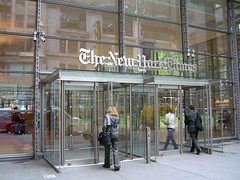
NY Times Dying a Slow Death

The New York Times

The New York Times reported worse-than-expected results on Thursday as advertisers cut spending on both print and digital outlets, sending shares down 12 percent. The newspaper company said that revenue was up almost 1 percent to $449 million. Still, the result missed the analysts' consensus estimate of $479.23 million, according to Thomson Reuters I/B/E/S.

Adjusting for severance costs and other special items, the company reported a quarterly loss of 1 cent per share, well below expectations of earnings of 8 cents per share. The slight uptick in revenue was due to a 7.4 percent rise in circulation revenue helped by the company's digital subscription plans.

But as the company tries to rely more on circulation for its revenue, advertising sales are in a persistent slump. "It wasn't a nice quarter on revenue," said Edward Atorino, an analyst with Benchmark Co. "The advertising numbers look terrible. I thought they might do a little better. They are caught up in the downslide like everybody else." Read more >>

Enhanced by Zemanta

Thursday, October 18, 2012

Violent crime jumps 18 percent in 2011, first rise in nearly 20 years

IMMOBILISE PROPERTY CRIME

Violent crimes unexpectedly jumped 18 percent last year, the first rise in nearly 20 years, and property crimes rose for first time in a decade. But academic experts said the new government data fall short of signaling a reversal of the long decline in crime.

The U.S. Bureau of Justice Statistics reported Wednesday that the increase in the number of violent crimes was the result of an upward swing in simple assaults, which rose 22 percent, from 4 million in 2010 to 5 million last year. The incidence of rape, sexual assault and robbery remained largely unchanged, as did serious violent crime involving weapons or injury.

Property crimes were up 11 percent in 2011, from 15.4 million in 2010 to 17 million, according to the bureau's annual national crime victimization survey. Household burglaries rose 14 percent, from 3.2 million to 3.6 million. The number of thefts jumped by 10 percent, from 11.6 million to 12.8 million.

The growth in violent crime experienced by whites, Hispanics, younger people and men accounted for the majority of the increase. Read more >>


Enhanced by Zemanta

Saturday, October 13, 2012

AMD could slash up to 30 percent of its workforce

Image representing AMD as depicted in CrunchBase
AllThingsD and CNET are reporting that 30 percent of AMD's workforce could be laid off, though one of several unnamed sources notes the cuts could be as low as 10 percent. If these reports hold true, this would be the second round of layoffs for AMD within a year's time.

The reductions will reportedly affect the firm's engineering and sales employees, and may be serious enough to cause a paring back of product lines.

The silicon giant could potentially reveal its plans as early as next week, which would coincide with the announcement of its third quarter financial results. With the company expecting a ten percent revenue drop in Q3, it looks like the latest figures will continue the trend of less than ideal results.

Source:
Enhanced by Zemanta

Thursday, October 11, 2012

Food Inflation To Surge


We have been very active in our discussions of the impact of the pending rise in food prices around the world (from central bank largesse to weather-related chaos).

As Goldman notes, food inflation has been one of the most significant sources of headline inflation variation in emerging markets (EM) over the past few years. Since June, international prices for agricultural commodities have risen almost 30%, increasing the risk of fresh, food-related increases to EM headline inflation.

Richmoor Macaroni & Cheese 12 - 4.75 oz. - Emergency Food Storage A (Google Affiliate Ad)

We, like Goldman, expect EM headline inflation to start to reflect the relevant pressures more broadly in the October prints at the latest. While the effects, for now, are expected to be less extreme than the 2010-2011 episode, the timing as the US enters its fiscal-cliff-prone malaise, could mean a further round of easing will reignite this critical inflationary concern. Read more >>

Enhanced by Zemanta

Friday, September 28, 2012

Durable goods drop worst since recession


New orders for long-lasting U.S. manufactured goods in August fell by the most in 3-1/2 years, pointing to a sharp slowdown in factory activity even as a gauge of planned business spending rebounded.

The Commerce Department said on Thursday durable goods orders dived 13.2 percent, the largest drop since January 2009, when the economy was in the throes of a recession. Orders for July were revised down to show a 3.3 percent increase instead of the previously reported 4.1 percent gain.

Economists polled by Reuters had expected orders for durable goods -- items from toasters to aircraft that are meant to last at least three years -- to fall 5 percent. Last month, the drop in orders reflected weak aircraft and automobiles demand. Boeing received only one aircraft order in August, down from 260 in July, according to information posted on the plane maker's website. Read more >>

Wednesday, September 26, 2012

Low-wage work force grows 30% as the number of jobs shrinks


Low-wage workers in Chicago are better educated, older and rely more on that income these days to meet basic needs than 10 years ago. And there are substantially more of them. That’s according to a new report released by Chicago-based Women Employed and Action Now Institute that shows nearly one in six low-wage workers here last year held a college degree.

The report, authored by Marc Doussard, assistant professor in the University of Illinois at Urbana-Champaign’s Department of Urban and Regional Planning, defines low-wage workers as those making $12 an hour or less. The report revealed the share of payroll employees ages 18 to 64 working in low-wage jobs rose from 23.8 percent in 2011 to 31.2 percent last year. That’s a more than a 30 percent rise in the proportion of such workers.

Meanwhile the share of households with a low-wage earner that got all income from low-wage earnings rose from 45.7 percent to 56.7 percent. That’s evidence more people are relying more on those dollars to meet basic needs rather than for disposable income. Read more >>

Thursday, September 20, 2012

MI jobless rate raises to 9.4 percent


Michigan authorities say the state's seasonally adjusted unemployment rate rose 0.4 percentage points in the latest month to 9.4 percent.

The Michigan Department of Technology, Management and Budget released the August jobless figures Wednesday. The nation's August unemployment rate was 8.1 percent, down from 8.3 percent in July.

The state's jobless has fallen 1 percentage point over 12 months from an August 2011 level of 10.4 percent. But it has risen for four straight months from April's 8.3 percent. Read more >>