Showing posts with label Real estate economics. Show all posts

Friday, August 30, 2013

Decline in homeownership is changing neighborhoods

CNBC
Beneath the spreading shade tree in Laura Holcomb's front yard, there are some 70 varieties of hosta, stands of elephant ear and a Japanese maple. For the 17 years she has owned the brick house on Rose Trail Drive in Memphis' Hillshire subdivision, Ms. Holcomb has devoted herself to her home and garden.

Across the street, Carl Osborne and his family have been tenants for two years, moving in after the previous owner lost the house in a foreclosure. They are happy to have a decent place to call home but, like many renters, they have not done much to improve the appearance or join the community.

They are not alone: the family behind Ms. Holcomb, the one two doors down, and several in the cul-de-sac across the way are among the renters who have been supplanting homeowners in this blue-collar, suburban neighborhood as investors buy single-family homes and convert them to rentals.

"Used to, we knew our neighbors," Ms. Holcomb said. Then she gestured toward the few remaining owner-occupied houses nearby. "Except for the two that have been here, I don't know any of my neighbors."

Across the country, a growing number of single-family rentals provide an option for many who lost their homes in the housing crash through foreclosure and for those who cannot obtain a mortgage under today's tougher credit conditions.

But the decline in homeownership is also changing many neighborhoods in profound ways, including reduced home values, lower voter turnout and political influence, less social stability and higher crime. Read more >>
Enhanced by Zemanta

Wednesday, May 1, 2013

U.S. Homeownership Rate Falls to Lowest in 18 Years

Brentford Dock
The U.S. homeownership rate fell to the lowest in almost 18 years, reflecting rising demand for rentals and investor purchases in the housing market.

The share of Americans who own their homes was 65 percent in the first quarter, down from 65.4 percent a year earlier and the lowest level since the third quarter of 1995, the Census Bureau reported today. The vacancy rate for rented homes dropped to 8.6 percent from 8.8 percent a year earlier, while vacancies for owner-occupied houses fell to 2.1 percent from 2.2 percent.

Investors are buying single-family homes and renting them out to capitalize on demand among families unable to qualify for a mortgage. Their purchases, many made with cash, are helping to support the housing recovery and pushing up prices. Home values in 20 cities increased 9.3 percent in February from a year earlier, the most since May 2006, according to the S&P/Case- Shiller (SPCS20Y%) index released today. Read more >>
Enhanced by Zemanta

Friday, August 24, 2012

Half of mortgage borrowers under 40 are underwater

Rising home prices helped nearly one million homeowners emerge from being underwater on their mortgages during the second quarter. But younger homeowners are still struggling to stay afloat, according to report from Zillow.

The percentage of borrowers who owed more on their homes than they were worth fell to 30.9% during the second quarter, down from 31.4% three months earlier, according to Zillow. Of the 15 million borrowers who were underwater during the quarter, a disproportionately large number are under the age of 40, said Zillow chief economist, Stan Humphries.

Nearly half, or 48%, of all mortgage borrowers under age 40 are underwater, about twice the rate of borrowers who are older. And that has created a sort of gridlock that could hinder the housing market's recovery, he said.

"We hear about tight inventory in many markets, and it's clear where this is coming from," he said. "Negative equity is trapping young people in their homes, preventing them from selling. These homes are like the very starter homes potential first-time homebuyers are seeking." Read more >>

Wednesday, July 25, 2012

New Home Sales Collapse 8.4%

New home sales declined 8.4 percent sequentially in June, missing expectations and falling to the lowest level since January. Sales fell to an annual rate of 350,000, according to new data from the U.S. Census Bureau.

Economists polled by Bloomberg had forecast a 0.7 percent increase, to 372,000 units. Median home prices also declined during the month, falling roughly $5,000 to $232,600. Deutsche Bank's Joe LaVorgna noted that part of the problem stems from the drop in housing starts since the financial crisis began in 2007.

"The lack of building means it is doubtful we can see a sustained rise in home sales even toward the higher end of their range," he says. "However, based on the National Association of Homebuilders’ housing market index, we expect this situation to change over the next couple of years." Read more >>

Friday, June 22, 2012

US Homeownership Rate Hits 15-Year Low

Family Homes, Barrow Waterfront
Despite the incentives to buy now — namely that average rates on a 30-year mortgages are now 3.7% — sales of single-family existing homes slipped 1.5% in May from a month earlier, according to data released today by the National Association of Realtors. Experts say the drop, which came during the historically busy spring season, suggests the housing market has a way to go to recover. If anything, the ranks of American homeowners are dwindling. The homeownership rate in the U.S. fell slightly from 66% to 65% during the first quarter of 2012 — the lowest in 15 years, according to the latest data by the U.S. Census. (It peaked at just over 69% in 2004.)

 Renters, meanwhile, have more inventory to choose from as owners who are unable to sell their homes often have no choice but to find tenants, says Dan McCue, research manager at Harvard University’s Joint Center for Housing Studies. The number of single-family homes for rent or being rented grew by two million units from 2006 to 2010, according to a JCHS report released this month, and McCue says the number has likely grown since then. “One third of all rentals are single-family homes,” he says. Read More >>

Tuesday, June 19, 2012

Housing Starts Plunge

CNBC reports that housing starts fell in May. The Commerce Department said on Tuesday that groundbreaking on new homes dropped 4.8 percent to a seasonally adjusted annual rate of 708,000 units. The reading, which is prone to significant revisions, was below the median forecast in a Reuters poll of a 720,000-unit rate. 

This from Zero Hedge:

We just got another indication of how US housing has "bottomed"... if only in terms of promises and strong words. While permits, or promises that at some point in the indefinite future, a house will be built, soared from 723K to an annualized rate of 780K, the highest since September 2008, on expectations of a 730K print, actual holes dug, or Starts plunged from a revised 744K to 708K, the biggest miss of expectations of a modest improvement from the pre-revision number since April 2011, and the biggest sequential drop since August 2011. 

And while recently all the starts strength was in multi-family units as America prepares to become a renter society, in May it was actually the 1-unit houses that saw an increase from 500K to 516K units, as multi-family tumbled from 236K to 179K. So much for the REO-To-Rent plan? Finally, looking at actual completions, the number tumbled by 10.3% from an annual rate of 667K to 598K in May.


Wednesday, May 9, 2012

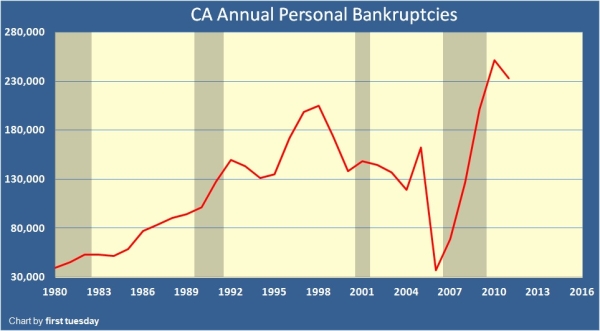
California Bankruptcies Increased 557% From 2006 to 2011

You essentially have a sub-group of folks with equity in their homes trying to trade to one another and first time buyers trying to scrape together enough for that 3.5 percent down payment FHA insured loan.  This is a reflection of a poor economy more than a healthy one.  Take a look at bankruptcies in the state:

bankruptcies in california

Keep in mind that the falloff in 2006 hit because of the rush to file in 2005 before bankruptcy law became tougher and more difficult to process.  We are very much near peak levels under these new stringent requirements.  In 2006 we were closer to 35,000 bankruptcy filings while last year we hit 230,000 (an increase of 557%). 

What this dramatic change signifies is that the underlying economy is still very weak and many people are unable to meet their current debts.  A large part of this is driven by housing debt via mortgages or HELOCs or other forms of debt based spending.  Keep in mind over 30 percent of California mortgage holders are currently underwater owing more on their home than it is currently worth. More...

Monday, April 30, 2012

No Housing Rebound for a Generation: Shiller


The Housing market is likely to remain weak and may take a generation or more to rebound, Yale economics professor Robert Shiller told Reuters Insider on Tuesday.

Shiller, the co-creator of the Standard & Poor's/Case-Shiller home price index, said a weak labor market, high gas prices and a general sense of unease among consumers was outweighing low mortgage rates and would likely keep a lid on prices for the foreseeable future.

"I worry that we might not see a really major turnaround in our lifetimes," Shiller said.

The S&P/Case-Shiller composite index of 20 metropolitan areas gained 0.2 percent in February on a seasonally adjusted basis, the first uptick in prices in 10 months. More...

Friday, April 27, 2012

U.S. Homeownership Hits Decade Low

PRINCETON, NJ - The 62% of Americans who say they own their own home marks a new low since Gallup began tracking self-reported homeownership in 2001.
U.S. Homeownership Rates, 2001-2012 Trend
The current level of homeownership marks a decline from 68% in 2011. For most of the prior decade, roughly seven in 10 Americans reported owning their own home. While the recession and financial crisis took place in 2008-2009, homeownership rates didn't begin to reflect the bursting of the housing bubble until 2010, when 65% of Americans reported owning their own home -- the lowest level recorded before this year. More...
Enhanced by Zemanta

Wednesday, December 14, 2011

Realtors: We Overcounted Home Sales for Five Years

Logo of the National Association of Realtors.Image via WikipediaData on sales of previously owned U.S. homes from 2007 through October this year will be revised down next week because of double counting, indicating a much weaker housing market than previously thought.

The National Association of Realtors said a benchmarking exercise had revealed that some properties were listed more than once, and in some instances, new home sales were also captured.

"All the sales and inventory data that have been reported since January 2007 are being downwardly revised. Sales were weaker than people thought," NAR spokesman Walter Malony told Reuters.

"We're capturing some new home data that should have been filtered out and we also discovered that some properties were being listed in more than one list." More...
Enhanced by Zemanta

Monday, October 31, 2011

Home prices heading for triple-dip

Willowood Townhomes in Salinas, California.Image via WikipediaThe besieged housing market has even further to fall before home prices really hit rock bottom. According to Fiserv, a financial analytics company, home values are expected to fall another 3.6% by next June, pushing them to a new low of 35% below the peak reached in early 2006 and marking a triple dip in prices.

Several factors will be working against the housing market in the upcoming months, including an increase in foreclosure activity and sustained high unemployment, explained David Stiff, Fiserv's chief economist.

Should home values meet Fiserv's expectations, it would make it the third (and lowest) trough for home prices since the housing bubble burst.

The first post-bubble bottom was hit in 2009, when prices fell to 31% below peak. The First-Time Homebuyer Credit helped perk prices up by mid-2010, but by the time the credit expired, prices fell again. More...
Enhanced by Zemanta

Tuesday, May 24, 2011

Nation’s biggest banks and mortgage lenders acquire a glut of foreclosed homes

MIAMI - DECEMBER 07:  A bank owned sign is see...Image by Getty Images via @daylifeThe nation’s biggest banks and mortgage lenders have steadily amassed real estate empires, acquiring a glut of foreclosed homes that threatens to deepen the housing slump and create a further drag on the economic recovery.

All told, they own more than 872,000 homes as a result of the groundswell in foreclosures, almost twice as many as when the financial crisis began in 2007, according to RealtyTrac, a real estate data provider. In addition, they are in the process of foreclosing on an additional one million homes and are poised to take possession of several million more in the years ahead.

Five years after the housing market started teetering, economists now worry that the rise in lender-owned homes could create another vicious circle, in which the growing inventory of distressed property further depresses home values and leads to even more distressed sales. With the spring home-selling season under way, real estate prices have been declining across the country in recent months. More...
Enhanced by Zemanta

Sunday, April 24, 2011

Builders of new homes see no signs of recovery

Small Single-family homeImage via WikipediaSales of new single-family homes in February were down more than 80 percent from the 2005 peak, far exceeding the 28 percent drop in existing home sales. New single-family sales are now lower than at any point since the data was first collected in 1963, when the nation had 120 million fewer residents.
Story: Sales of new homes plunge to record low

Builders and analysts say a long-term shift in behavior seems to be under way. Instead of wanting the biggest and the newest, even if it requires a long commute, buyers now demand something smaller, cheaper and, thanks to $4-a-gallon gas, as close to their jobs as possible. That often means buying a home out of foreclosure from a bank. More...
Enhanced by Zemanta

Monday, April 18, 2011

U.S. homebuilder sentiment down as home prices continue falling

Half million dollar house in Salinas, Californ...Image via WikipediaU.S. homebuilder sentiment slipped a notch in April as home prices continued to fall in most areas of the country amid widespread foreclosures, a survey released on Monday showed.

The National Association of Home Builders/Wells Fargo Housing Market index fell to 16 from 17, leaving the index in the pessimist range for a full five years.

A reading above 50 indicates that more builders view sales conditions as good than poor. The index has not been above 50 since April 2006.

“The spring home buying season is getting off to a slow start due to persistent concerns about home values as more foreclosures seem to be hitting the market, increasingly restrictive lending requirements for home buyers and builders, and the slow pace of economic recovery," said David Crowe, the NAHB's chief economist. More...
Enhanced by Zemanta

Tuesday, February 8, 2011

Foreclosure rates rise in 33 states

Bankruptcy levels remained largely unchanged...But the depressed housing market took a toll. Foreclosure rates rose in 33 states [in December], most sharply in Utah, New Jersey, Nevada and Arizona. The average county's score in December was 10.4, up from 10.3 in November. Slightly more than 40 percent of the nation's 3,141 counties were deemed stressed, up slightly from November. Read more...
Enhanced by Zemanta

Tuesday, July 20, 2010

Home construction sinks to lowest level since Oct.

Big single-family homeImage via Wikipedia

Home construction plunged last month to the lowest level since October as the economy remained weak and demand for housing plummeted.

But driving the June decline was a more than 20 percent drop in condominium and apartment construction, which makes up a small but volatile portion of the housing market. Construction of single-family homes, the largest part of the market, was down slightly. It dropped 0.7 percent.

Overall, construction of new homes and apartments in June fell 5 percent from a month earlier to a seasonally adjusted annual rate of 549,000, the Commerce Department said Tuesday. May's figure was revised downward to 578,000.

One bright area of the report was an increase in building permit applications, which are a sign of future activity. They rose 2.1 percent from a month earlier to an annual rate of 586,000, however this was also driven by apartment construction.

A slumping job market and competition from foreclosed properties have forced builders to limit construction, especially after tax credits that spurred sales expired at the end of April.

"The housing market remains the Achilles heel of the recovery," said M. Cary Leahey, a senior economist at Decision Economics. "It is hard to imagine confidence recovering to healthy levels until the housing market experiences much less distress." More...

Sunday, April 25, 2010

9 Years Worth of foreclosed homes in bank inventory

Sign Of The Times - ForeclosureImage by respres via Flickr

financialarmageddon.com

Economic theory has it that prices tend to rise when demand exceeds supply. But when the potential inventory of homes for sale by banks -- which is aside from the properties that homeowners and builders might also be looking to unload -- is equivalent to nine years' worth of demand, as detailed by Real Time Economics in "Number of the Week: 103 Months to Clear Housing Inventory," that suggests those who see signs of a recovery in the residential real estate market should probably be thinking about checking into rehab:

103: The number of months it would take to sell off all the foreclosed homes in banks’ possession, plus all the homes likely to end up there over the next couple years, at the current rate of sales.

How much should we worry about a new leg down in the housing market? If the number of foreclosed homes piling up at banks is any indication, there’s ample reason for concern.

As of March, banks had an inventory of about 1.1 million foreclosed homes, up 20% from a year earlier, according to estimates from LPS Applied Analytics. Another 4.8 million mortgage holders were at least 60 days behind on their payments or in the foreclosure process, meaning their homes were well on their way to the inventory pile. That “shadow inventory” was up 30% from a year earlier.

Based on the rate at which banks have been selling those foreclosed homes over the past few months, all that inventory, real and shadow, would take 103 months to unload. That’s nearly nine years. Of course, banks could pick up the pace of sales, but the added supply of distressed homes would weigh heavily on prices — and thus boost their losses.

Inventory_cs_20100423182245

Click here to read the rest.