wgrz.com
For a group often criticized for being out of touch with what's happening on Main Street, some argue Congress seems to be deeply in touch with what will soon happen on Wall Street, especially when compared to the average investor.
"If the question is -- are they using information that they're picking up in Congress to beat the market? The answer is absolutely," said Dr. Alan Ziobrowksi, a professor of economics at Georgia State University.
This may surprise you, but it's perfectly legal for both members of Congress and their staff to use inside knowledge about upcoming legislation to play the stock market.
For example, let's say Congress is quietly preparing to pass a bill that helps the dairy industry. Before the public is aware of Congress's intentions, our elected leaders and their staffer can invest in dairy companies that stand to benefit from the bill. Then, they can pass the bill and watch the stock take off. Critics call it a form of legalized insider trading.
For those of you wondering whether scenarios like that really happen, five years ago Dr. Ziobrowksi studied the stock market investments on United States Senators. He discovered they were beating the market averages by 12 percent a year.
ZIOBROWSKI: That's actually about twice as high as the abnormal profits made by insiders, corporate insiders -- which is an extraordinary amount of money.
REPORTER: Is there any way to explain how they made those profits other than the fact that they may have had advance knowledge of what would happen to those companies?
ZIOBROWSKI: Uh, no. Frankly... These guys are way outside the margin of accident.
Critics of Congressional investment practices point to a recent transaction made by Republican House Minority Leader John Boehner of Ohio. In September of 2008, when the economy was on the brink of collapse, the U.S. Treasury Secretary and Chairman of the Federal Reserve went to Capitol Hill to privately brief Boehner and other congressional leaders. At the time, one of the greatest economic dangers the country was deflation. One day after that meeting, records show Congressman Boehner pulled his money from a fund tied to inflation.
"It says to me he picked up some information and he tried to save himself a lot of money by dumping it as soon as he could," Dr. Ziobrowksi said. "And again, though, technically speaking, there is absolutely nothing illegal about that."
But if you're not a member of Congress, or not lucky enough to work for one, buying and selling stocks based on information not available to the public can be a crime. Just ask Martha Stewart, who went to prison for lying to investigators about that very topic.
Even corporate CEOs play by tougher rules than Congress. When a CEO or a company officer buys or sells stock in their company, of which they have inside information, they have to publicly disclose that transaction within two days. Members of Congress report their stock transactions once a year.
"Well, it's really a double standard between what we in the corporate world have to adhere to and what people in government have to adhere to," said Amherst-based investor Tony Ogorek of Ogorek Wealth Management.
There also are concerns about conflicts of interest. After all, members of Congress could be voting on bills that directly or indirectly affect the companies they're invested in.
"I think the worse danger of course is that they're going to be passing and lobbying legislation on the basis of what's good for their portfolio rather than what's good for you and I," Dr. Ziobrowski said.
For three years, U.S. Representative Louise Slaughter (D-Fairport, NY) has been trying to stop the practice.
"Well, the only reason it's legal is because it had never been declared illegal," Slaughter said.
In 2006, Slaughter introduced a bill known as The Stock Act, which would ban Congress and its members from using their inside knowledge of upcoming legislation to make money.
REPORTER: How big of a problem has this become?
SLAUGHTER: We don't know the real scope of it. We just knew that there was a point in time when it seemed to be pretty apparent.
According to Slaughter, when the market was soaring a few years ago, Congress discovered some of its staff members were using their government-owned computers to play the stock market during work.
"The first apparent piece of that came when there was some legislation about asbestos removal, and what we were going to do about it," Slaughter said. "And there was a senate bill that we were waiting for that sort of collapsed. The next morning, the stock on asbestos went through the roof, and there was no question that they had had some kind of prior notice that this was going to happen."
As powerful as Slaughter has become on Capitol Hill. Her cause has gained little momentum; however, she has found an ally in Senator Charles Schumer, who supports even tougher rules that would ban members of Congress from trading any stocks.
REPORTER: Why do you think this measure has not passed or gained any traction so far in Congress?
SCHUMER: I suppose there are Senators and Congressmen who would be affected by it and don't like being told they shouldn't do it. But you know what? You want to trade a lot of stocks? You want to own a lot of stocks? Don't be a Congressmen or Senator. No one is forcing you to run for office.
It's not uncommon for members of Congress, who are paid a base salary, to leave office a lot wealthier than when they arrived. We sifted through the financial disclosure forms for as many Western New York members of Congress - past and present - as we could find. Most did not directly own any company stock or had their money tied up in special funds whose investments they did not control.
We did, however, discover that former Buffalo Congressman John LaFalce, who rang the closing bell at the New York Stock Exchange before he retired in 2002, was heavily invested in the market while in office, even while he served as the ranking member of the House Financial Services Committee.
LaFalce declined an on-camera interview, but told 2 On Your Side, "I always stayed away from banking stocks and (any) stocks within the jurisdiction of my committee."
We found nothing to suggest LaFalce traded based on knowledge unavailable to the public. But in a body as big as Congress, with its massive staff, Slaughter is convinced that the practice of insider trading continues in Washington, D.C.
"We have no business doing that," Slaughter said. "What we're there for is writing legislation to benefit everybody in the United States of America. We are not there to make it possible for somebody to make any money what(so)ever on that information."
To some, it is a frightening prospect at a time when Congress has never had as much financial control over Wall Street, and perhaps inside knowledge of what will happen next in the market.
Slaughter said she is going to try to attach her bill banning Congressional insider trading to a bigger bill that regulates the credit card industry. She believes that could make it more difficult for her colleagues to vote against it.
Saturday, December 12, 2009

Friday, December 11, 2009
JIM ROGERS: A CURRENCY CRISIS IS COMING, ECONOMY IS GETTING WORSE
pragcap.com
Jim Rogers has an almost shockingly negative outlook on the economy. He not only believes we are overdue for a 
Part 1:
Part 2:
Part 3:
Source: Tech Ticker
Six-Figure Federal Salaries Jumped 46% During The Recession
USAToday
The number of federal workers earning six-figure salaries has exploded during the recession, according to a USA TODAY analysis of federal salary data.
Federal employees making salaries of $100,000 or more jumped from 14% to 19% of civil servants during the recession's first 18 months — and that's before overtime pay and bonuses are counted.
Federal workers are enjoying an extraordinary boom time — in pay and hiring — during a recession that has cost 7.3 million jobs in the private sector.
The highest-paid federal employees are doing best of all on salary increases. Defense Department civilian employees earning $150,000 or more increased from 1,868 in December 2007 to 10,100 in June 2009, the most recent figure available.
The number of federal workers earning six-figure salaries has exploded during the recession, according to a USA TODAY analysis of federal salary data.
Federal employees making salaries of $100,000 or more jumped from 14% to 19% of civil servants during the recession's first 18 months — and that's before overtime pay and bonuses are counted.
Federal workers are enjoying an extraordinary boom time — in pay and hiring — during a recession that has cost 7.3 million jobs in the private sector.
The highest-paid federal employees are doing best of all on salary increases. Defense Department civilian employees earning $150,000 or more increased from 1,868 in December 2007 to 10,100 in June 2009, the most recent figure available.
When the recession started, the Transportation Department had only one person earning a salary of $170,000 or more. Eighteen months later, 1,690 employees had salaries above $170,000.
The trend to six-figure salaries is occurring throughout the federal government, in agencies big and small, high-tech and low-tech. The primary cause: substantial pay raises and new salary rules.
"There's no way to justify this to the American people. It's ridiculous," says Rep. Jason Chaffetz, R-Utah, a first-term lawmaker who is on the House's federal workforce subcommittee.
Jessica Klement, government affairs director for the Federal Managers Association, says the federal workforce is highly paid because the government employs skilled people such as scientists, physicians and lawyers. She says federal employees make 26% less than private workers for comparable jobs.
USA TODAY analyzed the Office of Personnel Management's database that tracks salaries of more than 2 million federal workers. Excluded from OPM's data: the White House, Congress, the Postal Service, intelligence agencies and uniformed military personnel.
The growth in six-figure salaries has pushed the average federal worker's pay to $71,206, compared with $40,331 in the private sector.
Key reasons for the boom in six-figure salaries:
• Pay hikes. Then-president Bush recommended — and Congress approved — across-the-board raises of 3% in January 2008 and 3.9% in January 2009. President Obama has recommended 2% pay raises in January 2010, the smallest since 1975. Most federal workers also get longevity pay hikes — called steps — that average 1.5% per year.
•New pay system. Congress created a new National Security Pay Scale for the Defense Department to reward merit, in addition to the across-the-board increases. The merit raises, which started in January 2008, were larger than expected and rewarded high-ranking employees. In October, Congress voted to end the new pay scale by 2012.
• Paycaps eased. Many top civil servants are prohibited from making more than an agency's leader. But if Congress lifts the boss' salary, others get raises, too. When the Federal Aviation Administration chief's salary rose, nearly 1,700 employees' had their salaries lifted above $170,000, too.
Debt Limit to Be Increased By Up to $1.9 Trillion
Bloomberg
House Majority Leader Steny Hoyer said the chamber will vote next week on increasing the U.S. debt limit by $1.8 trillion or $1.9 trillion.
Hoyer said the increase will be added to a Defense Department spending measure. Also to be added to the Pentagon bill will be a six-month extension of unemployment benefits and subsidies to help jobless people buy health insurance through their former employer, said Hoyer, of Maryland.
The debt limit increase would be the fourth in 18 months. A $1.8 trillion boost would probably be enough to prevent lawmakers from having to raise the limit on government borrowing again before next year’s midterm elections.
![Reblog this post [with Zemanta]](http://img.zemanta.com/reblog_e.png?x-id=7561571b-aabf-4172-a207-9f19ef22f76f)
House Majority Leader Steny Hoyer said the chamber will vote next week on increasing the U.S. debt limit by $1.8 trillion or $1.9 trillion.
Hoyer said the increase will be added to a Defense Department spending measure. Also to be added to the Pentagon bill will be a six-month extension of unemployment benefits and subsidies to help jobless people buy health insurance through their former employer, said Hoyer, of Maryland.
The debt limit increase would be the fourth in 18 months. A $1.8 trillion boost would probably be enough to prevent lawmakers from having to raise the limit on government borrowing again before next year’s midterm elections.
Thursday, December 10, 2009
Greece Bankruptcy Could Doom Euro
Dan Weil
Greece’s debt has just been downgraded, and experts say that if the country goes belly up, the euro could be in big trouble.
"The Greek problem will be an acid test for the currency union," a senior German government official told German magazine Der Spiegel.
Fitch Ratings cut Greece’s credit rating to BBB+, the third-lowest investment grade.
Meanwhile, Standard & Poor's placed Greece's A- rating on watch for a possible downgrade, meaning it could be slashed within 60 days.
Greece is the lowest-rated country in the euro zone.
“Volatility is likely to continue for some time,” analysts at Barclays Capital wrote in a note to clients.
Greece is struggling with a weak economy and a massive debt burden.
The economy contracted 1.7 percent in the third quarter from a year earlier, and the budget deficit totals 12.7 percent of GDP.
While the government has plans to cut the gap, many analysts are skeptical.
"The likely rise in public debt to more than 120 percent of GDP next year and further to 125 percent in 2011 would leave the public finances highly exposed to shocks," Fitch analysts wrote in their report.
Experts are concerned that a Greek bankruptcy could spread to other countries in Europe.
“Greece is a whole lot more important than Dubai,” Uri Landesman, a fund manager at ING Investment Management, told Bloomberg.
“There are a lot of banks, in Europe especially, that have exposure to Greece.”
European Central Bank President Jean-Claude Trichet has said the euro-zone economy faces a rough road to recovery.
"The real economy is back to growth but we don't declare it (crisis) over. It is a bumpy road ahead, we have the sentiment that growth remains modest and we have to remain alert," Trichet said in an interview with the Europarltv, a television channel of the European Parliament.
Greece’s debt has just been downgraded, and experts say that if the country goes belly up, the euro could be in big trouble.
"The Greek problem will be an acid test for the currency union," a senior German government official told German magazine Der Spiegel.
Fitch Ratings cut Greece’s credit rating to BBB+, the third-lowest investment grade.
Meanwhile, Standard & Poor's placed Greece's A- rating on watch for a possible downgrade, meaning it could be slashed within 60 days.
Greece is the lowest-rated country in the euro zone.
“Volatility is likely to continue for some time,” analysts at Barclays Capital wrote in a note to clients.
Greece is struggling with a weak economy and a massive debt burden.
The economy contracted 1.7 percent in the third quarter from a year earlier, and the budget deficit totals 12.7 percent of GDP.
While the government has plans to cut the gap, many analysts are skeptical.
"The likely rise in public debt to more than 120 percent of GDP next year and further to 125 percent in 2011 would leave the public finances highly exposed to shocks," Fitch analysts wrote in their report.
Experts are concerned that a Greek bankruptcy could spread to other countries in Europe.
“Greece is a whole lot more important than Dubai,” Uri Landesman, a fund manager at ING Investment Management, told Bloomberg.
“There are a lot of banks, in Europe especially, that have exposure to Greece.”
European Central Bank President Jean-Claude Trichet has said the euro-zone economy faces a rough road to recovery.
"The real economy is back to growth but we don't declare it (crisis) over. It is a bumpy road ahead, we have the sentiment that growth remains modest and we have to remain alert," Trichet said in an interview with the Europarltv, a television channel of the European Parliament.
Wednesday, December 9, 2009
Nearly 38 Million on Food Stamps - a Record
Alan Bjerga
A record 37.2 million people, or about one out of every eight Americans, received food stamps in September, as the recession drove a surging jobless rate, according to a government report.
Recipients of the subsidy for retail-food purchases climbed 18 percent from a year earlier, according to a statement posted today on the U.S. Department of Agriculture’s Web site. Participation has set records for 10 straight months.
The government boosted food aid as unemployment soared, heading to a 26-year high of 10.2 percent in October. The jobless rate cooled to 10 percent last month, the Labor Department said on Dec. 4.
“We’ve been working to get that money out the door” to families that need assistance, Deputy Agriculture Secretary Kathleen Merrigan said last week in an interview.
Nevada had the biggest increase in food-stamp participation rates from a year earlier, surging 54 percent, followed by a 46.5 percent jump in Utah, according to the USDA. Texas had the most recipients at 3.1 million, followed by California with 2.9 million and New York with 2.6 million.
Recipients increased in every state and the District of Columbia, except Louisiana. Because of a sharp rise after Hurricanes Ike and Gustav in 2008, the number of people in Louisiana getting food stamps fell 65 percent in September from a year earlier. Gains of more than 30 percent from 2008 were reported in 18 states.
35 Million Budgeted
About 35 million people are expected to receive food stamps each month through the Supplemental Nutrition Assistance Program in the fiscal year that began Oct. 1, according to the budget that President Barack Obama sent to Congress in May.
“In this economic time, SNAP has been essential,” Merrigan said. The participation rate of state residents who are eligible for food stamps varies widely, the USDA said last month in a report based on 2007 data.
In Missouri, about 100 percent who were eligible that year took advantage of the program, the highest rate in the nation, followed by residents of Maine and Michigan, at 91 percent and 89 percent, respectively, the USDA said. Wyoming’s participation rate of 47 percent was the lowest in fiscal 2007, followed by California and Idaho at 48 percent and 50 percent, according to the study.
Nationwide, participation in the food-stamp program was 66 percent of those eligible for the aid in 2007, the USDA said. The department has budgeted for a rate of 68 percent in the current 2010 fiscal year.
“We know of a lot of people who are SNAP-eligible who are not participating in the program,” Merrigan said. “We are working with states to improve participation.”
A record 37.2 million people, or about one out of every eight Americans, received food stamps in September, as the recession drove a surging jobless rate, according to a government report.
Recipients of the subsidy for retail-food purchases climbed 18 percent from a year earlier, according to a statement posted today on the U.S. Department of Agriculture’s Web site. Participation has set records for 10 straight months.
The government boosted food aid as unemployment soared, heading to a 26-year high of 10.2 percent in October. The jobless rate cooled to 10 percent last month, the Labor Department said on Dec. 4.
“We’ve been working to get that money out the door” to families that need assistance, Deputy Agriculture Secretary Kathleen Merrigan said last week in an interview.
Nevada had the biggest increase in food-stamp participation rates from a year earlier, surging 54 percent, followed by a 46.5 percent jump in Utah, according to the USDA. Texas had the most recipients at 3.1 million, followed by California with 2.9 million and New York with 2.6 million.
Recipients increased in every state and the District of Columbia, except Louisiana. Because of a sharp rise after Hurricanes Ike and Gustav in 2008, the number of people in Louisiana getting food stamps fell 65 percent in September from a year earlier. Gains of more than 30 percent from 2008 were reported in 18 states.
35 Million Budgeted
About 35 million people are expected to receive food stamps each month through the Supplemental Nutrition Assistance Program in the fiscal year that began Oct. 1, according to the budget that President Barack Obama sent to Congress in May.
“In this economic time, SNAP has been essential,” Merrigan said. The participation rate of state residents who are eligible for food stamps varies widely, the USDA said last month in a report based on 2007 data.
In Missouri, about 100 percent who were eligible that year took advantage of the program, the highest rate in the nation, followed by residents of Maine and Michigan, at 91 percent and 89 percent, respectively, the USDA said. Wyoming’s participation rate of 47 percent was the lowest in fiscal 2007, followed by California and Idaho at 48 percent and 50 percent, according to the study.
Nationwide, participation in the food-stamp program was 66 percent of those eligible for the aid in 2007, the USDA said. The department has budgeted for a rate of 68 percent in the current 2010 fiscal year.
“We know of a lot of people who are SNAP-eligible who are not participating in the program,” Merrigan said. “We are working with states to improve participation.”
Dave’s Top 10 Reasons To Dismiss Last Friday’s Unemployment Report
By David Goldman
Over at Asia TImes Online, I take apart the Friday BLS report. Market reaction was amusing: every hedge fund in the world appears to have been offsides, and forced to liquidate gold and commodities. Central banks will be happy, particularly the ones who want to accumulate gold. The last thing they want is for hedge funds to run in front of them. Weak hands will be shaken out, but I think there is a buying opportunity here: the US economy remains extremely weak.
Here are my Top 10 Reasons to scrooge the BLS report:
10. Nearly 300,000 people disappeared from the labor force, yet the BLS reports no increase in “discouraged workers” or workers forced to take part-time jobs for economic reasons.9. Private sector service jobs supposedly increased by 51,000, yet the National Institute of Purchasing Managers’ (NIPM) survey shows that services employment fell during November. The unexpected drop in the NIPM report, which is a reasonably good advanced indicator of economic activity, doesn’t square with the BLS report.
8. The reported improvement in services was driven by an 86,000 increase in temporary employees in “administrative and support services”. There almost certainly is an element of truth in this report, but it is not necessarily good news. The biggest hiring boom stems from the huge backlog of home foreclosures. With one out of eight American homeowners behind on mortgage payments, the Wall Street Journal on November 19 reported, “Mortgage restructuring for strapped homeowners has emerged as a rare growth area in the economy as companies in the field keep hiring. Four of the largest mortgages servicers - Bank of America Corp, Citigroup Inc, JP Morgan Chase & Co and Wells Fargo & Co - have collectively hired almost 17,000 people this year, mostly to work with financially ailing homeowners. With the number of defaults rising, many are planning to keep adding staff.”
7. Goods-producing industries lost 69,000 jobs by the BLS count, about equally divided between manufacturing and construction - yet the “recovery” supposedly is led by manufacturing.6. ADP, America’s largest processor of payroll information, publishes an independent survey of employment based on its own data. This is somewhat less comprehensive than the BLS data, but far more reliable. ADP reported a loss of 169,000 jobs, compared to only 11,000 for the BLS survey.
5.The correlation between changes in the BLS employment measure since 2000 is about 95%, and the discrepancy between the BLS number of 11,000 jobs lost in November versus the ADP number of 169,000 jobs lost lies at the extreme range of error for the two series.
4. The job losses reported by ADP are equally split between goods-producing and services. It simply doesn’t make sense for ADP to show nearly identical job losses for goods-producing and services, while BLS shows a big jump in services employment combined with a big drop in goods-producing employment.
3. One of the brightest spots in the BLS report was a 12,600 increase in health services employment. Yet a forward-looking indicator of demand for health-service employees, the monster.com online advertising index for health-care jobs, fell in November to an all-time low of 83 (from an October level of 96 and a year-earlier level of 111).
2. According to the Conference Board’s monthly survey of consumer confidence, “Consumers’ assessment of the labor market deteriorated moderately. Those claiming jobs are ‘hard to get’ increased to 49.8% from 49.4%, while those claiming jobs are ‘plentiful’ decreased to 3.2% from 3.5%.”
And the top reason not to believe the BLS report is:
1. The level of un- and underemployment is so huge by historical standards as to make the usual sort of measurement questionable. With nearly 20% of the population unable to find proper work, there is a different sort of workforce. The vast majority of job creation in the US during the past two generations came from small businesses, which display only vaguely on the radar of government agencies as well as the bigger private surveys. The financial crisis killed small entrepreneurs as surely as Joseph Stalin killed the kulaks, and the roots of the economy are dead and dry.
Six Degress of Desperation; Alarming Rise of Abject Poverty
oftwominds.com/blog
What Must Be Addressed: Rising Abject Poverty
While the mainstream media hypes bogus statistics and endless propaganda about the economic "recovery," and Wall Street pockets billions in bonuses, abject poverty is rising while the government dithers away trillions.
What Must Be Addressed: Rising Abject Poverty
While the mainstream media hypes bogus statistics and endless propaganda about the economic "recovery," and Wall Street pockets billions in bonuses, abject poverty is rising while the government dithers away trillions.
CLARIFICATION: Many readers wrote to ask about the specific dates mentioned in yesterday's post. I did not realise I'd cast such an aura of mystery; 12/18/09 is OEX--options expiration, and Bullish market players usually ensure markets rise through OEX.
January 1, 2010 has two significances: Wall Street players will have booked their mouthwatering bonuses for 2009, and thus will be ready to go short to profit from the coming decline in stocks. Also, there will be a lunar eclipse on Jan. 1, and in at least one astrological tradition (Vedic/jyotish), eclipses are not considered positive omens.
I define abject poverty as lacking shelter and sufficient food to stave off hunger. By this simple measure, abject poverty is rising in the U.S. even as Wall Street pockets billions in bonuses, the government squanders $2 billion a day in Afghanistan and trillions more on toxic mortgage securities and other bailouts of the Power Elites.
Yes, there are homeless shelters and food stamps, but the reality of how many are living on the knife-edge financially is not captured in the usual (manipulated and massaged) government statistics.
The reality is better captured by this item from BusinessWeek's December 16 issue:
Almost half (46%) of 2,148 consumers surveyed recently said they weren't confident they could come up with $2,000 within a month in a crisis--from savings, family, friends, credit cards or other sources.Even among those earning $100,000 to $149,000 a year. almost 25% doubted they could raise it, according to the survey conducted by research firm TNS with academics from Harvard Business School and Dartmouth College.
"We wanted to know if people could fix a broken car or furnace," says Harvard finance professor Peter Tufano, who adds that most studies he has seen measure "how much cash people have... not how much they can access."
The survey results surprised him. "The ability to cope with emergencies is much less strong than we might have thought."
This survey offers a staggering set of implications. Let's grant that we have no idea if the survey was scientific, but we can assume that the academics from Harvard Business School and Dartmouth College would not besmirch their reputations with wildly inaccurate or fatally unrigorous data collection.
Let's follow the idea that 25% of households earning $100,000+ can't lay their hands on a meager $2,000. First off, only about 20% of households earn above $100K. Most households make do on a sum closer to the national median of $46,000.
What does it mean when households not only don't have $2,000 in cash (savings), but they also lack the ability to put their hands on $2,000 from family, friends, or even credit cards?
We can surmise:
1. Their social/family networks are either threadbare or populated by others without savings or credit;
2. Their creditworthiness is near-zero. Either they've maxed out the credit they once had, or their previous credit lines have been cut off in the general reduction of risk/credit, or they are in arrears/default and thus have zero credit.
It's also possible, and perhaps even probable (though we have no data to support this projection) that both are true: most of those in Americans' social networks are in dire straits/hanging by a financial thread and their access to credit either private or institutional is near-zero.
We might even extend our query deeper into social networking, and speculate that many Americans no longer possess a social network populated with people who they could ask for a loan. (A 1,000 "friends" on Facebook might not replace even one real friend.)
We might also speculate that many citizens are now wary of loaning their dwindling precious reserves of cash to anyone, even friends, who they rightly anticipate will be unable to pay back the loan if the economy continues devolving.
Perhaps the cultural ethics of the nation have been so eroded by the endless (and apparently richly rewarding) scams, fraud, embezzlement, cheating and lying that people no longer trust even their friends to act with fiscal responsibility--a suspicion fueled, perhaps, by the very fact that few were able to save even a paltry $2,000 for a rainy day.
Or it may just be that the majority of Americans are essentially one paycheck or unemployment check away from homelessness and hunger, and thus the social networks of most households are populated by others in the same general economic situation.
If so, we might ask: why have so many households failed to save even a modest sum? Let's grant that many households may well have already consumed their savings as job and pay cuts eroded household income. Medical emergencies alone apparently account for a significant percentage of financial ruination (foreclosures and bankruptcies).
But we would be remiss not to ask if some households have done better than others as the bogus prosperity evaporated, and if so, why. The answer is not difficult but it is terribly painful to those embedded in American culture's permanent adolescence: long-term shared sacrifice.
Those of you who reside in states with large immigrant populations probably know families who bought a home, and by combining three, four or even five incomes, paid off the mortgage in a few years. Was this possible if every household worker spent lavishly on consumer goods and the "luxury lifestyle" propagandized by TV? No. It was only possible if all the earners in the household rejected consumerist appeals to squander money and chose instead to sacrifice desires for the greater good, i.e. reducing the mortgage to zero and assemble a substantial savings (six figures in many cases).
Such thrift was commonplace in the post-Depression decades. People did not trust banks, hence my grandmother has six savings accounts, most with modest sums--she owned more savings accounts than dresses.
I remember my first credit card, whch I only applied for after years of accumulating savings. I already owned land before I ever "owned" a credit card. This was common in the so-called "hippie era," which generally distrusted debt and institutions like banks. Hippies paid with cash or barter--at least until they devolved into yuppies.
This is not to suggest every household was financially able to amass substantial savings, but it is an open question to American society: how much credit and cash which could have been saved, with relatively modest applications of sacrifice and restraint, was squandered on "luxury goods," toys and travel?
Yes, the zeitgeist (especially television) encouraged rampant consumption and saving has been disencentivised for years by super-low interest rates. But nonetheless we have to ask how many private trillions were squandered, as a sort of cultural match to the trillions in public taxpayer funds squandered to maintain the financial Elites in their positions of power and privilege.
The responsibility for our financial ineptitude and precariousness runs both wide and deep.
For a first-person view, I turn to correspondent Doug W.:
For 2-1/2+ years, I have been analyzing, discussing and discussing the Economic Maelstrom we are in and it's potential social, political and international relations effects, but yesterday and today I saw an actual effect of this relentless unforgiving Storm.Because I shut down internet and cable to my house, I use the computer at a branch of the Monmouth County (N.J.) Library System. This is located in an affluent town a few miles south of Red Bank & Rumson (a very wealthy town).
Yesterday at about 4:30 PM, I parked my car near a late-90s Toyota Carmry loaded to the roof with bags, clothes, suitcases and boxes. There was a woman in her fifties --I think--sitting in the car; I thought she was getting ready to leave. I went in to use the computer. When I left at 6:15 PM she was still there. I realized she was homeless. As I drove home, I remembered all the stories I've read in newspapers, on FinancialArmageddon.com, and elsewhere over the last two years about formerly middle-class people losing their jobs and then their homes and living in their cars; I realized how close I have come to that fate.
People who have never known homelessness or financial fear are now shell-shocked by forces they don't understand.
At about 1 AM I woke up (I haven't slept well for more than a year). It was raining very hard and it was cold out and I wondered about the woman at the library; and the countless millions of families and individuals on the edge of financial-economic oblivion around our once wealthy country worrying about what tomorrow will bring.
I realized how lucky I am --even though I must sell (or lose) my home of 24 years-- to have some investments and a home with NO DEBT in South Carolina to which I can retreat.
I just arrived here at the library a few minutes ago...the lady is still sitting in her car in the same parking spot.
Thank you, Doug. As someone who was down to his last $100 in cash during the last Great Recession (1981-82), I know the gnawing anxiety of being broke. (Yet I remain a debt-serf, too, still owing a mortgage.) Maybe such proximity to ruin is what sparked a fiscally conservative mindset in many of us. If so, the unlucky people are those who believed in the fantasy of endless asset-bubbling wealth and prosperity.
Correspondent Michael N. checked in with this account of how many households are balanced on a financial razor's edge:
I'm a part-time mortgage broker (in one form or another for about 24 years) and so I know the typical financial position of people. I can report that NONE of my originated loans have ever gone into foreclosure, but I must add that the majority of the people that I work with live paycheck-to-paycheck. This is for AAA, 6-digit income professionals. This is primarily why I have concluded "no way out" - either for the govt or society. We're in a debt trap.
Thank you, Michael. I am afraid I must concur with your conclusion.
Here is the first step to fiscal solvency and a saner worldview: turn off the TV except when watching quality films and documentaries via DVD. Take a walk outside in Nature; it will change your perspective for the better. (Thank you, Ken R. for this link).
Research how others are living well on absurdly modest sums of money; for instance, CONFESSIONS OF A BOTTOM FEEDER . (Thank you, Phillip H. for the link.)
We as a society have to deal with the rise in abject poverty on the local (decentralized) level. Hunger can be alleviated by the food stamps program, which helps feed over 30 million citizens for $30 billion a year--absurdly cheap when you consider we are blowing $2 billion a week in Afghanistan (gasoline and jet fuel are supposedly about $30 a gallon, delivered to forward bases). $30 billion is a mere 1% of the Federal budget. As Winston Churchill noted, putting milk in babies' bellies is a wise investment in the future--especially when it costs a mere fraction of the $8 trillion lavished on the banking sector Elites.
I have written about this many times recently:
Social Welfare, Socialism and Healthcare (May 19, 2009)
Unemployment: The Gathering Storm (September 26, 2009)
The Return of Big Government and the (de facto) Welfare State (March 17, 2009)
We as a nation must grapple with the difficult issue of providing shelter to millions of citizens. That will very likely involve setting aside secure (seasonal) campgrounds for tent cities and free RV parks, as well as some local control of housing units which have slipped between the cracks of bank/speculator ownership. As in: last previous known owner has 60 days to pay the taxes and bring the property up to livability codes or they forfeit the property to the municipality.
The days when some distant bank/fund owning 1/2,500th of a mortgage securitization can supposedly "own" a real house in a real neighborhood and do nothing but let it rot should end; either the "owner" (whoever that is, when the underlying mortgage has been tranched and sold and the mortgage holders purposefully avoid foreclosing just to avoid taking unambiguous ownership) maintains the property or they forfeit it to the community. Ownership entails responsibility: No responsibility accepted, ownership revoked.
There is no simple solution to rising poverty; the answer is not centralized or top-down. Radical self-reliance works on both a personal and community level.
Tuesday, December 8, 2009
Meredith Whitney: "Government Out of Bullets"
CNBC.com
The government is running out of ways to help the economy as the US faces major issues regarding credit and employment ahead, banking analyst Meredith Whitney told CNBC.
"I think they're out of bullets," Whitney said in an interview during which she reinforced remarks she made last month indicating she is strongly pessimistic about the prospects for recovery.
Primary among her concerns is the lack of credit access for consumers who she said are "getting kicked out of the financial system." She said that will be the prevailing trend in 2010.
Despite being able to borrow at near-zero percent interest, banks are not taking that money and putting it back into the marketplace. The Federal Reserve said Monday that consumer lending dropped 1.7 percent on an annualized basis in October, the ninth straight monthly decline.
With consumer spending making up about 70 percent of gross domestic product, the inability of even credit-worthy consumers being able to be able to borrow could put a severe crimp in future growth.
"What's so frustrating is you have an administration that is arguing such a populist (ideology) and not appreciating all the unintended consequences that the consumer and small businesses have far less credit," Whitney said.
"You're going to get a situation where you revert from a consumer standpoint," she added, "where those that had bank accounts for the first time, credit cards for the first time, homes for the first time get kicked out of the system and then fall prey to real predatory lenders."
The problems taken together also will pose difficulties for investors.
"I have 100 percent conviction that the consumer is not getting any better and there's not more liquidity," Whitney said. "So if everything touching the consumer is going to be represented in the S&P, then the S&P is going to be under pressure."
The solution, she said, is for the government to take proactive steps that will give consumers more money to spend.
"I don't think you can cut taxes enough to stimulate demand," Whitney said. "For a 2010 prediction, which is so disturbing on so many levels to have so many Americans be kicked out of the financial system and the consequences both political and economic of that, it's a real issue. You can't get around it. This has never happened before in this country."
The government is running out of ways to help the economy as the US faces major issues regarding credit and employment ahead, banking analyst Meredith Whitney told CNBC.
"I think they're out of bullets," Whitney said in an interview during which she reinforced remarks she made last month indicating she is strongly pessimistic about the prospects for recovery.
Primary among her concerns is the lack of credit access for consumers who she said are "getting kicked out of the financial system." She said that will be the prevailing trend in 2010.
Despite being able to borrow at near-zero percent interest, banks are not taking that money and putting it back into the marketplace. The Federal Reserve said Monday that consumer lending dropped 1.7 percent on an annualized basis in October, the ninth straight monthly decline.
With consumer spending making up about 70 percent of gross domestic product, the inability of even credit-worthy consumers being able to be able to borrow could put a severe crimp in future growth.
"What's so frustrating is you have an administration that is arguing such a populist (ideology) and not appreciating all the unintended consequences that the consumer and small businesses have far less credit," Whitney said.
"You're going to get a situation where you revert from a consumer standpoint," she added, "where those that had bank accounts for the first time, credit cards for the first time, homes for the first time get kicked out of the system and then fall prey to real predatory lenders."
The problems taken together also will pose difficulties for investors.
"I have 100 percent conviction that the consumer is not getting any better and there's not more liquidity," Whitney said. "So if everything touching the consumer is going to be represented in the S&P, then the S&P is going to be under pressure."
The solution, she said, is for the government to take proactive steps that will give consumers more money to spend.
"I don't think you can cut taxes enough to stimulate demand," Whitney said. "For a 2010 prediction, which is so disturbing on so many levels to have so many Americans be kicked out of the financial system and the consequences both political and economic of that, it's a real issue. You can't get around it. This has never happened before in this country."
The Supreme Case Against Sarbanes-Oxley
JAMES FREEMAN
The most powerful czar in Washington will receive some long-overdue scrutiny today when the Supreme Court hears a challenge to the constitutionality of the Public Company Accounting Oversight Board (PCAOB).
This board, created by the Sarbanes-Oxley Act of 2002, regulates the auditors of publicly-traded firms. The members are hired by the Securities and Exchange Commission (SEC) and, say the plaintiffs in Free Enterprise Fund v. PCAOB, do not answer to the president. This violates the Constitution's "appointments clause," according to which senior executive-branch officials should be appointed by the president and confirmed by the Senate.
Yet Sarbanes-Oxley, or Sarbox, itself should be subject to scrutiny. New research suggests that the costs of this legislation far outweigh its benefits to the investing public.
If you're wondering whether the members of PCAOB qualify as senior officials, consider that they have regulatory power over every public company in America. Board members fund their activities by collecting taxes, i.e., fees, from public companies based on the size of their assets.
But those fees are just the tip of the iceberg of costs imposed by PCAOB. The board is charged with making sure that Sarbox's Section 404 rules on "internal controls" over bookkeeping are implemented. These rules are so onerous that companies have had to undertake exhaustive investigations of such minor issues as how many people should be required to authorize small customer refunds at a retail location.
In 2003 the SEC estimated that the average company could do much of its internal controls work for $91,000 per year. In 2007, the commission acknowledged costs had gotten out of hand, particularly for smaller companies, and told the PCAOB to make the internal controls audits more cost-effective.
In 2008, the SEC's Office of Economic Analysis launched a survey of public companies to judge the results, and it recently posted the findings on the SEC Web site, after collecting data from thousands of corporations.
Section 404 is still consuming more than $2.3 million each year in direct compliance costs at the average company. The SEC's survey shows the long-term burden on small companies is more than seven times that imposed on large firms relative to their assets. Are the internal controls audits helpful? Among companies of all sizes, only 19% say that the benefits of Section 404 outweigh the costs. More respondents say that it has reduced the efficiency of their operations than say it has improved them. More say that Section 404 has negatively affected the timeliness of their financial reporting than say it has enhanced it.
In the years since its passage, the country has experienced an historic drought of initial public offerings. Is Sarbox to blame? Many financial pundits say no, but the SEC survey results point in the other direction. When public companies are asked whether Section 404 has motivated them to consider going private, a full 70% of smaller firms say yes, and 44% of all public companies also say yes.
Has Sarbox driven businesses out of the country? Among foreign companies, a majority in the survey say that Section 404 has motivated them to consider de-listing from U.S. exchanges, and a staggering 77% of smaller foreign firms say that the law has motivated them to consider abandoning their American listings.
In a separate survey of securities analysts, credit raters and other financial-information consumers, the SEC staff found a more favorable view of section 404, but these consumers admitted they found the "benefits . . . are inherently hard to quantify."
In fact, consumers have already participated in a much more robust and meaningful survey. University of Minnesota economist Ivy Zhang has tracked stock trading during the consideration of Sarbox in 2002 and then during periods when the SEC has considered exempting small companies from the most onerous audits. Comparing U.S.-listed companies to foreign companies free from Sarbox, she finds an increased likelihood of heavier Sarbox regulation is followed immediately by "negative abnormal returns" for U.S. stocks. On the other hand, news of potential relief from the law pushes up American stock prices.
That's not a vote of confidence from the people supposed to benefit from the law. Investors have been skeptical about this political exercise from the beginning. Little surprise that 74% of SEC survey respondents say that Section 404 has had little or no impact on investor confidence in their companies.
More troubling, a new paper in the Journal of Accounting and Economics finds that since the passage of Sarbox, U.S. firms reduced their investments in capital expenditures and research and development compared to firms in the U.K. and Canada. Authors Leonce Bargeron, Kenneth Lehn and Chad Zutter of the University of Pittsburgh count the ways the law discourages innovation: "First, by increasing the role of independent directors in corporate governance and expanding/criminalizing their liability for corporate misdeeds, [Sarbox] discourages directors from approving risky investments that are costly to monitor." The same goes for senior managers.
The authors also note that the SEC "acknowledges that the risk of financial misstatements is directly related to the complexity of a firm's operations, the extent to which it relies on specialized knowledge, and the degree to which its organizational structure is decentralized."
Where these factors are more prevalent, compliance costs will increase. In short, national policy imposes a disproportionate burden on innovative companies that delegate responsibility to highly-trained scientists. Could one devise a more destructive policy for the U.S. economy?
A glimmer of hope lies in the fact that Sarbox, drafted in the political panic following the Enron and Worldcom accounting scandals, failed to include a "severability clause." Thus if PCAOB is struck down as unconstitutional, all of Sarbanes-Oxley could come crashing down with it.
Is all this fuss about board appointments just legal hairsplitting? Sam Kazman, general counsel of the Competitive Enterprise Institute, one of the plaintiffs suing the PCAOB, doesn't think so. He notes that "responsibility for bureaucrats was a fundamental issue for the Framers," and that the appointments clause was created "as an essential check on overweening bureaucracy. As colonists of England, they had seen offices created by both the king and Parliament spawn more offices with no accountability, creating what the Declaration of Independence refers to as a 'multitude of new offices' and 'swarms of officers to harass our people and eat out their substance.'"
Today, people who work at public companies—and their investors—understand this problem perfectly.
The most powerful czar in Washington will receive some long-overdue scrutiny today when the Supreme Court hears a challenge to the constitutionality of the Public Company Accounting Oversight Board (PCAOB).
This board, created by the Sarbanes-Oxley Act of 2002, regulates the auditors of publicly-traded firms. The members are hired by the Securities and Exchange Commission (SEC) and, say the plaintiffs in Free Enterprise Fund v. PCAOB, do not answer to the president. This violates the Constitution's "appointments clause," according to which senior executive-branch officials should be appointed by the president and confirmed by the Senate.
Yet Sarbanes-Oxley, or Sarbox, itself should be subject to scrutiny. New research suggests that the costs of this legislation far outweigh its benefits to the investing public.
If you're wondering whether the members of PCAOB qualify as senior officials, consider that they have regulatory power over every public company in America. Board members fund their activities by collecting taxes, i.e., fees, from public companies based on the size of their assets.
But those fees are just the tip of the iceberg of costs imposed by PCAOB. The board is charged with making sure that Sarbox's Section 404 rules on "internal controls" over bookkeeping are implemented. These rules are so onerous that companies have had to undertake exhaustive investigations of such minor issues as how many people should be required to authorize small customer refunds at a retail location.
In 2003 the SEC estimated that the average company could do much of its internal controls work for $91,000 per year. In 2007, the commission acknowledged costs had gotten out of hand, particularly for smaller companies, and told the PCAOB to make the internal controls audits more cost-effective.
In 2008, the SEC's Office of Economic Analysis launched a survey of public companies to judge the results, and it recently posted the findings on the SEC Web site, after collecting data from thousands of corporations.
Section 404 is still consuming more than $2.3 million each year in direct compliance costs at the average company. The SEC's survey shows the long-term burden on small companies is more than seven times that imposed on large firms relative to their assets. Are the internal controls audits helpful? Among companies of all sizes, only 19% say that the benefits of Section 404 outweigh the costs. More respondents say that it has reduced the efficiency of their operations than say it has improved them. More say that Section 404 has negatively affected the timeliness of their financial reporting than say it has enhanced it.
In the years since its passage, the country has experienced an historic drought of initial public offerings. Is Sarbox to blame? Many financial pundits say no, but the SEC survey results point in the other direction. When public companies are asked whether Section 404 has motivated them to consider going private, a full 70% of smaller firms say yes, and 44% of all public companies also say yes.
Has Sarbox driven businesses out of the country? Among foreign companies, a majority in the survey say that Section 404 has motivated them to consider de-listing from U.S. exchanges, and a staggering 77% of smaller foreign firms say that the law has motivated them to consider abandoning their American listings.
In a separate survey of securities analysts, credit raters and other financial-information consumers, the SEC staff found a more favorable view of section 404, but these consumers admitted they found the "benefits . . . are inherently hard to quantify."
In fact, consumers have already participated in a much more robust and meaningful survey. University of Minnesota economist Ivy Zhang has tracked stock trading during the consideration of Sarbox in 2002 and then during periods when the SEC has considered exempting small companies from the most onerous audits. Comparing U.S.-listed companies to foreign companies free from Sarbox, she finds an increased likelihood of heavier Sarbox regulation is followed immediately by "negative abnormal returns" for U.S. stocks. On the other hand, news of potential relief from the law pushes up American stock prices.
That's not a vote of confidence from the people supposed to benefit from the law. Investors have been skeptical about this political exercise from the beginning. Little surprise that 74% of SEC survey respondents say that Section 404 has had little or no impact on investor confidence in their companies.
More troubling, a new paper in the Journal of Accounting and Economics finds that since the passage of Sarbox, U.S. firms reduced their investments in capital expenditures and research and development compared to firms in the U.K. and Canada. Authors Leonce Bargeron, Kenneth Lehn and Chad Zutter of the University of Pittsburgh count the ways the law discourages innovation: "First, by increasing the role of independent directors in corporate governance and expanding/criminalizing their liability for corporate misdeeds, [Sarbox] discourages directors from approving risky investments that are costly to monitor." The same goes for senior managers.
The authors also note that the SEC "acknowledges that the risk of financial misstatements is directly related to the complexity of a firm's operations, the extent to which it relies on specialized knowledge, and the degree to which its organizational structure is decentralized."
Where these factors are more prevalent, compliance costs will increase. In short, national policy imposes a disproportionate burden on innovative companies that delegate responsibility to highly-trained scientists. Could one devise a more destructive policy for the U.S. economy?
A glimmer of hope lies in the fact that Sarbox, drafted in the political panic following the Enron and Worldcom accounting scandals, failed to include a "severability clause." Thus if PCAOB is struck down as unconstitutional, all of Sarbanes-Oxley could come crashing down with it.
Is all this fuss about board appointments just legal hairsplitting? Sam Kazman, general counsel of the Competitive Enterprise Institute, one of the plaintiffs suing the PCAOB, doesn't think so. He notes that "responsibility for bureaucrats was a fundamental issue for the Framers," and that the appointments clause was created "as an essential check on overweening bureaucracy. As colonists of England, they had seen offices created by both the king and Parliament spawn more offices with no accountability, creating what the Declaration of Independence refers to as a 'multitude of new offices' and 'swarms of officers to harass our people and eat out their substance.'"
Today, people who work at public companies—and their investors—understand this problem perfectly.
Monday, December 7, 2009
Obama headed for the most spectacularly failed presidency since Woodrow Wilson
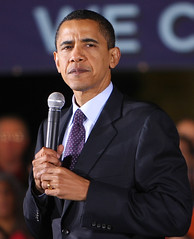 Image by jmtimages via Flickr
Barack Obama is on track to have the most spectacularly failed presidency since Woodrow Wilson. In the modern era, we've seen several failed presidencies--led by Jimmy Carter and LBJ. Failed presidents have one strong common trait-- they are repudiated, in the vernacular, spat out. Of course, LBJ wisely took the exit ramp early, avoiding a shove into oncoming traffic by his own party. Richard Nixon indeed resigned in disgrace, yet his reputation as a statesman has been partially restored by his triumphant overture to China 20.
But, Barack Obama is failing. Failing big. Failing fast. And failing everywhere: foreign policy, domestic initiatives, and most importantly, in forging connections with the American people. The incomparable Dorothy Rabinowitz in the Wall Street Journal put her finger on it: He is failing because he has no understanding of the American people, and may indeed loathe them. Fred Barnes of the Weekly Standard says he is failing because he has lost control of his message, and is overexposed. Clarice Feldman of American Thinker produced a dispositive commentary showing that Obama is failing because fundamentally he is neither smart nor articulate; his intellectual dishonesty is conspicuous by its audacity and lack of shame.
But, there is something more seriously wrong: How could a new president riding in on a wave of unprecedented promise and goodwill have forfeited his tenure and become a lame duck in six months? His poll ratings are in free fall. In generic balloting, the Republicans have now seized a five point advantage. This truly is unbelievable. What's going on?
No narrative. Obama doesn't have a narrative. No, not a narrative about himself. He has a self-narrative, much of it fabricated, cleverly disguised or written by someone else. But this self-narrative is isolated and doesn't connect with us. He doesn't have an American narrative that draws upon the rest of us. All successful presidents have a narrative about the American character that intersects with their own where they display a command of history and reveal an authenticity at the core of their personality that resonates in a positive endearing way with the majority of Americans. We admire those presidents whose narratives not only touch our own, but who seem stronger, wiser, and smarter than we are. Presidents we admire are aspirational peers, even those whose politics don't align exactly with our own: Teddy Roosevelt, FDR, Harry Truman, Ike, and Reagan.
But not this president. It's not so much that he's a phony, knows nothing about economics, and is historically illiterate and woefully small minded for the size of the task--all contributory of course. It's that he's not one of us. And whatever he is, his profile is fuzzy and devoid of content, like a cardboard cutout made from delaminated corrugated paper. Moreover, he doesn't command our respect and is unable to appeal to our own common sense. His notions of right and wrong are repugnant and how things work just don't add up. They are not existential. His descriptions of the world we live in don't make sense and don't correspond with our experience.
In the meantime, while we've been struggling to take a measurement of this man, he's dissed just about every one of us--financiers, energy producers, banks, insurance executives, police officers, doctors, nurses, hospital administrators, post office workers, and anybody else who has a non-green job. Expect Obama to lament at his last press conference in 2012: "For those of you I offended, I apologize. For those of you who were not offended, you just didn't give me enough time; if only I'd had a second term, I could have offended you too."
Mercifully, the Founders at the Constitutional Convention in 1787 devised a useful remedy for such a desperate state--staggered terms for both houses of the legislature and the executive. An equally abominable Congress can get voted out next year. With a new Congress, there's always hope of legislative gridlock until we vote for president again two short years after that.
Yes, small presidents do fail, Barack Obama among them. The coyotes howl but the wagon train keeps rolling along.
Margaret Thatcher: "The trouble with Socialism is, sooner or later you run out of other people's money."
"When you subsidize poverty and failure, you get more of both." - James Dale Davidson, National Taxpayers Union
"The more corrupt the state, the more it legislates." - Tacitus
"A Liberal is a person who will give away everything he doesn't own." - Unknown
US Mint Runs Out Of Tenth-Ounce Gold Coin Inventory Day After Its Release For Broad Purchase
 Image via Wikipedia
The sad state of affairs in gold land: the premium for the 1 ounce Gold Eagle coins has expanded from $59 to $99, Krugerrands are not available for sale in most places, and this most recent development just out of the US Mint: the one-tenth ounce American Eagle inventory at the mint has been depleted, almost instantaneously after the coin was made available for purchase. This occurred the day after the mint announced the release of fractional Eagle Gold Bullion Coins in one-half ounce, one-quarter ounce, and one-tenth ounce weights. As Coin News reports:
The Mint sold 345,000 coins to its authorized purchasers for a total of 58,000 ounces of gold. That, without a single one-ounce size leaving Mint doors.
Sales of 2009 one-ounce sized gold eagles are expected to resume in "early December" while the production of the 2010-dated American Eagle Gold and Silver One Ounce Bullion Coin are expected to begin in Jan., 2010.

So no sooner did the Mint start selling the new 1/10 ounce denominated gold pieces, than they ran out.
The US Mint ran out of one ounce 2009 American Gold Eagle coins last week which caused their temporary suspension, and now the fractional sizes that were just launched are either gone or being allocated following record one-day sales.
This is the notice sent out by the Mint to authorized purchasers:
Due to strong demand, the American Eagle Gold Tenth-Ounce Coin inventory was depleted. The inventory for the half-ounce and quarter-ounce coins remains very limited. We will offer the remaining half-ounce and quarter-ounce coins for sale via the United States Mint standard allocation process.
And indicative of the massive gold demand, the 24-karat one ounce Buffalo coin inventory was depleted as well:
"The United States Mint has depleted its inventory of 2009 American Buffalo One Ounce Gold Bullion Coins," the US Mint stated in a memorandum to authorized purchasers of the precious metal coins. "No additional inventory will be made available. As additional information becomes available regarding 2010-dated American Buffalo One Once Gold Bullion Coins, you will be notified."
Following their launch on Oct. 15, the selling pace was fierce. US Mint figures have the 2009-dated coins at 198,000. By comparison, the Mint has said 172,000 were sold in all of 2008 while 167,500 were purchased in 2007.
It appears the 79% of the US population that disapproves of Bernanke and is asking for his head, is not sitting idly and every single day continues expressing its "vote" of no confidence in the Chairman by making gold increasingly scarcer. In the meantime, the massive demand for silver coins is also starting to hit the Mint, which as of today had none in store.
Subscribe to:
Posts (Atom)