Wednesday, May 15, 2013
Amazon launches its own virtual currency
One Amazon Coin is worth one US penny, and Kindle Fire owners are getting 500 Coins ($5) for free as part of the launch.
The Coins will also be able to be used on the company's retail site when they become more widely available. Amazon has not yet confirmed when the scheme will be launched outside of the US, or if it will be available to non-Kindle users.
Amazon Coins can be bought in batches of 1000, 2500, 5000 and 10,000. The more you buy, the bigger the discount and 10,000 Coins costs $90, for example. Read more >>
Friday, January 18, 2013
Silver Buying at 5 Year High
The mint’s sales are “temporarily” suspended and will resume on or about the week of Jan. 28 when inventory is replenished, it said yesterday in an e-mailed statement. Holdings in the iShares Silver Trust jumped 571.6 metric tons on Jan. 16, an increase now valued at $584 million. Prices may rise as much as 27 percent to $40.25 an ounce this year, a Bloomberg survey of 49 analysts, traders and investors last month showed.
Global assets in silver ETPs climbed to a record valued at $20.1 billion as central banks from the U.S. to China pledged more steps to boost economic growth. The stimulus is raising demand for precious metals as a hedge against faster inflation and currency debasement. Strengthening economies may also benefit silver, because 53 percent of it is used in everything from televisions to batteries, the Silver Institute says.The U.S. Mint sold out of 2013 American Eagle silver coins at a time when investors bought the most metal in five years through the biggest exchange-traded product. Read more >>
US Mint runs out of 2013 silver coins
Sales to authorized dealers will resume on or about the week of Jan. 28 after the U.S. Mint has replenished its inventory, it said in an email to authorized dealers on Thursday. The coins are produced at the Mint's West Point, New York, facility.
While it is typical for collectors to snap up newly stamped coins, interest this year has ballooned due to investors seeking refuge from U.S. economic uncertainty.
Silver Eagle sales to Jan. 15 exceeded 5 million ounces and were on track to surpass the all-time monthly high of 6.1 million ounces, set in January 2012.
Physical coin sales had risen in the final months of 2012 as investors protected their nest eggs from a feared U.S. recession. Many economists predicted a U.S. economic downturn would occur if Congress and the White House did not act to stop pending huge tax hikes and automatic spending cuts known as the "fiscal cliff." Read more >>
Tuesday, December 18, 2012
U.S. Secret Service Bans Sale of Silver and Gold Liberty Dollars on Ebay
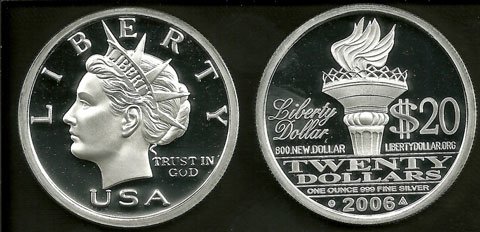
In early 2011 Bernad Von Nothaus was convicted by the US government and identified as a domestic terrorist by Federal prosecutors for minting his own silver and gold coinage, and then offering those coins for sale to clients. He dubbed the coins “Liberty Dollars” and by doing so brought upon himself the ire of the U.S. Secret Service, Federal Reserve and a host of other government agencies.
According to the government, Von Nothaus was a counterfeiter, though he made no attempts to actually counterfeit U.S. currency, but rather, provide another mechanism of exchange through the use of precious metals.
After Von Nothaus’ conviction, the Secret Service warned they would be confiscating all Liberty Dollar coins manufactured by Nothaus’ company, NorFed.
Since the shutdown of VonNothaus’ operation, many of the coins have been offered for sale or trade on mega-auction site Ebay, and this week the Secret Service took action. They contacted Ebay, which in turn advised sellers of the coins on their site that they could no longer engage in the trade of silver coins with the Norfed Liberty Dollar hallmark. Read more >>
Tuesday, May 15, 2012
Some Considerations on Precious Metals
If you want to expand your portfolio to include precious metals, here are some considerations: a single ounce of gold stores more value than silver. If you need portability for a large amount of wealth gold coins and bars will be your primary precious metals investment. Currently an ounce of gold is about $1550. With less than a pound of coins in your purse or backpack you can conveniently move $25,000 in value.
What gold offers in portability it lacks in divisibility. This is where silver comes in. You may not be able to move $25,000 of silver conveniently (weighing around 50 pounds!). But because of it’s lower value per ounce silver is an excellent mechanism of exchange for things like food, gas, clean water, or tools if the dollar hyper-inflates or crashes.
You can purchase silver in bars (100 oz, 10 oz) or coins (1 ounce, or U.S. government issued pre-1965 halves, quarters and dimes). With the smaller denomination coins like US quarters you will have portability for a small amount of cash (40 quarters is about $150 dollars worth) and you’ll have coinage that should allow you the ability to purchase just about any item someone is willing to sell.
Silver allows you to make modest, weekly investments of anywhere from $5 to $50 dollars and still build a store of wealth.
If you are investing a large sum of money into precious metals, gather details about the types of coins you are buying, especially if you’re buying gold. Acquire a coin caliper and/or testing kit to ensure you’re getting what is being advertised. More...
Sunday, May 22, 2011
Gold, silver coins to be legal currency in Utah
Monday, December 7, 2009
US Mint Runs Out Of Tenth-Ounce Gold Coin Inventory Day After Its Release For Broad Purchase
Image via Wikipedia
The sad state of affairs in gold land: the premium for the 1 ounce Gold Eagle coins has expanded from $59 to $99, Krugerrands are not available for sale in most places, and this most recent development just out of the US Mint: the one-tenth ounce American Eagle inventory at the mint has been depleted, almost instantaneously after the coin was made available for purchase. This occurred the day after the mint announced the release of fractional Eagle Gold Bullion Coins in one-half ounce, one-quarter ounce, and one-tenth ounce weights. As Coin News reports:
The Mint sold 345,000 coins to its authorized purchasers for a total of 58,000 ounces of gold. That, without a single one-ounce size leaving Mint doors.
Sales of 2009 one-ounce sized gold eagles are expected to resume in "early December" while the production of the 2010-dated American Eagle Gold and Silver One Ounce Bullion Coin are expected to begin in Jan., 2010.
So no sooner did the Mint start selling the new 1/10 ounce denominated gold pieces, than they ran out.
The US Mint ran out of one ounce 2009 American Gold Eagle coins last week which caused their temporary suspension, and now the fractional sizes that were just launched are either gone or being allocated following record one-day sales.
This is the notice sent out by the Mint to authorized purchasers:
Due to strong demand, the American Eagle Gold Tenth-Ounce Coin inventory was depleted. The inventory for the half-ounce and quarter-ounce coins remains very limited. We will offer the remaining half-ounce and quarter-ounce coins for sale via the United States Mint standard allocation process.
And indicative of the massive gold demand, the 24-karat one ounce Buffalo coin inventory was depleted as well:
"The United States Mint has depleted its inventory of 2009 American Buffalo One Ounce Gold Bullion Coins," the US Mint stated in a memorandum to authorized purchasers of the precious metal coins. "No additional inventory will be made available. As additional information becomes available regarding 2010-dated American Buffalo One Once Gold Bullion Coins, you will be notified."
Following their launch on Oct. 15, the selling pace was fierce. US Mint figures have the 2009-dated coins at 198,000. By comparison, the Mint has said 172,000 were sold in all of 2008 while 167,500 were purchased in 2007.
It appears the 79% of the US population that disapproves of Bernanke and is asking for his head, is not sitting idly and every single day continues expressing its "vote" of no confidence in the Chairman by making gold increasingly scarcer. In the meantime, the massive demand for silver coins is also starting to hit the Mint, which as of today had none in store.
Wednesday, November 25, 2009
Gold Krugerrands Run Out
Image via Wikipedia
For some time, I have been warning that apparently plentiful supplies of gold and silver bullion-priced coins and ingots could quickly evaporate. Last Thursday we saw the first signs of a looming shortage of physical metals when just about all U.S. bullion wholesalers were unable to accept orders for the South Africa Krugerrand. One primary distributor said they expected coins in a few weeks, which I think means that they are waiting for a shipment of freshly minted coins from the South Africa Mint. My own company had to discontinue accepting new orders until we could lock in a supply.
Tens of millions of Krugerrands have been struck since they were introduced in 1967. They are not rare. If demand for physical gold is so strong (and the World Gold Council last week reported that global third quarter demand was 15 percent higher than the second quarter) that they are no longer available, we could quickly see a domino effect where other gold and silver bullion-priced products also become sold out.
We may see some temporary price dips this week as the gold and silver options expire. However, I fear that there is little time to lock in physical precious metals at reasonable premiums for quick delivery.
Wednesday, October 7, 2009
United States Mint Cancells Gold and Silver Eagles
Image via Wikipedia
Yesterday at Noon, the United States Mint issued a press release with some shocking and disappointing news. The collectible 2009 Proof and Uncirculated Gold and Silver Eagles will not be offered this year. As partial consolation, the press release also announced plans to offer the 2009 Proof Gold Buffalo, the 2009 Proof Platinum Eagle, and fractional weight Gold Eagle bullion coins.
As it now stands, the following collector coins are now canceled:
- 2009 Proof Silver EagleThis is in addition to many other collector gold and platinum coins that had previously been announced as discontinued.
- 2009-W Uncirculated Silver Eagle
- 2009 Annual Uncirculated Dollar Coin Set
- 2009 Proof $50 Gold Eagle (one ounce)
- 2009 Proof $25 Gold Eagle (one-half ounce)
- 2009 Proof $10 Gold Eagle (one-quarter ounce)
- 2009 Proof $5 Gold Eagle (one-tenth ounce)
- 2009 Proof Gold Eagle 4 Coin Set
On the bullion front, the US Mint has canceled all 2009 American Platinum Eagle bullion coins. These coins are typically available in one ounce, one-half ounce, one-quarter ounce, and one-tenth ounce sizes.
The following collector coins will be offered:
- 2009 Proof $50 Gold Buffalo (release date October 29)The reason cited for the canceled products is a familiar one: "the unprecedented demand for American Eagle Gold and Silver Bullion Coins." This reason has been cited on numerous occasions over the past two years to explain bullion coin rationing, bullion and collector coin suspensions, and bullion and collector coin cancellations.
- 2009 Proof $100 Platinum Eagle (release date December 3)
Under law, the United States Mint is required to produce Gold and Silver Eagle bullion coins in quantities sufficient to meet public demand. Accordingly, the US Mint has been using all 22-karat gold and silver blanks to produce bullion coins, in lieu of collector coins, which they are not legally required to produce.
The status of this year's collectible Gold Eagles, Platinum Eagles, Silver Eagles, and Gold Buffaloes has been a topic of constant discussion and speculation. Way back in January, I had mentioned the possibility that these coins might not be issued in 2009. My reasoning was validated a few months later when the US Mint finally announced that the products were suspended (see posts here and here). In mid-June, there was a brief revival of hope for the collector coins when the US Mint finally ended bullion allocation programs, but apparently this was to no avail.
This is clearly an unhappy resolution to the situation for collectors. I will have further thoughts on this situation in the coming days.
Tuesday, October 6, 2009
Tuesday, September 8, 2009
The Continual Failure of Paper Money
Image via Wikipedia
The currency issued by the Yuan was the world's first fiat currency, known as Chao. Every paper currency that the Chinese ever implemented failed.
During the early Song dynasty (Chinese: 960-1279) China again reunited the currency system displacing coinages from ten or so independent states. Among pre-Song coins, the northern states tended to prefer copper coins. The southern states tended to use lead or iron coins with Sichuan using its own heavy iron coins which continued to circulate for a short period into the Song dynasty. By 1000 unification was complete and China experienced a rapid period of economic growth. This was reflected in the growth of coining. In 1073, the peak year for minting coins in the Northern Song, the government produced an estimated six million strings containing a thousand copper coins each. The Northern Song is thought to have minted over two hundred million strings of coins which were often exported to Inner Asia, Japan, and South-East Asia where they often formed the dominant form of coinage. Song merchants rapidly adopted forms of paper currency starting with promissary notes in Sichuan called "flying money" (feiqian). These proved so useful the state took over production of this form of paper money with the first state-backed printing in 1024. By the twelfth century various forms of paper money had become the dominant forms of currency in China and were known by a variety of names such as jiaozi, qianyin, kuaizi, or guanzi.
The Mongol-founded Yuan dynasty (Chinese: 1271-1368) also attempted to use paper currency. Unlike the Song dynasty they created a unified, national system that was not backed by silver or gold. The currency issued by the Yuan was the world's first fiat currency, known as Chao. The Yuan government attempted to prohibit all transactions in or possession of silver or gold, which had to be turned over to the government. Inflation in 1260 caused the government to replace the existing paper currency with a new paper currency in 1287, but inflation caused by undisciplined printing remained a problem for the Yuan court until the end of the Dynasty.
Silver sycee (yuanbao) ingots
The early Ming dynasty (Chinese: pinyin: Míng, 1368-1644) also attempted to use paper currency in the early re-unification period. This currency also experienced rapid inflation and issues were suspended in 1450 although notes remained in circulation until 1573. It was only in the very last years of the Ming dynasty when Li Zicheng threatened Beijing in 1643 and 1644 that printing took place again. For most of the Ming China had a purely private system of currency for all important transactions. Silver, which flowed in from overseas, began to be used as a currency in the Far South province of Guangdong where it spread to the lower Yangzi region by 1423 when it became legal tender for payment of taxes. Provincial taxes had to be remitted to the capital in silver after 1465, salt producers had to pay in silver from 1475 and corvée exemptions had to be paid in silver from 1485. The Chinese demand for silver was partially met by Spanish imports from the Americas, in particular Potosi in Peru and Mexico, after the Spanish became established at Manila in 1571. However the silver was not minted. It circulated as ingots (known as sycee or yuanbao) which weighed a nominal liang (about 36 grammes) although purity and weight varied from region to region. The liang was often referred to by Europeans by the Malay term tael.
Late Imperial China maintained both a silver and a copper currency system. The copper system was based on the copper cash (wen). The silver system had several units which by the Qing Dynasty were: 1 tael = 10 mace = 100 candareens = 1000 li (silver cash).
In 1889, the Chinese yuan was introduced at par with the Mexican Peso and was subdivided into 10 jiao (not given an English name, cf. dime), 100 fen (cents), and 1000 wen (cash). The yuan was equivalent to 7 mace and 2 candareens (or 0.72 tael) and, for a time, coins were marked as such in English.
The earliest issues were silver coins produced at the Kwangtung mint in denominations of 5 fen, 1, 2 and 5 jiao and 1 yuan. Other regional mints were opened in the 1890s producing similar coins. Copper coins in denominations of 1, 2, 5, 10 and 20 wen were also issued. The central government began issuing its own coins in the yuan currency system in 1903. Banknotes were issued in yuan denominations from the 1890s by several local and private banks, along with the "Imperial Bank of China" and the "Hu Pu Bank" (later the "Ta-Ch'ing Government Bank"), established by the Imperial government.

Tuesday, July 21, 2009
After The Collapse Stores Will Accept Gold and Silver
A good friend of mine sent me this enlightening video regarding grocery stores accepting silver in California. Many financial analysts and bloggers have devoted hours of their time in endless deflation versus inflation debates -- as if it matters, either way ultimately hyperinflation will result; nevertheless, the devaluation of U.S. currency will occur and may be caused in a variety of ways: a bank holiday, collapse of the dollar, or an accepted basket of currencies replacing the dollar as the new world reserve currency.
Food will be more valuable than gold and silver in the beginning stages of the collapse where unorganized chaos will prevail. During a bank holiday, ATMs may be inoperable, and huge retail outlets like Walmart will only accept cash; their minimum wage cashiers wouldn't have a clue what to do with gold or silver coins. But in time, as this video demonstrates, major retail stores will employ trained gold and silver conversion technicians who will -- based on the daily price of gold and silver -- tabulate the value of your precious metal in exchange for goods and services.