Saturday, January 30, 2010

Who helped corporate rich get richer? You did

General Electric CompanyImage via Wikipedia


In the banking industry in 2009, the rich got richer -- which has, of course, infuriated much of the nation.

But that same basic idea, mostly minus the public infuriation factor, is playing out across the business world.

The Great Recession has killed untold numbers of small firms, many of which were unable to line up financing to keep their operations afloat.

But money is no problem at all for corporate America. And the biggest businesses don't need banks, at least not for loans. As the credit crisis has eased, they've been able to turn to the welcoming arms of the bond market.

Recessions always are about the weak falling away while the strong survive. But this time around, the credit crunch has remained so severe for smaller firms that the advantage has been magnified for the major companies that have unfettered access to cash via bond sales.

Issuance of high-quality (i.e., investment-grade) bonds reached a record $2.83 trillion worldwide last year, a stunning 38% jump from 2008, according to data tracker Dealogic. Although governments were heavy borrowers, about half of that total raised was by big-name companies.

Who helped make the corporate rich even richer? You did -- if you're one of many Americans who pumped your savings into bond mutual funds. An unprecedented $375 billion poured into bond funds in 2009, providing a significant chunk of the capital that then flowed into newly issued bonds from companies such as General Electric Co., Pfizer Inc. and Dow Chemical Co.

And like any symbiotic relationship, this one has no good reason to end. While many investors now shun the stock market, their hunger for income may keep demand for corporate bonds strong in 2010 and beyond.

A bond is a promise to pay -- first, to pay a rate of interest each year, and second, to repay the investor's principal when the bond matures on a set date, if not before. Understandably, after the financial markets' crash of 2008, a promise to pay sounds a lot better to shell-shocked investors than taking a flier on a stock.

For a company like GE or Pfizer, bonds offer a way to raise large sums of cash at set interest rates. Those rates were declining for much of 2009 as fear subsided in financial markets and as investors bid aggressively for fixed-income securities.

It isn't just the Fortune 500 that can borrow through bonds, but this isn't a market that's open to the millions of small firms that have been the most starved for credit over the last 18 months.

Last year, the massive sums raised from corporate bond sales allowed some companies to pay off bank loans or bonds previously issued at higher interest rates. Others used the money to finance takeovers. And some firms just built up their cash reserves to bolster their finances.

The amount of cash on the balance sheets of the industrial companies in the Standard & Poor's 500 index soared to a record $820 billion as of Sept. 30 from $647 billion a year earlier, according to S&P.

Because cash pays nothing, big companies should be feeling pressure to put those dollars to more productive use -- say, by expanding.

But we live in a still-struggling global economy that already has too much vacant office space and too many idled factories. "Who needs more capital goods or structures with 15% excess capacity lurking in most economies?" said Carl Weinberg, chief economist at High Frequency Economics in Valhalla, N.Y.

Likewise, many big companies believe they have no need for additional workers, which is why double-digit unemployment has become the black cloud over the economic recovery of the last six months.

Yet even in the best of times, the Fortune 500 aren't engines of job growth in the U.S. "Almost all of the new jobs and investment in any economy come from small companies morphing into larger ones," Weinberg notes. "If they get squeezed, the economy loses its dynamism."

That's one of the great long-term risks the U.S. faces from the corporate-rich-get-richer syndrome that bond investors are abetting. If capital is being misallocated -- meaning, if its most productive use would be with smaller companies, except that they can't get into the bond market and they can't get loans from banks -- the economy can't live up to its true potential.

While corporate titans benefited from the bond market's largess last year, many also have been reaping the rewards of the ruthless drive to reduce head count and slash other costs. Even modest growth in sales now is falling directly to the bottom line.

The result: Fourth-quarter earnings reports from the S&P 500 index companies are coming in far above Wall Street analysts' expectations. Of the 220 companies in the index that have reported results so far, 78% have beaten estimates, according to data firm Thomson Reuters. And on average, earnings have been 17% above expectations -- a "surprise" factor that, if it holds up, would be the highest for any quarter since Thomson Reuters began tracking data in 1994.

It could be that analysts, more than usual, are lowballing their estimates to make it easier for companies to post pleasant surprises. Still, there's no question that earnings have improved dramatically for the biggest firms.

That profit rebound should be good news for stock prices, and it was for much of the last 10 months. But the equity market has hit an air pocket over the last two weeks.

On Friday, the Dow Jones industrial average lost 53.13 points, or 0.5%, to 10,067.33, its lowest since Nov. 6. The Dow has slid 6.1% from its 15-month high of 10,725 on Jan. 19.

Despite the government's report Friday that the economy expanded at a strong 5.7% annualized rate in the fourth quarter, there are more questions now than even a few weeks ago about the sustainability of the recovery.

If those doubts grow, Wall Street could face another downdraft. And if investors grow warier of stocks, they may turn in even greater numbers to the relative safety of high-quality corporate bonds.

One unusual twist in the bond market this year is that global investors may have reason to feel more secure in bonds of mega-companies than in bonds of some foreign governments. This week, worries about Greece's dire fiscal situation also infected other Southern European countries. Investors pushed yields on Greek, Portuguese and Spanish bonds sharply higher, a sign of eroding faith in the countries' creditworthiness.

Mark Kiesel, who manages the $6.5-billion Pimco Investment Grade Corporate Bond mutual fund in Newport Beach, says he's betting that many high-quality corporate bonds will continue to attract investors looking for decent annualized yields -- in the 5% to 7% range -- and balance sheets strong enough to weather a still-rough economy.

"Corporate America," Kiesel says, "is a cash-flow machine."

That isn't any solace to the unemployed, but it offers a level of comfort that is bond investors' No. 1 priority.

Reblog this post [with Zemanta]

Roubini: 4Q GDP a Joke

Nouriel Roubini, Turkish economist, professor ...Image via Wikipedia

Roubini Calls U.S. Growth ‘Dismal and Poor,’ Predicts Slowing
Simon Kennedy and Erik Schatzker
Bloomberg
New York University Professor Nouriel Roubini, who anticipated the financial crisis, called the fourth quarter surge in U.S. economic growth “very dismal and poor” because it relied on temporary factors.

Roubini said more than half of the 5.7 percent expansion reported yesterday by the government was related to a replenishing of inventories and that consumption depended on monetary and fiscal stimulus. As these forces ebb, growth will slow to just 1.5 percent in the second half of 2010, he said.

“The headline number will look large and big, but actually when you dissect it, it’s very dismal and poor,” Roubini told Bloomberg Television in an interview at the World Economic Forum’s annual meeting in Davos, Switzerland. “I think we are in trouble.”

Roubini said while the world’s largest economy won’t relapse into recession, unemployment will rise from the current 10 percent, posing social and political challenges.

“It’s going to feel like a recession even if technically we’re not going to be in a recession,” he said.

Friday, January 29, 2010

Census Bureau - obligated to answer, $1,000 fine for each question refused

None of Your Business!
Rep. Ron Paul
You may not have heard of the American Community Survey, but you will. The national census, which historically is taken every ten years, has expanded to quench the federal bureaucracy’s ever-growing thirst to govern every aspect of American life. The new survey, unlike the traditional census, is taken each and every year at a cost of hundreds of millions of dollars. And it’s not brief. It contains 24 pages of intrusive questions concerning matters that simply are none of the government’s business, including your job, your income, your physical and emotional heath, your family status, your dwelling, and your intimate personal habits.

The questions are both ludicrous and insulting. The survey asks, for instance, how many bathrooms you have in your house, how many miles you drive to work, how many days you were sick last year, and whether you have trouble getting up stairs. It goes on and on, mixing inane questions with highly detailed inquiries about your financial affairs. One can only imagine the countless malevolent ways our federal bureaucrats could use this information. At the very least the survey will be used to dole out pork, which is reason enough to oppose it.

Keep in mind the survey is not voluntary, nor is the Census Bureau asking politely. Americans are legally obligated to answer, and can be fined up to $1,000 per question if they refuse!

I introduced an amendment last week that would have eliminated funds for this intrusive survey in a spending bill, explaining on the House floor that perhaps the American people don’t appreciate being threatened by Big Brother. The amendment was met by either indifference or hostility, as most members of Congress either don’t care about or actively support government snooping into the private affairs of citizens.

One of the worst aspects of the census is its focus on classifying people by race. When government tells us it wants information to “help” any given group, it assumes every individual who shares certain physical characteristics has the same interests, or wants the same things from government. This is an inherently racist and offensive assumption. The census, like so many federal policies and programs, inflames racism by encouraging Americans to see themselves as members of racial groups fighting each other for a share of the federal pie.

The census also represents a form of corporate welfare, since the personal data collected on hundred of millions of Americans can be sold to private businesses. Surely business enjoys having such extensive information available from one source, but it’s hardly the duty of taxpayers to subsidize the cost of market research.

At least the national census has its origins in the Constitution, which is more than one can say about the vast majority of programs funded by Congress. Still, Article I makes it clear that the census should be taken every ten years for the sole purpose of congressional redistricting (and apportionment of taxes, prior to the disastrous 16th amendment). This means a simple count of the number of people living in a given area, so that numerically equal congressional districts can be maintained. The founders never authorized the federal government to continuously survey the American people.

More importantly, they never envisioned a nation where the people would roll over and submit to every government demand. The American Community Survey is patently offensive to all Americans who still embody that fundamental American virtue, namely a healthy mistrust of government. The information demanded in the new survey is none of the government’s business, and the American people should insist that Congress reject it now before it becomes entrenched.

Thursday, January 28, 2010

Behind the Bailouts, Bonuses and Backroom Deals from Washington to Wall Street

Bailout and Subsidization Type Report
by Nomi Prins and Krisztina Ugrin
January 2010
How They Got It and Who Gave It Click

AIG’s mysterious Schedule A finally revealed

reuters.com
The heavily-redacted regulatory filing that spells out the details of the New York Federal Reserve’s controversial bailout of American International Group is a secret no more.

Reuters has obtained a copy of the five-page document the giant insurer and the New York Fed had asked the Securities and Exchange Commission to keep confidential. The effort by the New York Fed to keep the document under wraps has sparked a furor on Capitol Hill and was the subject of a hearing on Wednesday by House Committee on Oversight and Government Reform.

The unredacted version of the “Schedule A – List of Derivative Transactions” fills out some of the missing pieces in the AIG bailout, in which an entity set-up by the New York Fed effectively funneled tens of millions of dollars to 16 big U.S. and Europeans banks that had bought credit default swaps from the insurer.

The unredacted version of the Schedule A enables some to identify all of the 178 mortgage-related securities, or collateralized debt obligations, that AIG wrote insurance-like protection on.

It’s been known for months that Goldman Sachs and Societe Generale were the two banks who recieved the most money in the dea because they had insured the most CDOs with AIG. But the new information enables traders, investors and the general public to see just which deals the banks had purchased insurance on.

The new information also reveals that of the 178 tranches of CDOs that AIG insured, some 14% were on deals issued after 2005. That’s critical because in December 2007, former AIG Financial Products head Joseph Cassano had said AIG largely got out of the CDS business by the end of 2005.

The newly disclosed information also reveals that Goldman not only bought a lot of CDS from AIG to protect itself; the Wall Street firm also originated a good number of the CDOs that were in SocGen’s portfolio. Some of the Goldman deals in SocGen’s portfolio that AIG had insured includes CDOs with names like Adirondack 2005, Putnam Structured Product CDO 2002 and Davis Square Funding IV.

Janet Tavakoli, a derivatives consultant who has called the AIG bailout a gift to the Wall Street banks, said the issue isn’t just what deals AIG insured, but the underlying assets in those deals. She noted that a goodly number of the CDOs held by the banks also held pieces of other CDOs.

Goldman Sachs, Societe Generale, Deutsche Bank, Merrill Lynch and other banks sold their ailing collateralized debt obligations to the New York Fed-sponsored entity, Maiden Lane III. AIG then canceled out the CDS contracts it had sold as default insurance on those 178 CDOs.

“If all of this had come out in the public domain in late 2008, Goldman Sachs and Merrill would have been deeply embarassed and the Federal Reserve woudl have been questioned,” said Tavakoli.

In the process, the banks were made whole and AIG no longer had to pay out billions of dollars in cash collateral to the banks everytime the CDOs dropped in value.

Wednesday, January 27, 2010

U.S. households struggle to afford food: survey

Nearly one in five U.S. households ran out of money to buy enough food at least once during 2009, said an antihunger group on Tuesday, urging more federal action to help Americans get enough to eat.

"There are no hunger-free areas of America," said Jim Weill of the Food Research and Action Center. Weill said he hoped President Barack Obama would exempt public nutrition programs from a proposed three-year freeze on domestic spending.

Obama has a goal to end childhood hunger by 2015. He backed a $1 billion a year increase in school lunch and other child nutrition programs a year ago.

Nationwide polling found 18.2 percent of households reported "food hardship" -- lacking money to buy enough food -- in 2009, according to the group. That is higher than the government's "food insecurity" rating of 14.6 percent of households, or 49 million people, for 2008.

Households with children had a "food hardship" rate of 24.1 percent for 2009 compared with 14.9 percent among households without children. Twenty states had rates of 20 percent or higher. Seven Southern states led the list.

The figures were based on responses to the question, "Have there been times in the past 12 months when you did not have enough money to buy the food that you or your family needed?" The question is similar to one asked by the Census Bureau in collecting data for the annual food-insecurity report.
Source: Reuters

Sprint, Pfizer, Home Depot, Caterpillar, Philips Electronics slash 60 Thousand Jobs

Yesterday US News and World Report calculated that Sprint, Pfizer, Home Depot, Caterpillar, and Philips Electronics slashed 60 Thousand Jobs.

Job Cuts Get Brutal: Sprint, Pfizer, Home Depot, Caterpillar
The job loss tally so far today: 54,500. Cuts are coming across industries as further weakness in the economy keeps major employers slashing away. On the same day it agreed to buy rival drugmaker Wyeth, Pfizer said it would cut 15 percent from its combined workforce (that's a bit less than 19,500 jobs). Meanwhile, Caterpillar is faring poorly in the global recession. It's cutting its workforce by 20,000 including 11 percent of its workforce, or 12,000 jobs, and 8,000 contractors. Home Depot, a lingering victim of the downturn in both consumer spending and housing, said it would slash another 7,000 jobs as it shutters its high-end EXPO business. And finally, Sprint Nextel is eliminating 14 percent of its workforce, or 8,000 jobs. Update: Add another 6,000 to the tally above. Philips Electronics is cutting too.

Tuesday, January 26, 2010

With $50 and a plane ticket to Haiti, one can buy a slave

Author Struggles to Stay Removed from Slave Trade
NPR
March 11, 2008

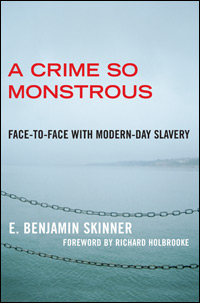
With $50 and a plane ticket to Haiti, one can buy a slave. This was just one of the difficult lessons writer Benjamin Skinner learned while researching his book, A Crime So Monstrous: Face-to-Face with Modern-Day Slavery.

Skinner met with slaves and traffickers in 12 different countries, filling in the substance around a startling fact: there are more slaves on the planet today than at any time in human history. Skinner speaks with Anthony Brooks about his experience researching slavery.

Though now illegal throughout the world, slavery is more or less the same as it was hundreds of years ago, Skinner explains. Slaves are still "those that are forced to work under threat of violence for no pay beyond sustenance."

Something disturbing has changed however — the price of a human. After adjusting for inflation, Skinner found that, "In 1850, a slave would cost roughly $30,000 to $40,000 — in other words it was like investing in a Mercedes. Today you can go to Haiti and buy a 9-year-old girl to use as a sexual and domestic slave for $50. The devaluation of human life is incredibly pronounced."

Skinner obtained this specific figure through a very hands-on process. In the fall of 2005, he visited Haiti, which has one of the highest concentrations of slaves anywhere in the world.

"I pulled up in a car and rolled down the window," he recalls. "Someone said, 'Do you want to get a person?'"

Though the country was in a time of political chaos, the street where he met the trafficker was clean and relatively quiet. A tape of the conversation reveals a calm, concise transaction. He was initially told he could get a 9-year-old sex partner/house slave for $100, but he bargained it down to $50.

"The thing that struck me more than anything afterwards was how incredibly banal the transaction was. It was as if I was negotiating on the street for a used stereo."

In the end, he agreed on the price, but told the trader not to make any moves.

"When I was talking to traffickers, I had a principle that I wouldn't pay for human life," he says.

This principle enabled him to keep a certain distance from the system, but not giving in to the temptation to free a suffering human being was an emotionally taxing struggle, he says.

"It's one thing when you are planning an effort like this, this is a work of journalism — I'm not going to interfere with my subjects. It's another thing when you are in an underground brothel in Bucharest, who has this girl with Down Syndrome, who you know is undergoing rape several times a day. When this girl is offered to me in trade for a used car ... I walk away ... it's not an easy thing to do," he says.

At one point, he did violate his principal — helping a mother free her daughter from slavery. He says he does not regret his decision, however, and continues to track her progress through a local NGO in Haiti. She's now in school, he says, and wrote him a letter over Christmas.

Slavery consumes Skinner, he says.

"When I come back to a nice loft in Brooklyn and I have to think about writing this thing — that drove me. I knew that I had to write as compelling a book as possible. This is a life-long commitment for me."

Excerpt: 'A Crime So Monstrous:

Face-to-Face with Modern-Day Slavery'

Book Cover
Courtesy of Simon and Schuster

Chapter 1: The Riches of the Poor

For our purposes, let's say that the center of the moral universe is in Room S-3800 of the UN Secretariat, Manhattan. From here, you are some five hours from being able to negotiate the sale, in broad daylight, of a healthy boy or girl. Your slave will come in any color you like, as Henry Ford said, as long as it's black. Maximum age: fifteen. He or she can be used for anything. Sex or domestic labor are the most frequent uses, but it's up to you.

Before you go, let's be clear on what you are buying. A slave is a human being who is forced to work through fraud or threat of violence for no pay beyond subsistence. Agreed? Good. You may have thought you missed your chance to own a slave. Maybe you imagined that slavery died along with the 360,000 Union soldiers whose blood fertilized the Emancipation Proclamation and the Thirteenth Amendment. Perhaps you assumed that there was meaning behind the dozen international conventions banning the slave trade, or that the deaths of 30 million people in world wars had spread freedom across the globe.

But you're in luck. By our mere definition, you are living at a time when there are more slaves than at any point in history. If -you're going to buy one in five hours, however, you've really got to stop navel—gazing over things like law and the moral advance of humanity. Get a move on.

First, hail a taxi to JFK International Airport. If you choose the Queensboro Bridge to the Brooklyn—Queens Expressway, the drive should take under an hour. With no baggage, you'll speed through security in time to make a direct flight to Port au Prince, Haiti. Flying time: three hours.

The final hour is the strangest. After disembarking, you will cross the tarmac to the terminal where drummers in vodou getup and a dancing midget greet you with song. Based on Transportation Security Administration warnings posted in the departure terminal at JFK, you might expect abject chaos at Toussaint L'Ouverture Airport. Instead, you find orderly lines leading to the visa stamp, no bribes asked, a short wait for your bag, then a breeze through customs. Outside the airport, the cabbies and porters will be aggressive, but not threatening. Assuming you speak no Creole, find an English—speaking porter and offer him $20 to translate for the day.

Ask your translator to hail the most common form of transport, a tap-tap, a flatbed pickup retrofitted with benches and a brightly colored canopy. You will have to take a couple of these, but they only cost 10 gourdes (25 cents) each. Usually handpainted with signs in broken English or Creole, tap-taps often include the words my god or jesus. my god -it's my life reads one; another announces welcome to jesus. Many are ornate, featuring windshields covered in frill, doodads, and homages to such figures as Che Guevara, Ronaldinho, or reggae legend Gregory Isaacs. The -driver's navigation is based on memory, instinct. There will be no air conditioning. Earplugs are useful, as the sound system, which cost more than the rig itself, will make your chest vibrate with the beats of Haitian pop and American hip-hop. Up to twenty people may accompany you: five square inches on a wooden bench will miraculously accommodate a woman with a posterior the size of a tractor tire. Prepare your spine.

You'll want to head up Route de Delmas toward the suburb of Pétionville, where many of the -countr''s wealthiest thirty families—who control the -nat'on's economy—maintain a—ied--à-terre. As you drive southeast away from the sea, the smells change from rotting fish to rotting vegetables. Exhaust fumes fill the ai'. You'll pass a billboard featuring a smiling girl in pigtails and the words: Give me your hand. Give me tomorrow. Down with Child Servitude. Chances are, like the majority of Haitians, yo' -can't read French or Creole. Like them, you ignore the sign.

Heading out of the airport, -you'll pass two UN peacekeepers, one with a Brazilian patch, the other with an Argentine flag. As you pass the blue helmets, smile, wave, and receive dumbfounded stares in return. The United Nations also has Jordanians and Peruvians here, parked in APVs fifteen minutes northwest, along the edge of the hyperviolent Cité Soleil slum, the poorest and most densely populated six square miles in the poorest and most densely populated country in the hemisphere. The peacekeepers -do''t go in much, neither do the national police. If they do, the gangsters that run the place start shooting. Best to steer clear, although yo''d get a cheap price on children there. You might even get offered a child gratis.

You'll notice the streets of the Haitian capital are, like the tap—taps, overstuffed, banged up, yet colorful. The road surfaces range from bad to terrible, and grind even the toughest SUVs down to the chassis. Parts of Delmas are so steep that the truck may sputter and die under the exertion.

Port au Prince was built to accommodate about 150,000 people, and hasn't seen too many centrally planned upgrades since 1804. Over the last fifty years, some 2 million people, a quarter of the nation's population, have arrived from the countryside. They've brought their animals. Chickens scratch on side streets, and boys lead prizefighting cocks on string leashes. Monstrously fat black pigs root in sooty, putrid garbage piled eight feet high on street corners or even higher in enormous pits that drop off sidewalks and wind behind houses.

A crowd swells out of a Catholic church broadcasting a fervent mass. Most Haitians are Catholic. Despite the efforts of Catholic priests, most also practice vodou. In the countryside, vodou is often all they practice.

The foregoing is excerpted from from the first chapter of A Crime So Monstrous: Face-to-Face with Modern-Day Slavery by Ben Skinner. All rights reserved. No part of this book may be used or reproduced without written permission from Simon & Schuster.

Pew Poll: Public's Priorities for 2010: Economy, Jobs, Terrorism

Pew Research Center

As Barack Obama begins his second year in office, the public’s priorities for the president and Congress remain much as they were one year ago. Strengthening the nation’s economy and improving the job situation continue to top the list. And, in the wake of the failed Christmas Day terrorist attack on a Detroit-bound airliner, defending the country from future terrorist attacks also remains a top priority.

At the same time, the public has shifted the emphasis it assigns to two major policy issues: dealing with the nation’s energy problem and reducing the budget deficit. About half (49%) say that dealing with the nation’s energy problem should be a top priority, down from 60% a year ago. At the same time, there has been a modest rise in the percentage saying that reducing the budget deficit should be a top priority, from 53% to 60%.

Other policy priorities show little change from a year ago. For example, despite the ongoing debate over health care reform, about as many now call reducing health care costs a top priority (57%) as did so in early 2009 (59%). In fact, the percentage rating health care costs a top priority is lower now than it was in both 2008 (69%) and 2007 (68%).

In addition, the percentage placing top priority on providing health insurance to the uninsured stands at 49%. That is little changed from a year ago and off its high of 61% in January 2001. Notably, there is now a wider partisan gap in opinion about this issue than for any of the other 20 issues in the survey: fully 75% of Democrats rate providing health insurance to the uninsured as a top priority compared with just 26% of Republicans.

More than six-in-ten Americans say securing the Social Security system (66%) and securing the Medicare system (63%) should be top priorities for Obama and Congress. About as many (65%) say that improving the educational system should be a top policy priority. For all three items, public evaluations are not significantly different than they were one year ago.

In the wake of the financial crisis, the public does not place increased financial regulation among its top policy priorities. Fewer than half (45%) say stricter regulation of financial institutions should be a top priority for the president and Congress.

Budget Deficit and Energy

The priority given to reducing the budget deficit has risen seven points over the last year; in early 2009, 53% of the public called deficit reduction a top priority compared with 60% in the current survey. Both Republicans (+10 points) and Democrats (+8 points) have become more likely to say this is a top priority.

Emphasis on the budget deficit has increased since 2002, when it reached a low ebb following several years of budget surpluses (from 1998 to 2001 the question was worded “paying off the national debt”). Currently, the priority given to reducing the budget deficit is not significantly higher than it was in 2008 (58% top priority) or 1997 (60% top priority) and it lags slightly behind the high of 65% in December 1994.

In the past two years, there has been no difference between the priority Republicans and Democrats place on reducing the budget deficit. In the current survey, a single point separates Republicans (61% top priority) from Democrats (60% top priority). In 2009, partisans were equally close in their views. This is a dramatic change from much of the previous decade. Throughout the Bush administration, Democrats expressed far more concern than Republicans over the deficit. The opposite was true in 1997, when Bill Clinton was in office. At that time significantly more Republicans than Democrats said reducing the budget deficit should be a top priority.

Six-in-ten independents say this should be a top priority, matching the views of Republicans and Democrats. Independents’ concern over the budget deficit has been stable over the past three years.

While concern over the budget deficit has gone up, the percentage giving priority to dealing with the nation’s energy problem has declined significantly – and this decline has taken place among Republicans, Democrats and independents alike. In the current survey, 49% rate energy a top priority, down 11 points from 60% in 2009. In the late 2000s, about six-in-ten consistently gave top priority to dealing with the nation’s energy problem. The current number is more in line with views from the early years of that decade, when the percentage that said dealing with the nation’s energy problem should be a top priority ranged from the low-to-mid 40s.

Global Warming and the Environment

Dealing with global warming ranks at the bottom of the public’s list of priorities; just 28% consider this a top priority, the lowest measure for any issue tested in the survey. Since 2007, when the item was first included on the priorities list, dealing with global warming has consistently ranked at or near the bottom. Even so, the percentage that now says addressing global warming should be a top priority has fallen 10 points from 2007, when 38% considered it a top priority. Such a low ranking is driven in part by indifference among Republicans: just 11% consider global warming a top priority, compared with 43% of Democrats and 25% of independents.

Protecting the environment fares somewhat better than dealing with global warming on the public’s list of priorities, though it still falls on the lower half of the list overall. Some 44% say that protecting the environment should be a top priority for Obama and Congress, little changed from 2009.

Jobs, Economy and Terrorism Defense

Strengthening the nation’s economy, improving the job situation and defending the country from future terrorist attacks are far-and-away the top three policy priorities for the public. No other item comes within 14 points. Last year, both the economy and jobs edged ahead of defending the nation against terrorism as top priorities. In 2008, the economy and terrorism defense were virtually tied atop the priority list, while somewhat fewer people expressed concern over jobs. In 2006 and 2007, the public was more concerned about terrorism than it was about economic issues.

Improving the job situation has moved to the top of the list only recently. For much of the past decade, the percent of the public calling the job situation a top priority fluctuated in the 60s and trailed the economy. It spiked to 82% in 2009 and stands at 81% in the current survey.

There are no major differences in how Republicans, Democrats and independents prioritize strengthening the economy. Democrats are somewhat more likely than Republicans and independents to rate improving the job situation as a top priority. And Republicans are slightly more inclined than Democrats and independents to give top priority to defending the country from future terrorist attacks. Nonetheless, at least 75% of all groups give top priority to these issues, and partisan differences are generally modest when compared to differences over other policy priorities.

Dueling Partisan Agendas

Despite general partisan agreement on the importance of improving the job situation, strengthening the economy and protecting the country, large differences exist between Republicans and Democrats on other leading issues.

Republicans and Democrats take starkly different positions on the importance of providing health insurance to the uninsured; 75% of Democrats call this a top priority compared with 26% of Republicans. The 49-point gap in opinion is the largest for any of the 21 issues tested. Health insurance also was the most political divisive issue a year ago, though the gap was smaller at 38 points. In the current survey, 41% of independents call providing health insurance to the uninsured a top priority.

Democrats also are far more likely than Republicans to put a top priority on dealing with global warming, the problems of poor and needy people, protecting the environment, reducing health care costs and improving the educational system. In each case, Democrats are at least 20 points more likely than Republicans to consider each of these issues top priorities.

Republicans, by contrast, place more emphasis than do Democrats on strengthening the military, dealing with illegal immigration, and reducing the influence of lobbyists and special interests in Washington. Here again, the gaps in opinion are relatively large, with Republicans being about 20 points more likely than Democrats to call each of these issues top priorities.

The gap between Republicans and Democrats on reducing the influence of lobbyists and special interest groups in Washington has widened this year; 45% of Republicans say this should be a top priority compared with 27% of Democrats. In 2009, Republicans (37%) were somewhat more likely than Democrats (30%) to call reducing the influence of lobbyists and special interests a top priority. And in 2007, the partisan balance was reversed with more Democrats (44%) calling this a top priority than Republicans (28%).

Reducing the budget deficit and reducing federal income taxes for the middle class are two points of partisan agreement. Almost the same percentage of Republicans and Democrats call these issues top priorities.

State of the Union Address

With Obama’s State of the Union address set for Jan. 27, 39% say that this year’s address will be more important than past years’ addresses, while 45% think it will be about as important as previous State of the Union addresses. Just 9% say it will be less important. At 39%, the public assigns greater importance to Obama’s address than they did to the last three State of the Union speeches given by former President George W. Bush. Nonetheless, fewer see Obama’s upcoming address as more important than said that about Bush’s State of the Union addresses in 2002 and 2003.

In January 2002, 54% said that Bush’s State of the Union was more important than in previous years. Opinion was similar a year later in January 2003. The percentage saying that Obama’s State of the Union address is more important than in previous years is much greater than it was for former President Clinton’s speeches in 1999 and 2000.

About half of Democrats (54%) say that Obama’s State of the Union address will be more important than speeches in past years. Republicans and independents are less inclined to take this view: 30% of Republicans and 32% of independents say it will be more important, while pluralities of both groups say it will be about as important as past addresses (49% of independents say this, as do 47% of Republicans).

Monday, January 25, 2010

Marc Faber: U.S. is total disaster; we're all doomed


Six minutes into the video, Faber says "You cannot imagine the U.S. can solve its problems. The U.S. is a total disaster. We're all doomed. "

Vatican bank charged with money-laundering

ITALY - SEPTEMBER 02:Pope Benedict XVI arrives...Image by Getty Images via Daylife

presstv
The Bank of the Vatican has been accused of laundering USD 200 million by proxy through an Italian creditor, a report indicates.

The allegation of the Vatican bank's financial corruption has been made by an Italian magazine that pointed to the financial institute's purported involvement in stealth fiscal transactions —via several accounts —with Italy's UniCredit Bank, Russia Today television network quoted the Panorama magazine as reporting.

“This corruption is continuing on a regular basis in the Vatican,” claimed Janathan Levy, a lawyer familiar with the bank.

“Again, there's no reason for a religion to have a bank that does worldwide commercial activities, dealing in gold, dealing in insurance, dealing in property and then hiding behind the Roman Catholic Church," Levy pointed out.

“I had the privilege to walk inside this bank. It's nothing like a bank,” the Russian news channel quoted another lawyer, Massimiliano Gabrieli, as saying.

“If you go there you deposit or withdraw money without limit, without any kind of receipt for the bank and for the client. All you have is a single card with a number,” he stated.

The British London Telegraph, has recently ranked the Bank of the Vatican ahead of the Bahamas, Switzerland and Liechtenstein in banking secrecy.

The Vatican has denied all charges.