Showing posts with label Los Angeles. Show all posts

Monday, August 12, 2013

Top 20 cheapest neighborhoods to buy a home in the U.S

In order to determine the cheapest neighborhoods to buy a home, we gathered data from real estate firm Zillow, and looked at the lowest median home prices of neighborhoods in the 20 most populous cities in the country.

The neighborhoods on this list are cheaper than others in their city for a number of reasons. Sometimes the average home size is smaller; some places have a lot more condos than single-family homes; some places are still dealing with a huge number of foreclosures and haven't recovered from the housing crisis yet, while other places have long histories of unemployment and crime.

Melrose, New York 
If you're looking for a cheap place to live in New York City, Staten Island or the Bronx are your best bets. The Melrose neighborhood in the Bronx is the cheapest in the city with the median price at $200,300, followed by a slew of North Shore neighborhoods in Staten Island, which range from $221,700 to $250,300. A number of new development projects have started to turn around Melrose, which has a high concentration of people living in public housing.

Boyle Heights, Los Angeles
The least expensive areas in Los Angeles are scattered throughout the city, but many are located within South Los Angeles or the San Fernando Valley, where median home prices are under $300,000. However, Boyle Heights on the city's east side has the lowest median price at $254,000. Home prices are making leaps and bounds in these areas, having increased double digits over the past year.

O'Hare, Chicago
Compared to its big-city counterparts Los Angeles and New York City, Chicago's median home price is a steal at $159,000. But if you're looking for a place even cheaper than that, head to the O'Hare area where the median price is a meager $85,700. For that price, you are committing to living near the fifth busiest international airport in the world. If you want to skip the airplane noise, the next cheapest neighborhood is Roger's Park, followed by West Humboldt Park, where median prices hover around $100,000. Roger's Park is home to Loyola University and edges along Lake Michigan. West Humboldt Park is located near some of the city's hottest neighborhoods such as Logan Square and Wicker Park, but it hasn't seen the same kind of gentrification yet.

Harrowgate, Philadelphia
Homes in Philadelphia are cheap, cheap, cheap--the median price is $104,000. For the fourth-biggest city in the country, you can buy a home in Philly for less than a down payment in most areas, but that comes at a cost. The cheapest neighborhoods in Philadelphia have not weathered the recession well, and are experiencing high levels of unemployment and crime. The least expensive are the Harrowgate neighborhood with a median price of $38,600, the Fairhill neighborhood with a median price of $39,300 and Strawberry Mansion with a median price of $41,800. There are also some up-and-coming neighborhoods where homes are cheap, like Brewerytown, where you can find homes around $60,000. Prices there have increased nearly 25 percent since last year.

Alahambra, Phoenix
Only three "urban villages" in Phoenix fall below the city's median price of $141,900. Alahambra has a median price of $98,300, followed by Estrella at $110,100 and then Encanto at $139,900. Prices in Alahambra, an older suburban village located a few miles from downtown, are up nearly 50 percent over last year, an incredible turnaround in just a year.

Charleston Heights, Las Vegas
The cheapest neighborhood in Las Vegas is tiny Charleston Heights, located on the northern end of Las Vegas, miles away from downtown. The median price there is $86,300. The next cheapest is Winchester, where the median price is $94,100. Unlike Charleston Heights though, Winchester includes part of Las Vegas Boulevard, with all the accompanying attractions.

Like the rest of Vegas, both communities' home prices are up nearly 30 percent over last year--which is still only half what they were worth before the bubble burst. Read more >>
Enhanced by Zemanta

Monday, July 15, 2013

Demonstrations in major cities across the country over Zimmerman verdict

1 usq sign justice 4 trayvon
Angry crowds gathered in major cities across the country late last night following the not guilty verdict in the Trayvon Martin case.

The demonstrators carried signs and gathered en masse from New York to Washington D.C. and Los Angeles. Though the marches were largely non-violent, police assembled close by to monitor activity - fearful strong reactions to the verdict could spill over into rioting.

In Oakland, California, long a hotbed of racial tension, some protestors turned violent - vandalizing police cars, breaking windows and setting fire to garbage cans.

One photo from the protests in the city shows men dousing a flag in lighter fluid and setting it alight. More demonstrations are planned today under the banner of 'Justice 4 Trayvon.' At least three separate protests are scheduled for New York City alone - one in lower Manhattan, one in Harlem an a third in Brooklyn. Read more >>
Enhanced by Zemanta

Thursday, June 6, 2013

Computer virus found on Facebook steals bank details and money from accounts

Image representing Facebook as depicted in Cru...
A computer virus that steals bank details and empties money from accounts has been found on Facebook by security experts. Trend Micro discovered the malicious links were being posted by fake Facebook profiles on popular brand pages, such as the U.S. National Football League.
The links are believed to be controlled by the Russian Business Network - an online criminal gang accused of stealing internet users' identities and private information.

The link discovered by Trend Micro was for a page called 'Bring the N.F.L to Los Angeles'.
The page has since been removed. The security firm claim that there may be many more hidden on pages, or even being spread inadvertently by Facebook friends. When a Facebook user clicks the links the Trojan - which gets its name from the Trojan horse the Greeks used to enter the city of Troy undetected - is installed on their computer.

It then scans all the personal files and steals any private information. The malware is also able to collect login details, even if they aren't stored in documents on your PC, by using keystroke logging. Keystroke logging, also known as keylogging, can record which keys on a keyboard are being pressed. It can then wait until the user types in their online banking address and login details and steal them. Read more >>
Enhanced by Zemanta

Thursday, May 2, 2013

U.S. Mint Sales of Gold Coins Jump to Highest in Three Years

American Gold Eagle
Sales of gold coins by the U.S. Mint rose to the highest since December 2009 after the price of the metal in April fell the most in 16 months.

Last month, sales totaled 209,500 ounces, up from 62,000 ounces in March, data on the mint’s website show. The amount for December 2009 was 231,500 ounces. Silver-coin sales rose to 4.2 million ounces from 3.36 million in March.

Demand surged at mints from Australia to the U.K. and the U.S. after futures slumped 13 percent in two days through April 15. Gold futures tumbled 7.8 percent last month and dropped into a bear market as some investors lost faith in the metal as a store of value.

Perth Mint, which refines almost all of the nation’s bullion, said that demand jumped to the highest in five years after prices plunged, with the factory kept open through the weekend to meet orders.

“People are flocking to buy physical gold,” Todd Dutkevitch, a senior account executive at Los Angeles-based American Bullion Inc., said in a phone interview. “The price drop has made it possible for many retail buyers to add gold.” Read more >>
Enhanced by Zemanta

Friday, December 7, 2012

More U.S. service jobs heading offshore


The strike that crippled two of the nation's busiest shipping ports was settled this week, but the trend it spotlighted — the offshoring of service jobs — is expected to continue to grow across the USA.

The eight-day walkout by clerical workers at the ports of Los Angeles and Long Beach largely centered on the outsourcing of their jobs overseas and elsewhere in the U.S., says Craig Merrilees, a spokesman for the International Longshore and Warehouse Union. Shippers denied outsourcing jobs, but the tentative settlement restricts the practice, according to the Associated Press.

Yet service companies have been sending jobs abroad in large numbers the past decade to cut labor costs — a trend that accelerated in the recession and is expected to continue the next few years before slowing after 2016. About 663,000 large-company jobs in information technology, human resources, finance and purchasing — the category that includes the port workers — have been offshored since 2002, according to The Hackett Group. Read more >>

Enhanced by Zemanta

Friday, September 28, 2012

Workers give up in Los Angeles


Just over 100,000 of workers have left the Los Angeles labor force since the beginning of the year, according to seasonally adjusted data from the California Employment Development Department. The decline stands in stark contrast to other major metropolitan areas. New York, Chicago, Washington D.C., and San Francisco are all seeing their labor forces grow.

So what's going on in Southern California?

The real estate boom and bust hurt L.A. far more dramatically than those other cities, and a lack of construction jobs may partially explain why some workers have stopped looking for employment. Construction jobs have recently started to come back slowly, but in L.A. they're still off by about 50,000 jobs from 2007 levels. Read more >>

Enhanced by Zemanta

Wednesday, August 15, 2012

It will soon be feasible to record and store everything everyone says or does

Sony DCR PC100E Video Camera

Data Storage Could Expand Reach of Surveillance
SCOTT SHANE

John Villasenor, an electrical engineer at the University of California, Los Angeles, studied the plummeting cost of computer data storage and reached an astonishing conclusion: It will soon be technically feasible and affordable to record and store everything that can be recorded about what everyone in a country says or does.

And there is plenty of data to store. The average person today leaves an electronic trail unimaginable 20 years ago — visiting Web sites, sending e-mails and text messages, using credit cards, passing before a proliferating network of public and private video cameras and carrying a cellphone that reports a person’s location every minute of the day.

Mr. Villasenor, also a senior fellow at the Brookings Institution, estimates that to store the audio from telephone calls made by an average person in the course of a year would require about 3.3 gigabytes and cost just 17 cents to store, a price that is expected to fall to 2 cents by 2015. Tracking a person’s movements for a year, collected from their cellphone, would take so little space as to carry a trivial cost. Storing video takes far more space, but the price is dropping so steadily that storing millions of hours of material will not be a problem soon. Read more >>

Monday, August 13, 2012

Hermosa Beach, CA meter maids making nearly $100K

English: 6th and The Strand Hermosa Beach take...
6th and The Strand Hermosa Beach

When contemplating the many reasons cities in California and elsewhere are venturing closer to bankruptcy, look no further than the relatively lucrative and often-unjustifiable salaries bestowed on municipal employees – and the lofty pension benefits attached to the high pay.

One of the latest examples comes from the California coastal city of Hermosa Beach, where some community service staffers who collect money from parking meters and manage their operations – positions once widely known as “meter maids” – are making nearly $100,000 a year in total compensation, according to city documents.

There are 10 parking enforcement employees for the 1.3-square-mile beach city southwest of downtown Los Angeles, and they pull down some disproportionate compensation, considering their job functions. In fact, the two highest-earning employees for fiscal year 2011-12 are estimated to have made more than $92,000 and $93,000, respectively, according to city documents provided by Patrick “Kit” Bobko, one of five council members and who also serves as mayor pro tem. Those two have supervisory roles. The other eight parking-enforcement employees make from $67,367 to $84,267 in total compensation. Read more >>

Thursday, July 19, 2012

California World Leader in Imprisonment

CHINO, CA - DECEMBER 10:  California Departmen...
 Press TV
An American activist says the state of California leads the world in terms of incarcerations and suppression-style policing methods it uses, Press TV reports. Kim McGill of Youth Justice Coalition, a community-based Los Angeles organization that works to curb youth violence, also said prisons have become a big business in the state and politicians are not unwilling to change that.

Monday, June 11, 2012

Cities Criminalize Being Homeless Across Country

English: A homeless man in Paris Français : Un...
Philadelphia recently banned outdoor feeding of people in city parks. Denver has begun enforcing a ban on eating and sleeping on property without permission. And this month, lawmakers in Ashland, Ore., will consider strengthening the town's ban on camping and making noise in public.

And the list goes on: Atlanta, Phoenix, San Diego, Los Angeles, Miami, Oklahoma City and more than 50 other cities have previously adopted some kind of anti-camping or anti-food-sharing laws, according to the National Law Center on Homelessness & Poverty.

The ordinances are pitting city officials against homeless advocates. City leaders say they want to improve the lives of homeless people and ensure public safety, while supporters of the homeless argue that such regulations criminalize homelessness and make it harder to live on the nation's streets. Read more >>

Sunday, April 29, 2012

RFK Assassination Witness: "There Was a Second Shooter"

Boris Yaro's photograph of Robert F. Kennedy l...
Boris Yaro's photograph of Robert F. Kennedy lying wounded on the floor immediately after the shooting. Kneeling beside him is 17-year-old Juan Romero, "PHOTOS: A busboy kneels again next to RFK". Los Angeles Times . . who shook Kennedy's hand when the shots fell. (Photo credit: Wikipedia)
As a federal court prepares to rule on a challenge to Sirhan Sirhan's conviction in the Robert F. Kennedy assassination, a long overlooked witness to the murder is telling her story: She heard two guns firing during the 1968 shooting and authorities altered her account of the crime.

Nina Rhodes-Hughes wants the world to know that, despite what history says, Sirhan was not the only gunman firing shots when Senator Kennedy was murdered a few feet away from her at a Los Angeles hotel.

"What has to come out is that there was another shooter to my right," Rhodes-Hughes said in an exclusive interview with CNN. "The truth has got to be told. No more cover-ups." More...

Wednesday, July 6, 2011

Foreign buyers lifting U.S. home sales

Foreign buyers are helping to stoke home sales in U.S. vacation hot spots decimated by the real estate crash, especially in southern Florida.

For the 12 months ending in March, 31% of Florida's home sales were to foreign buyers, up from 10% in 2007, according to a survey by the National Association of Realtors.

In Arizona, 6% of sales in the same period were to foreigners. That was down from 11% last year but still up from 5% in 2007, the data show.

Foreign buyers are being enticed by low U.S. home prices, down 30% nationwide since peaking in 2006, and the weakened dollar, which makes their money go further. Since the start of 2006, the Canadian dollar has soared 18% against the U.S. dollar, while the euro has gained 22%, says data tracker Oanda.

U.S. home prices, meanwhile, have fallen far more than the national average in some places — down 55% from their peaks in Miami-Fort Lauderdale and Phoenix and 36% in Los Angeles, says Zillow.com. Those are three of the most popular areas for foreigners searching for real estate on Trulia's website, that company says. More...
Enhanced by Zemanta

Thursday, December 23, 2010

Grandmother arrested protesting Bank of America foreclosures

On the heels of homeowner arrests last week protesting bank foreclosure and eviction in Los Angeles, six people were arrested December 20 when they locked arms as they attempted to enter a Bank of America branch at 7800 Forsyth Boulevard in Clayton, Missouri, refusing police orders to turn back.

After an hour of chanting and singing parody Christmas carols by 80 protesters manifesting their solidarity with Mike and Mary Boehm, the six demonstrators headed for BofA's door when bank officials broke their promise to have a representative familiar with the couple's modification request address the group.

The six were then arrested, booked and released on misdemeanor charges that carry a maximum penalty of up to a year in jail and a $1,000 fine, according to Nancy Cambria in stltoday.com. More...
Enhanced by Zemanta

Thursday, April 29, 2010

99 of 100 metros lost jobs in past year

bizjournals.com

Ninety-nine of the nation’s 100 largest markets -- including Buffalo -- have fewer private-sector jobs now than they did a year ago, according to a report released Wednesday by the U.S. Bureau of Labor Statistics.

The sole exception is Augusta, Ga., which added 100 private-sector jobs between March 2009 and the same month this year.

The biggest declines occurred in the Chicago market, which lost 133,200 private-sector jobs during the past year, and the New York City area, which lost 133,000.

Buffalo’s year-to-year decline totaled 4,600 private-sector jobs, which ranked 22nd on a list that went from Augusta's gain down to the biggest losses. More than three-quarters of America’s 100 major metros suffered bigger drops in raw numbers.

Click here for the latest employment data for all 100 markets.

Wichita, Kans., suffered the worst 12-month decline in percentage terms. Its private-sector employment fell 6.0 percent between March 2009 and March 2010. Las Vegas was next with a drop of 5.9 percent.

Buffalo posted one of the nation’s 10 smallest declines on a percentage basis, 1.1 percent.

Other information released by the Bureau of Labor Statistics on Wednesday:

• Seventeen of the top 100 markets have expanded their employment bases during the past half-decade, led by Houston, which has 142,300 more private-sector jobs now than it did in March 2005. Austin was second with a five-year gain of 55,200 jobs.

• Los Angeles suffered the biggest decline since 2005, losing 344,500 private-sector jobs. Detroit came next with a drop of 318,600. Buffalo’s five-year loss was 11,500.

• Forty-eight markets have gained private-sector jobs over the past decade. Houston was again the leader, with a 10-year increase of 205,000 jobs. Washington was the runner-up with a pickup of 202,900 jobs since March 2000.

• Nearly half a million private-sector jobs have vanished from the Detroit area during the past decade -- 474,700, to be precise. That’s by far the worst decline suffered by any top 100 market. Buffalo’s 10-year loss was 27,500 private-sector positions.

Monday, March 22, 2010

Rampant Unemployment across America: 35 Cities Suffer Unemployment Above 15%

Ben Rooney
Unemployment rates continue to rise, with the majority of U.S. metropolitan areas showing an increase in January, according to a government report.


In fact, there were 35 metropolitan areas with unemployment rates at or above 15% in January. California and Michigan remain the hardest hit, with 19 cities in California showing rates above 15%, according to the Labor Department. Michigan logged the next highest number, with 6. In December, there were 25 cities with jobless rates above 15%, most of which were also in California and Michigan.


Overall, jobless rates increased in 363 of the nation's 372 metropolitan areas in January. The number of metro areas with jobless rates above 10% reached 187 in January. Contrast that with the national unemployment rate, which stood at 9.7% in January, according to the government's monthly jobs report.


There were only 2 urban centers with rates below 5% in January. That compares with 10 areas that posted rates below 5% in December.


Spotlight on California


Friday's report highlights the ongoing job woes for the nation's most populous state. Unemployment increased in all but one of California's 27 metropolitan areas during January. El Centro, the one city where the jobless rate fell, continues to have the highest rate in the nation, at 27.3%. Merced, Calif., had the second highest rate at 21.7%, followed by Yuba City, Calif., at 20.8%.


However, high unemployment rates in California's agricultural areas are not unusual since many seasonal farm workers collect unemployment for several months out of the year in those areas. Still, the job market remains strained in parts of California where farming is not the main industry. Los Angeles, for example, suffered a jobless rate of 12.4% in January, compared with 11.3% the month before. A year ago, unemployment in LA was 9.8%. Meanwhile, all 15 of the metropolitan areas in Michigan reported higher jobless rates in January.


One jobs bill down, what's next?


Michigan has suffered rising unemployment for several years as the state's manufacturing industry has gone into deep decline. In the Detroit metro area, unemployment rose to 15.6%. Another city that has suffered from a prolonged job slump, Elkhart, Ind., reported a 15.6% unemployment rate in January. While that's still high, it marks an improvement over the 19.2% that the former auto-industry town posted a year ago.


Among the cities with comparatively low unemployment rates, many were located in North Dakota, Iowa and Kansas. All four of the metro areas in North Dakota, for example, reported declines in the unemployment rate during January.

Sunday, February 21, 2010

Increasing No. of homeowners pay big bucks for "panic rooms"

Mark David

Is This the Safest House in the World?

Nowadays, increasing numbers of homeowners are spending big bucks to have panic rooms, safe cores and other sorts of high-tech security systems installed in their home to ensure their family and possessions are kept safe from intrepid intruders and other calamitous events.

SafeOutside.jpg
Hurwitz James Company

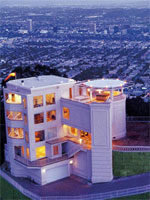
One residence, located high in the hills above Los Angeles, goes several steps further than a simple but effective panic room. The lavish and luxurious appointments of the sky-high mansion discreetly hide and disguise a security system so tight that it just may be the safest house in the world.

Modern-Day Fortress

The modern-day fortress was designed and built in 2002 by Al V. Corbi, a renowned authority on residential and yacht security. Corbi's stock in trade is designing integrated systems with detection, deterrence, defensive and offensive options. The heavily fortified and super secure residence occupies an easily defended promontory with 360-degree views. The well-defended dwelling stands five stories tall, measures almost 8,000 square feet and includes 32 rooms that all sit atop a virtually impenetrable batcave-like garage that will hold six, preferably armored, cars.

SafeWindows.jpg
Hurwitz James Company

Safe and Luxurious

When not aiding the defense and security of its occupants, the fortress-like home functions like any other well-appointed mansion with deluxe creature comforts such as an elevator for whisking folks from the garage level to the living levels, a gourmet kitchen with granite counter tops and commercial grade appliances, two offices, a wine cellar and a home theater.

Buy Some Peace of Mind

The home's real luxury is, of course, the ensured safety of its inhabitants. Should an intruder manage to breach the extensive exterior security measures that include comprehensive surveillance abilities, there are two hidden panic rooms and two architecturally invisible "safe cores."

The safe cores consist of entire sections of the residence that can be isolated from the rest of the home and where the homeowner can retreat in complete safety -- not to mention luxury -- from an outside threat that might include an intruder, a natural disaster or even a nuclear, biological or chemical attack.

SafeHouse6.jpg
Hurwitz James Company

The homeowner declined to discuss some of the specifics of the heavy-duty security set up out of obvious concern that it could compromise the overall system. This means they're not going to tell this writer or anyone else but the next owner that the property is equipped with semi-automatic weaponry that can be remotely controlled from the panic room(s). It may not be, but then again, maybe it is.

Room for Refugees

In addition to the handicap-accessible guest suite, the seriously safe house has five bedrooms and eight bathrooms including a master suite with panoramic views, a fireplace, a luxurious bathroom and a custom-fitted dressing room that would satisfy any clothes horse with a penchant for high-powered security systems.

Whirly-Gig Accessible

The sprawling and tiled terrace on the roof takes full advantage of the 360-degree views that include Mount Baldy, the Palos Verdes Peninsula and the Pacific Ocean. There is also a built-in barbecue center and a spa situated under the heliport designed for emergency evacuations in the event of a home intrusion or for fire emergencies.

The Price of Safety

While it can be tough to put a price of the safety and security of one's family, in this case the tab is $7.25 million.


Reblog this post [with Zemanta]

Friday, February 19, 2010

Cars: The latest form of affordable housing

Downtown Los AngelesImage via Wikipedia

Ann Brenoff
At the precise moment that President Obama was proclaiming how well his stimulus package worked, a news story crossed my computer screen saying that 10% of Los Angeles County's 50,000 homeless are now sleeping in their cars each night. Multiply that number of car-dwellers to include the whole nation, and that's a lot of people who will no doubt sleep -- albeit behind the wheel -- more soundly tonight knowing just how much better off they are than our President thinks they would have been.

Let's get serious, folks.

The car-dwelling population has now reached sufficient numbers to qualify for its own bureaucratic designation. Meet the "Vehicular Homeless." Many are families whose lives were tossed in a recessionary salad spinner of job loss, followed by apartment and/or home loss. In some cases, there was health insurance loss and a family member's illness that wiped out their savings and sped the process along of moving from roof to backseat.

"Cars are the new homeless shelters," says Joel John Roberts, CEO of PATH (People Assisting the Homeless) Partners, the largest provider of services for the homeless in Los Angeles County. Warm weather climates tend to draw more car-dwellers for obvious reasons, so places like Florida and southern California are a car-dweller's Riviera. It's not illegal to sleep in your car, by the way, unless a municipality makes it so. There's a 40-something woman named Sandy who sleeps on a Berkeley sidewalk next to her car because she was busted for sleeping in it. So much for the People's Republic of Berkeley.

More often than not, car-dwellers park where they fall so to speak. Often, you will see a family sleeping in a car in the same neighborhood where they once slept on beds. Gas is expensive.

Mark Horvath, a one-time TV executive earning six figures who lost his own home in foreclosure, is now an advocate for the homeless. He runs Invisible People TV, where he travels the country and films their stories.

"Car and RV homeless are the fastest-growing demographic in our society," Horvath says. "You had 7 million jobs lost since 2007 and we are seeing the effects of that. Just go down to the beach areas around 7 or 8 p.m. any night and you'll see it. Families sleeping in cars and RVs on the street, just parked there."

Horvath helped a family recently who had lost their home to foreclosure. They and their three children were sleeping in the family car. "How do you do that? How do you keep your kids in school? It's impossible," he said. "Life just unravels."

"I recently helped a couple with a six-year-old boy who was going to school in Hollywood. When they lost their home, they were living in friends' cars -- not even their own. The child was always late for school and the school was getting upset," said Horvath, who found the family hotels and got them vouchers.

One of the least talked-about aspects of the recession is under-employment. People lost good jobs and the lifestyle that came with them, replaced by lesser-paying positions. They, too, are winding up in their cars. Yes, you can be working and still not be able to afford shelter that doesn't come on four wheels.

Becky Blanton, who spoke at TED Global 2009 last summer about living in her van, was one of the thousands of working homeless. She spent a year parked at a Wal-Mart outside of Denver. A freelance writer and editor, she earned money during this time, but not enough to pay for housing. The 54-year-old former journalist lives now with a friend in Virginia and regards the year of her homelessness as an adventure -- although not without its dark and lonely moments.

Car dwelling isn't just for older people. JJ CampbelI, 26, lived in a van for three months in Provo, Utah while looking for a job. He graduated from BYU in April, and like many recent college graduates, was unable to find work. He took the family's van, removed the seats, put in an old memory foam mattress and a rod to hang his clothes. It became home. He showered and cooked at friends' houses and spent a few nights on couches. "One night I spent in the van," he said, "it got down to 1 degree Farenheit; I woke up with a ring of ice on the blanket around my head where my breathe had condensed and frozen."

He now shares a basement apartment in Provo where he pays $250 for rent and utilities. He earns about $1,000 a month working full-time and launching his start-up, tippingbucket.org.

Kevin Sudeith calls himself part of the "Ford family" -- a Depression era term for people living in their cars. He is planning to decamp on April 1 from New York City to pursue work as a rock carver while touring the country in a van. He ran a successful Persian rug business, which he says was featured in Forbes Magazine's collectors' edition twice.

His business first slowed noticeably in July 2007, and by summer 2008 he'd eliminated all extraneous expenses -- like cable TV and extra phone lines. "People were no longer taking out home equity loans to buy Persian rugs," he says.

By mid 2009, after cutting every possible expense and being as frugal as possible, he was running in the red, so he came up with this plan. He purchased a container in which to store his possessions and he will house them in the mid-west in a $40 a month storage unit. And he will hit the road. "Dispersed camping while living out of an automobile may not be the most comfortable life, but its better than running in the red, and its bound to be an adventure," he says.


Reblog this post [with Zemanta]

Friday, November 27, 2009

Fourth Generation war on American soil

Naval Postgraduate SchoolImage via Wikipedia

William S. Lind
One of the ongoing themes of this column has been gangs and the role they play in a Fourth Generation world. Here in the United States they already serve as an alternative primary loyalty (alternative to the state) for many urban young men. Gangs will likely be a major player in 4GW because gang members are expected to fight. Those who won’t do not remain gang members.

The November 15 Washington Post had a story about gangs in Salinas, California, that deserves close attention from 4GW theorists. Salinas is reportedly overrun with Hispanic gangs. The Post wrote that its homicide rate is three times that of Los Angeles. It quoted a Salinas police officer, Sgt. Mark Lazzarini, on one of the classic results of state breakdown, chaos:

“Only half of our gangs are structured; the Norteños,” he said. “The southerners are completely unstructured. Half of our violence is kids who get into a car and go out and hunt. These kids don’t know their victims. How do you stop that? It’s very chaotic.”

Salinas’s new slogan might be, “Salinas: where even the lettuce has tattoos.”

But what is interesting in the Post’s article is not the gangs themselves. It is a new response to the gangs. Salinas has brought in the U.S. military to apply counter-insurgency doctrine to a situation on American soil. The Post reports that:

Since February combat veterans of Iraq and Afghanistan have been advising Salinas police on counterinsurgency doctrine, bringing lessons from the battlefield to the meanest streets in an American city…

“It’s a little laboratory,” said retired Col. Hy Rothstein, the former Army career officer in Special Forces who heads the team of 15 faculty members and students (from the Naval Postgraduate School), mostly naval officers…

Rothstein…notes the “significant overlap with how you deal with insurgencies and how you deal with cities that are under siege from gangs.”…

Leonard A. Ferrari, provost of the naval Postgraduate School, embraced the project from the start, hearing…an opportunity for a school “in transition from just a defense institution to a national homeland and even a human security institution.”…

“The idea was, not just Salinas,” Ferrari said, “but is there a national model for this”

From the perspective of 4GW theory, this is an important development. The Naval Postgraduate School is a DOD institution, part of the U.S. government. Its involvement in Salinas marks the federal government’s formal recognition of Fourth Generation war on American soil, and the need for a “national model” to counteract it. If we must involve the U.S. military to lead counterinsurgency efforts in American cities, then it is difficult to deny that we face something like insurgencies in those same cities. Again, the significance is that this is now formally admitted by the U.S. government, not merely noted by “outside the beltway” observers of 4GW.

The U.S. military officers advising Salinas on how to wage an anti-gang counterinsurgency are doing so as volunteers, according to the Post, to avoid Constitutional issues. But the camel’s nose is obviously inside the tent. Many wars have begun by sending “volunteers.” If, as likely, the volunteers prove insufficient, regular troops will follow.

As someone who believes in a strictly limited federal government, the government envisioned by our Founders, I find this troubling. But from a 4GW perspective, I also know it is inevitable. As I have said time and again, the main Fourth Generation threat we will face will be on our own soil, not halfway around the world, where we are currently pouring our strength out into the sand. We will come to regret that waste bitterly.

Objectively, what the Washington Post has reported is a milestone, to be neither praised nor regretted but merely noted. It denotes another step toward 4GW here at home. It is a step we cannot avoid. As both imported and domestically-generated Fourth Generation entities ramp up their warfare on American soil, the U.S. military will be drawn in. As is the case in 4GW overseas, it will probably fail. Old Uncle Karl was right: the state will wither away. But what follows will not be communism. It will be chaos.

Note: Regrettably, the d-n-i website, which had become the worldwide “go to” forum on 4GW, is shutting down. It is a major loss. Fortunately, John Robb has agreed to carry all my columns on his website, Global Guerrillas. All my archived columns will also be moved there from d-n-i, as will the important K.u.K Austro-Hungarian field manuals on Fourth Generation war.

Tuesday, November 10, 2009

Bloomberg Editor Mocks "Collapse" and Mike Ruppert

In Andrew Dunn's arrogant and condescending piece for Bloomberg below, Dunn expresses clear contempt for both Mike Ruppert and director/filmmaker Chris Smith. Dunn characterizes Ruppert as a crackpot for urging people to hoard gold and for suggesting the CIA is involved in the drug trade, that U.S. foreign policy is ruled by the pillage and theft of other countries' natural resources. Dunn has absolutely no clue that it is he, not Ruppert, that appears the abject, utter fool.

Cassandras must be three things: prophetic, pessimistic and ignored. Michael Ruppert, a Los Angeles policeman turned independent reporter, fits at least two of those categories.

Ruppert, the subject of director Chris Smith’s documentary “Collapse,” warns that industrial civilization is headed for cataclysm as a burgeoning population relies on a dwindling supply of oil and our leaders stand idly by or, worse, actively hasten the disaster. [see Carolyn Baker's Review of "Collapse"]

“The only thing that amazes me is the speed with which things are falling apart,” he says over the course of what amounts to an 80-minute interview, conducted in the basement of an abandoned Los Angeles meat-packing plant.

The camera prowls around Ruppert, who smokes cigarette after cigarette and calmly indicts our thirst for oil, alleges Central Intelligence Agency plots to sell drugs and claims U.S. foreign policy is geared toward securing energy reserves.

Smith emulates the placid storytelling style of Errol Morris (“The Fog of War”). The chilly result differs in texture and pace from Smith’s best-known effort, the warm, chaotic and hilarious “American Movie.” Even the score, by Didier Laplae and Joe Wong, has the minimalist feel of a soundtrack by Philip Glass, a Morris collaborator.

Editor Barry Poltermann punctuates the lecture with archival footage of farms and oil wells and passages from cheesy instructional films.

Smith was researching a film on C.I.A. involvement in drug smuggling when he met Ruppert and decided to do a picture about him. At times, Ruppert comes across as a mild-mannered crackpot, urging us to hoard gold, claiming credit for predicting the economic collapse, accusing Dick Cheney and Donald Rumsfeld of taking an “intense” interest in him, and dwelling on mysterious deaths he connects to U.S. covert operations.

A seasoned public speaker, Ruppert is as quick with dire hyperbole (“The whole economy is a pyramid scheme”) as with evocative images (“The soil has become a junkie”). But the picture’s measured pace and Ruppert’s grave, mournful delivery produce the opposite of the attention-grasping audiovisual circus of a Michael Moore polemic.

Smith seems less interested in argument than character. He seldom challenges Ruppert’s allegations and presents no alternative points of view.

Ruppert’s grand vision contrasts with his simple life: He lives with his dog in Culver City, California. His latest book has not sold well and he is facing eviction. He loses his composure once in the picture, a moment that succinctly conveys the burden of his life’s work.

“I have emotion about this. I’m losing it,” he says. “We have felt so angry.”

“Collapse” is showing in New York and opens in Los Angeles on 11/13. Rating: ***

Monday, November 2, 2009

Now Goldman Wants Your Home and Could Care Less if You're Homeless


Greg Gordon|McClatchy
When California wildfires ruined their jewelry business, Tony Becker and his wife fell months behind on their mortgage payments and experienced firsthand the perils of subprime mortgages.

The couple wound up in a desperate, six-year fight to keep their modest, 1,500-square-foot San Jose home, a struggle that pushed them into bankruptcy.

The lender with whom they sparred, however, wasn't the one that had written their loans. It was an obscure subsidiary of Wall Street colossus Goldman Sachs Group.

Goldman spent years buying hundreds of thousands of subprime mortgages, many of them from some of the more unsavory lenders in the business, and packaging them into high-yield bonds. Now that the bottom has fallen out of that market, Goldman finds itself in a different role: as the big banker that takes homes away from folks such as the Beckers.

The couple alleges that Goldman declined for three years to confirm their suspicions that it had bought their mortgages from a subprime lender, even after they wrote to Goldman's then-Chief Executive Henry Paulson — later U.S. Treasury secretary — in 2003.

Unable to identify a lender, the couple could neither capitalize on a mortgage hardship provision that would allow them to defer some payments, nor on a state law enabling them to offset their debt against separate, investment-related claims against Goldman.

In July, the Beckers won a David-and-Goliath struggle when Goldman subsidiary MTGLQ Investors dropped its bid to seize their house. By then, the college-educated couple had been reduced to shopping for canned goods at flea markets and selling used ceramic glass.

Theirs is an infrequent happy ending among the hundreds of cases in which subsidiaries of Goldman, better known for sending top officers such as Paulson to serve in top Washington posts, have sought to contain bondholder losses by foreclosing on properties and evicting delinquent borrowers.

Goldman spokesman Michael DuVally declined to comment on individual cases or on the firm's new role in bankruptcy courts.

Joining other Wall Street firms that bought millions of subprime mortgages, Goldman companies have gone to courts from California to Florida seeking approval to foreclose on the homes of middle- and lower-income Americans who couldn't keep up with their loans' soaring monthly payments.

Some borrowers were speculators or homebuyers who exaggerated their incomes on loan applications, thinking they'd always have an escape hatch because housing prices would keep rising. Others, however, were victims of fast-talking mortgage brokers who didn't explain that the loans' interest rates could rise to as high as 15 percent. Many borrowers who defaulted on their mortgages may never qualify for a home loan again.

In court encounters, Goldman and other Wall Street firms have faced the impact of their own wheeling and dealing. Many of the families being put on the street never would've gotten their big mortgages if investment banks hadn't provided a seemingly insatiable secondary market for millions of loans to marginally qualified buyers.

Subprime borrowers were supposed to provide a safe income stream for investors who bought mostly high-grade, triple-A-rated bonds from Goldman and bigger subprime players, such as now-defunct Lehman Brothers and Merrill Lynch.

Now, millions of these borrowers have defaulted on mortgage payments, contributing to a historic slump in home prices and depressing the bonds' value. Half the homes in some California neighborhoods have been subject to foreclosures or short sales, in which a home is sold for less than the mortgage balance, and either the seller or the lender takes a loss.

Earlier this year in Los Angeles, the Wall Street giant took possession of the home of Gladys Aguirre, a housecleaner who's married to a construction worker. Together, the couple listed monthly earnings of $7,480, including $3,480 from a job she'd held for two months.

Aguirre originally took a $444,000 subprime mortgage on Sept. 1, 2005, from Argent Mortgage Co., a subsidiary of big subprime lender Ameriquest Mortgage Co., which shut down in 2007. The adjustable interest rate sent her monthly payments zooming to $3,800 from $2,479, and Aguirre couldn't keep pace on that loan or a $119,000 second mortgage. She filed for bankruptcy protection.

Aguirre's Los Angeles lawyer, Eber Bayona, declined to discuss her case, but said that subprime loans amounted to "setting up the person for failure" because interest rate adjustments hit borrowers with "shock payments."

For example, he said, loan agents promised applicants that they could buy a $600,000 house for payments of $1,200 a month, and the buyers "never read the fine print ... (and) didn't know their interest would increase and that eventually they would lose their house and their money."

In San Fernando, Calif., Dina Alfero-Pacheo qualified for two mortgages totaling nearly $500,000, with monthly payments starting at $2,004. By 2007, the payments had grown to $3,761. In a bankruptcy filing early this year, Alfero-Pacheo said she was a bartender earning $3,800 a month. Goldman bought her first mortgage from Argent and recently got title to the house, which had sunk in value to $280,000 from more than $500,000.

In Orlando, Fla., Adela Mendez seems to be someone who would've known the risks when she took a $164,000 mortgage from Argent on her home in 2005 and a $75,000 second mortgage a year later. In a bankruptcy filing this year, she listed her occupation as a loan specialist for Washington Mutual, a leading subprime lender that collapsed last year.

Not only did Mendez fall 11 months behind on her mortgage payments, but her home's value also plummeted to $100,000. Goldman Sachs Mortgage, which bought the Argent loan, took the house — and at least a 50 percent loss.

Alfero-Pacheo and Mendez, whose cases are detailed in court records, couldn't be reached to comment.

The Beckers charged that in their case, Goldman engaged in years of obfuscation and resistance.

"In bankruptcy court, they tried to portray us as incompetent or deadbeats,'' said Celia Fabos-Becker, blinking back tears as she sat with her husband in their living room, with boxes of mortgage-related documents surrounding them.

The couple thought they'd made a safe bet in 2000 when they opened a retail jewelry business in two San Diego County areas populated mainly by military personnel.

The wars in Afghanistan and Iraq, however, brought big military call-ups, sapping their market. After a wildfire ravaged much of the area in 2002, the Beckers refinanced their house to generate some $70,000 in cash to prop up their two stores. They wound up with an adjustable-rate, subprime loan from WMC Mortgage Corp., an arm of General Electric's GE Money unit, and a 10.75 percent second mortgage with the same lender.

A second wildfire in 2003 all but killed their business and left the couple reeling financially as interest-rate adjustments pushed the mortgage payments higher.

"We'd gotten to the point where I was cutting my own hair. I was cutting his on occasion," Fabos-Becker said.

"And trolling the Goodwills," Tony Becker said.

Tony Becker, an engineer, took short-term contract jobs amid the technology bust. Celia Fabos-Becker, meanwhile, found a provision in the mortgages that allowed the borrower to push payments to the end of the loan term in the event of a disaster such as the two fires.

When she wrote to Paulson, however, lawyers for Goldman denied that it owned the Beckers' mortgages. So did Germany's Deutsche Bank, a trustee that was holding thousands of subprime mortgages Goldman had converted to bonds.

To stall foreclosure, the Beckers wound up negotiating "forbearance agreements" with Ocwen Loan Servicing, a Florida company, that required the couple to pay several thousand dollars under the threat that their house would be auctioned off in a week or a month, Fabos-Becker said. Their monthly payments rose to nearly $3,300 from $2,650.

The couple already had taken Goldman and Morgan Stanley, another Wall Street firm, to arbitration over their $325,000 in stock market losses, accusing the investment banks of misleading investors about public offerings.

On the same day in June 2006, Goldman sued to end the arbitration, and Ocwen filed papers seeking to foreclose on the Beckers' home.

In desperation, the couple filed for bankruptcy protection. With no money to hire an attorney, they acted as their own lawyers.

As the months dragged on, Fabos-Becker finally found a filing with the Securities and Exchange Commission confirming that Goldman had bought the mortgages. Then, when a lawyer for MTGLQ showed up at a June 2007 court hearing on the stock battle, U.S. District Judge William Alsup of the Northern District of California demanded to know the firm's relationship to Goldman, telling the attorney that he hates "spin."

The lawyer acknowledged that MTGLQ was a Goldman affiliate.

That was an understatement. MTGLQ, a limited partnership, is a wholly owned subsidiary of Goldman that's housed at the company's headquarters at 85 Broad Street in New York, public records show.

In July, after U.S. Bankruptcy Judge Roger Efremsky of the Northern District of California threatened to impose "significant sanctions" if the firm failed to complete a promised settlement with the Beckers, Goldman dropped its claims for $626,000, far more than the couple's original $356,000 in mortgages and $70,000 in missed payments. The firm gave the Beckers a new, 30-year mortgage at 5 percent interest.

That lowered their monthly payment to $1,900, less than half the maximum $4,000 a month their subprime loans could've demanded.

Fabos-Becker, 60, said that the trauma has left her hair "a lot grayer." Much of the stress would have been alleviated, she said, if a law required lenders to identify themselves, especially to borrowers facing hardships.

"I take solace," Tony Becker said, "in knowing that I was up against the worst possible opponent — the biggest, strongest investment bank in the world."

Reblog this post [with Zemanta]