Showing posts with label Health insurance. Show all posts

Saturday, September 7, 2013

Citing costs, IBM to move 110,000 retirees off health plan

Image representing IBM as depicted in CrunchBase
International Business Machines Corp. plans to move about 110,000 retirees off its company-sponsored health plan and instead give them a payment to buy coverage on a health-insurance exchange, in a sign that even big, well-capitalized employers aren't likely to keep providing the once-common benefits as medical costs continue to rise.

The move, which will affect all IBM retirees once they become eligible for Medicare, will relieve the technology company of the responsibility of managing retirement health-care benefits. IBM said the growing cost of care makes its current plan unsustainable without big premium increases.

IBM's shift is an indication that health-insurance marketplaces, similar to the public exchanges proposed under President Barack Obama's health-care overhaul, will play a bigger role as companies move coverage down the path taken by many pensions, paying employees and retirees a fixed sum to manage their own care. Read more >>
Enhanced by Zemanta

Wednesday, August 28, 2013

IRS issues final rules on Obamacare's 'individual mandate'

A centerpiece of Affordable Care Act, also known as Obamacare, is a requirement that all individuals carry some minimum health insurance or pay a tax. The new system aims to provide insurance through state marketplaces and subsidies for tens of millions of Americans who lack it.

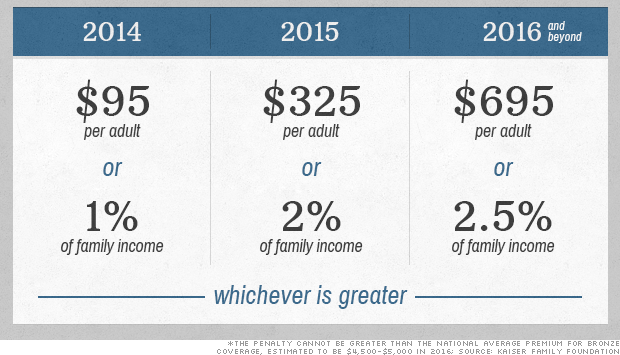
If individuals choose not to carry insurance, they are subject to a penalty, starting at $95 per person per year or 1 percent of income in 2014, whichever is greater, and eventually reaching $695 per person or 2.5 percent of income by 2016.

The IRS, which is administering parts of the law involving revenue collection, released the final rules spelling out the details of what constitutes minimum essential coverage, and how individuals are responsible for spouses, children and other dependents, among other topics.

The individual mandate is distinct from the employer mandate, which imposes a fee on most large employers that do not offer a minimum level of coverage. The Administration delayed that provision, putting off the effective date until 2015. Read more >>
Enhanced by Zemanta

Thursday, August 15, 2013

Uninsured next year? Here's your Obamacare penalty

NEW YORK (CNNMoney)
Thinking of ignoring the Obamacare mandate to get health insurance next year? It could cost you. To try to ensure that people sign up for coverage, the Affordable Care Act carries complex penalties for those who remain uninsured that could cost them hundreds, or even thousands of dollars. Some 6 million people could be hit with these fines in 2016, forking $7 billion over to the federal government, according to the Congressional Buget Offfice.

Here's how the penalties will work: Uninsured adults will either pay a flat fee for themselves and their children or pay a share of their income, whichever is greater. The penalty is pro-rated if people have coverage for part of the year, and they won't be liable if they lack coverage for less than a three-month period during the year.

The penalties start relatively small, but ramp up within a few years. But there is a limit. They cannot exceed the national average premium for bronze coverage -- the cheapest plan tier -- in the state-based exchanges.

For 2014, the flat fee is $95 per adult and $47.50 per child, up to $285 per family. Or the penalty could be 1% of family income, if that results in a larger fine. (Income is defined as total income above the filing threshold, which is $10,000 for an individual and $20,000 for a family in 2013.)

So a person making $50,000 would be subject to a $400 penalty, while a couple earning that amount would each pay $300. Read more >>
Enhanced by Zemanta

Wednesday, August 7, 2013

Cost of health care to rise 72% in Indiana

Get ready to shell out more money for individual health insurance under Obamacare ... in some states, that is.

While many residents in New York and California may see sizable decreases in their premiums, Americans in many places could face significant increases if they buy insurance through state-based exchanges next year.

That's because these people live in states where insurers were allowed to sell bare-bones plans and exclude the sick, which has kept costs down. Under Obamacare, insurers must offer a package of essential benefits -- including maternity, mental health and medications -- and must cover all who apply. But more comprehensive coverage may lead to more expensive insurance plans.

Under Obamacare, all Americans must have insurance coverage starting in 2014 or face penalties of $95 or 1% of family income, whichever is greater. Enrollment in the exchanges begins October 1, with coverage kicking in in January. Plans will come in four tiers, ranging from bronze to platinum. Read more >>
Enhanced by Zemanta

Monday, April 22, 2013

Obamacare causes spike in health insurance scams

Law enforcement agencies are reporting a spike in health insurance scams across the country, many of which are preying on the public's confusion over the massive changes taking place in the nation's health care system.

One recent morning, 86-year-old Evelyne Lois Such was sitting at her kitchen table in Denver when the phone rang.  She didn’t recognize the phone number or the deep voice on the other end of the line. “He asked if I was a senior, and I said yes, and he said we are sending out all new Medicare cards and I want to make sure I have all of your statistics correct,” Such recounts.

At first, the caller didn’t seem too fishy; he started by running through her address and phone number, just to make sure they were right. But then he read off a series of numbers and asked if it was her bank routing number. “I didn’t know really at the time whether it was or not, but I just said no. He said, well could you give it to me so I’ll have it correctly, and I said, well I’m not so sure about that. And he started to say something and I hung up.” Read more >>
Enhanced by Zemanta

Monday, January 14, 2013

ObamaCare's Health-Insurance Sticker Shock

Barack Obama signing the Patient Protection an...
Health-insurance premiums have been rising—and consumers will experience another series of price shocks later this year when some see their premiums skyrocket thanks to the Affordable Care Act, aka ObamaCare.

The reason: The congressional Democrats who crafted the legislation ignored virtually every actuarial principle governing rational insurance pricing. Premiums will soon reflect that disregard—indeed, premiums are already reflecting it.

Central to ObamaCare are requirements that health insurers (1) accept everyone who applies (guaranteed issue), (2) cannot charge more based on serious medical conditions (modified community rating), and (3) include numerous coverage mandates that force insurance to pay for many often uncovered medical conditions.

Guaranteed issue incentivizes people to forgo buying a policy until they get sick and need coverage (and then drop the policy after they get well). While ObamaCare imposes a financial penalty—or is it a tax?—to discourage people from gaming the system, it is too low to be a real disincentive. The result will be insurance pools that are smaller and sicker, and therefore more expensive. Read more >>
Enhanced by Zemanta

Monday, December 3, 2012

Walmart plans to deny health insurance to employees working fewer than 30 hours/wk

English: President Barack Obama, Vice Presiden...

Walmart, the nation’s largest private employer, plans to begin denying health insurance to newly hired employees who work fewer than 30 hours a week, according to a copy of the company’s policy obtained by The Huffington Post. …

Walmart declined to disclose how many of its roughly 1.4 million U.S. workers are vulnerable to losing medical insurance under its new policy. …

Labor and health care experts portrayed Walmart’s decision to exclude workers from its medical plans as an attempt to limit costs while taking advantage of the national health care reform known as Obamacare. Among the key features of Obamacare is an expansion of Medicaid, the taxpayer-financed health insurance program for poor people. Many of the Walmart workers who might be dropped from the company’s health care plans earn so little that they would qualify for the expanded Medicaid program, these experts said.

By making the fine for not providing health care cheaper than providing health care, this was always the plan: to encourage employers to send us to the government.

Remember how Obama's big ObamaCare sell was, "You get to keep the health insurance you have"?

It was all a lie, a hustle, a con, a ruse… Read more >>

Enhanced by Zemanta

Thursday, November 29, 2012

Unaffordable Cost Seen for Some Under Affordable Care Act

English: Barack Obama signing the Patient Prot...

To Megan Hildebrandt, President Barack Obama’s Affordable Care Act means she can no longer be denied health insurance because of her lymphatic cancer.

There’s a big catch: Coverage for the 28-year-old artist and many other Americans without insurance will come at a potentially unaffordable cost.

Hildebrandt, who relies on hospital charity, will face more than $1,000 in annual premiums, by one estimate, and probably more in out-of-pocket expenses even with new federal subsidies. She and her husband have a combined income of $25,000.

“It’s great that I’m not going to have to pay some hugely impossible amount,” said Hildebrandt, who lives in Austin, Texas. “Though now I’m in the health-care system and still have to pay money that we can’t really afford.”

The landmark health-care law, which survived the threats of repeal and a Supreme Court review, now confronts another hurdle: living up to expectations. As the administration spells out the details, many uninsured will be surprised at how much they will have to pay. It may involve “very substantial amounts,” and “there still will be a significant number of people who can’t afford health coverage,” said Ron Pollack, head of Families USA, a consumer group that backs the law. Read more >>

Enhanced by Zemanta

Tuesday, July 24, 2012

High Court Health Ruling to Increase Uninsured, CBO Says

About 3 million fewer low-income Americans will have health insurance as a result of the Supreme Court decision that threw out part of President Barack Obama’s health-care overhaul, the Congressional Budget Office said.

The cost of expanding coverage will shrink by $84 billion to $1.168 trillion under the court decision, which voided a requirement that states expand Medicaid coverage for the poor in 2014, the nonpartisan agency said in a report today. At the same time, the report said the per-person cost of expanding aid will increase because some who would have been covered by Medicaid will instead receive more-expensive subsidies to buy private health insurance.

It is the first official estimate of the effects of the June 28 court decision upholding the core requirement in the Patient Protection and Affordable Care Act that most Americans carry health insurance or pay a penalty. The court threw out a provision requiring states that don’t comply with the Medicaid expansion to lose existing federal Medicaid funding. The court said Congress can require states to meet conditions to receive new Medicaid money. Read more >>

Monday, July 2, 2012

Obamacare, the Great Swindle

SAN FRANCISCO, CA - MARCH 28:  U.S. House mino...
Now that Obamacare has been ruled a tax by the U.S. Supreme Court, reality is starting to sink in for all those who emotionally supported it. Promoted as a way to provide either free health care or low-cost health care to the masses, the sobering reality is that under Obamacare, health insurance prices keep rising, not falling.

That's no surprise, of course, since the Obamacare legislation was practically written by the health insurance companies, and they sure didn't put their weight behind a sweeping new law that would earn them less profit. In an era when the so-called "99%" are sick and tired of being exploited by the one percent who control everything, they just handed their medical futures over to precisely the one percent who skillfully monopolize the conventional health care system! Obamacare is, at every level, a huge victory for the one percent.

By the year 2016, the Obamacare "penalty" tax will reach roughly $2,000 per year for a two-person household. According to Stephen Moore of the Wall Street Journal, 75% of the financial burden of Obamacare's new taxes will fall onto Americans making less than $120,000 a year. Read more >>

Wednesday, September 14, 2011

More Americans 'double up' in tough economy

There's been talk of people sharing homes during the recession, and now the Census Bureau has released the data to prove it.

This spring, there were 21.8 million "doubled-up" households across the nation, a 10.7 percent increase from the 19.7 million households in the spring of 2007, the Census Bureau said. That means 18.3 percent of all households were combined households.

Much of the increase was the result of adult children who either moved back home during the recession or never left. Among adults between the ages of 25 and 34, some 5.9 million were living with their parents this spring, up from 4.7 million before the recession hit in 2007. That 25 percent increase translated to 14.2 percent of all young adults living with their parents in March, the bureau said. More...
Enhanced by Zemanta

Wednesday, March 24, 2010

Obamacare Winners: Big Pharma / Hospitals / MDs / Insurance Companies ... The People: Who Knows ?

David Caploe PhD, Chief Political Economist, EconomyWatch.com
America continues to be a sad sad place, with a lot of great people and qualities that are nevertheless increasingly overcome by the very worst elements of a society that doesn’t see itself as such but, rather, as a random collection of individuals somehow thrown together.

This goes against, I realize, the whole notion of American exceptionalism, the idea the US is a “universal” nation, open to people of all other countries, brought together in search of both ideal and material satisfactions unavailable elsewhere in the world, and transformed in the process into a new kind of being.

But as we witness the bizarre spectacle of President Obama’s health care “reform” “victory,” it’s hard not to be reminded of Shakespeare’s phrase, “a tale told by an idiot, full of sound and fury, signifying nothing,” or, at least in this case, signifying not too much, despite a hell of a lot of noise.

Yes, it’s true that if the legislation had failed, it would have been a disaster for Obama personally, his presidency, and probably made a bad situation, both generally and re health “care,” even worse – so in that sense, I guess this is a “victory” of sorts.

But it’s really hard to feel excited / positive / full of hope / all teary-eyed etc, the way I see some of my FaceBook friends getting.

And I’m not just saying this because a lot of them felt that way about Obama initially, and have been so disappointed they simply WANTED to “feel good again” about him – or they were just so scared by the not-unreasonable idea a legislative defeat would, somehow, portend a return to the awful days of Cheney / Bush.

If this sounds cynical, my apologies. But after the spectacle we’ve witnessed – whose sordid details really DON’T need to be re-hashed here for the thousandth time – the only emotion I can feel is slight relief the unabashedly obstructionist Republicans didn’t succeed in this initial phase, although they seem bound and determined, as they keep reminding us, to “keep on fighting” this battle, most of which is in their heads, until the November elections at least.

That sort of effort is all too pathetically predictable. But so too is what we identified last year as the fundamental difficulty with Obama’s approach to just about EVERY important problem: playing ball with the middlemen, in this case, the health insurance companies, as if they were the only game in town.

Once that decision was taken – and it obviously happened early on, when Obama made clear that not only was single-payer off the table, but he also wasn’t going to push very hard for the “public option” that, its exponents claimed, would impose some “market discipline” on the insurance companies – the outcome was basically foreordained: either the whole thing would go down in flames, or the insurance companies would definitely be taken care of in whatever emerged.

And that’s exactly what happened.

To be sure, the ability of insurance companies to deny coverage for pre-existing conditions is SUPPOSED to be eliminated within three months of Obama’s signing of the law, albeit in a very indirect way as they would become “eligible for subsidized coverage through a new high-risk insurance program,” the details of which I still haven’t been able to discern, despite reading every article in the New York Times and a raft of other websites on the subject.

And that’s one big part of the problem: no one really has any idea of what the hell is going on here EXCEPT, of course, the insurance companies and the drug companies and the hospitals – who know because it was THEIR K Street lobbyists who put in the specific sections of the law that “insure” they make plenty of money from all the new changes.

To see just how ludicrous the situation is – and how dominated it is by middlewo/men who control the process – check out this passage from the Q & A the Times set up to try to shed some light into this incredibly UN-transparent “brave new world”: more...

Saturday, March 20, 2010

Fact Sheet: The Truth About the Health Care Bill

Huffington Post

The Firedoglake health care team has been covering the debate in congress since it began last year. The health care bill will come up for a vote in the House on Sunday, and as Nancy Pelosi works to wrangle votes, we've been running a detailed whip count on where every member of Congress stands, updated throughout the day.

We've also taken a detailed look at the bill, and have come up with 18 often stated myths about this health care reform bill.

Real health care reform is the thing we've fought for from the start. It is desperately needed. But this bill falls short on many levels, and hurts many people more than it helps them.

While details are limited, there is apparently a "Plan B" alternative that the White House was considering as recently as two weeks ago, which would evidently expand existing programs -- Medicaid and SCHIP. It would cover half the people at a quarter of the price, but it would not force an unbearable financial burden to those who are already struggling to get by.

Congress may be too far down the road with this bill to change course. But before Democrats cast this vote which could turn "ban the mandate" into "gay marriage" for the GOP in 2010, they should consider the first rule of patient safety: first, do no harm.

Myth 1: This is a universal health care bill.

Fact: The bill is neither universal health care nor universal health insurance. According to the Congressional Budget Office:


  • Total uninsured in 2019 with no bill: 54 million

  • Total uninsured in 2019 with Senate bill: 24 million


Myth 2: Insurance companies hate this bill.

Fact: This bill is almost identical to the plan written by AHIP, the insurance company trade association, in 2009.
The original Senate Finance Committee bill was authored by a former Wellpoint vice president. Since Congress released the first of its health care bills on October 30, 2009, health care stocks have risen 28.35%.

Myth 3: The bill will significantly bring down insurance premiums for most Americans.

Fact: The bill will not bring down premiums significantly, and certainly not the $2,500/year that President Obama promised during his campaign.

Annual premiums in 2016: status quo / with bill:
Small group market, single: $7,800 / $7,800
Small group market, family: $19,3oo / $19,200
Large Group market, single: $7,400 / $7,300
Large group market, family: $21,100 / $21,300
Individual market, single: $5,500 / $5,800
Individual market, family: $13,100 / $15,200

(The cost of premiums in the individual market goes up somewhat due to subsidies and mandates of better coverage. The CBO assumes that cost of individual policies goes down 7-10%, and that people will buy more generous policies.)

Myth 4: The bill will make health care affordable for middle class Americans.

Fact: The bill will impose a financial hardship on middle class Americans who will be forced to buy a product that they can't afford to use.

A family of four making $66,370 will be forced to pay $5,243 per year for insurance. After basic necessities, this leaves them with $8,307 in discretionary income -- out of which they would have to cover clothing, credit card and other debt, child care and education costs, in addition to $5,882 in annual out-of-pocket medical expenses for which families will be responsible.

Myth 5: This plan is similar to the Massachusetts plan, which makes health care affordable.

Fact: Many Massachusetts residents forgo health care because they can't afford it. A 2009 study by the state of Massachusetts found that:


  • 21% of residents forgo medical treatment because they can't afford it, including 12% of children

  • 18% have health insurance but can't afford to use it


Myth 6: This bill provides health care to 31 million people who are currently uninsured.

Fact: This bill will mandate that millions of people who are currently uninsured purchase insurance from private companies, or the IRS will collect up to 2% of their annual income in penalties. Some will be assisted with government subsidies.

Myth 7: You can keep the insurance you have if you like it.

Fact: The excise tax will result in employers switching to plans with higher co-pays and fewer covered services.
Older, less healthy employees with employer-based health care will be forced to pay much more in out-of-pocket expenses than they do now.

Myth 8: The "excise tax" will encourage employers to reduce the scope of health care benefits, and they will pass the savings on to employees in the form of higher wages.

Fact: There is insufficient evidence that employers pass savings from reduced benefits on to employees.

Myth 9: This bill employs nearly every cost control idea available to bring down costs.

Fact: This bill does not bring down costs and leaves out nearly every key cost control measure, including:


  • Public Option ($25-$110 billion)

  • Medicare buy-in

  • Drug re-importation ($19 billion)

  • Medicare drug price negotiation ($300 billion)

  • Shorter pathway to generic biologics ($71 billion)


Myth 10: The bill will require big companies like Wal-Mart to provide insurance for their employees.

Fact: The bill was written so that most Wal-Mart employees will qualify for subsidies, and taxpayers will pick up a large portion of the cost of their coverage.

Myth 11: The bill "bends the cost curve" on health care.

Fact: "Bends the cost curve" is a misleading and trivial claim, as the U.S. would still spend far more for care than other advanced countries.


  • In 2009, health care costs were 17.3% of GDP.

  • Annual cost of health care in 2019, status quo: $4,670.6 billion (20.8% of GDP)

  • Annual cost of health care in 2019, Senate bill: $4,693.5 billion (20.9% of GDP)


Myth 12: The bill will provide immediate access to insurance for Americans who are uninsured because of a pre-existing condition.

Fact: Access to the "high risk pool" is limited and the pool is underfunded. Only those who have been uninsured for more than six months will qualify for the high-risk pool. Only 0.7% of those without insurance now will get coverage, and the Centers for Medicare and Medicaid Services report estimates it will run out of funding by 2011 or 2012.

Myth 13: The bill prohibits dropping people in individual plans from coverage when they get sick.

Fact: The bill does not empower a regulatory body to keep people from being dropped when they're sick. There are already many states that have laws on the books prohibiting people from being dropped when they're sick, but without an enforcement mechanism, there is little to hold the insurance companies in check.

Myth 14: The bill ensures consumers have access to an effective internal and external appeals process to challenge new insurance plan decisions.

Fact: The "internal appeals process" is in the hands of the insurance companies themselves, and the "external" one is up to each state.

Ensuring that consumers have access to "internal appeals" simply means the insurance companies have to review their own decisions. And it is the responsibility of each state to provide an "external appeals process," as there is neither funding nor a regulatory mechanism for enforcement at the federal level.

Myth 15: This bill will stop insurance companies from hiking rates 30%-40% per year.

Fact: This bill does not limit insurance company rate hikes. Private insurers continue to be exempt from anti-trust laws, and are free to raise rates without fear of competition in many areas of the country.

Myth 16: When the bill passes, people will begin receiving benefits under this bill immediately

Fact: Most provisions in this bill, such as an end to the ban on pre-existing conditions for adults, do not take effect until 2014.

Six months from the date of passage, children could not be excluded from coverage due to pre-existing conditions, though insurance companies could charge more to cover them. Children would also be allowed to stay on their parents' plans until age 26. There will be an elimination of lifetime coverage limits, a high risk pool for those who have been uninsured for more than 6 months, and community health centers will start receiving money.

Myth 17: The bill creates a pathway for single payer.

Fact: Bernie Sanders' provision in the Senate bill does not start until 2017, and does not cover the Department of Labor, so no, it doesn't create a pathway for single payer.

Obama told Dennis Kucinich that the Ohio Representative's amendment is similar to Bernie Sanders' provision in the Senate bill, and creates a pathway to single payer. Since the waiver does not start until 2017, and does not cover the Department of Labor, it is nearly impossible to see how it gets around the ERISA laws that stand in the way of any practical state single payer system.

Myth 18: The bill will end medical bankruptcy and provide all Americans with peace of mind.

Fact: Most people with medical bankruptcies already have insurance, and out-of-pocket expenses will continue to be a burden on the middle class.


  • In 2009, 1.5 million Americans declared bankruptcy

  • Of those, 62% were medically related

  • Three-quarters of those had health insurance

  • The Obama bill leaves 24 million without insurance

  • The maximum yearly out-of-pocket limit for a family will be $11,900 (PDF) on top of premiums

  • A family with serious medical problems that last for a few years could easily be financially crushed by medical costs


Real health care reform is needed. But this bill falls short of that on many levels.

Documentation:


  1. March 11, Letter from Doug Elmendorf to Harry Reid (PDF)

  2. The AHIP Plan in Context, Igor Volsky;Max Baucus WellPoint/Liz Fowler Plan" href="http://emptywheel.firedoglake.com/2009/09/08/liz-fowlers-plan/" target="_blank"> The Max Baucus WellPoint/Liz Fowler Plan, Marcy Wheeler

  3. CBO Score, 11-30-2009

  4. "Affordable" Health Care, Marcy Wheeler

  5. Gruber Doesn't Reveal That 21% of Massachusetts Residents Can't Afford Health Care, Marcy Wheeler; Massachusetts Survey (PDF)

  6. Health Care on the Road to Neo-Feudalism, Marcy Wheeler

  7. CMS: Excise Tax on Insurance Will Make Your Insurane Coverage Worse and Cause Almost No Reduction in NHE, Jon Walker

  8. Employer Health Costs Do Not Drive Wage Trends, Lawrence Mishel

  9. CBO Estimates Show Public Plan With Higher Savings Rate, Congress Daily; Drug Importation Amendment Likely This Week, Politico; Medicare Part D IAF; A Monopoloy on Biologics Will Drain Health Care Resources, Lancet Student

  10. MaxTax Is a Plan to Use Our Taxes to Reward Wal-Mart for Keeping Its Workers in Poverty, Marcy Wheeler

  11. Estimated Financial Effects of the "Patient Protection and Affordable Care Act of 2009," as Proposed by the Senate Majority Leader on November 18, 2009, CMS (PDF)

  12. ibid

  13. ibid

  14. ibid

  15. Health insurance companies hang onto their antitrust exemption, Protect Consumer Justice.org

  16. What passage of health care reform would mean for the average American, DC Examiner

  17. How to get a State Single Payer Opt-Out as Part of Reconciliation, Jon Walker

  18. Medical bills prompt more than 60 percent of U.S. bankruptcies, CNN.com; The Patient Protection and Affordable Care Act Section-by-Section Analysis (PDF)
Reblog this post [with Zemanta]

Saturday, February 27, 2010

The Unemployed Now Have Their Own Union, and It's Catching on Quickly

alternet.org

An ingenious grassroots union for the unemployed is only a month old -- and its numbers are growing.

It's been only a month that a union for the unemployed has come into existence through an ingenious grassroots organizing campaign. In case you haven't heard about it, the union's name is "UR Union of the Unemployed" or its nickname, "UCubed," because of its unique method of organizing.

UCubed is the brain-child of the International Association of Machinists and Aerospace Workers (IAM), whose leaders feel that the millions of unemployed workers need a union of their own to join in the struggle for massive jobs programs.

The idea is that if millions of jobless join together and act as an organization, they are more likely to get Congress and the White House to provide the jobs that are urgently needed. They can also apply pressure for health insurance coverage, unemployment insurance and COBRA benefits and food stamps. An unemployed worker is virtually helpless if he or she has to act alone.

Joining a Cube is as simple as it is important. (Please check the union web site: www.unionofunemployed.com). Six people who live in the same zip code address can form a Ucube. Nine such UCubes make a neighborhood. Three neighborhood UCubes form a power block that cntains 162 activists. Politicians cannot easily ignore a multitude of power blocks, nor can merchants avoid them. More...

Reblog this post [with Zemanta]

Friday, February 19, 2010

Cars: The latest form of affordable housing

Downtown Los AngelesImage via Wikipedia

Ann Brenoff
At the precise moment that President Obama was proclaiming how well his stimulus package worked, a news story crossed my computer screen saying that 10% of Los Angeles County's 50,000 homeless are now sleeping in their cars each night. Multiply that number of car-dwellers to include the whole nation, and that's a lot of people who will no doubt sleep -- albeit behind the wheel -- more soundly tonight knowing just how much better off they are than our President thinks they would have been.

Let's get serious, folks.

The car-dwelling population has now reached sufficient numbers to qualify for its own bureaucratic designation. Meet the "Vehicular Homeless." Many are families whose lives were tossed in a recessionary salad spinner of job loss, followed by apartment and/or home loss. In some cases, there was health insurance loss and a family member's illness that wiped out their savings and sped the process along of moving from roof to backseat.

"Cars are the new homeless shelters," says Joel John Roberts, CEO of PATH (People Assisting the Homeless) Partners, the largest provider of services for the homeless in Los Angeles County. Warm weather climates tend to draw more car-dwellers for obvious reasons, so places like Florida and southern California are a car-dweller's Riviera. It's not illegal to sleep in your car, by the way, unless a municipality makes it so. There's a 40-something woman named Sandy who sleeps on a Berkeley sidewalk next to her car because she was busted for sleeping in it. So much for the People's Republic of Berkeley.

More often than not, car-dwellers park where they fall so to speak. Often, you will see a family sleeping in a car in the same neighborhood where they once slept on beds. Gas is expensive.

Mark Horvath, a one-time TV executive earning six figures who lost his own home in foreclosure, is now an advocate for the homeless. He runs Invisible People TV, where he travels the country and films their stories.

"Car and RV homeless are the fastest-growing demographic in our society," Horvath says. "You had 7 million jobs lost since 2007 and we are seeing the effects of that. Just go down to the beach areas around 7 or 8 p.m. any night and you'll see it. Families sleeping in cars and RVs on the street, just parked there."

Horvath helped a family recently who had lost their home to foreclosure. They and their three children were sleeping in the family car. "How do you do that? How do you keep your kids in school? It's impossible," he said. "Life just unravels."

"I recently helped a couple with a six-year-old boy who was going to school in Hollywood. When they lost their home, they were living in friends' cars -- not even their own. The child was always late for school and the school was getting upset," said Horvath, who found the family hotels and got them vouchers.

One of the least talked-about aspects of the recession is under-employment. People lost good jobs and the lifestyle that came with them, replaced by lesser-paying positions. They, too, are winding up in their cars. Yes, you can be working and still not be able to afford shelter that doesn't come on four wheels.

Becky Blanton, who spoke at TED Global 2009 last summer about living in her van, was one of the thousands of working homeless. She spent a year parked at a Wal-Mart outside of Denver. A freelance writer and editor, she earned money during this time, but not enough to pay for housing. The 54-year-old former journalist lives now with a friend in Virginia and regards the year of her homelessness as an adventure -- although not without its dark and lonely moments.

Car dwelling isn't just for older people. JJ CampbelI, 26, lived in a van for three months in Provo, Utah while looking for a job. He graduated from BYU in April, and like many recent college graduates, was unable to find work. He took the family's van, removed the seats, put in an old memory foam mattress and a rod to hang his clothes. It became home. He showered and cooked at friends' houses and spent a few nights on couches. "One night I spent in the van," he said, "it got down to 1 degree Farenheit; I woke up with a ring of ice on the blanket around my head where my breathe had condensed and frozen."

He now shares a basement apartment in Provo where he pays $250 for rent and utilities. He earns about $1,000 a month working full-time and launching his start-up, tippingbucket.org.

Kevin Sudeith calls himself part of the "Ford family" -- a Depression era term for people living in their cars. He is planning to decamp on April 1 from New York City to pursue work as a rock carver while touring the country in a van. He ran a successful Persian rug business, which he says was featured in Forbes Magazine's collectors' edition twice.

His business first slowed noticeably in July 2007, and by summer 2008 he'd eliminated all extraneous expenses -- like cable TV and extra phone lines. "People were no longer taking out home equity loans to buy Persian rugs," he says.

By mid 2009, after cutting every possible expense and being as frugal as possible, he was running in the red, so he came up with this plan. He purchased a container in which to store his possessions and he will house them in the mid-west in a $40 a month storage unit. And he will hit the road. "Dispersed camping while living out of an automobile may not be the most comfortable life, but its better than running in the red, and its bound to be an adventure," he says.


Reblog this post [with Zemanta]

Tuesday, January 26, 2010

Pew Poll: Public's Priorities for 2010: Economy, Jobs, Terrorism

Pew Research Center

As Barack Obama begins his second year in office, the public’s priorities for the president and Congress remain much as they were one year ago. Strengthening the nation’s economy and improving the job situation continue to top the list. And, in the wake of the failed Christmas Day terrorist attack on a Detroit-bound airliner, defending the country from future terrorist attacks also remains a top priority.

At the same time, the public has shifted the emphasis it assigns to two major policy issues: dealing with the nation’s energy problem and reducing the budget deficit. About half (49%) say that dealing with the nation’s energy problem should be a top priority, down from 60% a year ago. At the same time, there has been a modest rise in the percentage saying that reducing the budget deficit should be a top priority, from 53% to 60%.

Other policy priorities show little change from a year ago. For example, despite the ongoing debate over health care reform, about as many now call reducing health care costs a top priority (57%) as did so in early 2009 (59%). In fact, the percentage rating health care costs a top priority is lower now than it was in both 2008 (69%) and 2007 (68%).

In addition, the percentage placing top priority on providing health insurance to the uninsured stands at 49%. That is little changed from a year ago and off its high of 61% in January 2001. Notably, there is now a wider partisan gap in opinion about this issue than for any of the other 20 issues in the survey: fully 75% of Democrats rate providing health insurance to the uninsured as a top priority compared with just 26% of Republicans.

More than six-in-ten Americans say securing the Social Security system (66%) and securing the Medicare system (63%) should be top priorities for Obama and Congress. About as many (65%) say that improving the educational system should be a top policy priority. For all three items, public evaluations are not significantly different than they were one year ago.

In the wake of the financial crisis, the public does not place increased financial regulation among its top policy priorities. Fewer than half (45%) say stricter regulation of financial institutions should be a top priority for the president and Congress.

Budget Deficit and Energy

The priority given to reducing the budget deficit has risen seven points over the last year; in early 2009, 53% of the public called deficit reduction a top priority compared with 60% in the current survey. Both Republicans (+10 points) and Democrats (+8 points) have become more likely to say this is a top priority.

Emphasis on the budget deficit has increased since 2002, when it reached a low ebb following several years of budget surpluses (from 1998 to 2001 the question was worded “paying off the national debt”). Currently, the priority given to reducing the budget deficit is not significantly higher than it was in 2008 (58% top priority) or 1997 (60% top priority) and it lags slightly behind the high of 65% in December 1994.

In the past two years, there has been no difference between the priority Republicans and Democrats place on reducing the budget deficit. In the current survey, a single point separates Republicans (61% top priority) from Democrats (60% top priority). In 2009, partisans were equally close in their views. This is a dramatic change from much of the previous decade. Throughout the Bush administration, Democrats expressed far more concern than Republicans over the deficit. The opposite was true in 1997, when Bill Clinton was in office. At that time significantly more Republicans than Democrats said reducing the budget deficit should be a top priority.

Six-in-ten independents say this should be a top priority, matching the views of Republicans and Democrats. Independents’ concern over the budget deficit has been stable over the past three years.

While concern over the budget deficit has gone up, the percentage giving priority to dealing with the nation’s energy problem has declined significantly – and this decline has taken place among Republicans, Democrats and independents alike. In the current survey, 49% rate energy a top priority, down 11 points from 60% in 2009. In the late 2000s, about six-in-ten consistently gave top priority to dealing with the nation’s energy problem. The current number is more in line with views from the early years of that decade, when the percentage that said dealing with the nation’s energy problem should be a top priority ranged from the low-to-mid 40s.

Global Warming and the Environment

Dealing with global warming ranks at the bottom of the public’s list of priorities; just 28% consider this a top priority, the lowest measure for any issue tested in the survey. Since 2007, when the item was first included on the priorities list, dealing with global warming has consistently ranked at or near the bottom. Even so, the percentage that now says addressing global warming should be a top priority has fallen 10 points from 2007, when 38% considered it a top priority. Such a low ranking is driven in part by indifference among Republicans: just 11% consider global warming a top priority, compared with 43% of Democrats and 25% of independents.

Protecting the environment fares somewhat better than dealing with global warming on the public’s list of priorities, though it still falls on the lower half of the list overall. Some 44% say that protecting the environment should be a top priority for Obama and Congress, little changed from 2009.

Jobs, Economy and Terrorism Defense

Strengthening the nation’s economy, improving the job situation and defending the country from future terrorist attacks are far-and-away the top three policy priorities for the public. No other item comes within 14 points. Last year, both the economy and jobs edged ahead of defending the nation against terrorism as top priorities. In 2008, the economy and terrorism defense were virtually tied atop the priority list, while somewhat fewer people expressed concern over jobs. In 2006 and 2007, the public was more concerned about terrorism than it was about economic issues.

Improving the job situation has moved to the top of the list only recently. For much of the past decade, the percent of the public calling the job situation a top priority fluctuated in the 60s and trailed the economy. It spiked to 82% in 2009 and stands at 81% in the current survey.

There are no major differences in how Republicans, Democrats and independents prioritize strengthening the economy. Democrats are somewhat more likely than Republicans and independents to rate improving the job situation as a top priority. And Republicans are slightly more inclined than Democrats and independents to give top priority to defending the country from future terrorist attacks. Nonetheless, at least 75% of all groups give top priority to these issues, and partisan differences are generally modest when compared to differences over other policy priorities.

Dueling Partisan Agendas

Despite general partisan agreement on the importance of improving the job situation, strengthening the economy and protecting the country, large differences exist between Republicans and Democrats on other leading issues.

Republicans and Democrats take starkly different positions on the importance of providing health insurance to the uninsured; 75% of Democrats call this a top priority compared with 26% of Republicans. The 49-point gap in opinion is the largest for any of the 21 issues tested. Health insurance also was the most political divisive issue a year ago, though the gap was smaller at 38 points. In the current survey, 41% of independents call providing health insurance to the uninsured a top priority.

Democrats also are far more likely than Republicans to put a top priority on dealing with global warming, the problems of poor and needy people, protecting the environment, reducing health care costs and improving the educational system. In each case, Democrats are at least 20 points more likely than Republicans to consider each of these issues top priorities.

Republicans, by contrast, place more emphasis than do Democrats on strengthening the military, dealing with illegal immigration, and reducing the influence of lobbyists and special interests in Washington. Here again, the gaps in opinion are relatively large, with Republicans being about 20 points more likely than Democrats to call each of these issues top priorities.

The gap between Republicans and Democrats on reducing the influence of lobbyists and special interest groups in Washington has widened this year; 45% of Republicans say this should be a top priority compared with 27% of Democrats. In 2009, Republicans (37%) were somewhat more likely than Democrats (30%) to call reducing the influence of lobbyists and special interests a top priority. And in 2007, the partisan balance was reversed with more Democrats (44%) calling this a top priority than Republicans (28%).

Reducing the budget deficit and reducing federal income taxes for the middle class are two points of partisan agreement. Almost the same percentage of Republicans and Democrats call these issues top priorities.

State of the Union Address

With Obama’s State of the Union address set for Jan. 27, 39% say that this year’s address will be more important than past years’ addresses, while 45% think it will be about as important as previous State of the Union addresses. Just 9% say it will be less important. At 39%, the public assigns greater importance to Obama’s address than they did to the last three State of the Union speeches given by former President George W. Bush. Nonetheless, fewer see Obama’s upcoming address as more important than said that about Bush’s State of the Union addresses in 2002 and 2003.

In January 2002, 54% said that Bush’s State of the Union was more important than in previous years. Opinion was similar a year later in January 2003. The percentage saying that Obama’s State of the Union address is more important than in previous years is much greater than it was for former President Clinton’s speeches in 1999 and 2000.

About half of Democrats (54%) say that Obama’s State of the Union address will be more important than speeches in past years. Republicans and independents are less inclined to take this view: 30% of Republicans and 32% of independents say it will be more important, while pluralities of both groups say it will be about as important as past addresses (49% of independents say this, as do 47% of Republicans).

Thursday, December 24, 2009

Bogus Healthcare Bill Abolishes The Right to Sovereignty Over Our Own Bodies

Ellen Brown
Compulsory Private Health Insurance: Just Another Bailout for the Financial Sector?

Dr. Benjamin Rush, a signer of the Declaration of Independence, is quoted as warning two centuries ago:

"Unless we put medical freedom into the Constitution, the time will come when medicine will organize into an underground dictatorship. . . . The Constitution of this republic should make special privilege for medical freedom as well as religious freedom."

That time seems to have come, but the dictatorship we are facing is not the sort that Dr. Rush was apparently envisioning. It is not a dictatorship by medical doctors, many of whom are as distressed by the proposed legislation as the squeezed middle class is. The new dictatorship is not by doctors but by Wall Street -- the FIRE (finance, insurance, and real estate) sector that now claims 40% of corporate profits.

Economist L. Randall Wray observes that ever since Congress threw out the Glass-Steagall Act separating commercial banking from investment banking, insurance and Wall Street finance have been "two peas in a pod." He writes:

"[T] here is a huge untapped market of some 50 million people who are not paying insurance premiums--and the number grows every year because employers drop coverage and people can't afford premiums. Solution? Health insurance "reform' that requires everyone to turn over their pay to Wall Street. . . . This is just another bailout of the financial system, because the tens of trillions of dollars already committed are not nearly enough."

The health reform bills now coming through Congress are not focused on how to make health care cheaper or more effective, how to eliminate waste and fraud, or how to cut out expensive middlemen. As originally envisioned, the public option would have pursued those goals. But the public option has been dropped from the Senate bill and radically watered down in the House bill. Rather than focusing on making health care affordable, the bills focus on how to force people either to buy health insurance if they don't have it, or to pay more for it if they do. If you don't have insurance and don't purchase it, you will be subject to a hefty fine. And if you do purchase it, premiums, co-pays, co-insurance payments and deductibles are liable to keep health care cripplingly expensive. Most of the people who don't have health care can't afford to pay the deductibles, so they will never use the plans they are forced to buy.

To subsidize those who can't pay, the Senate bill would make families earning two to four times the poverty level who don't have employer-sponsored insurance surrender 8% to 12% of their income to insurance payments, or pay a fine. In another effort to make the insurance payments "affordable," the Senate bill calls for the lowest cost plan to cover only sixty percent of health care costs. "In other words," wrote Dr. Andrew Coates in a November 23 article, "a guarantee of insurance industry dominance and the continued privatization of health care in every arena."

An excellent analysis was posted on December 22 by a national organization of 17,000 physicians called Physicians for a National Health Program. The authors observed:

"Some paint the Senate bill as a flawed first step to reform that will be improved over time, citing historical examples such as Social Security. But where Social Security established the nidus of a public institution that grew over time, the Senate bill proscribes any such new public institution. Instead, it channels vast new resources including funds diverted from Medicare into the very private insurers who caused today's health care crisis. Social Security's first step was not a mandate that payroll taxes which fund pensions be turned over to Goldman Sachs! . . .

"The bill would drain $43 billion from Medicare payments to safety-net hospitals, threatening the care of the 23 million who will remain uninsured even if the bill works as planned. . . . The bill would leave hundreds of millions of Americans with inadequate insurance an "actuarial value' as low as 60 percent of actual health costs. . . . The bill would inflate the already crushing burden of insurance-related paperwork that currently siphons $400 billion from care annually. . . . [T]he bill will cause U.S. health costs to increase even more rapidly than presently, and budget neutrality is to be achieved by draining funds from Medicare and an accounting trick front-loading the new revenues while delaying most new coverage until 2014."

The Right to Sovereignty Over Our Own Bodies

Compulsory health insurance is like compulsory selective military service (the draft), except that all of our numbers have come up. The argument has been made that auto insurance is compulsory, so why not health insurance? But the obvious response is that you can choose to drive a car. The only way to escape the vehicle we call a body is to give up the ghost.

And that brings up another issue alluded to by Dr. Rush: the matter of freedom of choice in health care, which some people would equate with freedom of religion. Not everyone believes in Modern Medicine. If we the people have a right to choose what we believe about life after death, we should have the right to choose what we believe about life before death, by choosing how to maintain our own bodies.

The conventional treatment promoted by the medical/pharmaceutical complex is an aggressive approach that can wind up killing the patient as collateral damage in its war on the disease. Among other researchers questioning the wisdom of this approach is Gary Null, who reported the results of an exhaustive independent review by the Nutrition Institute of America in 2004. The reviewers concluded that the number one killer is not heart disease or cancer but conventional medicine itself. Conventional medicine was found to be responsible for an estimated 783,936 deaths annually, including 106,000 deaths from adverse drug reactions, 98,000 from medical errors, and 88,000 from infection; and those figures were conservative, since no more than 20 percent of iatrogenic (doctor- or drug-caused) mishaps are ever reported.

There are more natural, less invasive alternatives, but most are not covered by insurance; and even such simple remedies as healthy organic food may be too expensive for people forced to use a major portion of their incomes for medical insurance. A true public option of the Medicare-for-all variety could have solved the problem by keeping health care affordable. If other industrialized countries can find the money for a national health service, we could too. For a model, we could follow the lead of Canada, which originally obtained the funds for its national health service from its own publicly-owned central bank. But that will be the subject of another article. Stay tuned.

Friday, December 11, 2009

Debt Limit to Be Increased By Up to $1.9 Trillion

Bloomberg
House Majority Leader Steny Hoyer said the chamber will vote next week on increasing the U.S. debt limit by $1.8 trillion or $1.9 trillion.

Hoyer said the increase will be added to a Defense Department spending measure. Also to be added to the Pentagon bill will be a six-month extension of unemployment benefits and subsidies to help jobless people buy health insurance through their former employer, said Hoyer, of Maryland.

The debt limit increase would be the fourth in 18 months. A $1.8 trillion boost would probably be enough to prevent lawmakers from having to raise the limit on government borrowing again before next year’s midterm elections.

Reblog this post [with Zemanta]

Monday, November 30, 2009

One in Four Children on Food Stamps

Alex Spillius
One in eight people is now taking advantage of the nationwide subsidised scheme, with 20,000 more signing up each day, according to research by the New York Times.

It found that in 239 counties, at least 25 per cent of residents collected food stamps, which are plastic cards that can be used for a wide range of staple goods at supermarkets.

The scheme has existed for years, and was made easier to apply for by George W Bush, despite conservative opposition. Under Mr Bush, the scheme was also given a less pejorative formal title, the Supplemental Nutrition Assistance Programme.

But officials have put the rapid increase down to hard economic times, with demand rising most sharply in places blighted by collapsed housing markets. The newspaper's research showed there are about 60 counties where registration has doubled since the foreclosure crisis was unleashed in 2007.

One new recipient, an electrician in Ohio, said the monthly benefit of $300 (£180) was plugging the gap left by the collapse of his overtime payments and rising health insurance premiums.

"I always thought it was people trying to milk the system. But we just felt like we really needed the help right now," said Greg Dawson, a father of five.

Critics maintain that the system is widely abused, with beneficiaries piling up on steaks and soft drinks, but its defenders argue that genuine need for help with food is overwhelming.

"This is the most urgent time for our feeding programmes in our lifetime, with the exception of the Depression," Kevin Concannon, a senior agriculture department official, told the New York Times. "It's time for us to face up to the fact that in this country of plenty, there are hungry people.

Friday, October 16, 2009

Missing Blue Cross Laptop has names and ID's on nearly every practicing physician in the country

Sony VAIO model C1 subnotebook Author: Cser La...Image via Wikipedia

Tribune

About 800,000 doctors -- nearly every practicing physician in the country -- are being warned that business and personal information such as Social Security numbers, addresses and certain identification numbers may be open for a possible breach after an insurance trade group employee's laptop was stolen from a car in Chicago.

The Chicago-based Blue Cross and Blue Shield Association, a trade group for the nation's Blue Cross health insurance plans, confirmed an employee "broke protocol and transferred to a personal laptop" information that was later stolen in late August.

No patient information was on the database, so concern by consumers having personal health records breached is unwarranted, the association said. And doctors have not reported security breaches. About 16 to 20 percent of the doctors listed in the database have their Social Security numbers as their medical-care provider identification, putting these health professionals at risk for identity theft.

The information transferred to the association employee's personal laptop was from the association's medical care "provider data repository," which includes names, addresses, and provider identification numbers of physicians that are used by insurance companies to pay doctors.

"At this point, we have no evidence that the data was misused," said Jeff Smokler, spokesman for the Blue Cross and Blue Shield Association, which represents 39 Blue Cross and Blue Shield companies that provide health coverage for 100 million Americans. "We think this was a random criminal act. Regardless, we take these kinds of breaches extremely seriously and so we are alerting all doctors in the database."

Doctor groups across the country, including the American Medical Association, have been notifying medical care providers across the country about the potential for a breach.

"The data is used in performing internal matching analyses to compare Blue Cross and Blue Shield provider networks to the networks of other health plans for employer groups," AMA President Dr. James Rohack said in a statement being distributed to physicians this week.

The AMA also said physicians should not worry that the theft of the data was intended to steal doctor identities.

"The data set was stored on a laptop that was stolen from a car, which was one of several cars in the immediate vicinity that were vandalized," Rohack said. "There is no reason to believe that the thief intends to use the data to commit identity theft. However, as a precaution, BCBSA is offering credit monitoring services to those providers whose Social Security number was exposed."