Showing posts with label Medicaid. Show all posts

Thursday, May 30, 2013

NJ prisoners received more than $23 million in unemployment benefits

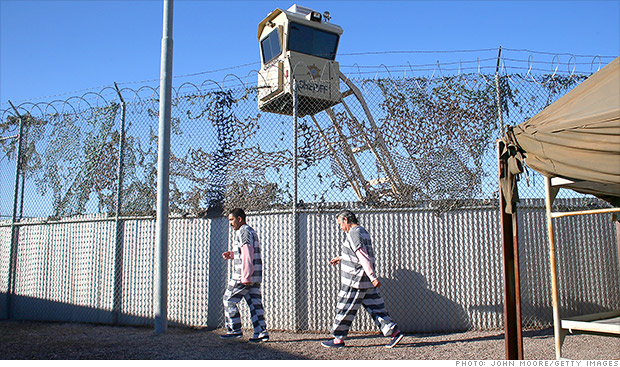
New Jersey prisoners incorrectly received more than $23 million in unemployment benefits, Medicaid and other public assistance, according to a state audit released Wednesday.

Between July 2009 and April 2011, the state paid out the benefits to or on behalf of more than 20,000 incarcerated individuals who don't appear to be entitled to the payments, according to a press release from State Comptroller Matthew Boxer, who led the audit.

More than $10 million of the payments were unemployment benefits paid out to about 7,600 incarcerated individuals, according to the release. State law requires that only those who are "able" or "available" to work are eligible to receive unemployment.

One prisoner received more than $39,000 in unemployment payments while behind bars for a drug-related offense, according to the audit. Another, convicted of unlawful possession of a firearm, who took in more than $25,000 in unemployment benefits, didn't start receiving the payments until he'd already been in prison for three months.

"Suffice it to say that when thousands of inmates are collecting unemployment checks from behind bars, there is a serious gap in program oversight," Boxer said in a statement. Read more >>
Enhanced by Zemanta

Wednesday, February 27, 2013

Unemployed lose benefits if federal budget cuts go through

Unemployment
The long-term unemployed can kiss goodbye almost 10% of their weekly jobless benefits if federal budget cuts go into effect on March 1.

Many safety net programs, such as food stamps and Medicaid, are protected from the $85 billion in forced spending cuts, but extended federal unemployment benefits are vulnerable.

Those payments kick in when state benefits, which last up to 26 weeks, run out. Eligible workers can then collect federal benefits for up to 47 weeks. The payments, which average $300 a week, are an emergency measure Congress has been authorizing since 2008. It's a stopgap aimed at protecting the millions of Americans struggling to find new jobs in a challenging economy.

The forced spending cuts scheduled to take effect next month trim the program's funding. Recipients of those payments could lose an average of more than $400 in benefits each through the end of the federal fiscal year, according to the Department of Labor. The fiscal year ends on Sept. 30. Read more >>
Enhanced by Zemanta

Monday, December 3, 2012

Walmart plans to deny health insurance to employees working fewer than 30 hours/wk

English: President Barack Obama, Vice Presiden...

Walmart, the nation’s largest private employer, plans to begin denying health insurance to newly hired employees who work fewer than 30 hours a week, according to a copy of the company’s policy obtained by The Huffington Post. …

Walmart declined to disclose how many of its roughly 1.4 million U.S. workers are vulnerable to losing medical insurance under its new policy. …

Labor and health care experts portrayed Walmart’s decision to exclude workers from its medical plans as an attempt to limit costs while taking advantage of the national health care reform known as Obamacare. Among the key features of Obamacare is an expansion of Medicaid, the taxpayer-financed health insurance program for poor people. Many of the Walmart workers who might be dropped from the company’s health care plans earn so little that they would qualify for the expanded Medicaid program, these experts said.

By making the fine for not providing health care cheaper than providing health care, this was always the plan: to encourage employers to send us to the government.

Remember how Obama's big ObamaCare sell was, "You get to keep the health insurance you have"?

It was all a lie, a hustle, a con, a ruse… Read more >>

Enhanced by Zemanta

Wednesday, November 7, 2012

Here's what REAL socialists think of Obama's Victory

Excerpted from The World Socialist Website: 

Obama will repay those who turned out to vote for him by carrying out measures that will devastate their jobs, living standards and social conditions. The “grand bargain” that he has pledged to negotiate with the Republicans will come at the expense of the working class, through trillions in cuts to Social Security, Medicare, Medicaid and other social programs.

Obama also hailed the US military, mentioning specifically the special forces troops who killed Osama bin Laden, while claiming that his administration was “bringing war to an end.” This was a reference to Afghanistan, but US troops will remain there in force for years to come, while those who are moved out will be redeployed for intervention in Syria, Iran or other targets of imperialist military attack.

Many who voted for Obama did so to keep Romney and the Republicans out, not because they were enthusiastic about a second Obama term.

The Democrats will, as always, interpret their own victory in the most restrained and conservative terms. The last thing they want is a mandate to oppose the plutocracy, since they serve the same corporate interests. They will extend the olive branch to the Republicans, allowing the Republican-controlled House of Representatives to set the agenda in Washington, as it has for the past two years.

The Obama White House made virtually no effort to elect a Democratic-controlled House, with the president providing a recorded phone call offering his personal support to only one Democratic congressional candidate. Read more >>

Enhanced by Zemanta

Wednesday, August 8, 2012

Over 100 Million Now Receiving Federal Welfare

A new chart set to be released later today by the Republican side of the Senate Budget Committee details a startling statistic: "Over 100 Million People in U.S. Now Receiving Some Form Of Federal Welfare."
"The federal government administers nearly 80 different overlapping federal means-tested welfare programs," the Senate Budget Committee notes. However, the committee states, the figures used in the chart do not include those who are only benefiting from Social Security and/or Medicare. 
Food stamps and Medicaid make up a large--and growing--chunk of the more than 100 million recipients. " Read more >>

Wednesday, August 1, 2012

Rationing Begins: States Limiting Drug Prescriptions for Medicaid Patients

Sixteen states have set a limit on the number of prescription drugs they will cover for Medicaid patients, according to Kaiser Health News. Seven of those states, according to Kaiser Health News, have enacted or tightened those limits in just the last two years.

Medicaid is a federal program that is carried out in partnership with state governments. It forms an important element of President Barack Obama's health-care plan because under the Patient Protection and Affordable Care Act--AKA Obamcare--a larger number of people will be covered by Medicaid, as the income cap is raised for the program.

With both the expanded Medicaid program and the federal subsidy for health-care premiums that will be available to people earning up to 400 percent of the poverty level, a larger percentage of the population will be wholly or partially dependent on the government for their health care under Obamacare than are now. Read more >>

Tuesday, July 24, 2012

High Court Health Ruling to Increase Uninsured, CBO Says

About 3 million fewer low-income Americans will have health insurance as a result of the Supreme Court decision that threw out part of President Barack Obama’s health-care overhaul, the Congressional Budget Office said.

The cost of expanding coverage will shrink by $84 billion to $1.168 trillion under the court decision, which voided a requirement that states expand Medicaid coverage for the poor in 2014, the nonpartisan agency said in a report today. At the same time, the report said the per-person cost of expanding aid will increase because some who would have been covered by Medicaid will instead receive more-expensive subsidies to buy private health insurance.

It is the first official estimate of the effects of the June 28 court decision upholding the core requirement in the Patient Protection and Affordable Care Act that most Americans carry health insurance or pay a penalty. The court threw out a provision requiring states that don’t comply with the Medicaid expansion to lose existing federal Medicaid funding. The court said Congress can require states to meet conditions to receive new Medicaid money. Read more >>

Saturday, June 30, 2012

Obamacare leaves many of the poorest Americans at risk of remaining uninsured

English: President Barack Obama, Vice Presiden...
The Supreme Court may have upheld health care reform, but the ruling has left many of the poorest Americans at risk of remaining uninsured. The justices' decision Thursday kept in place nearly all of the Affordable Care Act's provisions, including the mandate that all consumers buy health insurance by 2014 or pay a tax. Also upheld was a provision that expands Medicaid coverage to include all adults with annual incomes at or below 133% of the federal poverty level, which is currently $14,404 for an individual.

The federal government will pick up the total cost of the expensive expansion for the first three years, after which the funding will phase down to 90%. The expansion could reduce the number of uninsured adults with incomes under 133% of poverty by more than 11 million by 2019, according to a Kaiser Family Foundation estimate.

But here's the catch: The states can opt out of the Medicaid expansion program, since the court said the federal government can't penalize them by withholding all Medicaid funding. Instead, these states wouldn't get the additional Medicaid money to cover newly eligible enrollees. And that could mean trouble for many poor adults who are not eligible for Medicaid under the current system but would have qualified under the expansion. Read more >>

Monday, June 25, 2012

Study: First Time in US History More Poor in Suburbs Than Cities

Dalas skyline and suburbs
MSNBC
The small communities that dot the picturesque mountain landscape outside Boulder, Colo., conjure up an image from long before the great recession. Here the manicured lawns and expensive cars are a testament to the achievements of a fiercely independent and educated middle class; a 21st century version of suburban bliss. But often these days, the closed doors of well-kept houses hide a decidedly different reality: hushed conversation about food stamps and Medicaid, depleted bank accounts and 401K’s, kitchen shelves stocked with groceries from food pantries.

Sunday, May 27, 2012

Half of U.S. Lives in Household Getting Benefits

Nearly 50% of the population lives in a household where at least one member received some type of government benefit in the first quarter of 2011.

Cutting government spending is no easy task, and it’s made more complicated by recent Census Bureau data showing that nearly half of the people in the U.S. live in a household that receives at least one government benefit, and many likely received more than one.

The 49.1% of the population in a household that gets benefits is up from 30% in the early 1980s and 44.4% as recently as the third quarter of 2008. The increase in recent years is likely due in large part to the lingering effects of the recession.


As of early 2011, 15% of people lived in a household that received food stamps, 26% had someone enrolled in Medicaid and 2% had a member receiving unemployment benefits. Families doubling up to save money or pool expenses also is likely leading to more multigenerational households. But even without the effects of the recession, there would be a larger reliance on government. Read More >>


Monday, November 7, 2011

Seniors Join Occupy Chicago, Protest Cuts To Medicare, Social Security


Hundreds of senior citizens gathered in Chicago's Federal Plaza Monday morning to let Congress know how they feel about cutting Medicare, Medicaid and Social Security. The group ultimately blocked traffic at a downtown intersection -- leading to 47 arrests.

Members of the Jane Addams Senior Caucus were joined by other grassroots organizations, including Occupy Chicago, in a rally outside of Sen. Mark Kirk and Sen. Dick Durbin's office, followed by a march.

“We are fighting for our elders, for our children, and for our future," Occupy Chicago's Rachael Perrotta said in a statement. "Their welfare is our priority. We demand our elected leaders, like Durbin, Kirk and 'Mayor 1%' Emanuel, choose to serve the people, and protect the programs that ensure our futures.” More...
Enhanced by Zemanta

Monday, July 11, 2011

Job crises ahead for "99ers"

Portland 99ers RallyImage by Jobs with Justice via FlickrIn 2010, an estimated 3.9 million unemployed Americans exhausted unemployment benefits, according to the National Employment Law Project, an advocacy group that campaigns for lower-wage workers.

More than 14 percent of the U.S. unemployed have been out of a job for 99 weeks, or longer. The Labor Department’s report on Friday showed that the unemployment rate climbed to a six-month high of 9.2 percent in June.

Many so-called "99ers" subsist on social services like food stamps and Medicaid, programs now in danger of deep cuts demanded by many Republicans in Congress in exchange for allowing the federal government to go deeper into debt.

"An increase in demand for social services is what you would expect in a downturn of this magnitude and so the fact that they are cutting the social safety net is quite perplexing," said Sylvia Allegretto, a labor economist at the University of California at Berkeley. "We've just never seen (long-term unemployment) at these levels, period."

Forty six percent of those looking for work have been jobless for six months or more and the average length of job searches that eventually result in a hiring has doubled to 10 weeks between 2007 and 2010. More...
Enhanced by Zemanta

Wednesday, September 1, 2010

Record number in government anti-poverty programs

Urban decay, as seen here in Harlem in New Yor...Image via WikipediaGovernment anti-poverty programs that have grown to meet the needs of recession victims now serve a record one in six Americans and are continuing to expand.

More than 50 million Americans are on Medicaid, the federal-state program aimed principally at the poor, a survey of state data by USA TODAY shows. That's up at least 17% since the recession began in December 2007.

"Virtually every Medicaid director in the country would say that their current enrollment is the highest on record," says Vernon Smith of Health Management Associates, which surveys states for Kaiser Family Foundation.

The program has grown even before the new health care law adds about 16 million people, beginning in 2014. That has strained doctors. "Private physicians are already indicating that they're at their limit," says Dan Hawkins of the National Association of Community Health Centers.

More than 40 million people get food stamps, an increase of nearly 50% during the economic downturn, according to government data through May. The program has grown steadily for three years. More...

Saturday, March 20, 2010

Big Pharma loves Obama Care

Logo of the Pharmaceutical Research and Manufa...Image via Wikipedia

Brian Schwartz
From Tim Carney’s article in the Washington Examiner, Dems tap drug maker millions for PhRMA-friendly bill:

Of all the single-industry lobbies in Washington, the largest is the Pharmaceutical Researchers and Manufacturers of America. PhRMA spent $26.2 million on lobbying last year — that’s nearly three times as much as the insurance lobby, America’s Health Insurance Plans, which spent $8.9 million.

If you include individual companies’ lobbying, pharmaceuticals blow away the competition, beating all other industries by 50 percent, according to data at the Center for Responsive Politics.

Given this Big Pharma clout, it’s unsurprising that the bill Obama’s whipping for — Senate bill — has nearly everything the drug companies wanted: prohibiting reimportation of drugs, preserving Medicare’s overpayment for drugs, lengthy exclusivity for biotech drugs, a mandate that states subsidize drugs under Medicaid, hundreds of billions in subsidies for drugs, and more.

Read the whole article: Dems tap drug maker millions for PhRMA-friendly bill.

Fact Sheet: The Truth About the Health Care Bill

Huffington Post

The Firedoglake health care team has been covering the debate in congress since it began last year. The health care bill will come up for a vote in the House on Sunday, and as Nancy Pelosi works to wrangle votes, we've been running a detailed whip count on where every member of Congress stands, updated throughout the day.

We've also taken a detailed look at the bill, and have come up with 18 often stated myths about this health care reform bill.

Real health care reform is the thing we've fought for from the start. It is desperately needed. But this bill falls short on many levels, and hurts many people more than it helps them.

While details are limited, there is apparently a "Plan B" alternative that the White House was considering as recently as two weeks ago, which would evidently expand existing programs -- Medicaid and SCHIP. It would cover half the people at a quarter of the price, but it would not force an unbearable financial burden to those who are already struggling to get by.

Congress may be too far down the road with this bill to change course. But before Democrats cast this vote which could turn "ban the mandate" into "gay marriage" for the GOP in 2010, they should consider the first rule of patient safety: first, do no harm.

Myth 1: This is a universal health care bill.

Fact: The bill is neither universal health care nor universal health insurance. According to the Congressional Budget Office:


  • Total uninsured in 2019 with no bill: 54 million

  • Total uninsured in 2019 with Senate bill: 24 million


Myth 2: Insurance companies hate this bill.

Fact: This bill is almost identical to the plan written by AHIP, the insurance company trade association, in 2009.
The original Senate Finance Committee bill was authored by a former Wellpoint vice president. Since Congress released the first of its health care bills on October 30, 2009, health care stocks have risen 28.35%.

Myth 3: The bill will significantly bring down insurance premiums for most Americans.

Fact: The bill will not bring down premiums significantly, and certainly not the $2,500/year that President Obama promised during his campaign.

Annual premiums in 2016: status quo / with bill:
Small group market, single: $7,800 / $7,800
Small group market, family: $19,3oo / $19,200
Large Group market, single: $7,400 / $7,300
Large group market, family: $21,100 / $21,300
Individual market, single: $5,500 / $5,800
Individual market, family: $13,100 / $15,200

(The cost of premiums in the individual market goes up somewhat due to subsidies and mandates of better coverage. The CBO assumes that cost of individual policies goes down 7-10%, and that people will buy more generous policies.)

Myth 4: The bill will make health care affordable for middle class Americans.

Fact: The bill will impose a financial hardship on middle class Americans who will be forced to buy a product that they can't afford to use.

A family of four making $66,370 will be forced to pay $5,243 per year for insurance. After basic necessities, this leaves them with $8,307 in discretionary income -- out of which they would have to cover clothing, credit card and other debt, child care and education costs, in addition to $5,882 in annual out-of-pocket medical expenses for which families will be responsible.

Myth 5: This plan is similar to the Massachusetts plan, which makes health care affordable.

Fact: Many Massachusetts residents forgo health care because they can't afford it. A 2009 study by the state of Massachusetts found that:


  • 21% of residents forgo medical treatment because they can't afford it, including 12% of children

  • 18% have health insurance but can't afford to use it


Myth 6: This bill provides health care to 31 million people who are currently uninsured.

Fact: This bill will mandate that millions of people who are currently uninsured purchase insurance from private companies, or the IRS will collect up to 2% of their annual income in penalties. Some will be assisted with government subsidies.

Myth 7: You can keep the insurance you have if you like it.

Fact: The excise tax will result in employers switching to plans with higher co-pays and fewer covered services.
Older, less healthy employees with employer-based health care will be forced to pay much more in out-of-pocket expenses than they do now.

Myth 8: The "excise tax" will encourage employers to reduce the scope of health care benefits, and they will pass the savings on to employees in the form of higher wages.

Fact: There is insufficient evidence that employers pass savings from reduced benefits on to employees.

Myth 9: This bill employs nearly every cost control idea available to bring down costs.

Fact: This bill does not bring down costs and leaves out nearly every key cost control measure, including:


  • Public Option ($25-$110 billion)

  • Medicare buy-in

  • Drug re-importation ($19 billion)

  • Medicare drug price negotiation ($300 billion)

  • Shorter pathway to generic biologics ($71 billion)


Myth 10: The bill will require big companies like Wal-Mart to provide insurance for their employees.

Fact: The bill was written so that most Wal-Mart employees will qualify for subsidies, and taxpayers will pick up a large portion of the cost of their coverage.

Myth 11: The bill "bends the cost curve" on health care.

Fact: "Bends the cost curve" is a misleading and trivial claim, as the U.S. would still spend far more for care than other advanced countries.


  • In 2009, health care costs were 17.3% of GDP.

  • Annual cost of health care in 2019, status quo: $4,670.6 billion (20.8% of GDP)

  • Annual cost of health care in 2019, Senate bill: $4,693.5 billion (20.9% of GDP)


Myth 12: The bill will provide immediate access to insurance for Americans who are uninsured because of a pre-existing condition.

Fact: Access to the "high risk pool" is limited and the pool is underfunded. Only those who have been uninsured for more than six months will qualify for the high-risk pool. Only 0.7% of those without insurance now will get coverage, and the Centers for Medicare and Medicaid Services report estimates it will run out of funding by 2011 or 2012.

Myth 13: The bill prohibits dropping people in individual plans from coverage when they get sick.

Fact: The bill does not empower a regulatory body to keep people from being dropped when they're sick. There are already many states that have laws on the books prohibiting people from being dropped when they're sick, but without an enforcement mechanism, there is little to hold the insurance companies in check.

Myth 14: The bill ensures consumers have access to an effective internal and external appeals process to challenge new insurance plan decisions.

Fact: The "internal appeals process" is in the hands of the insurance companies themselves, and the "external" one is up to each state.

Ensuring that consumers have access to "internal appeals" simply means the insurance companies have to review their own decisions. And it is the responsibility of each state to provide an "external appeals process," as there is neither funding nor a regulatory mechanism for enforcement at the federal level.

Myth 15: This bill will stop insurance companies from hiking rates 30%-40% per year.

Fact: This bill does not limit insurance company rate hikes. Private insurers continue to be exempt from anti-trust laws, and are free to raise rates without fear of competition in many areas of the country.

Myth 16: When the bill passes, people will begin receiving benefits under this bill immediately

Fact: Most provisions in this bill, such as an end to the ban on pre-existing conditions for adults, do not take effect until 2014.

Six months from the date of passage, children could not be excluded from coverage due to pre-existing conditions, though insurance companies could charge more to cover them. Children would also be allowed to stay on their parents' plans until age 26. There will be an elimination of lifetime coverage limits, a high risk pool for those who have been uninsured for more than 6 months, and community health centers will start receiving money.

Myth 17: The bill creates a pathway for single payer.

Fact: Bernie Sanders' provision in the Senate bill does not start until 2017, and does not cover the Department of Labor, so no, it doesn't create a pathway for single payer.

Obama told Dennis Kucinich that the Ohio Representative's amendment is similar to Bernie Sanders' provision in the Senate bill, and creates a pathway to single payer. Since the waiver does not start until 2017, and does not cover the Department of Labor, it is nearly impossible to see how it gets around the ERISA laws that stand in the way of any practical state single payer system.

Myth 18: The bill will end medical bankruptcy and provide all Americans with peace of mind.

Fact: Most people with medical bankruptcies already have insurance, and out-of-pocket expenses will continue to be a burden on the middle class.


  • In 2009, 1.5 million Americans declared bankruptcy

  • Of those, 62% were medically related

  • Three-quarters of those had health insurance

  • The Obama bill leaves 24 million without insurance

  • The maximum yearly out-of-pocket limit for a family will be $11,900 (PDF) on top of premiums

  • A family with serious medical problems that last for a few years could easily be financially crushed by medical costs


Real health care reform is needed. But this bill falls short of that on many levels.

Documentation:


  1. March 11, Letter from Doug Elmendorf to Harry Reid (PDF)

  2. The AHIP Plan in Context, Igor Volsky;Max Baucus WellPoint/Liz Fowler Plan" href="http://emptywheel.firedoglake.com/2009/09/08/liz-fowlers-plan/" target="_blank"> The Max Baucus WellPoint/Liz Fowler Plan, Marcy Wheeler

  3. CBO Score, 11-30-2009

  4. "Affordable" Health Care, Marcy Wheeler

  5. Gruber Doesn't Reveal That 21% of Massachusetts Residents Can't Afford Health Care, Marcy Wheeler; Massachusetts Survey (PDF)

  6. Health Care on the Road to Neo-Feudalism, Marcy Wheeler

  7. CMS: Excise Tax on Insurance Will Make Your Insurane Coverage Worse and Cause Almost No Reduction in NHE, Jon Walker

  8. Employer Health Costs Do Not Drive Wage Trends, Lawrence Mishel

  9. CBO Estimates Show Public Plan With Higher Savings Rate, Congress Daily; Drug Importation Amendment Likely This Week, Politico; Medicare Part D IAF; A Monopoloy on Biologics Will Drain Health Care Resources, Lancet Student

  10. MaxTax Is a Plan to Use Our Taxes to Reward Wal-Mart for Keeping Its Workers in Poverty, Marcy Wheeler

  11. Estimated Financial Effects of the "Patient Protection and Affordable Care Act of 2009," as Proposed by the Senate Majority Leader on November 18, 2009, CMS (PDF)

  12. ibid

  13. ibid

  14. ibid

  15. Health insurance companies hang onto their antitrust exemption, Protect Consumer Justice.org

  16. What passage of health care reform would mean for the average American, DC Examiner

  17. How to get a State Single Payer Opt-Out as Part of Reconciliation, Jon Walker

  18. Medical bills prompt more than 60 percent of U.S. bankruptcies, CNN.com; The Patient Protection and Affordable Care Act Section-by-Section Analysis (PDF)
Reblog this post [with Zemanta]

Monday, October 12, 2009

Coroners Report Spike in Unclaimed Bodies

Katie Zezima with the The New York Times reports:
Coroners and medical examiners across the country are reporting spikes in the number of unclaimed bodies and indigent burials, with states, counties and private funeral homes having to foot the bill when families cannot.

The increase comes as governments short on cash are cutting other social service programs, with some municipalities dipping into emergency and reserve funds to help cover the costs of burials or cremations.

Oregon, for example, has seen a 50 percent increase in the number of unclaimed bodies over the past few years, the majority left by families who say they cannot afford services. “There are more people in our cooler for a longer period of time,” said Dr. Karen Gunson, the state’s medical examiner. “It’s not that we’re not finding families, but that the families are having a harder time coming up with funds to cover burial or cremation costs.”

About a dozen states now subsidize the burial or cremation of unclaimed bodies, including Illinois, Massachusetts, West Virginia and Wisconsin. Most of the state programs provide disposition services to people on Medicaid, a cost that has grown along with Medicaid rolls.

Financing in Oregon comes from fees paid to register the deaths with the state. The state legislature in June voted to raise the filing fee for death certificates to $20 from $7, to help offset the increased costs of state cremations, which cost $450.

“I’ve been here for 24 years, and I can’t remember something like this happening before,” Dr. Gunson said.

Already in 2009, Wisconsin has paid for 15 percent more cremations than it did last year, as the number of Medicaid recipients grew by more than 95,000 people since the end of January, said Stephanie Smiley, a spokeswoman for the Wisconsin Department of Health Services.

In Illinois, Gov. Pat Quinn tried to end the state’s indigent burial program this year, shifting the financing to counties and funeral homes, but the state eventually found $12 million to continue the program when funeral directors balked.

The majority of burials and cremations, however, are handled on the city, county, town or township level, an added economic stress as many places face down wide budget gaps.

Boone County, Mo., hit its $3,000 burial budget cap last month, and took $1,500 out of a reserve fund to cover the rest of the year. While the sum is relatively low, it comes as the county is facing a $2 million budget shortfall, tax collections are down 5 percent and the number of residents needing help is expected to grow.

“We’ve had a significant increase in unemployment, wages are dropping, industrial manufacturing jobs go away and companies scaled back or even closed their doors,” said Skip Elkin, the county commissioner. “But we feel an obligation to help families who don’t have any assets.”

The medical examiner of Wayne County, Mich., Dr. Carl Schmidt, bought a refrigerated truck after the morgue ran out of space. The truck, which holds 35 bodies, is currently full, Dr. Schmidt said. “We’ll buy another truck if we have to,” he said.

Many places are turning to cremation, which averages a third to half the price of a burial. However, they will accommodate families’ requests for burial.

Clyde Gibbs, the chief medical examiner in Chapel Hill, N.C., said the office typically averaged 25 to 30 unclaimed bodies each year. At the end of the 2008 fiscal year there were at least 60, Dr. Gibbs said. The office cremates about three-quarters of the remains, and scatters the ashes at sea every few years.

In Tennessee, medical examiner and coroners’ offices donate unclaimed remains to the Forensic Anthropological Research Center, known as the “Body Farm,” where students study decomposition at the University of Tennessee. The facility had to briefly halt donations because it had received so many this year, said its spokesman, Jay Mayfield.

The increase in indigent burials and cremations is also taking a toll on funeral homes, which are losing money as more people choose cremation over burial. In 2003, 29.5 percent of remains were cremated; by 2008 the number had grown to 36 percent, according to the Cremation Association of North America, and it is expected to soar to 46 percent by 2015, according to the association’s projection of current trends.

Don Catchen, owner of Don Catchen & Son Funeral Homes in Elsmere, Ky., who handles cremations of the poor in Kenton County, said the $831 county reimbursement for cremations was “just enough to cover the cost of what I do — I donate my time.”

In Florida, where counties switched to cremation a few years ago to save on costs, Prudencio Vallejo, general manager of the Unclaimed Bodies Unit of the Hillsborough County Medical Examiner’s Office, said cremations were $425, compared with $1,500 for a burial. They have risen about 10 percent this year, Mr. Vallejo said.

“Most people, the first thing that they say is ‘We wouldn’t be coming to you if we could afford to do it ourselves,’ ” he said.

Broward County, Fla., paid for the cremation of Renata Richardson’s daughter, Jazmyn Rose, who was born stillborn on Sept. 25, 2008. Ms. Richardson, 26, lost her job at an advertising agency in July and could not afford to pay.

The county spent about $1,000 on a cremation and pink urn, engraved with the baby’s birth and death date, and a Bible passage. It now sits in the bassinette where she was to sleep.

“I was strapped for cash, I was in mourning, and I didn’t know what they were going to do with her,” Ms. Richardson, of Davie, Fla., said. “I was honored that they went that far to help me.”

Reblog this post [with Zemanta]